Thy Distillery | DRAM1 Distillery Spotlight
A Distillery That Begins Long Before the Still
Some distillery visits stay with you because of the whisky you taste. Others because of the people you meet. My visit to Thy Distillery in Denmark in 2024 managed to do both. I travelled there to interview the team for Whisky Passion, expecting to discover one of the rising stars of Scandinavian whisky. What I found instead was a distillery that challenged the way I think about whisky production altogether.
I’ve visited plenty of distilleries over the years. Whether in Scotland or Ireland, the conversation usually starts in the still house or the warehouse. At Thy, we hardly spoke about either during the first part of the tour. Instead, Jakob enthusiastically talked about barley varieties, crop rotation, soil quality and harvests. Before we’d even reached the stills, I realised I was standing in a place where whisky wasn’t considered the final product of the process. It was the natural result of years of careful farming.
That may sound like a subtle distinction, but it colours every decision the distillery makes. Spend a day with the team and you quickly understand that the whisky isn’t built around a clever cask finish or an impressive age statement. Everything begins with the grain itself. Once you appreciate that, the rest of Thy’s production methods suddenly make perfect sense.
In recent years, “terroir” has become something of a buzzword in the whisky industry. Distilleries increasingly talk about local barley and regional identity, often borrowing concepts from the wine world. At Thy, however, those ideas never feel like marketing language. They simply describe the way the farm has always operated. Long before whisky entered the picture, this was an organic family farm, and the arrival of a distillery never changed that identity. If anything, it strengthened it.
From Family Farm to International Recognition
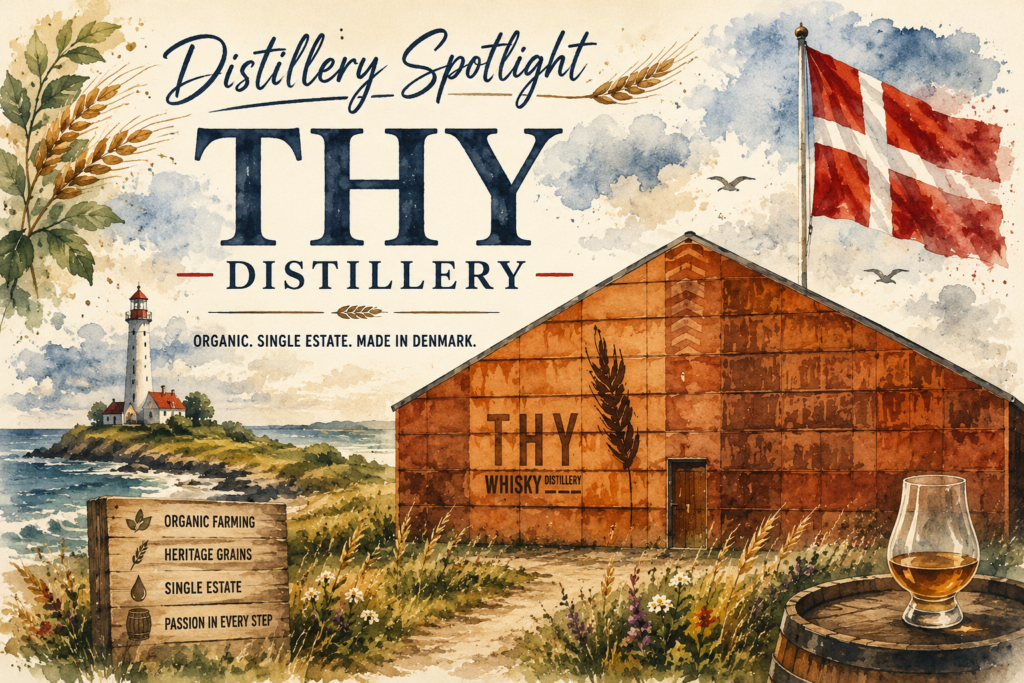
Thy Distillery sits on Gyrup Farm in the windswept north-west of Denmark, a landscape shaped by the North Sea, fertile farmland and generations of agricultural tradition. The Nicolajsen family had been working this land long before they ever considered filling casks with new make spirit. That agricultural heritage remains the foundation of everything the distillery produces today.
Founder Nicolaj Nicolajsen envisioned something remarkably straightforward, yet surprisingly ambitious: to create a whisky made entirely from grain grown on the family’s own land. Not because it sounded romantic or because it would make for a compelling story on the label, but because he genuinely believed that controlling every stage of production would ultimately produce a better whisky. That vision continues today under the guidance of Marie, Jakob, Ellen and Andreas, who have carefully expanded the distillery without losing sight of its original purpose.
That commitment has not gone unnoticed. In 2023, Thy was recognised as the world’s best Single Estate Whisky Distillery outside Scotland at the Icons of Whisky Awards. It’s an accolade that reflects something far more meaningful than simply producing excellent whisky. It acknowledges a production model that remains exceptionally rare within the industry.
The term Single Estate is often misunderstood. Many distilleries proudly source local barley, while others malt their own grain or mature spirit on site. Thy takes the concept considerably further. Every stage, from growing the grain and malting it to distillation, maturation and bottling, happens under the stewardship of the same estate. There are very few whisky producers anywhere in the world that can make that claim with complete confidence.
As I walked around the farm, it became increasingly obvious that this wasn’t something created to differentiate the brand in a crowded market. The distillery exists because the farm exists. Had Gyrup Farm never been established generations ago, there would be no Thy Distillery today. That order of events matters, because it explains why discussions about flavour inevitably lead back to the fields rather than the warehouse.
Why Grain Matters More Than Ever
If you’ve followed DRAM1 for a while, you’ll know I’ve become increasingly fascinated by the role grain plays in whisky. It’s one of the reasons I have so much admiration for producers like Waterford, who have worked tirelessly to put terroir back at the centre of the conversation. Visiting Thy reinforced that appreciation even further.
Modern whisky production has, understandably, become incredibly efficient. Over decades, farmers have selected barley varieties capable of producing the highest yields, the greatest resistance to disease and the most predictable harvests. From an economic perspective, that makes perfect sense. From a flavour perspective, however, something has inevitably been lost along the way.
Thy is among a small group of distilleries attempting to rediscover those forgotten flavours by cultivating heritage grains—ancient barley varieties that disappeared from commercial farming because they were simply less practical to grow. Lower yields and greater vulnerability to disease meant they gradually fell out of favour, despite often possessing fascinating flavour characteristics.
During my visit, Jakob explained just how much patience is required to bring those varieties back into cultivation. Grain banks preserve only tiny quantities of seed, meaning the process begins with little more than a handful of grains. Those first harvests are measured almost by the handful rather than the tonne. Each growing season produces just enough seed to plant a slightly larger field the following year until, eventually, there is sufficient grain to produce whisky. From the moment the first seeds leave the grain bank to the day the resulting whisky reaches a bottle, well over a decade may have passed.
Listening to that explanation, I couldn’t help but smile. Whisky enthusiasts often become obsessed with a spirit spending twelve or fifteen years inside a cask, yet here was a distillery willingly investing six or seven years before fermentation had even begun. It perfectly encapsulates the mindset at Thy. Patience isn’t reserved for maturation. It’s built into every stage of production.
What impressed me most, though, wasn’t the technical achievement. It was the reason behind it. Nobody spoke about heritage grains as though they were a marketing opportunity or a way to produce more expensive bottles. The conversation always came back to flavour. If an old barley variety could produce a more expressive spirit—even if it yielded less alcohol—that alone justified the effort.
That philosophy feels increasingly refreshing in today’s whisky landscape, where efficiency often wins out over individuality.
And, as I would discover later that afternoon, that same mindset extends far beyond the fields.
Bringing the Farm Into the Distillery
After spending time walking around the farm, it finally became time to step inside the production buildings. By that point, however, I’d already begun looking at the distillery differently. Instead of wondering what shape the stills would be or which casks were stacked in the warehouse, I found myself curious about what happened between harvest and distillation. If grain really is the star of the show at Thy, how do you make sure all those subtle characteristics survive the journey into the glass?
The answer, as it turned out, was to control as much of that journey as possible.
Around six years before my visit, the team installed their first drum malting system on the estate. It wasn’t the easiest route. The drums had to be built almost entirely to their own specifications, using local craftsmen and whatever materials were available nearby. It took time, plenty of experimentation and no shortage of determination before everything worked exactly as intended. Looking at the polished operation today, it’s difficult to imagine just how much trial and error went into getting there.
The investment proved worthwhile almost immediately. Before long, local breweries began asking Thy to produce malt for them, followed by artisan bakeries that discovered just how much flavour freshly malted grain could add to their bread. Demand grew so quickly that one drum eventually became two, and today the distillery operates three separate drum maltings producing around 750 tonnes of malt every year. Only a fraction of that—roughly 125 tonnes—is destined for Thy’s own whisky, with the remainder supplying other local producers.
What struck me most wasn’t the production capacity, impressive though it is. It was the mindset behind it. Most distilleries outsource malting because it’s simply more practical. Thy chose the opposite path because every additional step they could bring in-house meant another opportunity to preserve the character of their grain. When you’ve spent years nurturing heritage barley in your own fields, handing it over to an industrial maltster would almost feel like breaking the chain.
That attention to detail continues long before the grain ever reaches the mash tun. One of the more unexpected highlights of the tour was a grain sorting machine that quietly performs an enormously important task. Jakob proudly demonstrated how the vibrating system separates kernels not only from stones and other debris, but even by size and shape. It might not be the most glamorous piece of equipment in the distillery, yet it perfectly reflects the team’s mentality. Better raw materials lead to better fermentation, more consistent milling and, ultimately, a cleaner, more expressive spirit. Sometimes innovation isn’t about flashy technology; it’s about solving practical problems exceptionally well.
A Fermentation Worth Drinking
One of my favourite moments during the visit arrived before a single drop of spirit had been distilled.
Jakob walked over to one of the thousand-litre fermentation tanks, filled a glass straight from the tap and handed it to me with a smile. What I expected was something sweet, thick and vaguely reminiscent of porridge. What I tasted couldn’t have been further from that image.
The freshly fermented wash burst with aromas of citrus, tropical fruit and lively esters. If someone had blind-poured it into my glass, I’d probably have guessed it was an unusually fruity craft IPA rather than the precursor to whisky. It was vibrant, surprisingly refreshing and packed with character. That brief tasting did more to convince me of fermentation’s importance than any technical explanation ever could.
It’s also where Thy once again refuses to follow convention.
Many distilleries work to carefully planned fermentation schedules designed to maximise efficiency. Thy certainly has targets too, aiming for a minimum of four days, but the team isn’t afraid to let fermentation continue when circumstances allow. During busy periods on the farm—or even around holiday schedules—it may stretch to a week, and on rare occasions as long as two weeks. Rather than seeing that flexibility as an inconvenience, Thy embraces it as another opportunity to build flavour before distillation has even begun.
It reinforced an impression I’d already formed earlier in the day. Every production decision seemed to ask the same question: does this improve the flavour? If the answer was yes, efficiency became a secondary concern. That’s a remarkably refreshing attitude in an industry where consistency and production targets often dominate the conversation.
One Distillation Instead of Two
By the time we finally reached the still house, I thought I had a reasonable idea of what to expect. Danish whisky has developed rapidly over the past decade, but most producers still follow principles that would feel familiar to anyone who has toured Scotland or Ireland.
Thy, naturally, had other ideas.
Where Scottish malt whisky is almost always distilled twice and Irish whiskey is often distilled three times, Thy produces its spirit through a single distillation. At first glance, that sounds almost counterintuitive. Surely fewer distillations would leave the spirit rougher or heavier?
That was certainly my first thought.
Jakob explained that the goal wasn’t to create a heavier spirit for its own sake. The objective was to retain as much of the grain’s natural character as possible. If you’ve spent years cultivating distinctive barley varieties, stripping away too much character during distillation would defeat the entire purpose of growing them in the first place.
Of course, single distillation presents its own challenges. Copper plays a vital role in removing unwanted sulphur compounds from spirit, and reducing the number of distillations inevitably reduces the amount of copper contact. Thy’s solution is elegant rather than conventional.
Instead of adding another distillation, the distillery uses a rectifier built by Müller Brennereianlagen, increasing reflux inside the still and allowing the vapours to spend significantly longer in contact with copper. Jakob compared the principle to the rectifiers used at Ardbeg, albeit on a much smaller scale. The result is a spirit that retains the weight and personality of a single distillation while still achieving the refinement needed for elegant whisky.
I particularly enjoyed hearing Jakob mention Ardbeg during this part of the tour. As many regular DRAM1 readers will know, Ardbeg has long been one of my favourite distilleries, so discovering an unexpected connection between an Islay icon and a Danish farm distillery certainly wasn’t something I had anticipated that morning. More importantly, though, Thy hadn’t copied Ardbeg’s production. They had borrowed an idea, adapted it to their own circumstances and used it in service of their own philosophy.
That’s a distinction worth making.
Throughout my visit, I never once felt that Thy was trying to become “the Danish Islay” or “the Danish Speyside.” Every technical choice, from the fields to the still house, exists for one reason alone: to make whisky that could only ever come from Thy.
The Influence of Wood Without Letting It Take Over
By the time we reached the warehouses, a pattern had emerged. Every production decision at Thy is designed to preserve rather than overpower the character of the spirit. It should come as no surprise, then, that the same philosophy extends to cask selection.
Whisky enthusiasts often talk about casks as though they’re the defining ingredient of a whisky. To a certain extent, that’s understandable. Put the same spirit into a first-fill bourbon barrel, a fresh oloroso butt and a PX hogshead and you’ll end up with three completely different whiskies. Yet during my conversations at Thy, the cask was never treated as the hero of the story. It was an important supporting actor, but never the star.
Jakob spoke passionately about this while showing me around the warehouse. For their bourbon-matured whiskies, Thy works exclusively with casks from Heaven Hill in Kentucky. There are plenty of excellent bourbon barrels available on the market, but the team would rather wait for the right casks than compromise with alternatives. That patience seemed to define almost every aspect of the distillery. If waiting a little longer ultimately produces better whisky, then waiting is simply part of the job.
That doesn’t mean Thy avoids experimentation. Alongside bourbon and sherry casks, the warehouses contain more unusual maturations, including casks that previously held apple ice wine. It’s the sort of finishing cask that immediately catches the attention of whisky enthusiasts, yet even here the enthusiasm is tempered by healthy scepticism. Jakob openly admitted that he wasn’t yet convinced it would become a long-term success. I appreciated that honesty. In an industry where every experimental release is often presented as revolutionary, it was refreshing to hear someone acknowledge that not every idea automatically deserves a permanent place in the range.
There was, however, one type of cask that Jakob spoke about with noticeably less enthusiasm: new oak.
He explained that while the distillery has experimented with virgin oak, he believes fresh wood can too easily dominate the spirit, masking precisely those grain characteristics Thy works so hard to preserve. It’s a viewpoint that fits perfectly with everything I’d seen throughout the day. If your whisky begins with exceptional grain, why would you bury those flavours beneath layers of aggressive oak?
Standing inside the warehouse, that philosophy suddenly felt very tangible. Unlike many traditional dunnage warehouses in Scotland, Thy’s maturation warehouse has been designed with carefully perforated steel walls that encourage a constant flow of air. Even on the warm summer day I visited, the warehouse remained pleasantly cool, with a gentle breeze moving between the casks. Combined with Denmark’s relatively stable climate, it creates an environment where maturation progresses slowly and steadily rather than being driven by dramatic seasonal extremes.
It’s easy to become obsessed with age statements in whisky, but places like Thy are a reminder that the quality of maturation often matters far more than the number printed on the label.
Danish Smoke With Its Own Identity
If there’s one aspect of Thy’s production that genuinely surprised me, it was the way they approach smoke.
Whenever peated whisky is discussed, Scotland inevitably dominates the conversation. Most enthusiasts immediately think of Islay and its unmistakable combination of medicinal peat smoke, sea spray and iodine. Even outside Scotland, many distilleries have tried to recreate that familiar profile. Thy has taken a different route altogether.
The distillery certainly uses peat, including peat harvested from its own local bogs, but even that comes in two distinct forms. Wet peat contributes the medicinal character many whisky drinkers will recognise from Islay, while dry surface peat—or “top soil” peat—adds a more earthy, mineral-driven style of smoke. Rather than relying on a single source, Thy combines different types of peat to create a flavour profile that reflects its own landscape.
What truly sets the distillery apart, however, is its use of beechwood.
Known as Bøg in Danish, beechwood has long been associated with traditional Danish cooking and everyday life. The aroma evokes memories that many Danes immediately recognise, making it an inspired choice for smoking malt. Instead of chasing a flavour profile borrowed from Scotland, Thy has embraced something unmistakably Danish. The resulting whiskies don’t simply taste smoky; they carry an identity rooted in the culture and landscape from which they come.
It’s exactly the kind of innovation I’d like to see more often in world whisky.
For years, emerging whisky-producing countries understandably measured themselves against Scotland. The assumption seemed to be that success meant producing something as close to Scotch as possible. Fortunately, that mindset is beginning to change. Distilleries are increasingly asking what makes their whisky unique rather than how closely they can imitate someone else’s.
Thy is one of the finest examples of that shift.
My Recommended Thy Bottles
If you’re discovering Thy Distillery for the first time, I’d encourage you to begin with one of their core Organic Single Malt expressions. They beautifully showcase the distillery’s house style, allowing the grain to shine without excessive cask influence. It’s the best introduction to what Thy is trying to achieve.
Once you’ve become familiar with that character, the Heritage releases are well worth exploring. They’re not gimmicks or limited editions created for collectors. Instead, they represent years of agricultural work aimed at bringing forgotten barley varieties back to life. Knowing how much patience lies behind each bottle only makes the experience of drinking them more rewarding.
Finally, if, like me, you enjoy exploring different styles of smoke, don’t overlook the Bøg expressions. They offer something genuinely different from the classic Islay profile and demonstrate just how expressive smoke can be when viewed through a distinctly Danish lens.
Here are some of my reviews on Thy if you’d like to explore which bottle would be your best fit:
- Thy Caramel Malt Review
- Thy Maltmod Review
- Thy PX Review
- Thy Bøg Review
- Thy Single Malt Review
- Thy Spelt-Rye Review
- Thy Hawboen Review
Final Thoughts
When I left Thy Distillery, I naturally brought home pages of notes about drum maltings, heritage grains, fermentation times and rectifiers. Looking back, though, those aren’t the details I remember most vividly.
What has stayed with me is the overwhelming sense of authenticity.
Nothing at Thy felt designed to impress visitors or create the perfect marketing story. Every production decision seemed to flow naturally from one simple belief: great whisky starts with great grain, and if you’re fortunate enough to grow that grain yourself, you owe it to the spirit to preserve its character every step of the way.
That conviction gives Thy a clear identity in an increasingly crowded whisky world. It isn’t trying to become Denmark’s answer to Islay or Speyside. It isn’t chasing trends or relying on extravagant cask finishes to grab attention. Instead, it has quietly built a style that could only come from this particular farm, this particular landscape and this particular team.
For me, that’s exactly what the future of whisky should look like.
As whisky drinkers, we often talk about authenticity, provenance and terroir. At Thy, those aren’t fashionable buzzwords. They’re simply the way whisky has always been made.
And after spending a day there, it’s difficult not to hope that more distilleries will follow their example.