
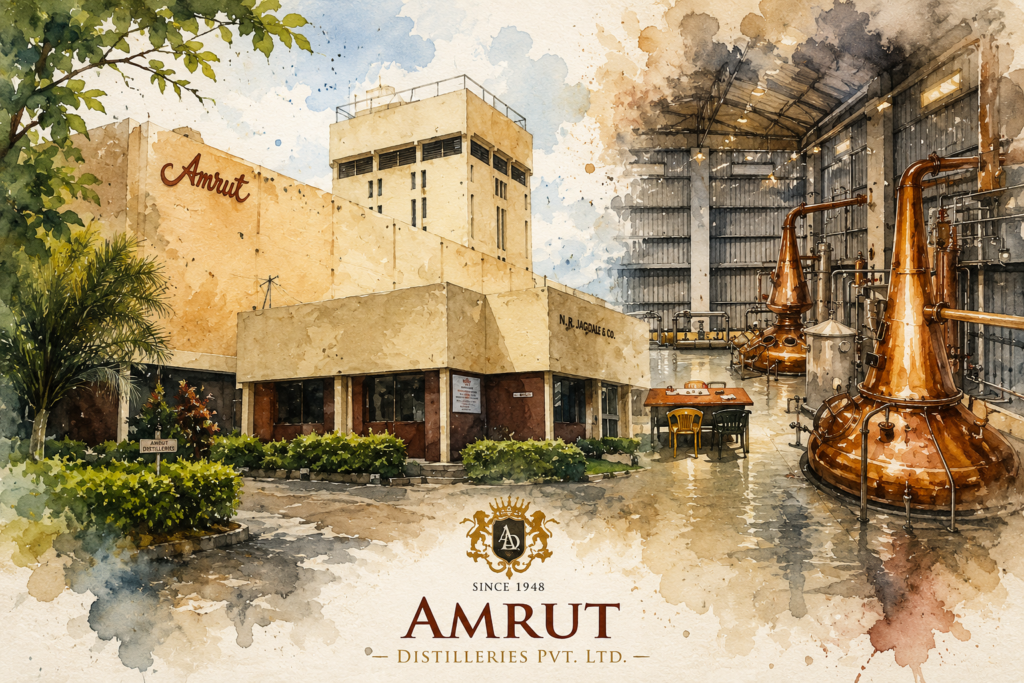
Amrut Distillery Spotlight: The Indian Pioneer That Challenged Scotch
For a long time, Indian whisky carried a rather awkward reputation outside India. Much of what was sold under the name was made with spirit distilled from molasses, sometimes blended with a relatively small amount of malt whisky. That may have suited the enormous domestic market, but it did little to convince serious whisky drinkers elsewhere that India could produce a single malt capable of competing internationally.
I first began properly discovering Indian whisky around five years ago while visiting whisky festivals here in the Netherlands. Amrut was one of the first names that kept appearing, followed by Paul John and, more recently, producers such as Indri. I also started noticing Indian whiskies released by independent bottlers, including the Scotch Malt Whisky Society. That caught my attention because the SMWS does not bottle whisky simply because it comes from somewhere unusual. The liquid still has to earn its place in the bottle.
The more Indian whisky I tasted, the more difficult it became to understand why some enthusiasts dismiss anything that was not distilled in Scotland. Scotland remains my favourite whisky-producing country and probably always will, but good whisky can come from anywhere. The country printed on the label may shape the story, yet the only things that truly matter are the nose and palate waiting inside the glass. If you enjoy what you find and love the experience the whisky gives you, it is good whisky. To me, it really is as simple as that.
Amrut changed that conversation.
When Amrut Indian Single Malt was introduced in Scotland in 2004, the decision sounded almost confrontational. An Indian distillery was taking its whisky to Glasgow and asking drinkers in the home of Scotch to judge it on its own merits. There was no established international category of Indian single malt to hide behind, nor a collection of successful predecessors to make the idea easier to accept.
Amrut had to prove that the climate was not too hot, the whisky was not too young and India was not merely a large market for whisky made elsewhere. It had to convince people that Indian barley, Indian maturation and Indian distilling could produce something distinctive in their own right.
More than two decades later, Indian single malt has become one of the most exciting parts of world whisky. Paul John, Rampur, Indri and Godawan have all developed identities of their own, but Amrut was the distillery that forced many drinkers to reconsider what Indian whisky could be. Anyone interested in how the category developed beyond Amrut can find a broader overview in my article Indian Whisky Explored: From Amrut to Indri.
From Bangalore Bottler to Indian Distilling Pioneer
Amrut Distilleries was founded in Bangalore, now officially known as Bengaluru, in 1948 by J.N. Radhakrishna Rao Jagdale. India had become independent only the previous year, making Amrut’s story closely intertwined with that of the young nation itself.
The company began as a relatively small blending and bottling operation. Its early business centred on Indian-made spirits, including brandy and rum, with products also supplied through the Canteen Stores Department serving India’s armed forces.
That beginning is important because Amrut did not start life with the ambition of becoming a fashionable international single malt producer. It developed gradually, responding to the Indian drinks market while building its own knowledge of distillation, blending and maturation. There was no ready-made international audience waiting for Indian single malt, nor a proven blueprint showing how to produce it successfully under Indian conditions.
Leadership eventually passed to the founder’s son, Neelakanta Rao Jagdale, who joined the business in the early 1970s. Under his direction, Amrut expanded its production capabilities and began looking more seriously at malt whisky.
The company moved into malt distillation during the 1980s, initially using the resulting spirit as a component in its blended whiskies. At that point, there was little domestic demand for Indian single malt. Scotch carried the prestige, while the Indian whisky market was dominated by blends produced for affordability and scale.
Amrut continued laying down malt spirit and learning from the way it developed. Over time, the family began to recognise that the whisky maturing in its warehouses deserved to be judged as more than a blending component.
The current Kambipura distillery was constructed in the late 1980s on the outskirts of Bengaluru. This became the home of Amrut’s malt whisky production and, eventually, the base from which the company would challenge deeply rooted assumptions about Indian spirits.
Amrut remains associated with the Jagdale family and the N.R. Jagdale Group. That continuity gives the distillery a different character from Indian single malt brands created more recently by large drinks companies or diversified industrial groups. Its rise was not based on a multinational organisation deciding that Indian single malt had become commercially attractive. Amrut helped make the category attractive in the first place, which is a distinction I think deserves far more recognition than it often receives.
The official Amrut history offers a timeline of that development, from the company’s foundation through its expansion into rum, brandy and malt whisky.
Why Amrut Launched in Scotland Before India
One of the boldest chapters in Amrut’s story began not in Bengaluru, but in Britain.
During the early 2000s, Neelakanta Jagdale asked his son Rakshit Jagdale, who was studying in the United Kingdom, to investigate whether Amrut’s malt whisky might have potential outside India. The company reportedly arranged blind tastings and sought technical advice as it prepared the spirit for an international audience.
The results were encouraging. Tasters did not dismiss the whisky as an exotic curiosity, and some compared its character to Speyside single malt.
Amrut could have chosen a market where consumers had fewer expectations about how single malt should taste, but instead it introduced its whisky in Glasgow on 24 August 2004. To me, that remains one of the gutsiest decisions in modern whisky. The company did not look for an easy audience or ask drinkers to lower their standards because the bottle came from India. It went straight to Scotland and asked to be judged alongside Scotch.
The logic was simple but brave: if an Indian single malt could gain acceptance in Scotland, the home of the world’s most influential whisky industry, it would have passed the most difficult test available.
Initial reactions were not universally enthusiastic. Amrut first had to persuade importers, retailers and drinkers that worthwhile single malt could be produced in India at all. The idea collided with several prejudices at once. Indian whisky was often associated with molasses-based spirit, hot-climate maturation was poorly understood, and the absence of a familiar age statement made the liquid easy to underestimate.
The whisky began finding its audience through specialist shops, whisky bars and enthusiasts willing to taste it without allowing geography to determine their verdict. That part of the story feels especially relevant to me because it mirrors what I later experienced at festivals in the Netherlands. Once people stopped discussing Indian whisky in theory and started putting it in a glass, many of the old arguments became much harder to maintain.
Amrut did not officially launch its single malt in its home city until 2010. That reversal—establishing credibility overseas before returning home—remains one of the most fascinating decisions in modern world whisky.
The international success of Amrut also helped to change perceptions within India. Imported Scotch had long represented status and quality, but Amrut demonstrated that an Indian producer could earn serious respect abroad without imitating every aspect of Scotch whisky.
This paved the way for the broader Indian single malt movement explored in Indian Whisky Explored: From Amrut to Indri.
The Whisky That Changed Everything
Amrut’s original Indian Single Malt established the distillery internationally, but Amrut Fusion turned growing curiosity into serious acclaim.
Fusion combines malted barley grown in India with peated malted barley sourced from Scotland. The two types of malt are distilled separately before their whiskies are brought together, creating a meeting of Indian fruit and spice with restrained Scottish peat smoke.
The concept could easily have become a marketing gimmick. Instead, Fusion developed a reputation as one of Amrut’s most complete and recognisable whiskies. Its generous fruit, malt, chocolate, spice and smoke gave drinkers something familiar enough to understand but sufficiently distinctive to remember.
Its profile also challenged the idea that world whisky needed to behave like Scotch to be taken seriously. Fusion did not hide the Indian part of its identity behind imported peat. The Scottish barley became one component in a whisky shaped primarily by Indian production and maturation.
That is one of the qualities I admire most about Amrut. The distillery did not succeed by disguising its origins or attempting to reproduce a Scottish style exactly. It used Scottish peat where it made sense, but the resulting whisky still tasted like something shaped by Indian barley, Indian heat and Indian decisions.
The whisky received a major boost when Jim Murray ranked Amrut Fusion third in his 2010 Whisky Bible. Individual awards and scores should never be treated as the final word on quality, but the publicity was significant. Amrut was no longer merely a curiosity discussed by adventurous whisky enthusiasts. It had become an internationally recognised producer.
Coverage of India’s growing single malt sector still tends to identify Amrut as the pivotal early name. In its examination of the category, Food & Wine described Amrut as the expression that helped establish Indian single malt internationally before producers such as Paul John, Rampur and Indri followed.
None of this means every Amrut is automatically exceptional, nor should the distillery receive a free pass because it was first. No producer deserves praise based on history alone. Its real achievement is that its whiskies eventually stopped being discussed solely as impressive products “for India.” They began appearing in tastings alongside Scotch, Japanese and Taiwanese whisky without requiring an apologetic introduction.
That is precisely how it should be. I do not want to be told an Indian whisky is good “for an Indian whisky”, any more than I want to hear that an English whisky is good “for an English whisky”. Either the whisky delivers in the glass or it does not. Amrut earned its place because enough of its whiskies delivered.
How Amrut Makes Its Single Malt
Amrut’s production follows a recognisable single malt process, but the ingredients and climate ensure that the result is not simply Scotch made somewhere warmer.
The distillery uses Indian barley for most of its unpeated single malt production. This is generally six-row barley grown in northern agricultural regions such as Punjab, Haryana and Rajasthan.
Six-row barley differs from the two-row varieties commonly associated with Scotch whisky. Its grains tend to be smaller, with a higher proportion of husk and protein. It can offer strong enzymatic power, although it generally produces less fermentable starch than many modern distilling varieties selected primarily for yield.
For Amrut, flavour matters more than recreating a Scottish agricultural model. The grain contributes to the robust malt, cereal and spice character often found across the range. I think that willingness to work with Indian ingredients rather than treat them as an inconvenience is fundamental to understanding the distillery.
The barley must travel a considerable distance south to Bengaluru before production. Peated expressions use malted barley sourced from Scotland, as peat-smoked malt is not part of India’s traditional barley supply chain.
After milling and mashing, the wort is fermented in temperature-controlled stainless-steel vessels. Temperature control is particularly important in India, where an uncontrolled fermentation could quickly become too warm. Amrut has historically used comparatively long fermentation periods, allowing fruity and complex flavours to develop before distillation.
The distillery employs copper pot stills manufactured in India but based broadly on the equipment and principles used for malt whisky production in Scotland. Slow distillation and significant copper contact help refine the spirit before it enters oak.
Precise production configurations can change as a distillery expands, so individual still numbers and capacities quoted in older sources should be treated cautiously. What matters most is that Amrut has deliberately developed a full Indian production identity rather than importing finished spirit or relying on a token amount of locally distilled malt.
The whisky is distilled, matured and bottled in India. Even when Scottish peated barley or European casks play a role, the spirit’s development in Bengaluru remains central to its character.
Tropical Maturation in Bengaluru
The most important difference between Amrut and a Scottish distillery becomes apparent once the new make enters its cask.
Bengaluru sits at an elevation of roughly 900 metres above sea level, which gives the city a more moderate climate than some people imagine when they hear “Indian maturation.” It is not exposed to the same conditions as a warehouse in the hottest parts of Rajasthan or Goa, but it remains considerably warmer than Scotland.
Heat increases the interaction between spirit and oak. As temperatures rise and fall, whisky moves more actively into and out of the wood. Colour and oak-derived flavours can develop quickly, giving a relatively young Indian whisky a concentration that would normally require considerably more time in a cool Scottish warehouse.
This does not mean that one year in India is mathematically equal to a fixed number of years in Scotland. That tempting comparison oversimplifies maturation. Whisky does not age along a single scale, and faster extraction is not identical to longer maturation.
A cask may gain colour, vanilla, spice and tannin rapidly without developing every characteristic associated with decades of slow ageing. Tropical maturation is different, not merely accelerated Scotch maturation. That distinction matters because Indian whisky is still too often discussed using Scottish expectations that were never designed for it.
The warmer environment also creates a punishing rate of evaporation. Depending on the warehouse, cask and conditions, Amrut has reported annual losses far beyond the roughly two per cent commonly associated with Scotland. Figures around 10 per cent or more have frequently been connected with Indian maturation, especially during the early years.
This evaporation explains why long-aged Amrut is both scarce and expensive. The whisky does not simply sit patiently in a warehouse for ten or twelve years. Each additional summer removes a meaningful portion of what remains.
By the time an Indian whisky reaches a double-digit age, the cask may have surrendered most of its original contents. The surviving spirit can also become heavily influenced by oak, meaning the maturation team must monitor it carefully rather than assuming that additional years always produce better whisky.
Amrut’s Greedy Angels name is therefore particularly appropriate. It does not refer to a gentle yearly tax. In Bengaluru, the angels drink with alarming enthusiasm. Whenever someone questions the price of older Indian whisky, this is the part of the story that usually puts it into perspective.
For a broader explanation of evaporation, warehouse climate and why every maturing cask slowly loses whisky, see The Angel’s Share Explained.
Why Most Amrut Whiskies Carry No Age Statement
Whisky drinkers have been trained to treat age as a simple indication of quality. A twelve-year-old must be better than an eight-year-old, while an eighteen-year-old should sit comfortably above both.
That hierarchy becomes far less useful in India.
A typical Amrut single malt may reach its intended balance after around four or five years. Keeping it in an active cask substantially longer can result in excessive tannin, drying oak and the loss of the vivid fruit that makes the spirit attractive.
A three- or four-year-old Amrut is not trying to pretend it has spent twelve years in Speyside. It has matured under entirely different conditions.
This is why age statements can be actively misleading when whiskies from different climates are compared without context. The number reveals how much time has passed, but not the intensity of the spirit’s interaction with the cask, the quality of the wood or whether the whisky was bottled at the right moment.
Personally, I think whisky drinkers often place far too much faith in the number printed on a label. Age can tell us something useful, but it cannot tell us whether the whisky is balanced, expressive or enjoyable. I would rather drink a well-made four-year-old Amrut bottled at the right time than an older whisky that spent several unnecessary years becoming dry and over-oaked.
Amrut has occasionally released age-stated whiskies under the Greedy Angels name, including eight, ten and twelve-year-old expressions. These releases demonstrate what Indian single malt can become with extended maturation, but they also illustrate the practical limits involved. Stocks become smaller every year, and the risk of excessive oak continues to rise.
The absence of an age statement on Amrut’s core whiskies should therefore not be interpreted as an attempt to conceal immature spirit. In many cases, it reflects the reality that a useful Scottish age benchmark does not translate neatly to Bengaluru.
Casks, Sherry and Amrut’s Experimental Side
Amrut built its international reputation with Indian malt, bourbon casks and tropical maturation, but experimentation has become equally important to its identity.
Ex-bourbon barrels remain fundamental. They provide vanilla, honey, coconut and sweet oak while allowing the fruity character of the spirit to remain visible. Amrut has also worked extensively with sherry casks, port pipes, wine casks, rum casks and more unusual wood combinations.
Intermediate Sherry is one of its best-known experiments. Rather than simply finishing mature whisky briefly in sherry wood, the expression has used a more elaborate maturation sequence involving bourbon and sherry casks. The result is usually dense, powerful and unmistakably shaped by warm-climate maturation.
Portonova similarly explores the use of port casks, combining dark fruit and chocolate with Amrut’s natural malt and spice.
Naarangi may be the most unconventional release of all. Amrut seasoned a sherry cask with wine and orange peel before using that cask to mature its single malt. The whisky itself was not flavoured by adding orange after maturation; instead, the cask became the vehicle for the influence.
That distinction mattered when the whisky was presented internationally, particularly in markets with strict definitions governing what may legally be called whisky. ScotchWhisky.com highlighted Naarangi as an example of the distillery’s willingness to explore ideas beyond established Scotch conventions.
Spectrum took cask construction in another direction. Some versions used specially coopered casks made from multiple types of oak, allowing the whisky to interact with different woods during a single maturation period.
There have also been rye-influenced releases, triple-distilled whisky, single-cask bottlings and collaborations that combine Amrut with malt whisky from Scotland.
Not every experiment will appeal to every drinker, and some Amrut releases can feel almost overwhelming in their concentration. That is part of the appeal for me. I would rather see a distillery occasionally push things too far than spend decades releasing safe variations of the same whisky. Amrut earned credibility by proving it could make serious traditional single malt, then used that credibility to push beyond traditional expectations.
The Amrut Range Explained
Amrut’s international portfolio has become extensive, with availability varying considerably between markets. Some expressions are regular fixtures, while others appear as limited editions, single casks or releases produced for specific importers.
The official Amrut single malt collection provides an overview of both established bottlings and more specialised releases.
Amrut Indian Single Malt
The original expression remains the most straightforward introduction to the distillery. Usually bottled at 46% ABV, it focuses on Indian barley, tropical fruit, honey, malt and oak spice.
It may lack the drama of the cask-strength and limited-edition releases, but it explains the foundation of the Amrut style without peat or heavy wine influence obscuring the spirit.
Amrut Fusion
Fusion combines Indian malted barley with peated Scottish malt. Usually bottled at 50% ABV, it is richer and smokier than the standard single malt while retaining plenty of fruit and spice.
This remains one of the most important bottles in the Amrut range and arguably the whisky that best represents the distillery’s international breakthrough. It also makes sense as an introduction for Scotch drinkers who remain uncertain about Indian whisky, because the peat offers a familiar point of reference without overpowering Amrut’s own identity.
Amrut Cask Strength
The cask-strength version amplifies the distillery’s fruit, cereal, spice and oak. It can be forceful, but a little water often opens it beautifully.
Anyone who finds the standard release slightly restrained may discover considerably more character here.
Amrut Peated and Peated Cask Strength
These expressions use peated Scottish barley rather than Indian barley dried over Indian peat. That makes them partly international in their raw materials, but the distillation and maturation remain Indian.
The peat generally works alongside Amrut’s ripe fruit and spice rather than turning the whisky into an imitation of Islay.
Amrut Intermediate Sherry
Intermediate Sherry has become a cult favourite for drinkers who enjoy intense, high-strength sherry maturation. Expect dark fruit, chocolate, spice, oak and considerable weight.
It is rarely subtle, but subtlety is not always what I am looking for in Amrut. The distillery is at its most memorable when it allows the richness of tropical maturation to show rather than trying to sand away every rough edge.
Amrut Portonova
Portonova uses port-influenced maturation to add berries, dried fruit, chocolate and wine richness. Its high bottling strength and active casks can make it one of the most muscular whiskies in the portfolio.
Amrut Spectrum
Spectrum explores multiple oak types, sometimes through specially constructed casks. The precise recipe has varied between editions, so each bottling needs to be considered on its own terms.
These releases show Amrut at its most technically curious and often attract collectors as well as drinkers.
Amrut Greedy Angels
Greedy Angels is used for some of Amrut’s oldest and rarest stocks. Eight, ten and twelve-year-old versions have appeared, occasionally with additional cask finishes or peat influence.
The prices can be substantial, but the real point of the series is what it reveals about extended maturation in India. Reaching those ages without losing the whisky to evaporation or burying it beneath oak is a genuine achievement.
Amrut Triparva
Triparva was presented as India’s first triple-distilled single malt. Triple distillation can create a lighter and more refined spirit, although the warm maturation environment ensures that the final whisky still carries considerable flavour.
Amrut Naarangi
Naarangi uses an orange-seasoned sherry cask to create one of the strangest and most recognisable whiskies in the Amrut catalogue. It sits somewhere between traditional whisky maturation and cask-driven flavour experimentation.
It will not suit purists, but it demonstrates exactly why Amrut remains so interesting. Purists have their place in whisky, but I sometimes think the category moves forward precisely because a distillery is willing to ignore them.
What Does Amrut Whisky Taste Like?
There is no single flavour that defines every Amrut, especially once peat, sherry, port and experimental casks enter the picture. Several characteristics nevertheless appear regularly.
Unpeated Amrut often carries ripe tropical or orchard fruit, with notes resembling banana, apricot, peach, orange or stewed apple. Honey, malt, vanilla and caramel frequently sit underneath, followed by pepper, clove, cinnamon and drying oak.
The spirit can feel concentrated even at a relatively young age. Tropical maturation gives the whisky colour and richness quickly, but it can also produce assertive wood spice. At its best, Amrut balances that intensity with enough fruit and malt to keep the cask under control.
Peated expressions add earthy smoke, char and sometimes a slightly medicinal edge, although they rarely taste exactly like Islay whisky. The Indian fruit and spice remain present beneath the imported peat.
Sherry-led bottlings tend to be powerful, with raisins, dates, dark chocolate, roasted nuts and dense baking spice. Some are wonderfully indulgent; others may be too heavily extracted for drinkers who prefer delicacy.
Amrut is not a distillery I would describe as quiet. Even its more approachable bottlings usually possess warmth, body and spice. That is one of the reasons I have become such a fan of Indian whisky in general. The category often delivers an intensity and generosity that feels quite different from the restraint found in many modern Scotch releases.
That character makes Amrut well suited to drinkers who enjoy robust Scotch whisky, cask-strength releases and active wood. Those seeking the lightest Lowland-style profile may need to choose carefully.
More reviews of whisky produced outside Scotland and Ireland can be found in the DRAM1 World Whisky archive.
The People Behind Modern Amrut
Although Amrut remains closely linked to the Jagdale family, several people have played important roles in developing its whisky identity.
The late Neelakanta Jagdale was instrumental in recognising the potential of Indian malt whisky and pursuing an international launch when the idea still seemed unlikely. His willingness to test Amrut in Scotland rather than choosing an easier market shaped the company’s reputation.
Rakshit Jagdale represents the next generation of family leadership and has overseen Amrut’s continued international expansion.
Surinder Kumar, long associated with Amrut’s production and blending, helped develop the practical understanding required to make malt whisky under Indian conditions. The distillery could not simply copy Scottish methods without adaptation. Fermentation temperatures, spirit character, cask management and evaporation all required local solutions.
Ashok Chokalingam became one of the most visible international representatives of Amrut. After joining the company in 2004, he worked across sales, international markets, product development and distillation. In 2026, Amrut appointed him chief operating officer and master distiller, formalising his influence over both production and the company’s wider direction. The appointment was reported by Drinks International.
His career reflects something important about Amrut. The company’s international success was not built solely in the still house. It also required people capable of explaining Indian whisky to audiences who did not yet understand its climate, age profile or raw materials. Amrut did not only have to make convincing whisky; it had to teach large parts of the whisky world how to judge it.
Can You Visit Amrut Distillery?
Amrut’s main malt distillery is located in Kambipura, outside central Bengaluru. It is a working production facility rather than a large, permanently advertised visitor attraction in the mould of many Scottish distilleries.
Public tour availability is not consistently promoted through the company’s website, and travellers should not assume they can arrive without an arrangement. Anyone hoping to visit should contact Amrut directly well in advance through the details on its official contact page.
That may make Amrut less immediately accessible than a distillery with an established daily tour schedule, but it also reflects the fact that this is first and foremost an operational Indian spirits producer rather than a tourism complex built around a historic still house.
Why Amrut Still Matters
Amrut is no longer the only Indian single malt worth discussing. That may be the clearest evidence of its importance.
Paul John has built a strong identity in Goa. Rampur has pursued a more luxurious style in northern India. Indri has generated enormous attention through awards and rapid international growth, while Godawan has used Rajasthan’s desert climate and a major corporate platform to reach new drinkers.
Amrut does not need those distilleries to remain in its shadow. Its legacy is stronger when Indian whisky becomes a broad, competitive category rather than a one-brand novelty.
There is now a genuine conversation about the different climates, barley varieties, cask strategies and house styles found across India. Whisky drinkers can compare Bengaluru with Goa, the Himalayan foothills and Rajasthan instead of discussing the country as though it were one uniform maturation environment.
That shift began when Amrut asked Scottish drinkers to taste an Indian single malt without prejudice. It is difficult to overstate how much nerve that must have required in 2004, when many enthusiasts still treated the idea of Indian single malt as a contradiction in terms.
Its importance should not be reduced to being first, though. Plenty of pioneers become historical footnotes after competitors improve upon their work. Amrut has remained relevant because it continues to release distinctive whisky, explore unusual casks and test the limits of tropical maturation.
Its range can be confusing, and the most extreme bottlings occasionally push oak, alcohol and cask influence close to excess. I would still rather see a distillery take those risks than settle into producing one safe flagship expression indefinitely. Not every experiment has to be perfect to be worthwhile, especially when the distillery behind it has already proved that it can make excellent whisky without relying on novelty.
Final Thoughts
Amrut did more than place Indian single malt on the international whisky map. It helped redraw the map itself.
The distillery proved that the conventions built around Scotch whisky could not simply be applied everywhere else. A young age statement did not automatically indicate an immature whisky. A hot climate was not necessarily an obstacle. Six-row Indian barley did not need to behave like a Scottish distilling variety, and Indian single malt did not need to disguise its origins to earn international respect.
That breakthrough created space for an entire generation of Indian producers. Today, drinkers may be drawn towards the hype surrounding Indri, the coastal character of Paul John, the premium image of Rampur or the desert maturation story of Godawan. None of that diminishes Amrut. It confirms the scale of the change the distillery helped begin.
My own journey with Indian whisky began far more modestly, with a few festival drams in the Netherlands and the growing realisation that bottles from India were appearing in places I trusted, including the Scotch Malt Whisky Society. Five years later, I actively look forward to tasting Indian releases. That change did not happen because somebody convinced me that I ought to support world whisky. It happened because the whisky in the glass was good.
I still encounter enthusiasts who behave as though anything made outside Scotland is automatically a lesser product. I think they are missing one of the greatest pleasures whisky has to offer: discovery. Scotland will always be central to my love of whisky, but it does not have a monopoly on flavour, craftsmanship or memorable drams.
Amrut’s greatest contribution was not convincing the world that India could reproduce Scotch whisky. It was proving that Indian whisky could succeed by becoming more confidently Indian. Pour the whisky, ignore the passport and judge what is actually in the glass. If the nose draws you in, the palate delivers and the experience stays with you after the final sip, you have found good whisky. Nothing else really matters.
What I found most interesting was how Amrut didn’t try to simply copy Scotch. The Bengaluru climate, Indian barley, and different maturation conditions clearly give the whisky its own identity. Seeing brands like Soorahi alongside this growing Indian whisky scene makes the category even more interesting to follow.