Macallan 12 Review: Double Cask vs Sherry Oak — The Most Misunderstood Luxury Whisky From Scotland?
Few distilleries irritate whisky geeks quite like The Macallan.
Mention Macallan 12 in the wrong whisky bar and someone will eventually start muttering about low ABVs, inflated prices, chill-filtration, or how “it used to be better in the seventies” before taking a long, slightly theatrical sip of cask-strength Springbank. At this point, criticising modern Macallan has become almost as predictable as Macallan itself, and honestly, I understand where a lot of that frustration comes from.
Modern Macallan is not the same whisky it once was. Older bottlings built their reputation on dense sherry influence, heavier texture, darker oak, and a richness that many contemporary releases rarely seem interested in recreating. Meanwhile, prices continue climbing steadily upward while the ABVs remain stubbornly conservative, making it very easy for experienced drinkers to look at a bottle of Macallan 12 and wonder whether the liquid still justifies the prestige surrounding the label.
But sitting down with these two bottles again reminded me that whisky enthusiasts often judge Macallan for what they wish it still was rather than what it is actually trying to be. Because modern Macallan is no longer built around intensity first and foremost. It is built around luxury, and whether people like admitting it or not, The Macallan still executes that vision remarkably well.
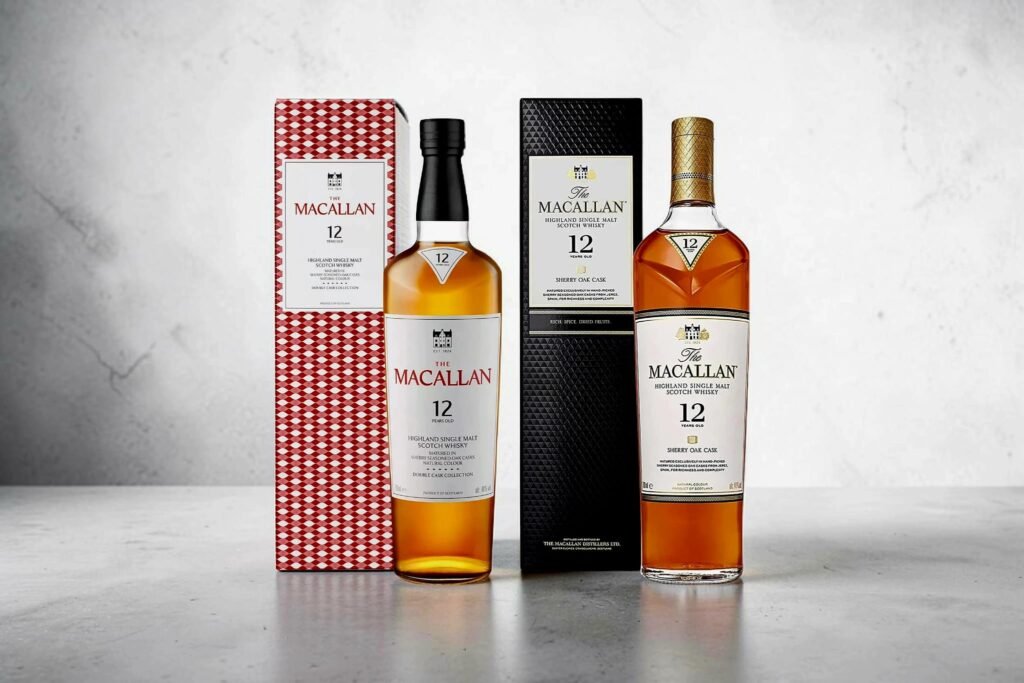
That became obvious again the moment these whiskies hit the glass. Before even taking a sip, both the Double Cask and the Sherry Oak immediately create that familiar sense of polish Macallan seems to engineer better than almost anyone else in Scotch whisky. Orange oils, soft oak, vanilla, dried fruit, warm spice — everything feels composed with almost irritating confidence. Even people who actively criticise modern Macallan often pause over the glass for slightly longer than they intended.
Quick Verdict:
The Macallan 12 Double Cask is softer, creamier, and more approachable, making it the easier whisky to recommend to newcomers exploring premium single malts. The Sherry Oak, however, feels richer, more structured, and ultimately more satisfying for experienced drinkers looking for a closer connection to Macallan’s classic sherried style.
And perhaps that is part of what makes Macallan so divisive in the first place. These whiskies constantly hint at something greater. The noses are so luxurious, so carefully shaped, that enthusiasts inevitably begin imagining the richer, heavier whisky they could have become with a little more strength or a little less restraint. But restraint is exactly what modern Macallan is about, and the Double Cask and the Sherry Oak simply express that restraint in very different ways. One feels softer, creamier, and deliberately approachable, while the other leans darker, richer, and closer to the old sherried Macallan style enthusiasts still romanticise today.
Same distillery. Same philosophy. Completely different mood.
If you want to explore how Macallan built that reputation in the first place, I highly recommend reading my deeper dive into the distillery itself in this Macallan Distillery Spotlight:
https://dram1.com/the-macallan-distillery-spotlight/
Listen to the Review:
Why Macallan 12 Still Dominates Whisky Culture
Part of what makes Macallan fascinating is that it no longer really belongs to whisky geeks.
Macallan exists in a completely different space now. These bottles are not just bought by enthusiasts comparing cask types online at two in the morning. They are bought by people celebrating promotions in hotel bars, travellers wandering through duty free shops, couples searching for wedding gifts, and newcomers wanting their first “serious” bottle without accidentally buying something too aggressive or challenging.
And most of those people are not chasing complexity in the way enthusiasts often are. They are looking for reassurance. Macallan sells that reassurance exceptionally well because every part of the experience feels carefully designed to remove friction. The packaging feels luxurious, the nose smells luxurious, and the palate arrives soft and controlled rather than sharp or demanding. Even people who normally struggle with whisky tend to relax around Macallan remarkably quickly.
That smoothness is not accidental either. It is the entire strategy.
Enthusiasts often judge whisky through the lens of intensity, rarity, value-for-money, or cask strength, while Macallan is playing an entirely different game altogether. It wants to feel expensive, polished, effortless, and universally enjoyable. Essentially, Macallan became the Rolex of whisky years ago while whisky geeks were still arguing about tasting notes, and honestly, that is probably why the distillery keeps winning.
Perhaps the clearest example of Macallan leaning fully into luxury presentation can be seen in releases like A Night On Earth: First Light, where the packaging alone almost feels more like high-end fashion than whisky:
https://dram1.com/macallan-a-night-on-earth-first-light-review/
Tasting Notes: Macallan 12 Double Cask Review
Stats
- Age: 12 Years Old
- ABV: 40% (80 Proof)
- Distillery: The Macallan
- Region: Speyside, Scotland
- Flavour Profile: Dessert Delight
- Chill-Filtration: Yes
- Colouring: Natural Colour
Nose
The Double Cask opens exactly the way a Macallan should. Vanilla custard, soft caramel, orange peel, butter biscuits, and honeyed oak rise from the glass with a kind of effortless smoothness that feels carefully engineered to make a strong first impression.
Compared to the Sherry Oak, the American oak influence becomes obvious fairly quickly. The whisky leans brighter and creamier overall, allowing sweeter vanilla notes to dominate while the sherry influence stays lighter and cleaner in the background. Nothing feels especially sharp or demanding here. The spice remains gentle, the oak stays controlled, and even the sweeter notes avoid becoming syrupy or heavy. Everything about the whisky feels deliberately rounded toward comfort and accessibility rather than intensity.
Some enthusiasts will inevitably call that “safe,” but I think that slightly misses the point. The Double Cask is not trying to challenge experienced drinkers searching for depth or aggression. It is trying to create a premium whisky experience that feels welcoming from the very first sip, and in many ways it succeeds remarkably well at exactly that.
Palate
The palate follows through on exactly what the nose promises. Creamy vanilla, caramel sauce, milk chocolate, and soft orchard fruit drift easily across the tongue while gentle baking spice quietly supports everything underneath. Texturally, the whisky feels extremely polished from beginning to end, almost to the point where that polish itself becomes the defining characteristic of the experience.
And that will either impress you or frustrate you depending entirely on what you expect from whisky. Experienced drinkers will probably keep waiting for the Double Cask to push a little harder, to deepen, or to lose its composure slightly, but it never really does. The whisky stays calm, controlled, and remarkably easy throughout, refusing to become especially aggressive or demanding at any point.
Personally, I found myself enjoying it far more once I stopped expecting complexity and started appreciating just how technically smooth the whisky actually is. Because creating something this approachable without allowing it to collapse entirely into blandness is probably much harder than whisky enthusiasts sometimes like admitting.
Finish
The finish is medium-short, but it suits the whisky’s personality perfectly. Vanilla cream, orange oils, and soft oak sweetness linger gently for a while before fading away with the same polished restraint that defines the rest of the experience. Nothing suddenly intensifies, nothing turns bitter, and nothing fights for attention on the way out. Instead, the Double Cask disappears quietly and elegantly, leaving behind the lingering impression of a whisky far more interested in smoothness and composure than dramatic impact.
Food Pairing
The softer and sweeter personality of the Double Cask lends itself beautifully to desserts and lighter comfort foods. Crème brûlée feels like the obvious pairing here, especially alongside those creamy vanilla and caramel notes, while almond pastries and butter biscuits mirror the whisky’s polished sweetness almost effortlessly. Even softer cheeses work surprisingly well, allowing the oak and citrus oils to stay present without overwhelming the palate.
Who Is This Whisky For?
The Macallan 12 Double Cask feels built for drinkers who value smoothness and refinement over raw intensity. It works particularly well as an introduction to premium single malt whisky because nothing about the experience feels intimidating or difficult to approach. More experienced drinkers searching for complexity may ultimately want more weight and development from the whisky, but for those looking for an elegant, effortless sipper that prioritises polish above all else, the Double Cask understands its role remarkably well.
Verdict
Strengths
- Extremely smooth and approachable
- Beautifully polished nose
- Elegant oak integration
- Excellent introduction to premium Speyside whisky
Weaknesses
- Limited depth for experienced drinkers
- Finish fades quickly
- Pricing remains difficult to justify for enthusiasts
Tasting Notes: Macallan 12 Sherry Oak Review
Stats
- Age: 12 Years Old
- ABV: 40%
- Distillery: The Macallan
- Region: Speyside, Scotland
- Flavour Profile: Sherry Velvet
- Chill-Filtration: Yes
- Colouring: Natural Colour
Nose
The Sherry Oak immediately feels more serious. Dark raisins, polished oak, orange oils, cinnamon, cocoa powder, old furniture polish, and dark chocolate rise slowly from the glass with considerably more richness than the Double Cask beside it. Side by side, this is clearly the bottle most whisky enthusiasts instinctively gravitate toward because it feels closer to the old Macallan identity people still speak about with near-religious nostalgia.
And honestly, the nose is gorgeous — possibly frustratingly so. Once again, Macallan demonstrates just how outrageously good it remains at shaping aromatics, because the whisky smells deeper, richer, and more substantial than its forty percent ABV perhaps has any right to. That inevitably creates a certain level of expectation before the first sip even arrives, especially for experienced drinkers still hoping modern Macallan might occasionally recapture a little of its old magic.
Palate
The Sherry Oak carries noticeably more structure than the Double Cask from the very first sip. Raisins, spiced orange peel, cocoa bitterness, caramelised nuts, polished oak, and dried fruit move steadily across the palate with far more weight and grip, creating a whisky that immediately feels richer and more traditionally “Macallan” in style.
Even so, modern Macallan restraint never fully disappears. The whisky remains composed almost to a fault, never becoming especially oily, explosive, or daring. Instead, everything feels carefully measured, as though the whisky constantly refuses to loosen its tie completely. That restraint frustrated me initially, particularly because the nose suggests a whisky capable of considerably more intensity than the palate ultimately delivers.
But strangely, the longer I sat with the dram, the more that restraint started making sense. The Sherry Oak is not really trying to recreate old-school Macallan. It is trying to deliver a cleaner, more refined, luxury-focused interpretation of sherried Speyside whisky for modern drinkers who value elegance and polish over brute force and cask-strength aggression.
Once I accepted that, I found myself enjoying the whisky considerably more for what it actually was rather than criticising it for what it chose not to be. Would I still love to see this bottled at forty-six percent ABV? Absolutely. But there is still a great deal to admire here once you stop asking the whisky to become something it never truly intended to be.
Finish
The finish carries noticeably more weight than the Double Cask, lingering through dried fruit, cocoa bitterness, polished oak, warming spice, and slow waves of orange peel before eventually fading into softer sweetness. What stands out most is not necessarily the intensity of the finish, but the composure of it. The whisky never suddenly turns sharp, dry, or overly tannic on the way out. Instead, it maintains that same carefully controlled elegance that defines the rest of the experience, leaving behind the impression of a dram far more interested in refinement than raw power.
Food Pairing
The richer sherried profile of the Sherry Oak naturally lends itself to heavier, more indulgent pairings. Christmas cake and sticky toffee pudding feel almost tailor-made for the whisky’s darker fruit and spice notes, while roasted nuts and aged Gouda bring out more of the oak and cocoa bitterness underneath. Dark chocolate desserts work beautifully as well, particularly alongside the whisky’s orange oils and lingering dried fruit character, creating the kind of pairing that feels dangerously easy to keep returning to on a cold evening.
Who Is This Whisky For?
The Macallan 12 Sherry Oak will appeal most to drinkers who enjoy sherried whisky for its richness, polish, and sense of quiet luxury rather than sheer intensity. Experienced enthusiasts searching for aggressive cask-strength power may still find themselves wanting more weight from the palate, but for those who appreciate elegant, composed Speyside whisky with darker fruit, oak spice, and a distinctly premium feel, the Sherry Oak understands its audience exceptionally well.
Verdict
Strengths
- Richer and more layered than Double Cask
- Outstanding nose
- More traditional Macallan personality
- Beautiful sherry integration
Weaknesses
- Still restrained for the price
- Lower ABV limits intensity
- Older Macallan fans may expect more depth
Macallan 12 Double Cask vs Sherry Oak — Which One Should You Buy?
The answer depends entirely on what you want whisky to do.
The Double Cask feels softer, creamier, brighter, and easier overall. It is the whisky equivalent of a luxury hotel lounge: comfortable, polished, reassuring, and carefully designed to offend absolutely nobody. The Sherry Oak, meanwhile, carries more spice, more dried fruit, more structure, and considerably more emotional pull for experienced whisky drinkers. It feels closer to the Macallan enthusiasts still romanticise, even if modern restraint keeps everything firmly under control.
Personally, I would choose the Sherry Oak every single time, not because it is dramatically more complex, but because it simply feels more satisfying to sit with over the course of an evening. The Double Cask is easier to admire immediately, whereas the Sherry Oak lingers in the mind longer afterward. And yet, if someone completely new to whisky asked me which bottle to buy first, I would probably still hand them the Double Cask without much hesitation.
That contradiction explains modern Macallan surprisingly well.
If you are curious how Macallan’s richer luxury style evolves further up the range, the Macallan 18 Sherry Oak remains one of the strongest examples of the distillery leaning fully into polished premium whisky:
https://dram1.com/macallan-18-sherry-oak-review-2025/
At the same time, bottles like Guardian Oak prove that Macallan can still surprise even experienced whisky geeks willing to approach the distillery without preconceived bias:
https://dram1.com/the-macallan-guardian-oak/
For readers wanting more historical context around Macallan’s evolution and luxury positioning, this excellent long-form piece from Esquire is also worth reading:
https://www.esquire.com/food-drink/drinks/a70975308/the-macallan-distillery-scotch-whisky-deep-dive/
And if you want a broader breakdown of Macallan’s modern identity within today’s whisky market, Whisky Advocate covered the distillery’s evolution and luxury positioning particularly well here:
https://www.whiskyadvocate.com/macallan-edition-series-retrospective/
Final Thoughts
Comparing these two bottles reminded me why Macallan continues dominating whisky culture despite endless criticism from enthusiasts online.
Because beneath all the debates about pricing, ABV, filtration, and endless nostalgia for old bottlings, The Macallan still understands something many distilleries either ignore or underestimate: most people are not actually searching for difficult whisky. They are searching for whisky that feels luxurious, comforting, polished, and reassuring from the very first sip onward. That is precisely why Macallan continues thriving despite the criticism constantly thrown at it by enthusiasts online.
The Double Cask delivers that experience through softness, creaminess, and effortless accessibility, while the Sherry Oak leans into a richer and more emotionally satisfying style that feels closer to the Macallan identity long-time drinkers still romanticise today. Neither bottle fully recreates the old-school magic whisky geeks often mourn, but dismissing them entirely feels just as dishonest as pretending they are flawless masterpieces.
Modern Macallan may no longer be built primarily for enthusiasts chasing intensity and value-for-money above all else, but for the audience these whiskies are actually designed for, The Macallan remains exceptionally good at what it does.
This article may contain affiliate links. If you purchase through them, Dram1 may earn a small commission at no extra cost to you.
If these bottles sparked your curiosity, The Whisky Exchange offers a broader look at The Macallan range, from the core collection to some of the distillery’s more luxurious limited releases.