Whisky Finally Feels Affordable Again — Thanks To James Eadie’s New Clynelish And Laphroaig Releases
For the first time in quite a while, parts of the whisky world actually feel exciting again in a way that reminds me why I fell in love with whisky to begin with. Not the exhausting kind of excitement that dominated the last few years, where every release instantly became a frenzy of waiting lists, inflated secondary prices and collectors posting unopened bottles online before most enthusiasts had even managed to secure a single dram for themselves. This feels different. Calmer somehow. Less performative. More grounded in the whisky itself again.
I honestly did not realise how much I missed that feeling until these new James Eadie releases appeared.
Independent bottlings from distilleries like Clynelish and Laphroaig would have caused absolute chaos not that long ago, especially releases carrying proper age statements at prices ordinary enthusiasts could still realistically justify. For a while, it seemed like every decent indie bottling connected to either distillery disappeared instantly into collector circles, while official releases became increasingly expensive and polished toward luxury audiences rather than the people who had supported these distilleries for years.
I remember opening whisky websites during that period and already assuming half the bottles would be gone before I had even finished reading the article itself. Every indie Clynelish suddenly carried cult-level pricing, while decent Laphroaig bottlings vanished so quickly that buying whisky slowly started feeling less like enthusiast culture and more like trying to secure limited sneakers online before the resale market exploded.
That atmosphere eventually became tiring in a way I never expected whisky to become.
Both Clynelish and Laphroaig easily sit within my personal top five distilleries in Scotland, yet there was a point where I almost stopped paying close attention to new releases altogether simply because the constant scarcity and escalating prices drained so much enjoyment out of the experience. Whisky is supposed to inspire curiosity. Obsession even. It should encourage people to open bottles with friends, compare casks, argue over distillery styles and endlessly chase flavour. It should not feel like competing against investors refreshing auction pages at midnight.
That is exactly why these new James Eadie releases feel so refreshing. Not simply because the whiskies themselves sound excellent, but because they quietly suggest the industry may finally be settling back into something a little healthier again, where sought-after bottles from legendary distilleries can once more feel obtainable rather than purely aspirational.
Why James Eadie Still Feels Enthusiast-Driven
Part of what makes James Eadie so respected among enthusiasts is that the company never really drifted into the kind of modern whisky hype culture that now dominates large parts of the industry. While countless brands chased luxury positioning, collectible packaging and increasingly theatrical marketing campaigns, James Eadie quietly kept doing something far less fashionable but ultimately far more important: selecting good casks and letting the whisky speak for itself.
The original James Eadie was a 19th-century brewer and whisky merchant best known for owning the famous X Ale, and the modern bottling company has carried that history forward in a way that feels unusually authentic compared to many contemporary whisky brands. There is very little sense of manufactured prestige surrounding these releases. No extravagant storytelling about rarity. No crystal decanters. No desperate attempts to transform whisky into luxury fashion. Just thoughtfully selected casks bottled with a clear respect for distillery character.
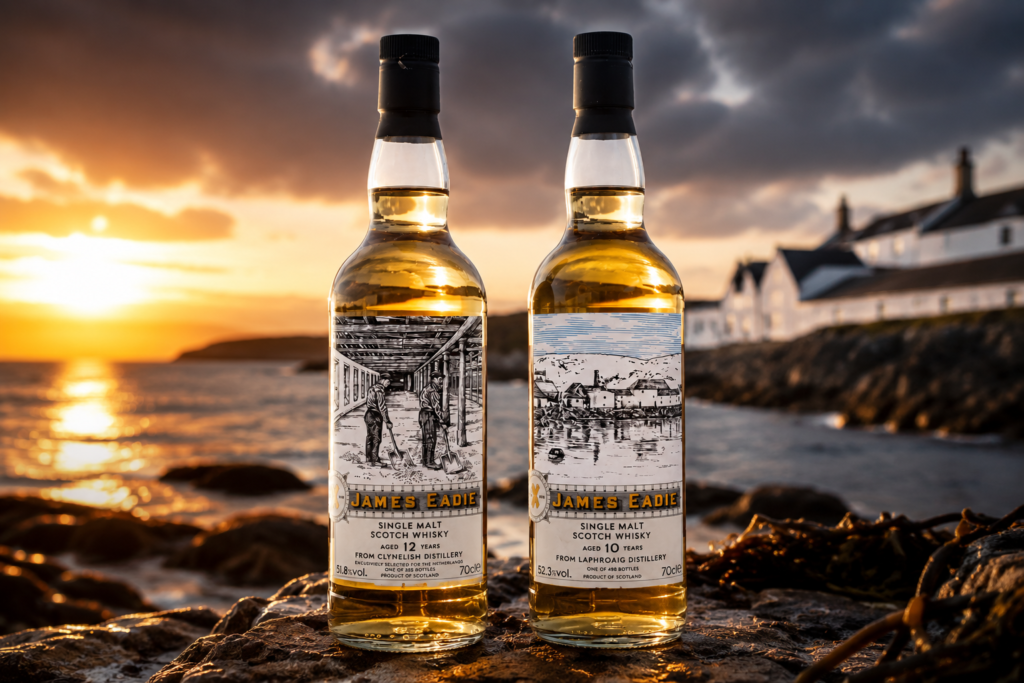
Even the labels communicate that philosophy beautifully. Rather than glossy branding or heavily stylised modern design, James Eadie bottles carry this archival Victorian aesthetic featuring sketches and illustrations tied to pubs and buildings once owned by the original James Eadie empire throughout Britain. They feel historical without becoming nostalgic for the sake of it.
The new 12-year-old Clynelish label, showing workers inside an industrial warehouse setting, somehow captures the spirit of the distillery perfectly. Clynelish has always possessed this slightly mechanical, oily personality underneath the citrus, wax and coastal minerality, and the artwork subtly reflects that character before the bottle is even opened. The 10-year-old Laphroaig, meanwhile, leans heavily into coastal imagery that immediately evokes Islay’s windswept identity, with the sort of stark maritime atmosphere that feels completely natural for a distillery built on medicinal peat smoke, sea air and raw coastal intensity.
What I especially love is that these bottles do not look designed for investors or collectors chasing status symbols. They look like whiskies intended to be opened, poured and argued over with friends late into the evening.
And honestly, that matters more to me now than it probably did ten years ago.
The Clynelish Might Quietly Be The Better Bottle
The new James Eadie Clynelish arrives at 12 years old and 51.8% ABV, exclusively selected for the Netherlands from a single cask yielding just 385 bottles. A few years ago, a release carrying those specifications would almost certainly have disappeared instantly, swallowed by collectors and auction flippers before most enthusiasts even had the chance to properly consider opening one.
That alone says quite a lot about how much the whisky landscape seems to be changing again.
Independent Clynelish bottlings have always carried a particular fascination among enthusiasts because the distillery itself produces such an unmistakably strange spirit. Official releases like Clynelish 14 remain fantastic introductions to the distillery’s waxy, coastal style, but indie bottlings often reveal a version of Clynelish that feels slightly less polished and far more spirit-driven. The texture becomes oilier, the minerality sharper and the distillate itself takes centre stage in a way official bottlings sometimes smooth out for consistency.
Trying to properly describe good Clynelish still feels slightly ridiculous even after years of drinking it. Whisky writers constantly reach for words like candlewax, mineral oil or wet stones because the distillery genuinely produces this dense, oily texture that barely resembles anything else in Scotch whisky. Underneath that waxy weight you usually find layers of lemon peel, coastal salinity, honeyed fruit and this faint industrial edge that somehow makes the whisky feel both elegant and rugged at exactly the same time.
Our Clynelish Distillery Spotlight goes much deeper into why enthusiasts became borderline obsessed with the distillery over the years, and honestly, I completely understand why. Some of my favourite whisky memories still involve Clynelish bottlings that sounded completely unremarkable on paper. No extravagant packaging. No impossible age statement. Just distillery character carrying the entire experience without needing anything else around it.
That is partly why this James Eadie release sounds so appealing to me personally. At 51.8%, it feels unlikely this whisky was designed for broad commercial appeal or carefully focus-grouped accessibility. It sounds like a bottling intended for people who genuinely enjoy Clynelish at its weirdest, waxiest and most characterful.
Which, if I am being honest, is exactly how I want my Clynelish.
Projects like Little Brown Dog’s Clynelish release show how much appetite still exists for releases from the distillery. Enthusiasts are still searching for Clynelish. They want bottlings with that authentic personality, texture and enough distillery character to spark arguments long after the bottle is opened.
The Laphroaig Sounds Completely Untamed
Then there is the James Eadie Laphroaig, bottled at 10 years old and 52.3% ABV from a single cask producing 498 bottles, and honestly, this is probably the bottle that immediately caught my attention first.
Good independent Laphroaig has always carried a very different kind of energy compared to official releases. Not necessarily “better” in every situation, but often rawer, sharper and considerably less interested in behaving itself. Official bottlings still retain that unmistakable medicinal peat profile the distillery became famous for, but independent bottlers frequently push those characteristics much further, stripping away some of the balancing softness and allowing the spirit to become slightly chaotic in the best possible way.
That unpredictability is exactly why I fell in love with Laphroaig years ago.
Official releases like Laphroaig 10 remain iconic for a reason, while comparisons such as Laphroaig 10 vs Cask Strength already show how dramatically the distillery changes depending on strength and presentation alone. Once independent bottlers get involved, things often become even more untamed. More medicinal peat smoke. More iodine. More coastal salinity. More burnt ash, TCP notes and that unmistakable hospital-meets-bonfire intensity that somehow makes Laphroaig both deeply divisive and completely addictive at the same time.
At 52.3%, this James Eadie bottling sounds very much built around distillery character rather than accessibility, and honestly, I am grateful for that. There was a period where it felt like too many whiskies across the industry were slowly being softened around the edges for broader audiences, while distilleries like Laphroaig were always at their best when they remained slightly uncompromising.
I still remember pouring my first heavily peated Laphroaig for a friend years ago and watching genuine confusion spread across his face after the first sip. Half disgust. Half fascination. He looked at the glass as though something had gone wrong with it, then immediately went back for another sip anyway. That reaction, in many ways, perfectly sums up the distillery itself. Laphroaig is not a whisky people merely “like.” It tends to become something people either obsess over completely or never fully understand at all.
And for enthusiasts already deep into the world of independent “Williamson” bottlings — widely understood to reference sourced Laphroaig spirit — releases like Living Souls Williamson 13 have already shown just how compelling indie Laphroaig can become when left slightly wild around the edges.
This James Eadie release sounds like it belongs firmly in that category.
Whisky Needed To Calm Down
That, more than anything else, is why these bottles feel important.
Not simply because they come from beloved distilleries like Clynelish and Laphroaig, but because they quietly feel like part of a whisky market slowly finding its balance again after years of overheating. There was a period where the industry genuinely started feeling unsustainable, at least from an enthusiast perspective. Every release instantly became an “investment,” every distillery suddenly developed luxury ambitions and prices climbed so aggressively that many ordinary drinkers simply stopped paying attention altogether.
I genuinely worried about where all of that was heading.
Not because premium whisky should not exist — of course it should — but because whisky increasingly felt disconnected from the people who built its culture in the first place. The enthusiasts opening bottles with friends, comparing casks late into the evening and obsessing over strange little distillery characteristics slowly became less important than collectors storing unopened cases in temperature-controlled rooms while waiting for values to rise.
For a while, the entire industry started feeling strangely tense. Bottles disappeared instantly. Conversations shifted from flavour to resale value. Even reading whisky news sometimes became exhausting because so much of it revolved around scarcity, allocations and increasingly theatrical luxury positioning rather than the whisky itself.
That is why these James Eadie releases feel refreshing in a way that goes well beyond the liquid inside the bottle.
They feel like a reminder that whisky can still simply be whisky. That independent bottlings from legendary distilleries such as Clynelish and Laphroaig can still generate excitement because of their spirit character, texture and individuality rather than because they were artificially engineered to become impossible to obtain.
And honestly, after the last few years, I am very happy to see that happening again.
Sources
- James Eadie Official Website
- Clynelish Official Distillery Page
- Laphroaig Official Website