Trump Just Scrapped Whisky Tariffs — And It Could Quietly Reset Scotch Prices
For years, Scotch whisky has been competing in the U.S. with a built-in disadvantage—a 25% price penalty that had nothing to do with quality, demand, or even whisky itself.
That’s just disappeared.
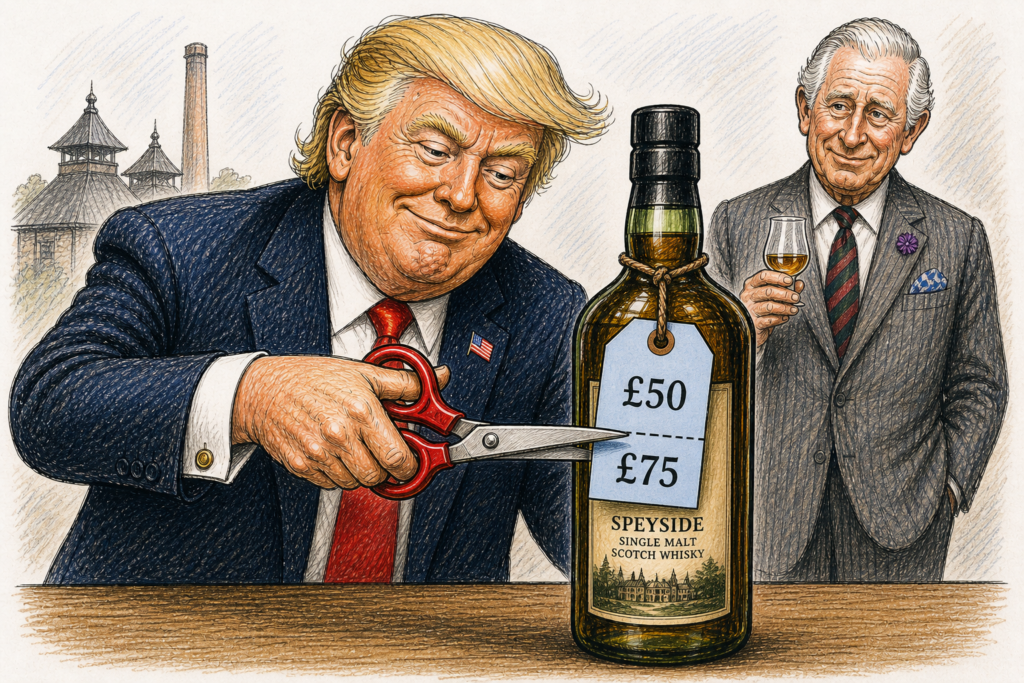
Donald Trump has removed tariffs on Scotch, effectively reopening its most important export market without that artificial pressure, and while it doesn’t look dramatic on the surface, this is the kind of shift that tends to work its way through the system slowly—and then suddenly feels obvious in hindsight.
Not because prices crash overnight.
But because the market starts behaving more naturally again.
Quick Answer: Will Scotch Whisky Get Cheaper Now?
Not immediately—but the conditions for lower or more stable pricing because of the cut on whisky tariffs are now firmly back in place.
Here’s what actually changes:
- The 25% U.S. import tariff is gone
- Distributors regain pricing flexibility
- Retail pressure in the U.S. should ease over time
- Global pricing may stabilise as demand rebalances
- Real impact likely plays out over 12–36 months
So no, this isn’t a “grab bottles now before prices spike” moment.
It’s more subtle than that—and arguably more important.
Why This Matters (Even If You Don’t Live in the U.S.)
To really understand why the whisky tariffs matters, you have to look at how Scotch actually fits into the American market, because it’s not just about scale—it’s about where it sits.
Yes, the U.S. is the biggest export destination for Scotch, worth around £1 billion a year according to the Scotch Whisky Association (their latest export figures are well worth a look if you haven’t seen them yet):
👉 https://www.scotch-whisky.org.uk/newsroom/2025-export-figures/
But culturally, it’s still a Bourbon-first country.
Bourbon dominates for a reason—it’s local, widely available, competitively priced, and sits comfortably as the default choice whether you’re in a bar or picking up a bottle without overthinking it.
Scotch plays a different role.
It tends to sit just outside that everyday space, leaning more toward:
- exploration
- occasion
- and, more often than not, a slightly higher price point
That positioning works—but only up to a point.
When whisky tariffs were introduced back in 2019 as part of the US–EU trade dispute over Airbus and Boeing subsidies, they added a 25% duty on single malt Scotch, and that didn’t just make it more expensive—it stretched the gap between “easy choice” and “considered purchase.”
That’s where Scotch lost ground.
Not at the top end, where buyers are less sensitive, but in that middle space where curiosity either turns into a purchase… or quietly disappears.
Removing the tariffs doesn’t suddenly flood the market with cheap whisky—but it does bring Scotch back into a range where it can compete properly again.
And that’s where the real shift begins.
The Slightly Messier Reality Behind “Trump Ends Tariffs”
The clean version of this story is simple: whisky tariffs are gone, the market improves, everyone wins.
The less clean version is that whisky arguably never should have been involved in the first place.
Because it wasn’t about whisky.
It was collateral damage from a broader dispute over aircraft subsidies, and for years the industry has been dealing with the consequences of a political decision that had nothing to do with what was actually in the bottle.
If you want a deeper look at how this is being framed politically—and who’s claiming credit—this breakdown from The Guardian is worth reading:
👉 https://www.theguardian.com/uk-news/2026/may/01/end-trump-tariffs-scotch-whisky-row-between-scottish-parties-claiming-credit
So in many ways, this isn’t just a win.
It’s a correction.
That said, it’s happening under Donald Trump, which adds a layer of unpredictability that’s hard to ignore, because if there’s one consistent theme with his trade policies, it’s that they can shift quickly—and sometimes just as quickly shift back.
So while this looks positive, it’s probably worth keeping one eye on how stable it actually turns out to be.
The Timing Is Almost Too Convenient
If this had happened during the peak years of 2020 to 2022, it would have been a bonus.
Right now, it feels more like relief.
Because the whisky market isn’t riding that same wave anymore.
Back then, demand was surging, prices were climbing, and limited releases were disappearing instantly, creating the sense that growth might just keep going indefinitely.
Now, things feel different.
You can see it if you’ve been paying attention:
- bottles sitting on shelves longer
- discounts appearing more frequently
- far less urgency around new releases
Underneath that, there’s been a quieter shift toward consolidation and restructuring, something you’ve already explored here:
👉 https://dram1.com/suntory-merges-laphroaig-and-bowmore-news/
So reopening the U.S. market without that tariff drag doesn’t just help—it arrives at a moment where the industry actually needs that bit of breathing room.
The Part Most People Overlook: Ex-Bourbon Casks
There’s another layer to this that doesn’t get the same attention, but arguably matters just as much over time.
Scotch doesn’t just rely on exporting to the U.S.—it relies on importing from it too, specifically ex-bourbon casks.
They’re fundamental to how a huge portion of Scotch is matured, shaping flavour, consistency, and availability across the category.
When trade between the U.S. and UK becomes more complicated, that flow gets tighter:
- supply becomes less predictable
- costs increase
- planning becomes more difficult
When trade opens up again, things loosen.
It’s not dramatic, and it doesn’t show up in next month’s pricing, but over time it feeds into production costs and availability in a way that quietly shapes the market.
If you’ve seen how whisky tariffs changes can ripple outward before, your China piece is still a useful comparison point—even though that was focused purely on whisky rather than supply chains:
👉 https://dram1.com/china-cuts-whisky-tariffs-whisky-news/
Different mechanism, same idea.
These things rarely stay contained.
Meanwhile… The Market Was Already Shifting
What makes this moment even more interesting is that the market had already started adjusting before this announcement.
Especially at the higher end, prices have been softening.
You’re seeing:
- more frequent discounts
- less urgency around releases
- bottles sticking around longer than they used to
Which tells you we’re no longer in that scarcity-driven phase.
So now you’ve got two forces moving at the same time:
- short-term demand cooling
- long-term trade conditions improving
And if you’re someone who actually drinks whisky rather than just collecting it, that’s not a bad place to be.
So… What Does This Really Change?
Not everything—and not all at once—but enough to matter.
It removes an artificial pricing barrier in the most important market for Scotch, it helps stabilise parts of the supply chain that have been under pressure, and it arrives at a moment where the industry is already recalibrating.
That combination doesn’t create a boom.
But it does create balance.
Final Thoughts
This doesn’t feel like a dramatic turning point—and that’s exactly why it’s worth paying attention to.
Because the whisky world rarely shifts in obvious ways.
It moves through decisions like this, where something that’s been quietly distorting the market gets removed, and over time things start to settle into a shape that makes more sense.
That’s what this feels like.
A correction, not a surge.
And yes, with Donald Trump involved, there’s always that underlying question of how permanent any of this really is—but if the whisky tariffs hold, this is the kind of change that won’t feel dramatic now, yet might end up shaping the next phase of Scotch far more than it first appears.