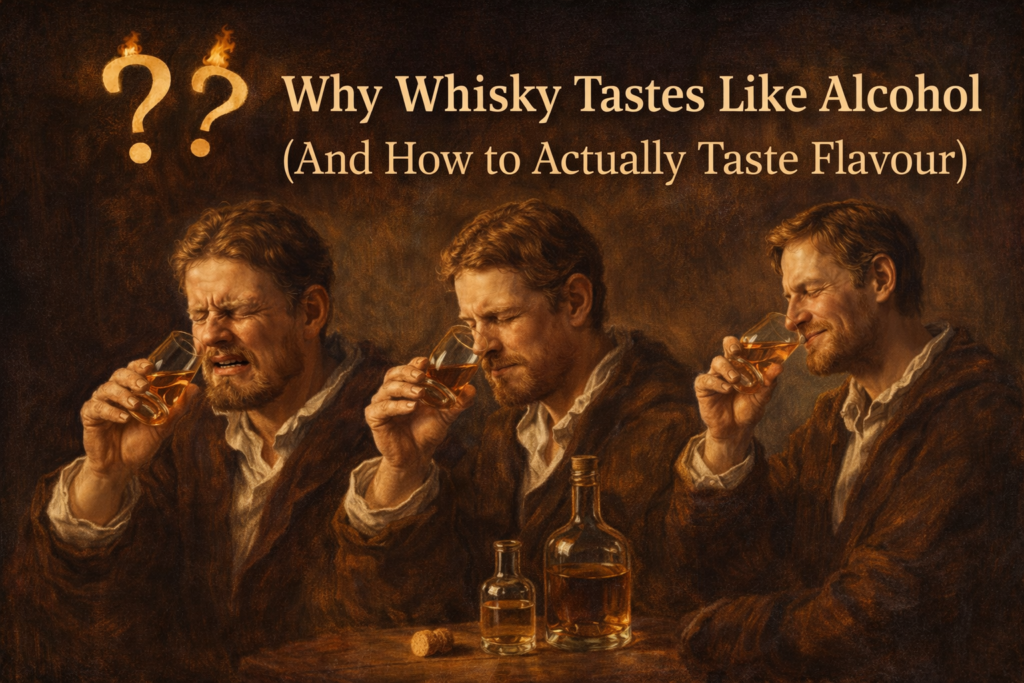
You pour a glass of whisky, take a sip, and instead of layers of flavour, you get one thing—alcohol. And you start wondering why whisky tastes like alcohol at first.
It’s sharp, a little overwhelming, and not at all what you expected after reading about notes of vanilla, fruit, or oak. For a lot of people, this is the moment where whisky feels confusing rather than enjoyable. This is something almost every whisky drinker runs into at some point.
What’s easy to miss is that this isn’t a problem with the whisky.
It’s a stage.
And for a lot of people, this is the point where they quietly decide whisky just isn’t for them.
And once you understand what’s happening—and make a few small adjustments—that wall of alcohol starts to break apart into something far more interesting.
Why Whisky Tastes Like Alcohol at First
Whisky sits at a strength where alcohol doesn’t just carry flavour—it competes with it. This is often why whisky tastes like alcohol in the beginning.
At 40% ABV and above, ethanol can dominate your senses, especially if you’re not used to it yet. That dominance shows up as heat on the palate and sharpness on the nose, masking everything underneath.
Three things are usually happening at the same time:
- Your nose hasn’t learned to separate alcohol from aroma
- Your palate isn’t adjusted to high-proof spirits
- Your brain doesn’t yet recognise whisky-specific flavours
Those flavours are already there. You’re just not picking them out yet.
If you want to understand where those flavours actually come from, this is where it starts:
Most of the Flavour Is in the Nose
The biggest shift happens when you stop relying on your palate and start paying attention to aroma.
Whisky carries far more detail on the nose than on the tongue, but it’s also where alcohol hits hardest. Go in too quickly and all you’ll get is ethanol.
A small adjustment makes a big difference:
- Don’t push your nose into the glass
- Approach gradually instead of all at once
- Keep your mouth slightly open while nosing
That last one softens the alcohol and lets more aroma through. It feels odd at first, but it works. The whisky hasn’t changed—only your ability to recognise it has.
If you’re curious about why this happens, this is a solid explanation of the science behind tasting:
The First Sip Isn’t the Real Sip
The first sip rarely shows you what a whisky actually tastes like.
It hits your palate before your senses have adjusted, which is why it often feels hot, thin, or one-dimensional—even with a well-made whisky.
Instead of judging it, use it.
Take a small sip, let it coat your mouth, and give your palate a moment to adapt. You’re setting the stage for what comes next.
If you want to see how this fits into a full tasting approach, it connects directly to this guide:
The Second Sip Is Where It Opens Up
Once your palate adjusts, the alcohol stops dominating and the whisky starts to separate into layers.
This is where you begin to notice:
- Sweetness becoming more defined
- Spice feeling structured rather than sharp
- Oak, fruit, or smoke starting to come through
The whisky hasn’t changed. Your perception has. Once you understand why whisky tastes like alcohol, it becomes much easier to move past it.
The mistake here is trying to “find” flavours you’ve read about. It’s far more useful to let something familiar come to mind first, then try to describe it afterwards.
If you need help putting that into words, this guide can help shape what you’re already noticing:
Alcohol Burn vs Flavour: Learning the Difference
Not all heat in whisky comes from alcohol.
There’s a clear difference between:
- Alcohol burn (sharp, immediate, fades quickly)
- Spice from wood or grain (warmer, slower, more integrated)
Once your palate settles, that difference becomes much easier to recognise.
A good example is how higher-proof bourbons behave. They can feel aggressive at first, but after a few sips, the structure underneath starts to come through. You can see that contrast clearly in this comparison of two widely available bottles:
Blanton’s Gold, bottled at a higher proof, comes across more intense and layered, while the Original leans more towards balance and ease. That initial intensity can easily be mistaken for “just alcohol” if your palate hasn’t adjusted yet.
Once it has, it starts to feel like part of the structure rather than the whole experience.
Adding Water Can Change Everything
A few drops of water can shift a whisky more than most people expect.
It slightly lowers the alcohol concentration, allowing aroma compounds to become more noticeable. In practical terms, that means more flavour, not less.
Try this:
- Taste the whisky neat
- Add a few drops of water
- Go back to the nose and palate
Sometimes the change is subtle. Sometimes it’s dramatic.
If you want to understand why, it ties directly into alcohol strength and structure:
The Shift Happens Gradually
There isn’t a single moment where whisky suddenly “clicks.”
It builds over time.
You start to recognise aromas more quickly. The alcohol becomes less intrusive. Flavours that once felt vague begin to stand out with more clarity.
Revisiting the same bottle weeks later often shows more than trying something new every time. Comparing styles helps even more.
If you’re building that reference point, this is a good place to explore different profiles:
Common Mistakes That Keep Whisky Tasting Like Alcohol
A few habits can keep everything stuck at that “just alcohol” stage:
- Nosing too aggressively
- Drinking too quickly
- Skipping the first sip adjustment
- Expecting specific flavours instead of noticing your own
- Avoiding water completely
None of these are major on their own, but together they can flatten the experience.
FAQ – Why Whisky Tastes Like Alcohol
Is it normal that whisky just tastes like alcohol to me?
Yes. It’s one of the most common early experiences, and it changes with time and practice.
How long does it take to taste more flavours?
Usually once you slow down and focus more on the nose, the shift starts fairly quickly.
Does higher ABV make this worse?
At first, yes. But it also means more depth once your palate adjusts.
Should I always add water to whisky?
Not always, but it’s always worth trying.
Is this about having a better palate?
No. It’s about familiarity and attention, not natural ability.
Final Thoughts
When whisky tastes like nothing but alcohol, it doesn’t mean you’re missing something.
It means you’re right at the point where things start to change.
Once you slow down, adjust how you approach the glass, and give your senses time to adapt, that initial wall of heat begins to separate into something far more detailed.
And from there, whisky becomes less about trying to find flavour—and more about recognising it when it shows up.