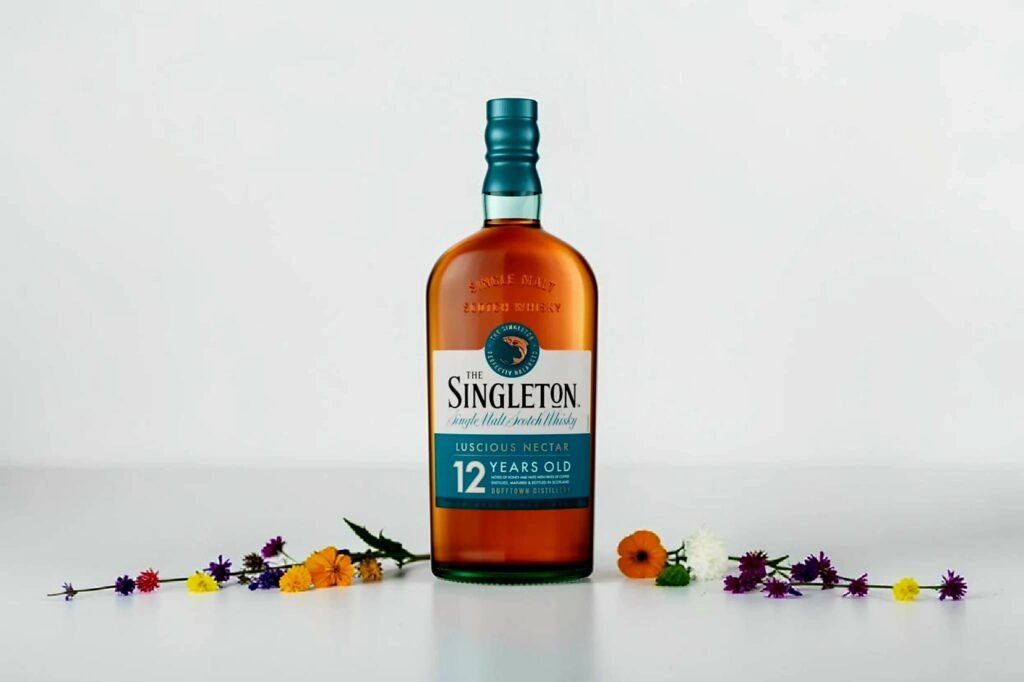
Singleton 12 Review: The Quiet Power of Simplicity
The Singleton 12 is one of those bottles that doesn’t try to impress you immediately—and that’s exactly why it works.
It’s often picked up as a first single malt. A safe choice. Something approachable. And yet, the more time you spend with it, the more you start to realise there’s a deliberate style behind that softness. This isn’t a whisky that lacks character—it’s a whisky that reveals it gradually.
And that, in many ways, is what makes this Singleton 12 review worth writing.
One Name, Three Distilleries
Before even getting into the glass, there’s something about the Singleton that’s worth understanding.
Unlike most single malts, “Singleton” isn’t tied to just one distillery.
Depending on where you are in the world, you’re actually drinking whisky from a different source:
- Dufftown (Scotland/Europe)
- Glen Ord (Asia)
- Glendullan (North America)
Each produces whisky under the Singleton name, all owned by Diageo, but with slightly different house styles.
This bottle—the one most commonly found across Europe—is from Dufftown, and it carries that classic Speyside DNA: soft fruit, gentle sweetness, and a structure that never feels aggressive.
If you’re curious about the Singleton brand, it’s worth exploring further:
What I find interesting here is that the Singleton isn’t trying to present itself as a “distillery-first” whisky. It’s built around accessibility—around making single malt feel less intimidating.
Where It Sits in the Whisky Landscape
The Singleton 12 is often placed in the same category as entry-level staples like:
And that comparison makes sense.
But where Glenfiddich leans crisp and orchard-driven, and Glengoyne leans richer and slightly more sherried, the Singleton 12 sits right in between—rounded, soft, and incredibly easy to return to.
This is a whisky that doesn’t challenge you straight away. It invites you in.
Tasting Notes: Singleton 12
Stats
- Age: 12 Years
- ABV: 40% (80 Proof)
- Distillery: Dufftown
- Region: Speyside, Scotland
- Flavour Profile: Malt House Classic
- Chill-Filtration: Yes
- Colouring: Yes
Nose
The first thing that comes through is a soft, almost creamy sweetness—like sliced pear left out for just a few minutes, slightly warmed by the air.
There’s honey here too, but not the thick, heavy kind. This is lighter, closer to acacia honey, drifting rather than dominating.
As it settles, a gentle maltiness starts to show—digestive biscuits, a touch of vanilla, and something faintly floral that feels more like a suggestion than a statement.
It doesn’t jump out of the glass. You have to meet it halfway.
Palate
The texture is softer than you might expect, almost silky at first, before a mild spice begins to build.
There’s a quiet sweetness running through it—baked apple, a hint of caramel, and that same honey note carrying over from the nose.
What stands out is how balanced it feels. Nothing is pushing too hard in any direction. The oak is there, but restrained. The fruit is present, but never sharp.
It’s the kind of palate that doesn’t overwhelm, but also doesn’t disappear.
Finish
Medium in length, gently drying.
The sweetness fades first, giving way to light oak and a soft, warming spice that lingers just long enough to keep your attention.
There’s no sudden drop-off. It tapers slowly, cleanly.
Food Pairing
The Singleton 12 works best when you don’t try to overcomplicate things:
- Mild cheeses (think brie or young cheddar)
- Apple-based desserts
- Shortbread or light pastries
It’s a whisky that complements rather than competes.
Who Is This Whisky For?
This is where the Singleton 12 really finds its place.
- If you’re just getting into single malts, this is an easy starting point
- If you’ve been drinking whisky for years, it becomes something you return to when you want something uncomplicated
- If you’ve ever found whisky too aggressive, this softens that experience
It’s not trying to be the most complex bottle on your shelf. It’s trying to be the one you actually reach for.
What About the Rest of the Range?
The 12 is the introduction, but the range builds from there.
Both take the same core style and stretch it further—more depth, more oak influence, more time to develop.
But what’s interesting is that the 12 never feels like it’s lacking because of that. It stands on its own.
What Do Others Write About This Whisky?
It’s always interesting to see how other reviewers approach the singleton 12 review, especially given how subtle this whisky can be.
- https://whiskyoftheweek.co.uk/singleton-12-yo/
- https://thewhiskeyramble.com/2021/01/30/the-singleton-12-scoresheet-review/
There’s a general agreement around its approachable nature, though some feel it leans a little too far into simplicity. Personally, I think that simplicity is the point—it’s what makes it so easy to revisit.
Verdict
Strengths
- Exceptionally approachable
- Well-balanced and easy to drink
- Works as both a beginner and everyday whisky
Weaknesses
- Lacks intensity
- Limited complexity compared to older expressions
Final Thoughts
The Singleton 12 doesn’t try to redefine what a Speyside whisky can be.
It focuses on getting the fundamentals right—balance, softness, and drinkability.
And in doing that, it becomes something more valuable than it first appears.
It becomes reliable.
Not in a boring way, but in a way that makes you come back to it without thinking too much about it. And sometimes, that’s exactly what you want from a whisky.
It may not have the sharp edges or bold statements of other bottles in its category, but it holds its own comfortably alongside names like Glenfiddich 12 and Glengoyne 12.
And for many people, it will be the bottle that quietly opens the door to everything else.