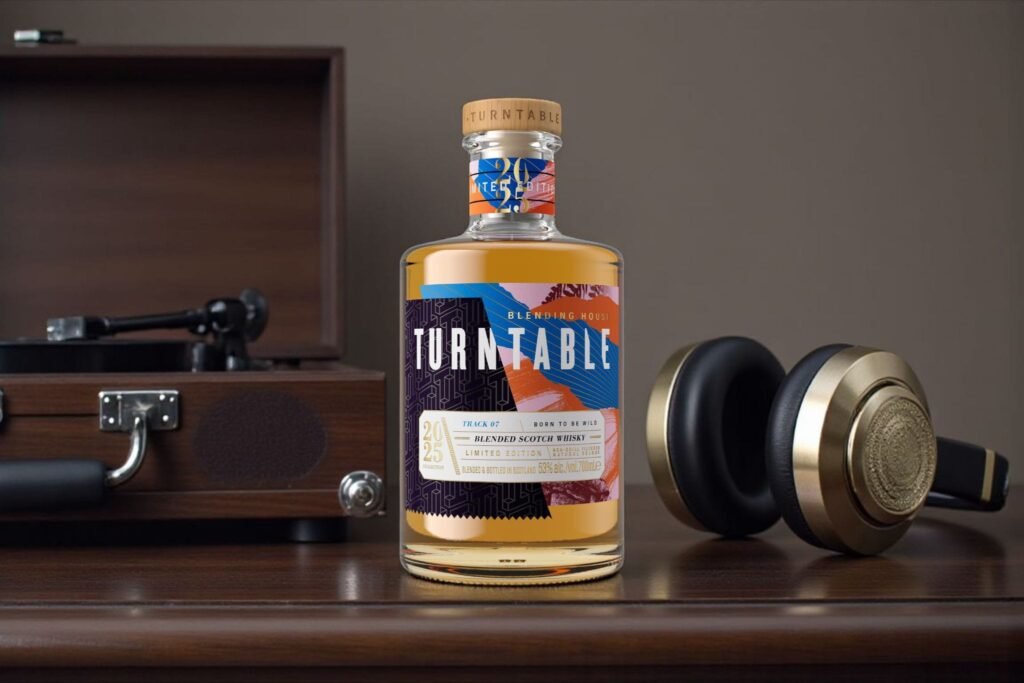
Turntable Bittersweet Symphony Review | DRAM1 Indie Awards 2026
Turntable Bittersweet Symphony was one of the most difficult whiskies from Set 1 to pin down. Reading through the tasting sheets after judging, the same question seemed to emerge again and again, albeit in different forms. Was this a sherry-forward whisky? Was there wine influence involved? Why were some panellists finding lavender sweets and strawberries while others were focusing entirely on raisins, oak and brown sugar?
That uncertainty became part of the whisky’s identity throughout the DRAM1 Indie Awards 2026. Long before anyone knew the bottle hidden behind Whisky #3 was Turntable Bittersweet Symphony, the panel was already debating what exactly they had in their glasses. Some found richness, complexity and old-school European oak. Others found sweetness that occasionally overwhelmed the experience. Very few people seemed entirely indifferent.
Before diving into the notes, it is worth mentioning that everything below comes directly from the DRAM1 Indie Awards tasting panel. These are not my own tasting notes. Every aroma, flavour and observation has been gathered from panellists who assessed this whisky completely blind, without knowing anything about the bottle behind the sample.
Tasting Notes: Turntable Bittersweet Symphony
Stats
Bottler: Turntable Spirits
Type: Blended Scotch Whisky
ABV: 46% (92 Proof)
Region: Scotland
Flavour Profile: Sherry Velvet
Nose
The nose produced some of the most interesting and varied feedback of the entire opening flight.
Dried fruits appeared repeatedly throughout the tasting sheets. Raisins, prunes and figs formed the backbone of many descriptions, often accompanied by brown sugar, caramel and dark honey. Several panellists found pears and apples adding freshness, while others detected strawberries and cherries sitting beneath the darker fruit notes.
Beyond the fruit, a surprisingly floral character emerged. One reviewer noted lavender sweets, plums and vanilla, while another described a perfume-like quality alongside old oak and raisins. Elsewhere, panellists found tobacco, chocolate, almonds, nutmeg and subtle medicinal notes.
What stands out when reading through the comments is how often the whisky seemed to evolve. One participant noted that a drop of water introduced hints of banana, while others commented that the whisky improved with time in the glass. The nose rarely revealed everything immediately, encouraging tasters to revisit it throughout the session.
Although the specific descriptors varied, the overall impression was of a whisky offering considerably more complexity on the nose than many expected from an anonymous blended Scotch.
Palate
The palate continued many of the themes established on the nose, although it also revealed why the whisky generated such a wide range of reactions.
For some panellists, this was one of the highlights of the opening set. Dried fruits, red berries, brown sugar and vanilla appeared frequently, joined by orange peel, milk chocolate and gentle spice. Several tasters praised the texture, describing it as oily, full-bodied and satisfying.
One reviewer summed up their experience simply:
“Oily. Full-bodied. Absolutely delicious.”
Another found themselves unexpectedly impressed:
“Oh wow. This is more luxurious than what I normally dabble with. I’m assuming this is PX and to my surprise I reeeeally like it.”
European oak was another recurring theme. Tannins and mature wood spice appeared throughout the notes, creating a profile that resonated strongly with some of the more experienced members of the panel.
As one particularly enthusiastic taster wrote:
“What a celebration! The tannins and European oak take me back to the early days of discovering whisky.”
Yet not everyone shared that enthusiasm.
A recurring criticism centred on sweetness. Several panellists felt the palate became dominated by sugary notes, preventing the fruit and oak from expressing themselves fully. One detailed reflection captured the issue particularly well:
“This could have been a beautiful dram, but the sweetness is so dominant that nothing else is allowed to shine.”
Other reviewers found the whisky pleasant but lacking definition, describing it as approachable and easy-drinking without necessarily delivering the depth promised by the nose.
Finish
The finish generated many of the same divisions seen on the palate.
Some panellists found a warming conclusion filled with lingering sherry notes, dried fruits, chocolate, liquorice and pepper. One reviewer specifically highlighted the “very nice warm, long finish”, while others praised how the whisky gradually shifted from sweetness towards spice.
For others, however, the finish faded more quickly than expected. Several tasting sheets mentioned a short aftertaste, with some reviewers feeling that the whisky exited before fully delivering on the promise shown earlier in the experience.
That contrast appeared repeatedly throughout the panel’s feedback. While some found richness and persistence, others experienced something softer and less memorable.
Verdict
The tasting sheets tell a fascinating story.
This was not a whisky that inspired consensus.
Some panellists loved it. One described it as “a lovely sip”. Another called it “absolutely delicious”. Others praised its combination of dried fruits, European oak and sherry influence, finding a richness and maturity that stood out within the opening flight.
At the same time, several reviewers struggled with the balance. The sweetness appeared again and again as the primary criticism, with some tasters feeling it overshadowed much of the complexity hinted at on the nose. A handful found the palate one-dimensional, while others felt the finish lacked the depth necessary to leave a lasting impression.
What makes Bittersweet Symphony particularly interesting is that even many of the more critical comments still acknowledged something intriguing about the whisky. One panellist simply asked:
“What kind of dram is this?”
That question feels remarkably appropriate when looking back at the tasting sheets as a whole.
When the scores were finally counted, Turntable Bittersweet Symphony achieved 72.80 points in the DRAM1 Indie Awards 2026. That score places it comfortably above average within a highly competitive field of independently bottled whiskies judged under completely blind conditions.
Looking through the notes after the reveal, the result makes sense. This was a whisky that challenged expectations and encouraged discussion. Some tasters found a luxurious sherry-led dram full of dried fruits and oak. Others found a whisky whose sweetness prevented it from reaching its full potential.
Either way, it left an impression.
DRAM1 Indie Awards 2026 Ranking
Whisky #3 – Set 1
Official DRAM1 Indie Awards Score: 72.80 Points
Final Thoughts
Perhaps the most revealing aspect of Turntable Bittersweet Symphony’s performance is not its final score, but the sheer variety of notes it generated.
Few whiskies in the competition produced such different reactions from experienced enthusiasts tasting the same sample under the same conditions. Some found lavender sweets and strawberries. Others found raisins, tobacco and old oak. Some praised a long warming finish, while others barely found one at all.
That level of disagreement can sometimes indicate a flawed whisky. In this case, it felt more like a whisky with multiple personalities.
For the DRAM1 panel, Bittersweet Symphony was never boring. It encouraged people to revisit the glass, rethink their initial impressions and question exactly what they were tasting. Not every whisky needs to dominate a competition to be memorable, and while this wasn’t the highest-scoring dram of the awards, it was undoubtedly one of the most intriguing.
Affiliate Disclosure: Some links on DRAM1 are affiliate links. If you purchase a bottle through these links, DRAM1 may earn a small commission at no extra cost to you. These commissions help support the site and allow us to continue producing independent whisky reviews, news and awards coverage. All DRAM1 Indie Awards results are based solely on blind tasting scores from the panel and are never influenced by affiliate partnerships or commercial relationships.