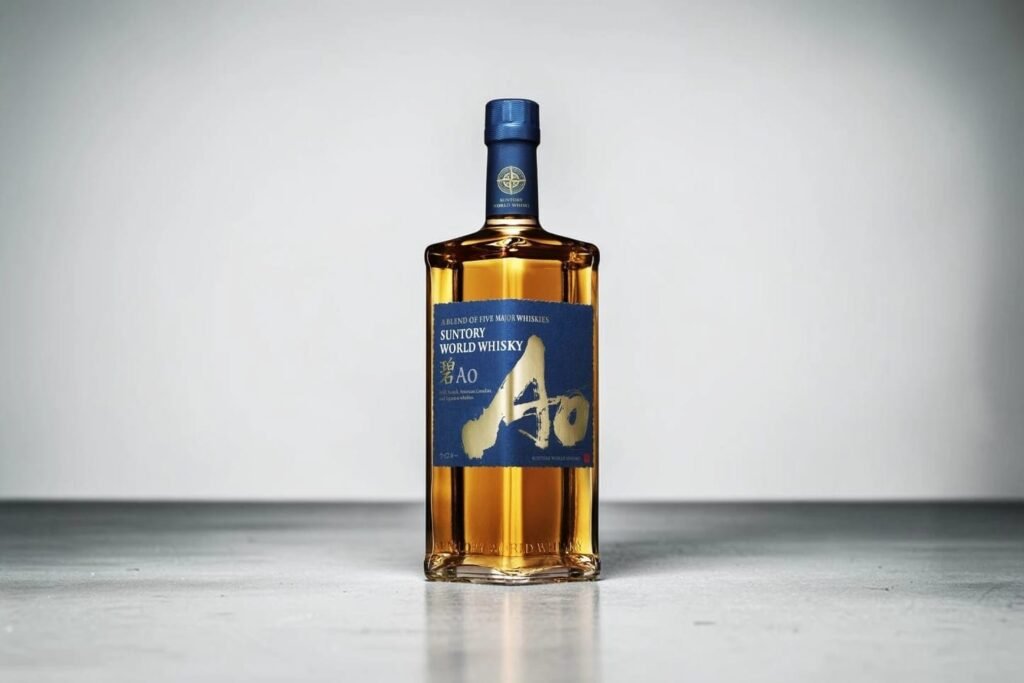
Suntory Ao Review | Can One Whisky Really Capture the Entire World?
Suntory Ao starts with an idea that sounds either wonderfully ambitious or suspiciously like something created during a long marketing meeting: combine whiskies from five major whisky-producing countries and somehow make them taste at home in the same glass.
Those whiskies come from Japan, Scotland, Ireland, Canada and the United States. Rather than presenting Ao as a Japanese whisky, Suntory describes it as a world blended whisky, which is both more accurate and considerably more interesting. The individual components are produced at seven distilleries within the wider Suntory portfolio, including Yamazaki, Hakushu, Ardmore, Glen Garioch, Cooley, Alberta Distillers and Jim Beam. Suntory openly identifies these distilleries, so there is refreshingly little mystery surrounding where Ao’s international character comes from.
The obvious comparison for me is Ichiro’s Malt & Grain, another world blend bottled in Japan and currently my personal favourite within the category. Ichiro’s is usually more affordable, yet it also sets a very high standard for how seamlessly whiskies from different countries can be brought together. Suntory Ao therefore has plenty to prove.
Listen to the Suntory Ao Review:
Tasting Notes: Suntory Ao World Whisky
Suntory Ao Stats
Category: World blended whisky
Producer: Suntory
Countries represented: Japan, Scotland, Ireland, Canada and the United States
Distilleries: Yamazaki, Hakushu, Ardmore, Glen Garioch, Cooley, Alberta Distillers and Jim Beam
Age statement: No age statement
ABV: 43%
Bottle size: 700ml
Colouring: Not stated
Chill-filtration: Not stated
DRAM1 flavour profile: Fruit Orchard Symphony meets Oak & Ember
Ao is made using both malt and grain whiskies. Its unusual five-sided bottle is designed to represent the five whisky-producing countries included in the blend, while the name Ao refers to the colour blue in Japanese: a reference to the oceans connecting those countries.
Nose
The first impression is soft and sweet, with runny honey, vanilla custard and slices of ripe Conference pear. There is a gentle freshness behind it that initially reminds me of lemon peel before becoming more tropical, moving towards grilled pineapple and slightly underripe mango.
The American whiskey influence appears through caramel, vanilla and freshly split oak, although it never develops into a full bourbon-style sweetness. Instead, toasted barley and a faint layer of fireplace ash gradually push their way through. The smoke is restrained, more like the remains of a distant campfire than anything distinctly coastal or medicinal.
With time, Ao becomes increasingly herbal. I find dried grass, pine needles and something resembling mint tea, followed by baked apple and a light dusting of cinnamon. It is an engaging nose because the balance keeps shifting. One moment it appears fruity and polished; the next, the malt and smoke begin to take control.
Palate
The arrival is sweeter and creamier than the nose suggests. Honey, vanilla fudge and baked apple come first, joined by buttery shortbread and a little caramel sauce. The texture is pleasantly rounded for a whisky bottled at 43%, although it remains light enough to be immediately approachable.
Ao then begins to reveal the different parts of its international composition. There is a soft Irish creaminess, followed by the vanilla and charred-oak sweetness I associate with American whiskey. A flash of rye spice brings cracked black pepper and cinnamon before the Scottish malt begins to make itself known through cereal, heather honey and dry smoke.
The Japanese components are harder to isolate as individual flavours, but their influence can perhaps be found in the construction of the blend rather than in one specific tasting note. Ao remains controlled even when several contrasting flavours appear at once. None of them is allowed to dominate completely.
Further sips bring poached pear, orange oil, toasted almonds and a slightly earthy quality that reminds me of damp woodland. Towards the back of the palate, the oak becomes firmer and the sweetness retreats, leaving black tea, nutmeg and a touch of char.
It is complex enough to reward attention, but not so demanding that it needs an entire evening to understand. Ao feels designed to be explored while remaining easy to drink, and Suntory has largely achieved that balance.
Finish
The finish is medium in length, beginning with honey-roasted almonds, toasted oak and lingering orchard fruit. Cinnamon and black pepper remain on the tongue before a light curl of dry smoke appears.
That smoke never becomes heavily peated. It is closer to smouldering wood and ash, with a slightly drying combination of black tea, apple skin and oak underneath. A final trace of caramel sweetness softens the edges, although the wood eventually wins.
The finish is clean and pleasantly warming, but this is also where Ao loses some of its momentum. After such a varied nose and palate, I hoped the flavours would remain for longer. Instead, the whisky becomes relatively dry and oak-led before disappearing.
Suntory Ao Verdict
Suntory Ao is a clever blend, but more importantly, it is an enjoyable one. A whisky built around five different countries could easily become disjointed, particularly when it includes such contrasting styles. Ao avoids that problem through careful blending, with enough sweetness and fruit to connect its smokier, spicier and more herbal elements.
Its greatest strength is the way it changes in the glass. The individual components do not completely disappear into one unified flavour. Instead, different influences seem to move forwards and backwards as you drink it. That makes Ao genuinely interesting to taste, even though identifying precisely where every note originates is largely an exercise in educated guesswork.
The weakness is its value. Ao is often positioned as a premium world whisky, and the drinking experience does not always feel quite as substantial as the price suggests. The 43% ABV works well enough, but a little more weight and a longer finish could have elevated it considerably.
Strengths: A genuinely distinctive concept, varied flavour development, good balance between fruit, sweetness, spice and smoke, and enough complexity to reward drinking it neat.
Weaknesses: The finish is shorter and drier than the nose promises, while the price places it against some very strong alternatives.
Suntory Ao vs Ichiro’s Malt & Grain
Comparing Suntory Ao with Ichiro’s Malt & Grain feels inevitable. Both are world blends assembled in Japan from whiskies produced across several countries, but their personalities are surprisingly different.
Ichiro’s Malt & Grain remains my personal favourite because it feels more harmonious. The various whiskies have been blended so effectively that their nationalities almost cease to matter. Rather than searching for Scotch, bourbon or Canadian whisky within the glass, I find myself enjoying it as one complete whisky. It has richness, balance and an effortless quality that makes the complexity feel natural.
Ao takes almost the opposite approach. Its individual influences are more noticeable, or at least they appear to be. The vanilla and oak can pull you towards America, the creamy fruit suggests Ireland and the peppery smoke points back towards Scotland. The Japanese character is found primarily in the precision with which those elements are arranged.
That makes Ao the more demonstrative of the two. It wants you to notice that you are drinking a whisky with five passports, whereas Ichiro’s seems less interested in showing where its components originated.
At similar prices, I would still choose Ichiro’s Malt & Grain. In practice, Ichiro’s can also be found for less in parts of Europe, making it an even easier recommendation. It offers greater cohesion, a more satisfying finish and, for my palate, better value.
That does not make Ao redundant. Someone interested in comparing international whisky styles may find Suntory’s interpretation more educational and perhaps even more entertaining. Ichiro’s is the bottle I would rather drink; Ao is the bottle I would be more likely to pour during a conversation about blending.
Food Pairing
Suntory Ao works particularly well with grilled pork belly glazed with honey and soy. The caramelised surface amplifies the whisky’s sweeter American oak notes, while the salt and fat provide a counterweight to its drying spice and smoke.
For a simpler pairing, try it with mature Gouda and apple chutney. The nutty cheese connects with the toasted almond and oak flavours, while the chutney brings the orchard fruit back to the foreground.
Dark chocolate also works, although I would avoid anything excessively bitter. A bar with roasted almonds or orange peel complements Ao’s caramel, citrus and gently smoky finish without overwhelming its lighter flavours.
Ao also makes a very good highball. Its combination of fruit, vanilla, herbs and smoke remains recognisable after dilution, while the carbonation brings out more citrus and green apple. I would still taste it neat first, but using it in a highball does not feel like a waste of the whisky.
Who Is Suntory Ao For?
Suntory Ao is best suited to curious whisky drinkers who have already explored more than one national style. Someone familiar with Scotch, bourbon, Irish whiskey and Japanese whisky will have more fun trying to recognise how those traditions interact.
It is also approachable enough for drinkers taking their first steps beyond conventional blended whisky. The smoke is gentle, the alcohol is controlled and the palate begins with familiar flavours such as honey, vanilla and baked apple.
Those primarily looking for the best possible value may struggle with it. There are single malts and blends available around the same price with more depth, while Ichiro’s Malt & Grain remains my stronger world-blend recommendation whenever it can be found for less.
Buy Ao because its concept interests you, not because you expect five countries to provide five times as much whisky.
What Others Write About Suntory Ao
Reading other reviews reveals a fairly consistent picture of Ao as an ambitious and approachable whisky, although opinions differ over how successfully its many components come together.
The Whiskey Reviewer found Ao complex yet accessible as a sipping whisky, highlighting cider, mulled spice, wood and ash before noting that the finish becomes spicy and dry. That drying finish closely matches my own experience, even though I find more orchard fruit and honey during the earlier stages.
The Whiskey Wash similarly identified a combination of smoke and rich fruit on the nose, followed by a lighter and sweeter palate with traces of peat in the aftertaste. Their review was less enthusiastic about its overall impact, which shows how much Ao’s appeal depends on whether you value the blending concept or judge it purely against similarly priced whisky.
The community ratings on Whiskybase place Ao at roughly 82 points at the time of writing. Individual notes repeatedly mention caramel, nuts, spice, fruit and light peat, all of which broadly align with the whisky I found in my own glass.
Final Thoughts
Suntory Ao could easily have been little more than a clever story wrapped around an attractive five-sided bottle. Thankfully, the whisky has enough personality to justify the experiment.
It moves between honeyed fruit, creamy vanilla, rye-like spice, toasted malt and dry smoke without collapsing into confusion. The different components retain some individuality, yet Suntory keeps them sufficiently controlled to create a coherent drinking experience. That is no small achievement when working with whiskies from five countries and seven distilleries.
Ao does not replace Ichiro’s Malt & Grain as my favourite world blended whisky from Japan. Ichiro’s remains more cohesive, more satisfying and frequently more affordable. It is the whisky I would buy again first.
Ao nevertheless offers something Ichiro’s does not. It makes the international nature of world whisky part of the tasting experience itself. You are encouraged to travel through the blend, moving between different production traditions while searching for traces of each country.
Not every stop on that journey is equally memorable, and the finish arrives at its destination sooner than I would like. Even so, Suntory Ao proves that world blended whisky can be much more than a novelty. It can be thoughtful, distinctive and genuinely worth exploring.