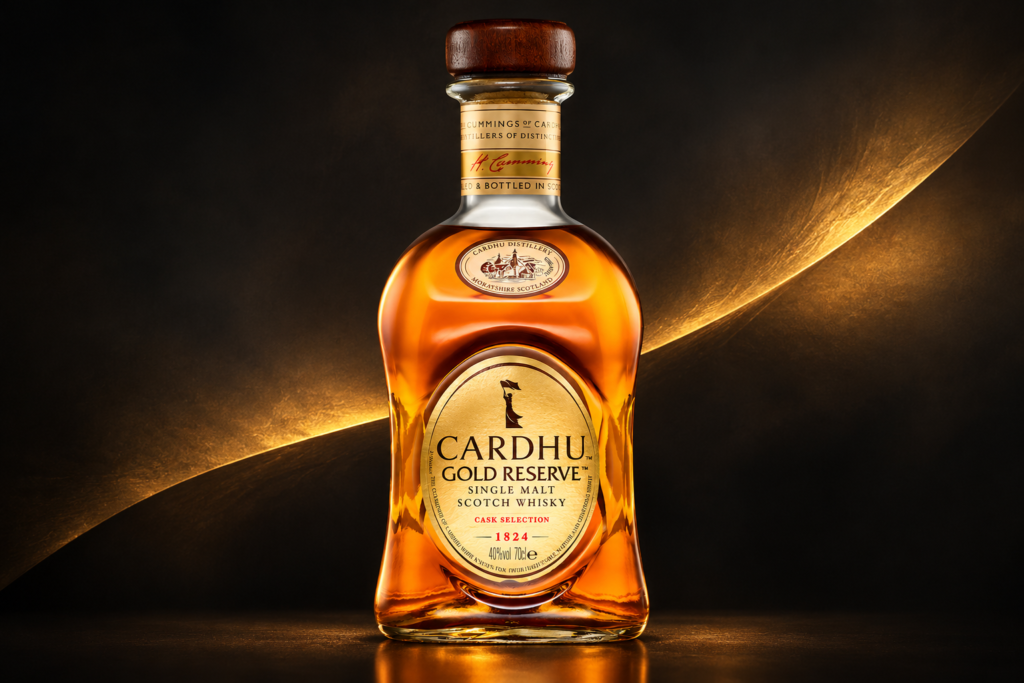
Cardhu Gold Reserve Review – The Beauty of Being Ordinary
I sometimes wonder whether I’ve become a little too demanding when it comes to whisky. After years of exploring independent bottlings, unusual cask maturations and increasingly obscure distilleries, it’s remarkably easy to forget that not every bottle needs to deliver an extraordinary experience. Sometimes you simply want to pour yourself a glass, sit down with a few friends and enjoy a perfectly pleasant whisky without spending the next twenty minutes trying to identify seventeen different flavours. And while that might sound rather unambitious, I think there’s something to be said for it.
Which brings me to Cardhu Gold Reserve, a whisky that I suspect very few enthusiasts would describe as particularly exciting. It’s a widely available Speyside single malt, bottled at a modest 40% ABV, without an age statement and with a flavour profile that rarely ventures beyond the familiar territory of apples, pears, honey and caramel. On paper, it has just about everything that would ordinarily make me reach for something else. And having tasted it, I can’t exactly claim that it surprised me with some hidden complexity or remarkable depth of character.
Yet I find myself appreciating it all the same. Not because it’s secretly brilliant, mind you, but because it does something that I think we occasionally undervalue in the whisky community: it makes single malt whisky approachable. Cardhu Gold Reserve is uncomplicated, affordable at around €30 in the Netherlands, and remarkably easy to drink. While I wouldn’t necessarily recommend it to someone looking for their next great whisky discovery, I can think of quite a few occasions when I would happily put a bottle on the table. And perhaps that’s worth exploring before we dismiss it as just another forgettable supermarket single malt.
Cardhu Distillery and the Importance of Keeping Things Simple
Cardhu has a rather interesting history, particularly because two women played such important roles in establishing the distillery. John and Helen Cumming began producing whisky at their farm in Speyside in 1811, initially without a licence, before John obtained one in 1824. Helen was heavily involved in the operation, and the distillery later flourished under their daughter-in-law, Elizabeth Cumming, who oversaw its expansion and eventually sold the business to John Walker & Sons in 1893.
That relationship with Johnnie Walker remains enormously important today. Cardhu has long been a significant contributor to the famous blended Scotch whisky, and its approachable, fruity character makes it particularly well suited to that role. The distillery is now owned by Diageo, and while it might not attract the same attention among enthusiasts as some of its Speyside neighbours, its influence on the wider Scotch whisky industry is difficult to overstate.
Cardhu Gold Reserve is positioned as an accessible expression within the distillery’s range, offering a slightly different interpretation of the familiar Cardhu character. Unlike the 12 Year Old, it carries no age statement, and while the whisky is matured in selected toasted oak casks, the complete maturation recipe isn’t disclosed. The emphasis is firmly on gentle fruitiness and sweetness, with the sort of approachable character that makes it particularly suitable for those taking their first steps into single malt.
There’s nothing inherently wrong with that approach, although I do think the presentation promises rather more than the whisky ultimately delivers. The distinctive bottle and attractive golden packaging give Gold Reserve a certain air of sophistication, and I can easily imagine someone picking it up as a gift without knowing very much about whisky. Fortunately, at around €30 in the Netherlands, the price is considerably more modest than the packaging might suggest, which makes the whole proposition rather easier to appreciate.
The question, of course, is whether being pleasant and affordable is enough to make a whisky worth recommending. I suppose that depends rather heavily on who you’re recommending it to.
Listen to the Review:
Tasting Notes: Cardhu Gold Reserve
Stats
- Distillery: Cardhu
- Type: Single Malt Scotch Whisky
- Age: NAS
- ABV: 40%
- Cask Type: Selected Toasted Oak Casks
- Country: Scotland
- Flavour Profile: Fruit Orchard Symphony
Cardhu Gold Reserve is bottled at 40% ABV, with added colouring and chill filtration. Its golden appearance certainly suits the name, although I wouldn’t read too much into that particular detail. With no age statement and relatively little information about the maturation beyond the use of toasted oak casks, we’ll have to let the whisky do the talking. Fortunately, it doesn’t have an enormous amount to say, so this shouldn’t take particularly long.
Nose
The first thing that comes to mind is a bowl of freshly sliced apples and pears, the sort you might find waiting on the kitchen table on a lazy Sunday afternoon. The apples are sweet and red-skinned, with just a little freshness from the peel, while the pears are wonderfully ripe, almost dripping with juice. There’s a gentle drizzle of honey over everything, accompanied by a soft vanilla sweetness that reminds me of custard before it has quite finished cooling.
A little banana begins to emerge underneath, followed by something rather comforting that reminds me of freshly baked white bread, still slightly warm and spread with a thin layer of honey. There’s also a touch of buttery toffee, a few almonds and the faintest suggestion of milk chocolate. Nothing particularly rich or indulgent, but pleasant in much the same way as discovering a forgotten Werther’s Original in your coat pocket. A little orange zest eventually brings some welcome freshness, although it never quite manages to pull the whisky away from its familiar orchard fruit.
What strikes me most is how quickly the nose reveals its intentions. There are no mysterious aromas waiting patiently to be discovered, no unexpected changes after ten minutes in the glass and certainly nothing that makes me question whether I’ve poured the right whisky. It’s sweet, fruity and thoroughly uncomplicated. I keep returning to it in the hope that something interesting might emerge, but Cardhu Gold Reserve seems perfectly content with what it has already offered. And while that makes for a rather uneventful nosing experience, I can’t deny that everything smells perfectly agreeable.
Palate
The first sip feels rather like biting into a soft, ripe red apple that’s been lightly coated in honey. There’s an immediate sweetness, accompanied by caramel and a little vanilla, before the familiar pear notes begin to appear. The fruit is considerably less expressive than on the nose, however, and rather than the juicy freshness I was hoping for, it reminds me more of the syrup left at the bottom of a tin of fruit cocktail. Pleasantly sweet, certainly, but without much of the character that made the individual fruits interesting in the first place.
A little cinnamon develops alongside something reminiscent of a lightly toasted digestive biscuit, with a faint suggestion of milk chocolate appearing towards the middle. There’s also a touch of orange peel, bringing a slightly sharper edge to the sweetness, while the oak gradually introduces a dry, woody character. Unfortunately, the texture is rather disappointing. At 40% ABV, Cardhu Gold Reserve is undeniably easy to drink, but it also feels somewhat watery, as though someone has taken a perfectly pleasant whisky and turned the volume down just a little too far.
The oak becomes more noticeable as the initial sweetness begins to fade, bringing a touch of bitterness that reminds me of almond skins and the slightly dry sensation of chewing on a wooden ice cream stick. There’s a little black pepper as well, although it never develops into anything particularly warming or substantial. Occasionally, I pick up a faint youthful sharpness that feels slightly out of place among all those soft, approachable flavours. It’s hardly aggressive, but it does make me wonder what a little more maturation, or perhaps a slightly higher bottling strength, might have brought to the experience.
And yet, despite everything I’ve just written, I find myself taking another sip without much hesitation. The flavours are familiar, the sweetness is reasonably well balanced, and nothing really gets in the way of enjoying it. It’s rather like listening to a song you’ve heard a hundred times before. You know exactly where it’s going, there are no surprises waiting around the corner, and you certainly wouldn’t call it a masterpiece. But sometimes you find yourself humming along anyway.
Finish
The finish begins with a little lingering honey and caramel, accompanied by the last traces of those sweet red apples. For a moment, there’s something reminiscent of the slightly browned edges of an apple tart, where the fruit has softened and the sugar has begun to caramelise. It’s a pleasant enough continuation of the palate, although unfortunately it doesn’t last particularly long.
The sweetness gradually gives way to dry oak, a little black pepper and the faint bitterness of almonds. There’s also something slightly herbal towards the end, almost like a weak cup of black tea that’s been left to cool, with a fleeting suggestion of cocoa powder. The flavours become increasingly faint until I’m left with little more than a gentle dryness and the memory of having tasted something sweet.
It’s a rather disappointing conclusion, if I’m being entirely fair. Just as the whisky begins to move beyond its familiar combination of fruit and caramel, it disappears altogether. There’s no lingering warmth, no particularly satisfying afterglow and certainly nothing that encourages me to spend another few minutes contemplating the experience. Then again, I suspect most people buying Cardhu Gold Reserve aren’t particularly concerned with how many minutes the finish lasts. And while I would have liked a little more persistence, there’s nothing unpleasant about the way it quietly takes its leave.
Food Pairing
With its gentle combination of apples, pears, honey and caramel, I think Cardhu Gold Reserve would work rather nicely alongside a warm apple tart. Preferably one with a little cinnamon and a scoop of vanilla ice cream, allowing the whisky’s familiar orchard fruit and sweetness to complement the dessert without either becoming particularly demanding. The buttery pastry should also bring some welcome richness to a whisky that occasionally feels a little too light for its own good.
A few pieces of milk chocolate would be another straightforward option, particularly something with a creamy character rather than an intensely bitter dark chocolate. The soft caramel notes should sit comfortably alongside the chocolate, while the whisky’s gentle oak influence might provide just enough contrast to keep things interesting. I wouldn’t reach for anything particularly intense here, because Cardhu Gold Reserve simply doesn’t have the body or flavour concentration to compete with stronger ingredients.
Although I suspect its greatest strength is that it doesn’t particularly need a food pairing. This is the sort of whisky I’d happily put on the table after dinner, allowing everyone to pour themselves a glass while the conversation continues. No elaborate tasting menu, no carefully selected accompaniments and certainly no need to explain why everyone should be detecting some obscure flavour that probably isn’t there in the first place.
Who Is Cardhu Gold Reserve For?
If you’ve spent years exploring single malt whisky and regularly find yourself reaching for cask-strength bottlings, heavily peated Islay malts or unusual independent releases, I suspect Cardhu Gold Reserve will leave you thoroughly underwhelmed. It simply doesn’t offer the depth, complexity or individuality that makes those whiskies so enjoyable, and there are plenty of alternatives worth exploring if you’re looking for something with a little more character.
But I don’t think experienced whisky enthusiasts are necessarily the intended audience here, and that’s an important distinction. Imagine having a few friends over for dinner, one of whom mentions that they’ve always been curious about single malt whisky but have never really known where to begin. You could introduce them to something wonderfully complex, of course, but there’s also a reasonable chance that an intense, high-strength whisky would be rather more intimidating than enjoyable.
Cardhu Gold Reserve offers a considerably gentler introduction. The familiar sweetness of honey, caramel and apples makes it easy to understand, while the modest bottling strength keeps everything approachable. It’s the sort of whisky someone can enjoy without feeling that they need to know anything about distillation, maturation or the differences between Scotland’s whisky-producing regions.
And at around €30 in the Netherlands, I think the price makes a rather convincing argument in its favour. There aren’t many barriers to picking up a bottle, particularly if you’re simply curious about trying your first Speyside single malt. Would I recommend spending considerably more on it? Absolutely not. But at that price, I think there’s enough enjoyment here to justify the purchase, especially when the bottle is intended for sharing rather than serious contemplation.
What Others Write
Cardhu Gold Reserve has received a rather mixed reception among whisky enthusiasts, although there seems to be considerable agreement about its fundamental character. The combination of apples, pears, honey and caramel appears frequently in tasting notes, as do observations about its light body and relatively short finish. Some drinkers appreciate its straightforward sweetness, while others find the lack of complexity rather difficult to forgive.
Over at Dramface, Dallas Mhor reviewed Cardhu Gold Reserve, awarding it 5/10. He describes a whisky that occupies the middle ground rather comfortably, while expressing frustration that a distillery with Cardhu’s history and potential doesn’t offer something more distinctive. Interestingly, he also finds reasons to prefer Gold Reserve over the distillery’s 12 Year Old, even if neither expression leaves him particularly enthusiastic.
Looking at the wider whisky community, the opinions are similarly divided. On Whiskybase, Gold Reserve has attracted plenty of scores in the seventies, with drinkers frequently praising its approachable fruitiness while criticising the thin palate and limited development. Others are considerably more positive, particularly when considering the whisky’s affordability and suitability as an everyday dram.
I find myself somewhere in the middle of those opinions. I agree with much of the criticism, particularly concerning the disappointing texture and lack of complexity, but I also think there’s a tendency to judge whiskies like this against expectations they were never really designed to meet. Cardhu Gold Reserve isn’t trying to compete with a twenty-year-old independent bottling or an intensely flavoured cask-strength release. It’s an accessible single malt intended for people who simply want something pleasant in their glass, and I think it succeeds reasonably well at that.
Verdict
Cardhu Gold Reserve is an extraordinarily average whisky, and I don’t mean that in an unnecessarily cruel way. The nose offers a perfectly pleasant combination of apples, pears, honey and vanilla, while the palate continues with caramel, gentle oak and a little spice. Unfortunately, the texture is rather thin, the flavours never develop much beyond their initial introduction, and the finish disappears before it has really had a chance to leave an impression.
There is very little here that I would describe as memorable, and I certainly wouldn’t recommend it to someone looking for an exciting or particularly characterful Speyside single malt. At a similar price, there are alternatives that offer considerably more complexity, and the modest 40% bottling strength doesn’t exactly help Cardhu Gold Reserve make a compelling case for itself among experienced whisky drinkers.
Yet I find it difficult to dislike. There’s something rather agreeable about a whisky that doesn’t demand anything from you, particularly when it comes at a price that makes sharing a bottle with friends an entirely reasonable proposition. The sweetness is pleasant, the alcohol is generally well integrated, and there’s enough familiar fruity character to make it an accessible introduction to single malt Scotch.
Would I buy it for myself when I’m in the mood to explore something interesting? Probably not. Would I happily put a bottle on the table for friends who are relatively new to whisky, knowing that they’ll likely find it approachable and enjoyable? Absolutely.
And I think that’s where Cardhu Gold Reserve deserves its appreciation. It isn’t a great whisky, nor even a particularly good one when judged purely on complexity and character. But it is a perfectly serviceable, affordable single malt that knows its audience rather well. Provided you don’t expect anything extraordinary, there’s a reasonable amount of enjoyment to be found here.
Final Thoughts
I think we sometimes make whisky unnecessarily complicated. We spend so much time discussing cask types, fermentation times, bottling strengths and the finer details of maturation that it’s easy to forget how most people actually enjoy their whisky. Not everyone wants to analyse every sip, and not every bottle needs to provide enough material for a lengthy tasting session.
Cardhu Gold Reserve reminded me of that rather effectively, although perhaps not quite in the way the distillery intended. I certainly didn’t discover anything particularly remarkable in my glass, and I doubt I’ll remember its individual flavours a few months from now. But I did enjoy drinking it, and I can easily imagine sharing a bottle with friends who are still discovering what single malt whisky has to offer.
There’s something refreshing about being able to recommend a whisky without pretending that it’s better than it actually is. Cardhu Gold Reserve has plenty of limitations, and I wouldn’t hesitate to point them out to anyone considering buying a bottle. But at around €30, for the right occasion and particularly for the right audience, I think it makes a perfectly sensible choice.
Perhaps that’s the distinction worth remembering. A whisky doesn’t have to be exceptional to be worth drinking, and an average score doesn’t necessarily mean that a bottle has nothing to offer.
Sometimes a whisky is simply a pleasant way to spend an evening with good company. And while Cardhu Gold Reserve certainly won’t be winning any awards from me, I’d be more than happy to pour another glass for someone curious about discovering single malt Scotch.
After all, everyone has to start somewhere.