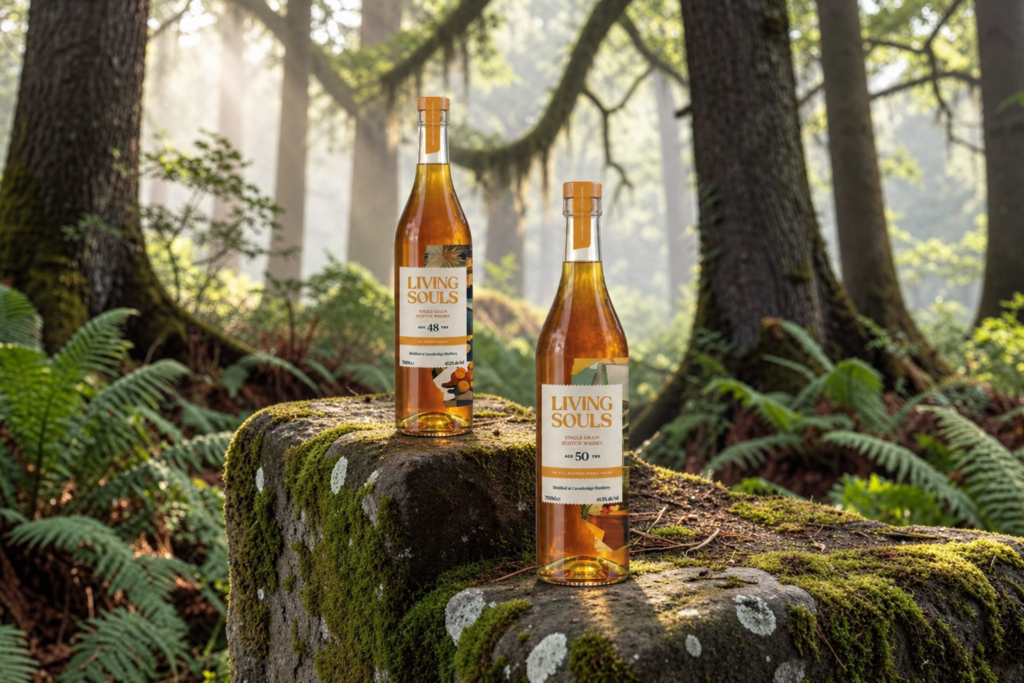
Living Souls Carsebridge 48 vs 50: Two Remarkable Old Grains, Two Years Apart and Far Less Alike Than You Might Think
There are worse things that can happen after a whisky festival than suddenly finding yourself with a 48 and 50 year old Carsebridge open on the same table. In fact, after Whisky Tasting Festival Utrecht, that was pretty much exactly the situation I found myself in. We had several brand ambassadors over at Hogshead Imports during and after WTF Utrecht, including Calum from Living Souls, who had rather conveniently brought along a bottle of their new 50 Year Old Carsebridge.
Now, I have been banging on about the Living Souls Carsebridge 48 for quite some time already. I absolutely love that whisky. There are plenty of fantastic old grain whiskies out there, but the thing that completely got me with the 48 was how little it seemed to care about being 48 years old. I remember finding all these wonderfully fresh wild peaches in it and thinking that it simply didn’t make any sense. Nearly half a century in a cask and somehow there was still this abundance of juicy, fresh fruit coming out of the glass.
So with the new 50 sitting there, I really wanted to know what another two years had done. Not because I necessarily expected it to be better – older certainly doesn’t automatically mean better in whisky – but because tasting two Carsebridges of this age side by side isn’t exactly an opportunity that presents itself every Tuesday afternoon. Out came the 48, two glasses went onto the table and what I thought might be a comparison between two fairly similar old grain whiskies turned out to be something much more interesting.
Because these two are surprisingly different. Actually, scratch surprisingly. They are really different.
And both are absolutely stunning.
Listen to this Living Souls Carsebridge 48 vs 50 Review:
A Little About Carsebridge and Living Souls
Carsebridge is one of those lost Scottish distilleries whose name has become increasingly familiar because of the incredible age of some of the stocks now appearing through independent bottlers. The distillery stood near Alloa and, after a very long history of producing grain whisky, eventually closed in 1983. That last part obviously makes bottles like these increasingly special. Nobody is quietly filling new Carsebridge casks somewhere. What is left is what is left.
Living Souls itself is a much younger name, but one that has impressed me enormously with the liquid they have been putting into bottles. Their approach isn’t particularly complicated either: find whisky they think tastes bloody good and bottle it. That might sound obvious, but in a whisky world where distillery names, age statements and collectability can occasionally become more important than what is actually in your glass, I rather like it.
And grain whisky deserves some love here as well. I know it still has that reputation among some whisky drinkers of being the cheap stuff used to bulk out blends, but spend some time with genuinely good old grain and that idea becomes increasingly difficult to defend. These two Carsebridges are rather spectacular examples of why.
Living Souls Carsebridge 48 Year Old
Stats
Distillery: Carsebridge
Bottler: Living Souls
Whisky Type: Single Grain Scotch Whisky
Age: 48 Years
ABV: 40.2%
Region: Lowlands, Scotland
Maturation: First-Fill Ex-Bourbon Barrels
Colour: Natural Colour
Chill-Filtration: No
Flavour Profile: Fruit Orchard Symphony
Nose
This is exactly where I fell for the 48 the first time around and, putting it next to the 50, I was immediately reminded why. Peaches. Loads and loads of peaches. And not peach syrup, peach yoghurt or those slightly sad peach slices you find floating around in a tin. These are fresh wild peaches, slightly tart around the skin, incredibly juicy and almost ridiculously vibrant considering we’re talking about a whisky that spent 48 years in oak.
Once I finally manage to drag myself away from those peaches, there is plenty more fruit underneath. Apricots, pineapple, orange oil and perhaps a little green mango, followed by runny honey, vanilla custard and buttery pastry. There is coconut too, and with time the oak finally begins to show itself with polished wood and a slightly dusty vanilla note, but it never takes control. That’s the part I find so fascinating. If somebody poured this blind and told me afterwards that it was 48 years old, I’m not entirely sure I would believe them.
Palate
The palate continues exactly where the nose left off, although it becomes creamier and sweeter here. Peach and apricot come first, followed by pineapple, mandarin and vanilla custard, with honeycomb and coconut cream underneath. There is something here that reminds me a little of those really good old-fashioned fruit tarts where the pastry has soaked up some of the juices from the fruit. Sweet, buttery and fruity all at once.
What it doesn’t have is that sour, slightly tired character that can sometimes creep into very old grain whisky. Nor does the oak suddenly arrive with a baseball bat after all those years in the cask. There is some dryness, obviously, and you get vanilla, coconut, a little pencil shaving and gentle wood spice towards the back, but everything remains remarkably soft.
And I keep coming back to the fruit. I know I’m repeating myself, but honestly, 48-year-old whisky should not have this much fresh peach in it. It just shouldn’t.
Finish
The finish isn’t enormous, which at 40.2% isn’t exactly shocking, but it lasts considerably longer than I expected. Peach skin and honey slowly make way for vanilla, toasted coconut, orange zest and gentle old oak. Eventually it becomes drier and slightly more tannic, but that fruit hangs around stubbornly for quite some time.
Food Pairing
I’d keep the food pairing fairly light here because I wouldn’t want to bury what makes this whisky so enjoyable. Grilled peaches with mascarpone, toasted almonds and just a little honey would probably be fantastic, although I realise pairing a peach-heavy whisky with actual peaches isn’t exactly revolutionary thinking.
A warm tarte tatin would be another option. The caramelised fruit, pastry and vanilla should work beautifully with the sweeter bourbon-cask notes without overwhelming the whisky.
Who Is This Whisky For?
If you’re one of those people who still dismisses grain whisky because it isn’t single malt, I genuinely want you to try something like this blind. Forget the category, forget the distillery and forget the age for a moment and just drink it. There is so much flavour here, and more importantly there is personality.
Bourbon drinkers should find plenty to enjoy as well. The vanilla, coconut, honey and American oak will all feel familiar, but 48 years of maturation have taken those flavours somewhere completely different. This isn’t a whisky that impresses me because it is old. It impresses me because after all those years it somehow still tastes so alive.
Verdict
Strengths: The freshness is frankly ridiculous for the age, with those wild peaches being the absolute star for me. The oak is beautifully integrated and there is none of the sourness or tired woodiness that can sometimes appear in very old grain whisky.
Weaknesses: At 40.2% it obviously doesn’t have enormous power or weight, and if you specifically want that dusty, deeply tannic old-whisky character, this might actually taste younger than you expect from something with 48 years on the label.
Living Souls Carsebridge 50 Year Old
Stats
Distillery: Carsebridge
Bottler: Living Souls
Whisky Type: Single Grain Scotch Whisky
Age: 50 Years
ABV: 40.3%
Region: Lowlands, Scotland
Maturation: Bourbon Casks / First-Fill Bourbon Finish
Colour: Natural Colour
Chill-Filtration: No
Flavour Profile: Oak & Ember
Nose
This is where the comparison suddenly becomes really interesting, because I expected a fairly obvious family resemblance and instead the 50 immediately heads off in another direction. There is still fruit, certainly, with mandarin, baked peach, orange blossom and dried apricot, but it feels darker and more mature from the start. The fruit isn’t jumping out of the glass anymore; it is woven into everything else.
There’s dark chocolate, walnut, polished oak and freshly made espresso, alongside orange oil and something slightly leathery. Give it longer and I start finding vanilla fudge, butter biscuits and a lovely cardamom note. There is also that difficult-to-describe character I associate with genuinely old whisky: polished wood, old cupboards, dried citrus and this slightly waxy, dusty sweetness that sounds horrible when you write it down but can be absolutely gorgeous in a glass.
It is immediately obvious that this is the more complex nose of the two. I probably spent twice as long smelling it, because every time I went back something seemed to have shifted around. The fruit would suddenly become more prominent again, then the espresso returned, then orange peel, then old oak. This one wants a bit of your time.
Palate
The palate is richer and considerably more structured than the 48. Mandarin and peach are still there, but they are riper now, almost cooked, and surrounded by vanilla fudge, toasted coconut and brown butter. Then come the darker flavours: proper bitter dark chocolate, espresso, walnut skin, burnt caramel and cinnamon bark, with increasingly noticeable oak tannins wrapping themselves around everything.
I really like what the oak does here. Fifty years is an absurdly long time for spirit and wood to be stuck together and yet this hasn’t crossed into that territory where you’re basically licking an antique table. It gets close enough for me to make that comparison, admittedly, but there is still enough fruit and sweetness to keep everything balanced. Orange oil in particular keeps popping back up between the darker chocolate and coffee notes, while somewhere underneath I occasionally find a little peach again.
Compared directly with the 48, this feels much more like an old whisky. There is considerably more depth, more oak influence and probably more to discover if you’re willing to sit with the glass for an hour. It’s not as immediately charming, but there is an awful lot going on.
Finish
The finish is long and increasingly dry, with espresso, bitter chocolate and orange peel slowly giving way to toasted coconut, walnut and mature oak tannins. There is still a trace of fruit underneath, particularly peach and mandarin, although by this stage the darker flavours have very much taken over.
Food Pairing
This one can handle something considerably richer than the 48. I’d happily put it alongside a dark chocolate tart with some orange zest, particularly if you’re using properly bitter chocolate rather than something overly sweet. The espresso and chocolate notes in the whisky are practically asking for it.
A properly aged Gouda could be great too. The nuttiness and little crystalline bursts in an old cheese should work nicely with the walnut and oak, while the sweeter caramel notes could draw some of the fruit back out.
Who Is This Whisky For?
This is probably the Carsebridge I’d pour for somebody who loves the character of genuinely old whisky. Not because 50 looks impressive on the label – although, come on, it does – but because you can actually taste that age here. There is polished oak, coffee, dark chocolate, dried citrus, spice and tannin, and it keeps changing in the glass.
It is also perhaps the whisky that makes the stronger intellectual argument for very old grain. There’s enough complexity here to keep you busy for ages and absolutely nothing about it feels like the lesser cousin of single malt. If you’re prepared to give grain whisky a fair chance, there is some seriously impressive liquid hiding in this category.
Verdict
Strengths: Far more complex than I expected, with gorgeous layers of espresso, dark chocolate, mature oak, citrus and fruit. It actually gives you that wonderful old-whisky character while somehow avoiding becoming completely dominated by wood.
Weaknesses: The tannins are noticeably deeper and the fruit isn’t nearly as exuberant as it is in the 48. If freshness and immediate drinkability are what you’re after, this requires more work.
Head-to-Head: Living Souls Carsebridge 48 vs 50
We had been happily going backwards and forwards between the two when my good friend and fellow whisky writer Thijs Klaverstijn from Words of Whisky joined in. Thijs isn’t exactly known for being the world’s greatest grain whisky cheerleader, and he freely admitted that old grain generally isn’t what gets him particularly excited either. I told him he really ought to try these two before writing them off, and when I spoke to him again afterwards he had to admit that, yes, these were very good indeed. I enjoyed that perhaps slightly more than I should have.
What makes the comparison so much fun, though, is that neither feels like a slightly older or younger version of the other. If I tasted them without knowing the details, I’m not convinced I would immediately place them as whiskies separated by only two years. The 48 is bright, fruity and almost stupidly youthful, while the 50 leans much further into everything I normally associate with seriously mature whisky.
The 48 throws those peaches at you almost immediately, followed by apricot, pineapple, honey, vanilla and coconut. It is ridiculously easy to drink and has this freshness that I still don’t entirely understand. The 50 asks considerably more of you. You get the fruit, but it sits between dark chocolate, espresso, dried citrus, walnut and old oak, with deeper tannins and flavours that seem to move around every time you return to the glass.
If we’re judging purely on complexity, I think the 50 takes it. Actually, I’m fairly certain it does. There is simply more happening in the glass and I could happily spend an evening pulling it apart. But complexity isn’t the only reason I drink whisky, and that’s where choosing between these two becomes rather difficult.
Final Thoughts: So Which Carsebridge Wins?
I tried not to decide too quickly. Then I tried them again. Then, purely in the interests of responsible whisky journalism of course, I tried them again. The annoying thing is that the 50 probably does more things. It has more depth, more obvious maturity and more of those flavours that make drinking genuinely old whisky such a fascinating experience. Dark chocolate, espresso, orange peel, old oak, tannins, fruit… there’s a lot going on, and I really do think it is an absolutely stunning grain whisky.
But I’m still picking the Living Souls Carsebridge 48 Year Old.
There. I’ve said it.
And perhaps I’m being slightly irrational here, because if I sat down with a scoring sheet and started awarding points for complexity, depth and development, there’s every chance the 50 would come out on top. But I don’t drink whisky with a bloody spreadsheet next to me. I drink it because every now and then something comes out of a glass that makes me genuinely excited, and those ridiculous wild peaches in the 48 do exactly that.
Forty-eight years in oak and it tastes that fresh. I can’t get over it. I’ve tried.
The 50 is darker, deeper and more complex, and probably does a better job of showing you just how beautiful properly aged grain whisky can become. The 48, however, has that one slightly bonkers characteristic that I can’t stop thinking about, and apparently two extra years of maturity, dark chocolate and espresso weren’t quite enough to knock it off its perch.
So the 48 wins this one for me. Barely. But left or right, both are stunning expressions!