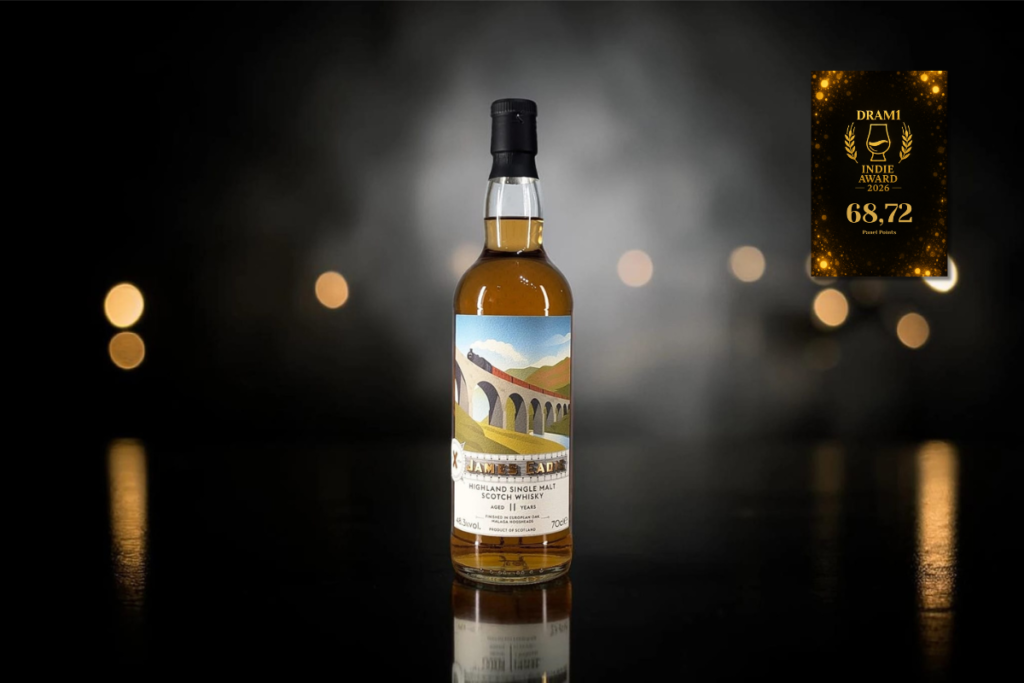
James Eadie Teaninich 11 Year Old Review | DRAM1 Indie Awards 2026
The first whisky of any blind tasting competition occupies a unique position. It arrives before expectations have formed, before comparisons begin and before anyone in the room has a sense of where the overall standard might land. Every panellist starts with a clean slate, and every note scribbled onto the tasting sheet becomes part of the benchmark for everything that follows.
That was the challenge facing this James Eadie Teaninich 11 Year Old, which appeared as Whisky #1 in Set 1 during the DRAM1 Indie Awards 2026. Long before anyone knew it was a Malaga-finished Teaninich bottled by James Eadie, it was simply the first anonymous sample poured for the panel. No distillery reputation. No cask story. No indication of age or price. Just a glass of whisky and a room full of enthusiasts trying to work out what they were experiencing.
Before diving into the notes, it is worth mentioning that everything below comes directly from the DRAM1 Indie Awards tasting panel. These are not my own tasting notes. Every aroma, flavour and comment has been gathered from panellists who assessed this whisky completely blind, without knowing anything about the bottle behind the sample.
Tasting Notes: James Eadie Teaninich 11 Year Old
Stats
- Distillery: Teaninich
- Bottler: James Eadie
- Age: 11 Years Old
- ABV: 48.3% (96.6 Proof)
- Region: Highland
- Flavour Profile: Fruit Orchard Symphony
- Chill-Filtration: No
- Colouring: No
- Cask Type: Finished in European Oak Malaga
Nose
The first impression emerging from the tasting sheets is one of freshness. While individual notes varied, a clear orchard fruit character seemed to run through much of the panel’s feedback, with apples, pears and citrus fruits appearing again and again alongside honey, vanilla and gentle malt sweetness. Several tasters found a floral quality hovering above the glass, while others were drawn towards richer notes of raisins, brown sugar and red fruit that hinted at a sweeter cask influence lurking beneath the surface.
What makes the nose particularly interesting is how differently it presented itself depending on the person holding the glass. Some panellists immediately connected with the fruit-forward profile, finding layers of sweetness and freshness that encouraged further exploration. Others took a little longer to get there, initially encountering slightly chemical notes before the whisky settled into something softer and more inviting. By the end of the session, however, the dominant impression was of a whisky that combined orchard fruit, floral notes and sweetness in a way that felt approachable rather than demanding.
Palate
The palate continued many of the themes established on the nose, although it also revealed why the whisky generated such a broad range of reactions across the room. Citrus fruits featured heavily throughout the notes, often joined by green apples, pears and flashes of red fruit. Vanilla appeared regularly, accompanied by honey, toffee and gentle oak influence that added structure without overwhelming the spirit.
As the discussion unfolded, several panellists began reaching for dessert-inspired comparisons. One found stewed pears, apple pie and whipped cream, while others mentioned shortbread, coconut and soft baking spices. Looking back after the reveal, it becomes easier to understand where some of those flavours may have originated. The Malaga finish had remained hidden throughout judging, yet many of the sweeter notes recorded by the panel seem entirely consistent with that style of maturation.
What stands out most when reading the comments is how often words such as “balanced”, “pleasant” and “easy-drinking” appear. One participant described it as a good daily drinker, while another simply noted that it was “lekker, middle of the road.” Neither comment was intended as criticism. Instead, they reflected a whisky that delivered enjoyment without demanding attention. The panel generally liked what they found in the glass, but there was also a recurring feeling that the whisky stopped just short of providing the moment that would elevate it from enjoyable to memorable.
Finish
The finish rarely became the centre of attention, which perhaps tells its own story. While some panellists found lingering vanilla sweetness, light fruit and gentle oak spice, the conversation tended to return to the nose and palate rather than what happened after swallowing. Several notes suggested a relatively short finish, with the whisky delivering its strongest impressions earlier in the experience.
That is not necessarily a flaw. Not every whisky needs a long, dramatic conclusion to be enjoyable. In this case, however, the finish reinforced the wider feeling that this was a dram built around accessibility and balance rather than power or intensity. The fruit remained present, the sweetness lingered briefly and the whisky exited the stage without making too much noise about it.
Verdict
The tasting sheets tell a remarkably consistent story.
Nobody disliked this whisky.
That may sound like faint praise, but in a room full of whisky enthusiasts tasting completely blind, it is actually quite an achievement. The panel repeatedly returned to the same themes throughout the session. Fresh fruit. Honey. Vanilla. Citrus. Balance. Again and again, tasters described a whisky that was enjoyable, approachable and well put together, even if it never fully captured the spotlight.
What the whisky earned in respect, it perhaps lacked in excitement. There were very few serious criticisms, but there was also a noticeable absence of the sort of enthusiastic comments that tend to accompany the highest-scoring bottles. Instead, the reaction was one of quiet appreciation. This was a whisky people enjoyed drinking, but not necessarily one that left them desperate to uncover the identity hidden behind sample number one.
When the scores were finally counted, the whisky achieved 68.72 points in the DRAM1 Indie Awards 2026. On its own, that represents a respectable result in a field filled with independently bottled whiskies competing under completely blind conditions. The more interesting story emerges when that figure is compared with its broader reputation among whisky enthusiasts.
At the time of writing, this bottling holds an average score of 85.29 points on Whiskybase, creating a significant gap between the public rating and the result achieved during the DRAM1 competition. Rather than suggesting one score is more accurate than the other, the difference highlights one of the most fascinating aspects of blind tasting. Once distillery names, bottler reputations, cask descriptions and price tags disappear, tasters often become far more difficult to impress.
That pattern appeared repeatedly throughout the DRAM1 Indie Awards. Bottles carrying impressive reputations frequently received more modest scores once the labels were removed, not because they were poor whiskies, but because they were being judged entirely on the experience they delivered in the glass. This Teaninich was no exception. The panel had no idea they were drinking a Malaga-finished James Eadie bottling carrying an 85-point Whiskybase average. They simply judged what was in front of them.
Looking back after the reveal, the result makes perfect sense. The Malaga finish contributed sweetness and fruit without overwhelming Teaninich’s naturally bright spirit character, creating a whisky that was easy to enjoy and difficult to dislike. What it did not do was dominate the room or force itself into the conversation.
DRAM1 Indie Awards 2026 Ranking
Whisky #1 – Set 1
Official DRAM1 Indie Awards Score: 68.72 Points
Final Thoughts
As the opening whisky of the DRAM1 Indie Awards 2026, this James Eadie Teaninich 11 Year Old had the unenviable task of setting the initial benchmark for the competition. Looking through the tasting sheets afterwards, it is difficult to argue that it failed in that role. The panel found plenty to enjoy, uncovering layers of orchard fruit, honey, vanilla and gentle sweetness that made for an approachable and thoroughly drinkable dram.
Perhaps the most revealing aspect of this whisky’s performance is not found in any individual tasting note, but in the contrast between its DRAM1 score and its Whiskybase rating. Together, those numbers tell a story about how differently whisky can be perceived once reputation is removed from the equation. Blind tasting does not necessarily produce the “correct” answer, but it often produces an honest one.
For the DRAM1 panel, this Teaninich was a good whisky. A balanced whisky. A whisky that many people would happily pour again. It simply wasn’t a whisky that demanded the room’s attention.
And sometimes that distinction is exactly what blind tasting is designed to uncover.