Dornoch Distillery Spotlight: Two Brothers, an Old Fire Station and the Whisky That Time Forgot
There is a particular kind of madness involved in opening a whisky distillery. You spend an extraordinary amount of money on equipment, ingredients and buildings, produce something you cannot legally sell as whisky for at least three years, and then hope that people will enjoy drinking it. Most sensible business owners would probably run screaming in the opposite direction. Simon and Phil Thompson, however, decided that the process wasn’t quite complicated enough. They wanted to use barley that modern distillers had largely abandoned, ferment their wash for an entire week and squeeze the whole operation into a Victorian fire station. Apparently, making whisky the conventional way would have been far too straightforward.
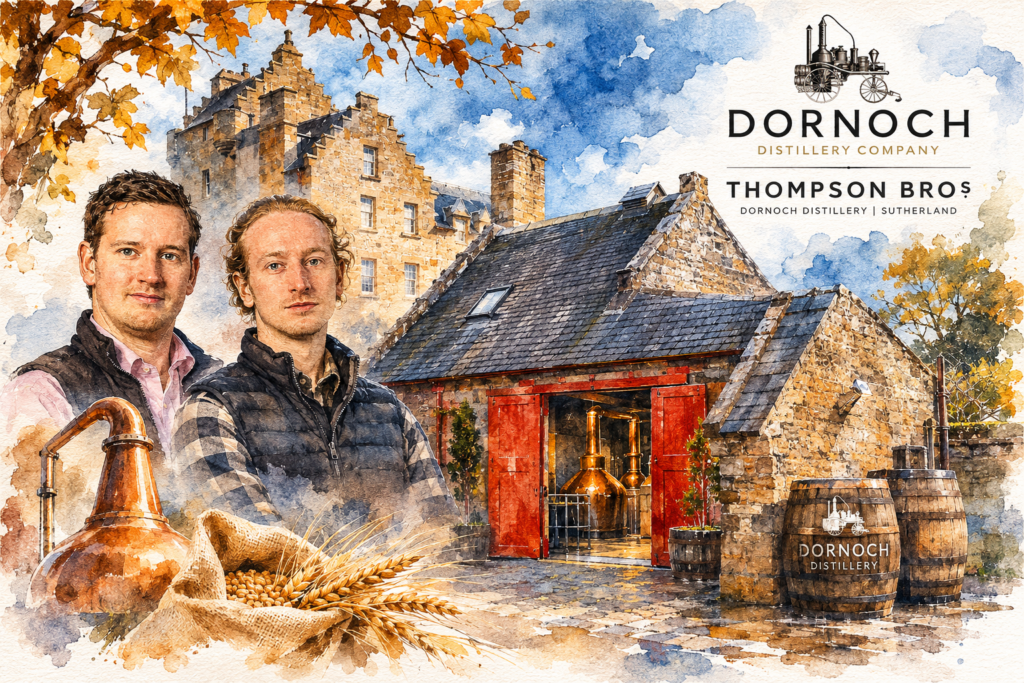
Hidden within the grounds of Dornoch Castle Hotel, in the northern Scottish Highlands, Dornoch Distillery is one of the more fascinating small distilleries to emerge in Scotland over the past decade. Not because it produces enormous quantities of whisky, or because somebody has constructed an architectural masterpiece overlooking a particularly photogenic loch. Quite the opposite. Dornoch is tiny, deliberately inefficient and built around an almost obsessive interest in the way Scotch whisky used to be made. And I find that rather appealing.
I have always been fascinated by old whisky, particularly those bottles from the 1960s and earlier that occasionally seem to possess flavours you rarely encounter in modern releases. There’s a particular combination of oily texture, waxiness, deep fruit and almost savoury complexity that can make an old Highland malt feel like an entirely different animal. It is tempting to conclude that whisky was simply better back then, although I suspect that’s partly because nobody is particularly interested in preserving fifty-year-old bottles of mediocre whisky for future generations to admire. Nevertheless, there is a legitimate question hiding beneath all that nostalgia. Has the Scotch whisky industry’s relentless pursuit of efficiency changed the flavour of the spirit itself? And if it has, could some of those older characteristics be brought back?
The Thompson brothers have spent years trying to find out. Their little distillery has become something of a working experiment in historical whisky production, using heritage barley, unusual yeast cultures, exceptionally long fermentations and directly heated copper stills to pursue a style of spirit that has largely disappeared from mainstream Scotch whisky. Now, in 2026, the brothers are preparing for their biggest challenge yet. Their ambitious Struie Distillery project promises to increase production more than tenfold, transforming what began as a wonderfully impractical experiment into a considerably larger whisky business. Which raises a rather delicious question: can a distillery built around being deliberately inefficient survive becoming successful?
Before we get to that, however, we need to visit the place where Simon and Phil first developed their obsession. And unlike most distillery stories, this one begins with a rather extraordinary whisky bar.
Growing Up Surrounded by Whisky History
The Thompson family’s connection to Dornoch Castle began in 2000, when Colin and Ros Thompson purchased the historic property and continued operating it as a hotel. For their sons, Simon and Phil, the castle would become something rather more important than a family business. It was effectively their whisky education, and I struggle to imagine a more entertaining classroom. Over the years, the brothers helped transform the hotel’s whisky bar into an internationally respected destination, developing a collection particularly renowned for old and rare bottlings. Whisky enthusiasts travelled to Dornoch not merely to spend a night in a Highland castle, but to explore bottles that offered a glimpse into an entirely different era of Scotch whisky production.
Consider what that means for a moment. Most of us discover whisky through whatever happens to be available at our local retailer, gradually developing preferences and occasionally treating ourselves to something special. The Thompson brothers had the opportunity to explore whiskies distilled decades before they were born, comparing different production eras, distillery styles and maturation approaches. That sort of experience can do terrible things to your expectations. Once you’ve tasted a truly exceptional old whisky, it becomes rather difficult to accept that every modern expression is automatically superior simply because its production has been optimised. You start asking questions. Why does this whisky feel so oily? Where does that extraordinary tropical fruit character come from? Why does the spirit seem to have so much personality before you even begin considering the cask?
In a fascinating Whisky Magazine interview with the Thompson brothers, Phil produced a bottle of Dalmore distilled in the 1920s while discussing the whisky styles that inspired them. I think that tells you practically everything you need to know about the sort of education these two have enjoyed. When your reference point for whisky production includes Dalmore from the 1920s, you’re probably not going to be particularly impressed by a distillery boasting about squeezing another half a litre of alcohol out of a tonne of barley.
Eventually, tasting the past wasn’t enough. The brothers wanted to understand how those flavours had been created in the first place. They established their independent bottling business in 2013, initially under the Black Isle Whisky Company name, but the ambition to make their own whisky was already developing. In 2015, planning permission was granted to convert an old fire station in the grounds of Dornoch Castle into a distillery. A successful crowdfunding campaign followed in 2016, supported by whisky enthusiasts who evidently thought the idea was just mad enough to be interesting. Whisky production began in 2017, and Dornoch Distillery was born.
And the building was barely big enough to accommodate it.
The Little Fire Station That Became a Whisky Distillery
There are small distilleries, and then there is Dornoch. The original distillery occupies a former fire station dating back to the 1880s, with a working area of approximately 47 square metres. That’s roughly the size of a modest apartment, except instead of a kitchen, sofa and somewhere to keep your shoes, the Thompson brothers somehow managed to install a mash tun, wooden washbacks and copper pot stills. It is a magnificent exercise in making do with what you’ve got, and perhaps the perfect setting for two brothers who never intended to follow the conventional whisky industry playbook.
The equipment is compact, the operation is hands-on and there is very little room for anything that doesn’t contribute directly to production. There are no enormous stainless steel fermentation vessels or computer-controlled production systems designed to maximise output. Everything happens on a scale where the distillers can remain intimately involved with the process. According to the distillery’s own figures, the original operation has produced approximately 12,000 litres of spirit annually. Some of Scotland’s largest distilleries produce millions of litres every year, which puts Dornoch’s output into rather amusing perspective.
But here’s the thing. Simon and Phil never set out to compete with those distilleries on volume. Their objective was to investigate how whisky used to be made, particularly during the period when some of their favourite historical bottlings were distilled. They wanted to experiment with ingredients and production methods that had become less common as the industry modernised, even if those choices came at a substantial cost. Heritage barley can be more expensive and less productive, long fermentations occupy equipment that could otherwise be producing additional batches, and slow distillation reduces throughput. At this scale, practically everything becomes more expensive.
In an interview with Drampath, Simon Thompson discussed just how poorly Dornoch performs when measured against conventional production efficiency. Low yields, high costs and lengthy production times are hardly the ingredients of a particularly attractive spreadsheet, but the brothers believe those sacrifices contribute to the character of their spirit. I rather love that attitude. Most distilleries spend considerable effort explaining how sophisticated and efficient their operations have become, while Dornoch seems almost proud of doing things the difficult way.
Of course, there is an important distinction between inefficiency and incompetence. The brothers aren’t wasting time and resources because they don’t understand how distillation works. They’re deliberately making choices that sacrifice yield in pursuit of a particular flavour profile. Whether those sacrifices are always justified is another question entirely, but at least they have a reason for making them. And that reason begins with something most whisky drinkers barely think about: barley.
Heritage Barley: The Ingredient We Forgot to Talk About
Whisky enthusiasts can spend an entire evening debating the merits of first-fill bourbon versus refill sherry casks. Mention an STR finish and everybody suddenly has an opinion. Ask about the barley variety used to make the whisky, however, and the conversation tends to become considerably quieter. Which is a little strange when you consider that barley is one of the fundamental ingredients of single malt Scotch whisky.
Modern distilling barley is generally selected for its agricultural performance, consistency and ability to produce large quantities of fermentable sugars. High alcohol yield is commercially attractive, and understandably so. If you’re producing millions of litres of spirit annually, relatively small improvements in efficiency can translate into substantial financial savings. But the Thompson brothers began wondering whether something had been lost as older barley varieties disappeared from mainstream production, particularly when it came to the texture and character of the spirit.
At Dornoch, they have experimented with heritage varieties including Plumage Archer, Chevalier, Scotch Annat, Hana and Bere. These grains represent different periods of barley cultivation, with some associated with whisky production long before modern high-yield varieties became dominant. Plumage Archer is particularly interesting. Developed in the early twentieth century, it became an important British malting barley before gradually being replaced by more productive alternatives. For the brothers, working with these grains offers an opportunity to investigate whether the raw materials used in older whisky production contributed to the distinctive characteristics they admire.
Now, I don’t believe for a moment that older barley automatically produces better whisky. That would be far too convenient, and whisky has never been particularly interested in making life easy for us. If simply using an old grain variety guaranteed magnificent spirit, everybody would be doing it. Nevertheless, different barley varieties have different compositions, and those differences can influence fermentation and the character of the resulting spirit. Proteins, lipids and other compounds may affect flavour development and texture, although the precise relationship between barley variety and mature whisky remains complicated.
The brothers are particularly interested in mouthfeel. During their experiments, they reported noticeable differences between spirits produced from heritage and modern barley varieties, with one trial involving a modern variety apparently producing a thinner spirit than their usual distillate. That immediately caught my attention, because I have a particular weakness for whiskies with a substantial, almost waxy texture. Clynelish is an obvious example, but you encounter that same fascination with mouthfeel in certain older Highland malts, where the spirit seems to coat the tongue rather than simply passing over it.
We often describe whisky as though it were a collection of flavours floating around in a glass. Apples, vanilla, raisins, tropical fruit, smoke. But texture is an enormous part of the experience. A whisky can smell absolutely wonderful and still feel disappointingly thin on the palate, while another might initially appear relatively restrained before revealing a magnificent oily weight. Dornoch is attempting to investigate whether some of those characteristics can be encouraged through the choice of grain itself. And rather than stopping there, the brothers then give that grain an extraordinarily long time to ferment.
Seven Days of Fermentation: Because Apparently Three Isn’t Enough
Fermentation is one of those stages of whisky production that rarely receives the attention it deserves. Everybody loves the still house. Copper is beautiful, distillation sounds wonderfully mysterious and there is something inherently romantic about watching clear spirit trickle from a spirit safe. Fermentation, meanwhile, involves large wooden or stainless steel vessels full of bubbling liquid that smells rather like a brewery. Not exactly the stuff of glamorous whisky advertisements, but it is where an enormous amount of flavour development begins, and Dornoch takes it very seriously indeed.
At many Scotch whisky distilleries, fermentation lasts somewhere between two and four days, although practices vary. Dornoch routinely allows its wash to ferment for a minimum of 168 hours. Seven full days in which the washbacks remain occupied while a more efficiency-minded distillery might have produced several batches. I suspect that somewhere, an accountant is experiencing physical discomfort just reading about it.
The distillery uses open-topped Eastern European oak washbacks and a variety of yeast cultures, including brewing yeasts and strains propagated in-house. Rather than relying exclusively on standardised distilling yeast, the brothers explore how different microorganisms influence the resulting wash. During fermentation, yeast converts sugars into alcohol while producing numerous secondary compounds that contribute to flavour and aroma. As yeast activity slows, bacteria can become increasingly influential, generating acids and other compounds that may subsequently contribute to ester formation. Esters are particularly interesting because many are associated with fruity aromas, contributing impressions of apples, pears, bananas and tropical fruit depending on the compounds involved.
Of course, this doesn’t mean leaving a washback alone for a week automatically produces a tropical fruit salad. Fermentation is considerably more complicated than that, and bacterial activity can create undesirable flavours just as easily as desirable ones. But Dornoch deliberately allows time for these interactions to develop. According to the distillery’s own explanation of its production process, the extended fermentation period is a fundamental part of its approach to flavour creation.
What fascinates me is that this is not something you can easily compensate for later with a particularly active cask. Oak can contribute sweetness, spice, tannins and an enormous range of aromas, but it cannot simply recreate every characteristic that might have developed during fermentation. The brothers are effectively investing a week in building complexity before the spirit has even reached the still. And once it does, they aren’t particularly interested in rushing that stage either.
Direct-Fired Stills and the Return of an Old Technique
Dornoch’s copper pot stills are small, directly heated and operated with an emphasis on slow distillation. Historically, direct firing was common across Scotland, with heat applied beneath the still rather than through the indirect steam systems used by many modern distilleries. As production technology developed, steam heating became increasingly popular because it offered greater control and reduced the risk of scorching. Dornoch deliberately returned to direct heating as part of its investigation into older production methods, although its equipment has evolved since the distillery first opened.
The original stills were heated using gas before being converted to direct electric heating. The distinction matters because the brothers are interested in the way concentrated heat can influence reactions within the wash, rather than simply recreating the appearance of a historical still house. Simon Thompson has discussed the potential contribution of Maillard reactions, the complex chemical processes associated with interactions between sugars and amino compounds under heat. These reactions are familiar from cooking, where they contribute to the aromas and flavours of everything from toasted bread to roasted meat.
Now, before anybody imagines Dornoch whisky tasting like a Sunday roast, the chemistry involved in distillation is rather more complicated. Direct heating doesn’t automatically produce a richer or better spirit, and the results depend on equipment design, operating conditions and the composition of the wash. Nevertheless, it is another variable the brothers consider important, alongside relatively low still charges, slow distillation and their decision to avoid anti-foaming agents. Spirit cuts are selected through sensory assessment, with the distillers evaluating which portions of the run contribute the characteristics they want to preserve.
This is where the entire Dornoch philosophy begins to make sense. The barley provides the raw material, fermentation develops a complex wash, and distillation determines which compounds make their way into the final spirit. Each stage influences the next, and the brothers are attempting to manage the entire process with flavour as the primary objective. It sounds obvious when you put it like that. Surely every distillery wants to make flavourful whisky? Of course they do, but the commercial realities of producing whisky on a large scale mean that efficiency, consistency and cost inevitably influence production decisions.
Dornoch is interesting because it deliberately places those considerations further down the list. The question, naturally, is whether the resulting whisky justifies all the trouble.
What Does Dornoch Whisky Actually Taste Like?
After all this discussion about heritage barley, bacterial activity and direct heating, we eventually arrive at the important part. The whisky. Dornoch is pursuing a spirit style associated with pronounced fruitiness, substantial texture and a certain old-fashioned weight. The brothers are particularly interested in the oily, ester-rich characteristics they admire in historical bottlings, rather than producing an exceptionally clean spirit whose personality comes primarily from maturation.
That doesn’t mean every Dornoch release tastes identical. The distillery experiments with different barley varieties, yeast cultures and maturation styles, and its single malts generally appear in very limited quantities. Depending on the particular bottling, maturation can bring forward orchard fruits, tropical notes, cereal sweetness, spice, waxiness and more savoury characteristics. But I want to be careful here. I haven’t personally tasted enough Dornoch releases to offer a definitive description of the distillery’s house style, and I would rather admit that than pretend otherwise.
What interests me most is the philosophy behind the liquid. Modern whisky marketing has become extraordinarily focused on casks. First-fill bourbon, Pedro Ximénez, oloroso, wine finishes, STR and increasingly elaborate combinations of wood dominate conversations about flavour. Sometimes it almost feels as though the distillery merely supplies the alcohol while the cooperage gets all the credit. And don’t misunderstand me. I love a good sherry cask. Give me a beautifully balanced oloroso-matured whisky and I’ll be perfectly happy for the rest of the evening.
But I also want to taste the distillery. I want to understand what makes a Clynelish different from a Ben Nevis, or why a properly characterful Campbeltown malt can remain unmistakable even after spending years in an active cask. Those differences are part of what makes whisky endlessly fascinating, and they are also why I enjoy exploring the different styles covered in DRAM1’s whisky flavour profiles. The influence of oak is enormously important, but it is only one part of the story.
Dornoch’s approach is a reminder that the spirit itself deserves at least as much attention as the wood in which it matures. And if the Thompson brothers can produce something genuinely distinctive before maturation begins, they have given themselves a rather interesting foundation on which to build.
Thompson Bros: Independent Bottling With a Personality
Before Simon and Phil Thompson became distillers, they were already deeply involved in the world of independent bottling. Their Thompson Bros label has developed a strong reputation among whisky enthusiasts for interesting cask selections, transparent presentation and releases that often favour character over familiarity. The brothers’ experience at Dornoch Castle undoubtedly helped shape their approach, with years spent exploring old and unusual whisky providing an extraordinary reference library against which to compare different distillery styles, production eras and maturation conditions.
Independent bottling, at its best, is about recognising something worth sharing. A cask doesn’t become interesting simply because it comes from a famous distillery, and an obscure name doesn’t automatically make a whisky less deserving of attention. Some of the most memorable independent releases I’ve encountered have come from producers that rarely generate much excitement through their official bottlings. That’s part of what makes the independent bottling world so entertaining. Remove the familiar packaging and carefully managed brand identity, and you’re left with the liquid itself.
The Thompson brothers seem particularly comfortable with that idea. Their bottlings are generally released without chill filtration or added colouring, and in 2024 Thompson Bros received the Online Scotch Whisky Awards’ Best Independent Bottler award. It is the sort of recognition that makes sense for a company built around selecting interesting whisky rather than simply relying on the reputation of a distillery name.
One of their more entertaining concepts is the Mystery Malt series, which attempts to remove some of the influence that branding has on our expectations. The whisky is presented in an opaque black bottle, with details such as the distillery identity and age concealed until the drinker chooses to reveal them. It’s a wonderfully mischievous idea, because we all like to believe that we judge whisky entirely on taste, but I’m not convinced any of us are quite as immune to labels as we’d like to think. Put a famous closed distillery name on a bottle and suddenly every unusual aroma becomes fascinating. Put an anonymous grain whisky in front of the same person and those characteristics might receive a rather less enthusiastic reception.
Mystery Malt challenges that tendency, encouraging drinkers to evaluate the whisky before discovering where it came from. For two brothers who built a distillery around questioning established assumptions, that seems entirely appropriate. You can explore the different businesses and projects through the official Thompson Bros website.
The Dornoch Ballot: Whisky Is Supposed to Be Drunk
One of the more irritating developments in modern whisky has been the increasingly speculative market surrounding limited releases. We’ve all seen it happen. A distillery announces a small batch, bottles disappear almost immediately, and before most enthusiasts have even had the opportunity to consider buying one, examples begin appearing on the secondary market at inflated prices. There is nothing inherently wrong with collecting whisky, of course. Some bottles are beautiful objects, and rare releases can have genuine historical significance. But I have always felt that whisky becomes considerably less interesting when its potential resale value matters more than what happens after you pull the cork.
Dornoch has attempted to address this through its ballot system. Rather than simply allowing every release to become a frantic race to the checkout, the distillery uses a structured allocation process intended to improve access for genuine enthusiasts. The exact arrangements can vary between releases, but the underlying philosophy is clear. The brothers would prefer their whisky to reach people who actually want to drink it, which is an admirable ambition in a market where some bottles seem destined to spend their entire lives being photographed, traded and occasionally admired through glass cabinets.
Naturally, no allocation system can eliminate speculation completely. Scarcity creates demand, and demand inevitably creates opportunities for resale. Nevertheless, I appreciate the effort, particularly when you consider how the distillery began. Dornoch exists partly because whisky enthusiasts supported the brothers’ ambitions through crowdfunding, taking a chance on a project that had little more to offer at the time than an unusual production philosophy and the promise of whisky several years down the line. Those supporters helped turn an old fire station into a functioning distillery, and it seems reasonable that the brothers should continue trying to make their whisky accessible to the community that helped create it.
Struie Distillery: The Problem With Being Successful
And now we arrive at the part of the Dornoch story that interests me most. For years, the Thompson brothers have operated one of Scotland’s smallest and least efficient whisky distilleries. They’ve deliberately sacrificed yield, accepted high production costs and spent extraordinary amounts of time experimenting with methods that much of the industry abandoned decades ago. And it worked. Not necessarily in the sense that they’ve proved every old production technique is superior, because that would be a ridiculous conclusion, but they have demonstrated that there is an enthusiastic audience for the sort of whisky they’re trying to make.
Which creates a rather inconvenient problem. The original fire station isn’t getting any bigger.
There is only so much spirit you can produce in a building measuring approximately 47 square metres, particularly when your preferred fermentation schedule involves occupying the washbacks for an entire week. Enter Struie Distillery, named after the Highland ridge overlooking the Dornoch Firth. Struie is the Thompson brothers’ ambitious next chapter: a much larger distillery development designed to expand production while preserving the principles behind the original operation. And when I say much larger, I really do mean it. The planned facility will have the capacity to produce approximately 400,000 litres of pure alcohol annually, more than ten times the output of the existing distillery.
For a business that began in a converted fire station, that’s an enormous leap. The project has already attracted significant support, with Highlands and Islands Enterprise announcing funding of up to £1.57 million in March 2026 towards the development of its energy-efficient infrastructure. According to The Spirits Business, the new facility is being designed around renewable energy technologies, including solar arrays, thermal energy storage and high-efficiency heat pumps. The plans also include warehousing, bottling facilities and a visitor centre expected to attract approximately 15,000 visitors annually.
What I find particularly interesting is the combination of traditional production principles and modern sustainable engineering. The brothers are trying to recover characteristics associated with historical whisky production, but they aren’t insisting that every part of the process must remain stuck in the nineteenth century. And quite right too. There is no particular virtue in wasting energy simply because somebody once heated a still by burning enormous quantities of fuel. If modern technology can reduce the environmental impact of whisky production while preserving the characteristics that make the spirit interesting, that seems like progress worth celebrating.
But Struie also raises a question that I suspect will make some Dornoch enthusiasts slightly nervous. Can the brothers preserve the character of their whisky when production increases so dramatically? And perhaps more importantly, can a distillery whose entire identity revolves around rejecting conventional efficiency become a considerably larger business without compromising the principles that made it interesting in the first place?
Can You Scale Up a Distillery Built Around Inefficiency?
This is where the Dornoch story becomes more than an entertaining tale about two whisky enthusiasts and an old fire station. The original distillery was designed around experimentation. Simon and Phil could afford to make unusual decisions, investigate different barley varieties and accept production methods that would be difficult to justify in a much larger operation. Struie changes the equation. Suddenly, the challenge isn’t simply producing a few thousand litres of distinctive spirit each year. It’s reproducing the philosophy behind that spirit on a significantly larger scale, with all the technical and commercial complications that inevitably follow.
Heritage barley needs to be sourced in much greater quantities. Extended fermentations must remain manageable within a larger production schedule. The new distillation equipment needs to preserve the characteristics the brothers have spent years trying to understand. And perhaps most importantly, the whisky still needs to taste like Dornoch. I don’t think that necessarily means reproducing the original spirit with absolute precision. Distilleries evolve, and a new facility offers opportunities for experimentation that simply weren’t possible inside the fire station. But there is a difference between developing a house style and losing it.
What makes this particularly interesting is that the brothers aren’t simply planning to copy their original production process on a larger scale. As they explained in their Whisky Magazine interview, the original distillery has served as an experimental laboratory, allowing them to identify which aspects of production are most important to the character they want to achieve. Struie is intended to apply those lessons more practically, and that strikes me as a sensible approach. There is little point in being inefficient merely for the sake of it. If the brothers can identify which production decisions genuinely contribute to flavour and which simply make life more difficult, they may be able to preserve the important characteristics without reproducing every inconvenience of the original operation.
But until the spirit is flowing and the whisky has matured, nobody can know exactly how successful that translation will be. And I rather like that uncertainty. Whisky has become an industry in which almost every new release arrives accompanied by confident marketing language explaining precisely why it is exceptional. Struie, by contrast, represents a genuinely interesting experiment whose outcome remains to be seen. The brothers have spent years asking whether old production methods can produce something modern whisky sometimes lacks. Now they’re asking whether those methods can survive the realities of modern production.
That is a story worth following.
Visiting Dornoch Distillery
Dornoch is a historic town in Sutherland, in the northern Scottish Highlands, overlooking the Dornoch Firth. The original distillery occupies the former fire station within the grounds of Dornoch Castle Hotel, close to the town centre. For whisky enthusiasts travelling through the Highlands, the castle’s whisky bar is arguably an attraction in its own right. Its reputation for old and unusual bottlings makes it a particularly appealing destination for anyone interested in exploring Scotch whisky beyond the usual core-range expressions.
The Thompson Bros bottle shop, located in Station Square, offers another opportunity to discover the brothers’ releases alongside a wider selection of spirits. The original distillery itself is not a conventional visitor attraction, however. Its limited space and working production environment mean that regular public tours are not generally available, although the development of Struie is expected to introduce new visitor facilities in the future.
Anyone planning a visit should check current arrangements through the official Thompson Bros website or Dornoch Castle Hotel. And if you do find yourself in the castle bar, I suspect it would be rather easy to lose track of time while exploring the whisky selection. Possibly also your budget.
Why Dornoch Distillery Matters
There is a tendency in whisky to romanticise the past. We talk about legendary distilleries, forgotten production methods and extraordinary old bottlings as though the industry once existed in a state of perpetual perfection before somebody came along and ruined everything with stainless steel and spreadsheets. The reality, naturally, is rather less romantic. Older whisky production was frequently inefficient, inconsistent and technically limited. Modern methods have improved quality control, safety and reliability, while allowing distillers to produce remarkable whisky on a scale that previous generations could scarcely have imagined.
But progress can involve trade-offs. When an industry becomes increasingly focused on efficiency, it is reasonable to ask whether some less productive methods might still have something valuable to offer. Not because they are old, but because they produce different results. That is the question Dornoch Distillery is attempting to answer. The Thompson brothers aren’t simply recreating historical production for the sake of nostalgia. They are investigating why certain whiskies developed particular characteristics and whether those characteristics can be encouraged through deliberate choices about ingredients, fermentation and distillation.
Sometimes those experiments may produce remarkable results. Sometimes they may reveal that a modern approach works just as well, or better. Either outcome is useful, because the important thing is the willingness to question assumptions and actually investigate the answers. In an industry where so much of the conversation revolves around packaging, age statements, limited editions and increasingly elaborate cask finishes, I find it refreshing to encounter a distillery that seems almost obsessively interested in the spirit itself.
Frequently Asked Questions About Dornoch Distillery
Where is Dornoch Distillery?
Dornoch Distillery is located in Dornoch, Sutherland, in the northern Highlands of Scotland. The original distillery occupies a converted nineteenth-century fire station within the grounds of Dornoch Castle Hotel.
Who owns Dornoch Distillery?
Dornoch Distillery was founded by brothers Simon and Phil Thompson, who are also behind the Thompson Bros independent bottling business and are closely associated with Dornoch Castle Hotel’s celebrated whisky bar.
When was Dornoch Distillery founded?
Dornoch Distillery was established in 2016 following a successful crowdfunding campaign, with whisky production beginning in 2017. The distillery occupies a former Victorian fire station in the grounds of Dornoch Castle.
What makes Dornoch Distillery different?
Dornoch focuses on old-style whisky production using heritage barley varieties, extended fermentations of at least 168 hours, wooden washbacks and directly heated copper pot stills. Its production philosophy prioritises spirit character and texture over maximum alcohol yield.
What barley does Dornoch Distillery use?
Dornoch has experimented with several heritage barley varieties, including Plumage Archer, Chevalier, Scotch Annat, Hana and Bere. The distillery believes older barley varieties can contribute distinctive characteristics to its spirit.
How long does Dornoch ferment its whisky?
Dornoch typically ferments its wash for a minimum of 168 hours, equivalent to seven days. The extended fermentation period allows additional microbial activity to contribute to flavour development.
What is Thompson Bros?
Thompson Bros is the independent bottling business operated by Simon and Phil Thompson. It releases selected whiskies and other spirits, generally without chill filtration or added colouring, and received the Online Scotch Whisky Awards’ Best Independent Bottler award in 2024.
Can you visit Dornoch Distillery?
The original distillery does not generally offer conventional public tours because of its small size. Visitors can explore the Thompson Bros bottle shop and Dornoch Castle Hotel whisky bar, while the planned Struie development is expected to offer additional visitor facilities.
Final Thoughts
I think what appeals to me most about Dornoch Distillery is that the Thompson brothers seem to have approached whisky production from the opposite direction to much of the modern industry. They didn’t begin with a business plan designed to produce a particular volume of spirit at a particular cost. They began with bottles of old whisky, a fascination with the flavours inside them and a question about whether those flavours could be created again. Everything else followed from there.
The heritage barley, the seven-day fermentations, the directly heated stills and the wonderfully impractical little fire station are all consequences of that original curiosity. None of those decisions makes much sense if your only objective is to produce whisky as efficiently as possible. But if your objective is to understand how flavour develops, they become considerably more interesting. And now, with Struie on the horizon, the brothers face a challenge that is almost the reverse of the one they started with. They have spent years proving that an exceptionally small distillery can pursue an unusually ambitious production philosophy. The next question is whether that philosophy can survive becoming something much bigger.
I hope it can. Not because I believe every distillery should abandon modern production methods and start fermenting whisky for a week. That would be ridiculous, and probably financially disastrous for quite a few of them. But because the Scotch whisky industry benefits enormously from people willing to experiment, challenge assumptions and remind us that there is more than one way to make a great dram.
Dornoch may never become a household name in the way that Macallan, Glenfiddich or Glenmorangie have. In fact, I suspect that would be rather beside the point. What Simon and Phil Thompson have created is something considerably more personal: a distillery built around their own curiosity, their own experiences and their own understanding of what makes whisky worth drinking.
It began with two brothers, an extraordinary whisky bar and a fire station that probably should have remained a fire station. Now they’re preparing to build something considerably bigger, and I find myself genuinely curious about what happens next. Not because I expect everything to go perfectly, but because the experiment is far from over.
And frankly, in a whisky industry that sometimes feels a little too predictable, that might be the most exciting thing of all.