Dubhghlas Distillery Spotlight: From the Seven Seas to Dutch Single Malt Whisky
There are distilleries born from carefully prepared business plans, market research and investors. Then there are distilleries that begin because two marine engineers spend enough nights at sea reading books about whisky to eventually think that surely they could build something like this themselves. Dubhghlas Distillery belongs very firmly in the latter category, and its wonderfully unconventional beginnings tell you a great deal about the distillery it would eventually become.
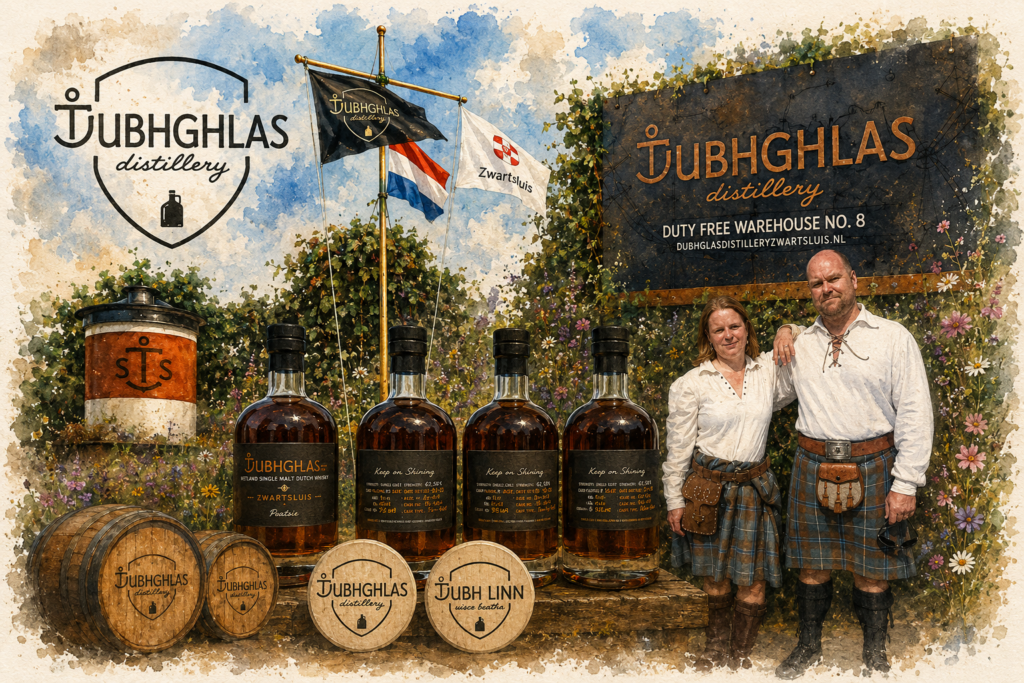
Hidden away in a large industrial shed near the docks of Zwartsluis in the Netherlands, Dubhghlas is one of the most unusual small distilleries I have visited. It is independent, unmistakably Dutch and absolutely overflowing with the personalities of the two people behind it: Cees and Laura Stravers. They also happen to be dear friends of mine, so there is inevitably a personal element to this particular Distillery Spotlight. I have followed their journey for years, tasted their new make, reviewed their rum and visited the distillery while studying for my Advanced Whisky Ambassador qualification.
More importantly, I have watched their spirit slowly grow older while waiting for the moment when Dubhghlas could finally put Dutch whisky into bottles of its own. That moment has now arrived. August 2026 marks an important milestone for this little distillery from Zwartsluis, with the arrival of its first three single malt whiskies. For DRAM1, that feels like a very good excuse to dedicate an entire week to Dubhghlas. Before opening those bottles, however, we need to tell the story of where they came from.
From the Merchant Navy to the Still House
Whisky may be the passion, but Cees and Laura’s professional lives have traditionally taken place somewhere rather wetter. Both work as chief engineers in the merchant navy, spending significant parts of the year aboard large ocean-going vessels. It means months away from home, enormous machinery, technical problem-solving and plenty of time surrounded by little other than steel and sea.
It also provided plenty of evenings for reading. Their fascination with spirits gradually developed into something considerably more serious as books about whisky, distillation and other spirits accumulated and visits to distilleries helped turn theory into something tangible. With plenty of lonely nights spent somewhere on the seven seas, there was time to disappear properly down the rabbit hole and understand not only what they enjoyed drinking, but how it was actually made.
For two engineers, simply reading about how something works was never likely to remain enough. At some point the proverbial lightbulb went on and the question changed from how do distillers make this? to why couldn’t we make this ourselves? They were already familiar with brewing, and producing a distiller’s beer wasn’t an impossible leap. The next ingredient was a still, and this is where the Dubhghlas story starts becoming wonderfully Dubhghlas.
Most people dreaming of opening a whisky distillery might start browsing manufacturers of beautiful copper pot stills. Cees and Laura went to the scrapyard, where they found an old copper Daalderop central-heating boiler and decided that, with a little engineering, it could be given a considerably more entertaining second life.
They turned it into a still.
The Dubhghlas Moonshine Years
In 2013, Cees and Laura began distilling experimentally for themselves. Dubhghlas affectionately refers to this period as its Moonshine era, and it became the laboratory in which everything they had read could finally be translated into something they could smell and taste. Their professional background obviously helped. When you spend your working life keeping the machinery of enormous ships functioning thousands of miles from home, looking at an old copper boiler and wondering how to turn it into functional distillation equipment probably feels considerably less intimidating than it would to most of us.
More importantly, the resulting spirit wasn’t bad. Before committing themselves to building an actual distillery, Cees and Laura took their experimental spirit to festivals and allowed people professionally involved in distillation to taste it. The reactions were sufficiently encouraging that what had started as an entertaining experiment began looking suspiciously like the beginnings of a proper distillery.
There was, admittedly, the small matter of becoming legal. After securing the necessary environmental permissions, they approached Dutch customs for the licences required to operate legitimately and confessed what they had been doing during their experimental years. Dubhghlas recalls the response rather wonderfully: they had now become grown-ups, they were told, so there would be no more mischief.
Work on the distillery began in 2017 in the former Schraa Watersport building in Zwartsluis, and by 2020 Dubhghlas Distillery was properly operational. What had started with books, curiosity and an old boiler from a scrapyard had turned into a licensed Dutch craft distillery.
Why the Name Dubhghlas?
Even the name connects Scotland, whisky and their Dutch home. Dubhghlas refers to dark or black water, chosen as a nod to the Zwarte Water, literally the Black Water, on which Zwartsluis is situated. The maritime connection continues throughout the company’s identity, including the anchor incorporated into its branding and the numerous seafaring references appearing on its bottles and website.
Their motto, Keep on Shining, is equally fitting. It connects their work as chief engineers with their life as distillers, two careers that might initially appear worlds apart but become increasingly difficult to separate once you have visited Dubhghlas. This isn’t merely a distillery owned by two people who happen to work at sea; it genuinely feels like a distillery that could only have been built by marine engineers.
The Most Unusual Still House in the Netherlands?
Walk into Dubhghlas and you quickly realise that comparing it to a traditional Scottish distillery isn’t particularly useful. There is no polished visitor centre or enormous glass-fronted still house constructed with tourists and Instagram photographs in mind. Instead, you enter a large working shed near the Zwartsluis docks and encounter rows of shipping containers that have been transformed into the individual working areas of the distillery.
Containers have been converted into spaces for production, storage, mashing, bottling and everything else required to turn raw ingredients into spirit. It makes practical sense from both an engineering and regulatory perspective, keeping different parts of production neatly separated while also ensuring everything that needs to remain under bond can be securely controlled. At the same time, it gives Dubhghlas an identity that perfectly suits its owners. It feels as though somebody has taken elements of life aboard a working vessel and transplanted them ashore in Zwartsluis.
Then you find the stills, and things become even more interesting. Dubhghlas’ distillation equipment is constructed using repurposed equipment rather than the traditional bespoke copper pot stills we associate with whisky production. The philosophy goes right back to that original scrapyard boiler and continues into the current distillery. Combined with the use of green electricity, there is something rather appealing about a distillery where old industrial equipment is given another life producing spirits.
What I particularly love about the setup, however, is how visible the process remains. Compared with many modern distilleries, the equipment is wonderfully bare-bones. You can follow what is happening, see how different parts of the system interact and understand the engineering behind turning fermented liquid into spirit. For anyone genuinely interested in how distillation works rather than simply admiring a pair of shiny copper stills, Dubhghlas is fascinating.
Learning Whisky at Dubhghlas
Years ago, while studying for my Advanced Whisky Ambassador qualification, I visited Dubhghlas as part of the course. It remains one of the occasions on which I learned the most about whisky production, precisely because Cees and Laura’s setup makes it possible to get so close to the mechanics of distillation.
Large modern distilleries are incredible pieces of engineering, but they can sometimes make distillation almost too elegant. Pipes disappear through walls, computer systems monitor processes and stainless steel and copper gleam around you while significant parts of what is actually happening remain hidden from sight. At Dubhghlas, much of that curtain disappears.
Cees and Laura could point towards individual components and explain precisely what was happening, where vapour was travelling, where temperatures were changing and why they had designed something in a particular way. Suddenly concepts that can seem abstract in textbooks became physical and visible. As somebody studying whisky seriously at the time, that was enormously valuable.
Perhaps it shouldn’t be surprising. These are two people whose careers revolve around understanding mechanical systems well enough to keep them operating in the middle of an ocean. Their distillery feels like an extension of that mentality: understand the process, build what you need, observe what happens and keep improving it. Dubhghlas doesn’t hide the mechanics of distillation behind polished presentation; the mechanics are part of its personality.
Far More Than a Single Malt Distillery
Calling Dubhghlas simply a Dutch single malt distillery doesn’t quite cover what Cees and Laura are doing. Spend your life travelling around the world and you inevitably encounter different drinking cultures, and their interests have never been confined to Scotch-style single malt. The production at Dubhghlas reflects that curiosity, with rum, genever, grain whisky, herbal liqueur and whisky recipes inspired by Scotland, Ireland and the United States all finding a place in Zwartsluis.
The flagship whisky is their single malt, produced in both unpeated and peated forms. Dubhghlas has experimented with different peat levels, while its releases deliberately remain small scale. Rather than chasing perfect batch-to-batch consistency, Cees and Laura want to release individual casks at cask strength, allowing differences in spirit, maturation and cask character to remain visible in the finished whisky. For whisky geeks like me, that immediately makes following the distillery considerably more interesting.
Then there is Sjaak 531, perhaps one of the best examples of Dubhghlas’ particular sense of humour. Its recipe consists of five parts corn, three parts rye and one part barley, taking obvious inspiration from the classic American bourbon tradition while putting a Dutch spin on the concept. It obviously cannot legally be bourbon, so Dubhghlas gave it a rather appropriate name instead. The Dutch name Sjaak translates rather conveniently to Jack in English, while the numbers reveal the mash bill: five, three, one. Sjaak 531. Terrible joke, excellent name.
Another particularly interesting development is Dubh Linn, under which Cees and Laura are exploring recipes inspired by Irish pot still whiskey traditions. That feels entirely logical for a distillery run by people whose whisky interests have never been confined to one country. Different grains, different mash bills and different traditions provide another playground for two engineers who clearly have very little interest in simply reproducing what everybody else is already doing.
Add grain whisky and genever to the equation and you begin to understand just how versatile this tiny operation actually is. Dubhghlas might be small, but creatively it is anything but narrow.
Rum, Herbs and a Secret Even Cees Doesn’t Know
Whisky may be their pride and joy, but some of Dubhghlas’ other spirits deserve mentioning. I previously reviewed their Merchant Navy Rum here on DRAM1, including expressions matured in first-fill Pedro Ximénez and Oloroso quarter casks. Made from sugarcane molasses, the rums impressed me precisely because Dubhghlas didn’t take the easy route of loading them with additional sweetness.
There was no added sugar trying to manufacture richness. Instead, the spirit and maturation did the talking, with those PX and Oloroso casks providing plenty of character of their own. It was another early indication for me that Cees and Laura weren’t merely interested in making spirits; they wanted to understand how the different components of production and maturation could be used to create them properly.
Then there is Laura’s herbal creation, made using fresh herbs from her own garden. The exact recipe is apparently so secret that even Cees doesn’t know it, which is probably evidence of a perfectly sensible division of responsibilities within the distillery. Between whisky, rum, grain spirits, genever and herbal liqueurs, there is always something happening at Dubhghlas.
Whisky Made by Sailors
One of the things separating Dubhghlas from many young distilleries is that the maritime connection isn’t decorative branding dreamed up after somebody commissioned a logo. It is their life, and you encounter references to it everywhere, from the containers inside the distillery to the names, stories and little jokes attached to their products.
The website is filled with what Dubhghlas calls Sailor Stories, snippets of maritime history and engineering knowledge connected to its labels and identity. Even the way Cees and Laura solve problems at the distillery seems shaped by years at sea. On a ship, you can’t simply phone somebody and expect a replacement component to arrive twenty minutes later. You understand the system in front of you, improvise when necessary and make things work with what you have available.
Dubhghlas feels built around exactly that philosophy. Nothing exists simply because whisky tradition says it should. There is usually an engineering reason, a practical solution or a personal story behind it, and that makes walking around the place infinitely more interesting than visiting a distillery that has simply copied the established template.
Single Casks, Cask Strength and a Distillery That Embraces Difference
Perhaps the most exciting part of Dubhghlas’ whisky philosophy is its commitment to individuality. The distillery intends its whisky releases to be single casks bottled at cask strength, and when you combine that with a willingness to experiment with grains, peat levels and different maturation styles, following Dubhghlas should become a journey rather than simply waiting for the next batch of an established core expression.
At this scale, there is no enormous inventory from which hundreds of barrels can be combined until every variation disappears. One cask may develop differently from the next, and rather than seeing that as a problem, Dubhghlas embraces it. Whisky is agricultural, biological and wonderfully unpredictable, and single-cask releases allow us to taste those differences rather than blending them away.
That makes the first official releases particularly exciting, because these aren’t simply the first bottles carrying a new label. They are the culmination of a story I have been fortunate enough to follow while it was still developing.
Peatsie: Dubhghlas Finally Becomes Whisky
And so we arrive in August 2026. Three years can feel remarkably short when you’re drinking whisky and remarkably long when you’re waiting for spirit to legally become it. I first wrote about Dubhghlas’ new make on DRAM1 years ago, and even then there was enough character in the spirit to make me genuinely curious about what would happen once oak and time entered the equation.
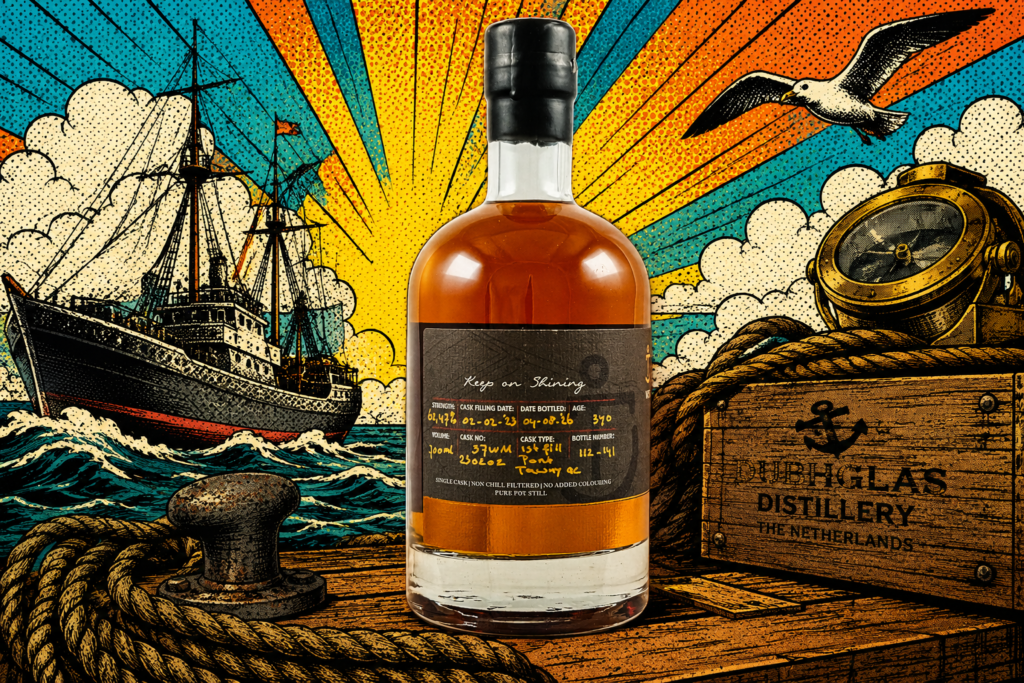
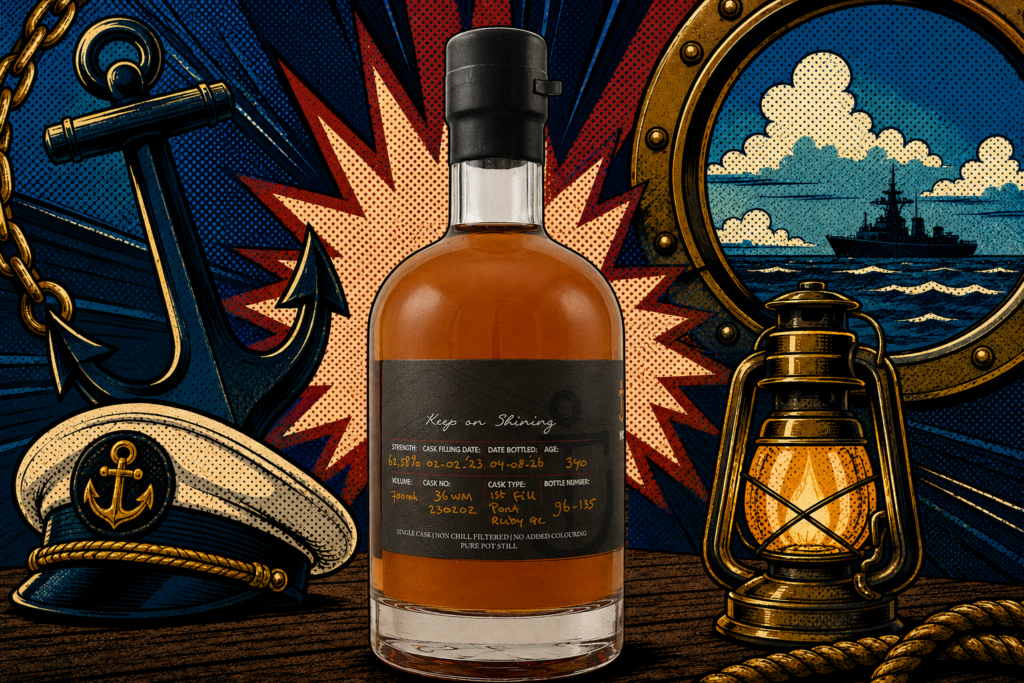
Now we know. The inaugural Peatsie whisky series consists of three peated Dutch single malt whiskies, all matured in first-fill quarter casks and bottled as individual casks at natural strength. There is a Palo Cortado Peatsie, distilled on 25 January 2023 and bottled at 62.8% ABV after maturation in a first-fill Palo Cortado quarter cask, producing just 138 bottles.
Alongside it are two whiskies distilled on 2 February 2023: a Ruby Port Peatsie and a Tawny Port Peatsie, both bottled at 62.58% ABV. The Ruby Port cask yielded 135 bottles, while the Tawny Port produced 141. Three tiny releases from a tiny Dutch distillery, but together they represent an enormous milestone for Cees and Laura.
Even here, of course, they couldn’t resist a joke. In Dutch, ietsie pietsie essentially means a tiny little bit of something. Throw a little peat into the equation and you get Peatsie. It is exactly the sort of wordplay I have come to expect from Dubhghlas, where the whisky can be taken very seriously without the people making it ever feeling the need to take themselves too seriously.
Watching a Distillery Come of Age
There is something uniquely satisfying about tasting the first whisky from a distillery whose spirit you knew before it was whisky. Normally we encounter distilleries somewhere halfway through their stories. The warehouses are already full, the house style has been established and generations of releases have shaped our expectations before we ever put a glass to our nose. With Dubhghlas, my experience has been almost the reverse.
I tasted the new make when these whiskies were still a promise. I walked around that wonderfully strange distillery and saw the shipping containers, homemade engineering and unmistakable fingerprints of Cees and Laura everywhere. I have tasted their rum, watched their experiments and seen their ideas gradually turn into bottles. Now, finally, the whisky is here.
There is obviously an added personal dimension because these aren’t anonymous distillers behind a corporate brand. Cees and Laura are dear friends. They are two wonderfully passionate people who spend months keeping enormous ships running somewhere out on the seven seas, come home to Zwartsluis and apparently decide that spending their precious time ashore relaxing would be far too sensible. Instead, they disappear into their distillery and make spirits.
That personal connection makes seeing Dubhghlas come of age particularly special, but friendship doesn’t make whisky taste good. Eventually the liquid has to justify everything that came before it. That promising new make needed to survive maturation, and those unconventional stills, strange little containers, quarter casks, experiments and years of patience eventually had to produce something worth drinking.
Having now tasted all three inaugural releases ahead of reviewing them this week, I can finally say that the spirit has lived up to the expectation. Watching a distillery come of age is a beautiful thing, but it becomes considerably more exciting when what comes out of those first casks genuinely delivers. Cees and Laura have managed exactly that.
Dubhghlas is no longer merely a promising Dutch distillery waiting for its whisky. It is a Dutch whisky distillery with bottles out in the world, and this week on DRAM1 we’re going to find out exactly what those first three bottles have to offer.
Frequently Asked Questions About Dubhghlas Distillery
Where is Dubhghlas Distillery?
Dubhghlas Distillery is located in Zwartsluis, Overijssel, in the Netherlands, close to the Zwarte Water and the town’s maritime infrastructure. Its location and the surrounding waterways play an important role in the identity of the distillery.
Who owns Dubhghlas Distillery?
Dubhghlas Distillery is run by Cees and Laura Stravers, both of whom also work as chief engineers in the merchant navy. Their engineering and maritime backgrounds heavily influence the design, philosophy and character of the distillery.
What does Dubhghlas mean?
Dubhghlas refers to dark or black water. The name was chosen as a reference to the Zwarte Water, or Black Water, beside which Zwartsluis is situated.
When was Dubhghlas Distillery founded?
Cees and Laura began experimenting with distillation in 2013 during what they now jokingly call their Moonshine period. Work on establishing the legal distillery began in 2017, and Dubhghlas became operational as a licensed distillery in 2020.
What whisky does Dubhghlas Distillery make?
Dubhghlas produces Dutch single malt whisky, including peated and unpeated spirit, alongside grain whisky and recipes inspired by American and Irish whiskey traditions. Its whisky philosophy centres around small-scale single-cask releases bottled at cask strength.
What is Dubhghlas Peatsie?
Peatsie is the name used for Dubhghlas’ first official peated single malt whisky releases. The inaugural 2026 series comprises single casks matured in Palo Cortado, Ruby Port and Tawny Port quarter casks.
What is Dubh Linn?
Dubh Linn is another direction being developed by Dubhghlas, focusing on recipes inspired by traditional Irish pot still whiskey. It demonstrates the distillery’s broader interest in different whisky-making traditions rather than concentrating exclusively on Scotch-style single malt.
Does Dubhghlas only produce whisky?
No. Alongside whisky and other grain spirits, Dubhghlas produces rum, genever and herbal spirits. This broad approach to distillation is one of the defining characteristics of the distillery.
Final Thoughts
The Dutch whisky landscape is becoming more interesting by the year, but Dubhghlas occupies its own peculiar little corner of it. There are more polished distilleries, bigger distilleries and certainly distilleries with substantially deeper pockets and considerably shinier equipment, but there aren’t many that feel quite this personal.
Dubhghlas is Cees and Laura translated into a distillery: maritime, technically minded, inventive, slightly mischievous and completely uninterested in doing something simply because that is how everybody else does it. A scrapyard boiler became a still, moonshining became a licensed distillery, shipping containers became production rooms and grain became new make. Now, after years of experimenting, building, distilling and waiting, that new make has finally become whisky.
The three Peatsie releases are only the beginning. Sjaak 531 offers a completely different interpretation of grain, Dubh Linn promises another fascinating direction inspired by Irish pot still traditions, and other casks are quietly ageing in Zwartsluis while their makers continue dividing their lives between the distillery and the sea. That makes predicting exactly what Dubhghlas will look like ten years from now virtually impossible, but it is also precisely what makes following this little distillery so much fun.
For now, though, the milestone deserves to be celebrated. Cees and Laura set out to understand how spirits were made, taught themselves to distil, built their own equipment, established a distillery and waited patiently while their spirit became whisky. I was excited by the new make when I first tasted it, and having now tasted what emerged from those first three casks, I’m even more excited about what comes next.
Welcome to Dubhghlas Distillery Week.