Remember When Lagavulin 16 Cost €120? The Whisky Market Has Changed
Quick Answer: Why Are Whisky Prices Falling?
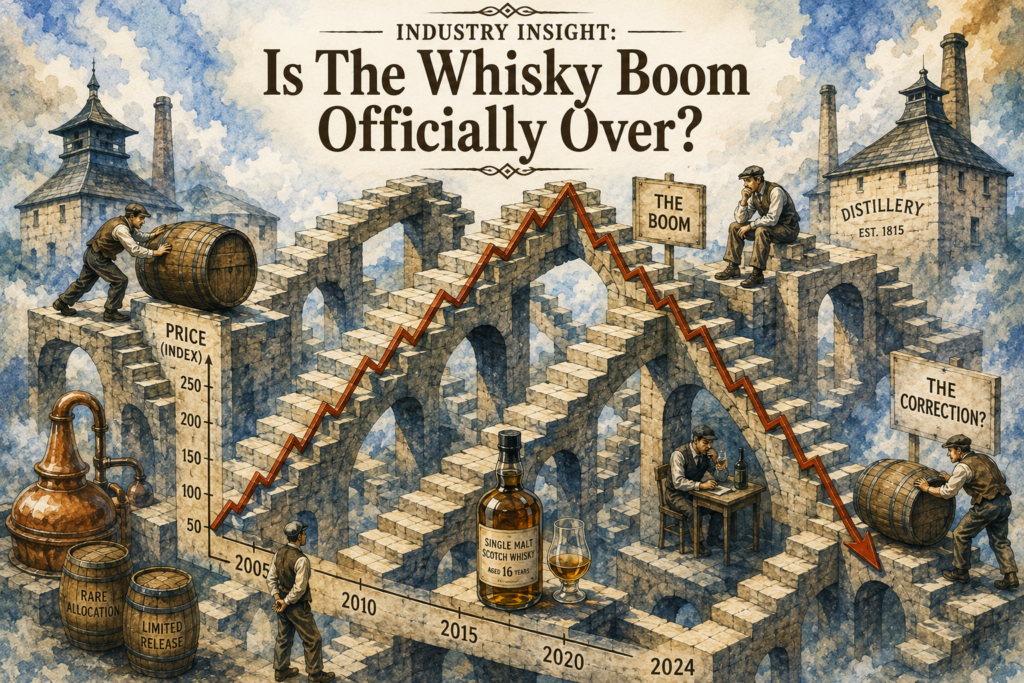
After more than a decade of relentless growth, the whisky market is showing clear signs of correction. Demand has softened in several key markets, collectors have become more selective, retailers are discounting stock that would once have sold effortlessly, and distilleries are adjusting to a reality that looks very different from the one they were planning for only a few years ago. For whisky drinkers, that increasingly means better availability and more realistic pricing. For producers, however, the adjustment is proving considerably more challenging.
I Started Seeing The Change Before The Numbers Did
Long before export figures began hinting at a slowdown, and long before industry commentators started debating whether the whisky boom had finally peaked, I remember noticing small changes in conversations taking place behind the counter at Salud Spirits.
At first, those changes were almost impossible to define. The customers were still there. The excitement around new releases remained. Allocations were still limited, and many bottles continued to generate enormous interest. Yet there was a subtle difference in the way people approached whisky, particularly at the higher end of the market. Questions became more deliberate. Purchasing decisions became less impulsive. The automatic urgency that had defined so much of the previous decade began to soften.
I remember one customer asking to join a waiting list for a bottle that had not yet arrived. When I asked whether he had tasted the whisky before, he admitted that he had not. In fact, he had never tasted anything from the distillery. The bottle itself was almost secondary. What mattered was the fear that if he did not secure one immediately, he might never have the opportunity again.
That mindset was hardly unusual at the time.
The whisky boom had created an environment in which scarcity often became as desirable as the liquid itself. Few distilleries embodied that better than Chichibu. Every allocation felt impossibly small, every release seemed destined to become more expensive than the last, and demand often appeared limitless. Bottles such as the remarkable 7even Gods of Fortune Fukurokuju attracted exactly the kind of attention you would expect from one of the world’s most sought-after distilleries.
Yet even within that world, something was beginning to shift.
Customers who once bought first and asked questions later started becoming more selective. Collectors who had spent years chasing almost every release became increasingly careful with their spending. Bottles that would once have sold themselves suddenly required a conversation. None of these developments felt particularly significant in isolation, but together they created the impression that the market was becoming more thoughtful and, perhaps more importantly, less willing to assume that every bottle would automatically justify its asking price.
At the time, I viewed it as a change within a relatively small corner of the whisky world. Looking back now, it feels much more like an early warning sign of a broader correction that would eventually become visible across the entire industry.
The Market Feels Different Today
A few years ago, ath the height of the Whisky Boom, finding a bottle of Lagavulin 16 for less than €100 felt increasingly unlikely. In some European markets, prices pushed towards €120, and there was a growing sense among enthusiasts that this was simply where the category was heading. Like many people, I gradually accepted those increases because they arrived in small increments rather than dramatic leaps. Prices had been rising for years, demand seemed unstoppable, and there was little reason to believe the trend would reverse itself.
Today, that same bottle can regularly be found between €70 and €80.
What makes that significant is not merely the saving itself, but what it represents. Lagavulin 16 is not an obscure bottling or a forgotten release from a closed distillery. It is one of the defining whiskies of Islay and one of the most recognisable single malts in the world. When a bottle of that stature becomes noticeably more affordable, it tells us something important about the wider market.
The same pattern is emerging elsewhere. Older Diageo Special Releases, many of which were launched during the height of the premiumisation wave, are increasingly appearing at prices that would have surprised collectors only a few years ago. Retailers who once struggled to secure stock are now finding themselves competing more aggressively for customers. Distilleries that built their strategies around seemingly endless demand are beginning to focus once again on value, accessibility and long-term consumer trust.
Bruichladdich provides a particularly interesting example. As explored in my article on Bruichladdich’s revolutionary comeback, the distillery has spent decades building one of the most respected reputations in Scotch whisky through transparency, innovation and authenticity. This was never a brand that relied solely on scarcity or collectability. The whisky itself was always the foundation of the story. That is precisely why increasingly competitive pricing across parts of the core range feels noteworthy. If a distillery with that level of consumer loyalty believes value matters more than ever, it suggests a broader shift in consumer behaviour that extends far beyond a single brand.
What Surprised Me Most About The Boom Years
The most remarkable thing about the whisky boom was never the growth itself. The industry earned much of its success through exceptional whisky, increased innovation and a willingness to reach audiences that previous generations of producers often ignored. New distilleries emerged, independent bottlers flourished, and consumers became more knowledgeable than ever before.
What surprises me when looking back is how quickly many of us adapted to rising prices and changing expectations.
Age statements quietly disappeared from some shelves. Limited editions became increasingly expensive. Packaging became more elaborate. Premiumisation transformed from a strategy into something that felt almost inevitable. Yet because each change happened gradually, there was little sense that anything unusual was taking place.
I know I accepted many of those changes myself.
When every distillery is increasing prices, every annual release is becoming more expensive and every conversation revolves around allocations and scarcity, it becomes easy to assume that this is simply how the whisky world works. The problem is that markets have a habit of convincing people that current conditions are permanent, right up until the moment they are not.
At some point, the conversation around whisky started moving away from flavour and towards availability. Instead of asking whether a bottle was worth drinking, consumers increasingly found themselves asking whether a bottle was worth securing before somebody else did. Collectors became more influential, investors entered the market, and scarcity often became a selling point in its own right.
That was probably the moment things started drifting away from the people who actually open their bottles.
I Think The Industry Needed This Correction
That may sound like an uncomfortable thing to say, particularly at a time when many distilleries are facing genuine challenges, but I believe it is true.
For years, whisky enthusiasts were conditioned to believe that prices would continue rising, that allocations would become increasingly difficult to secure, and that every limited release represented an opportunity that might never return. While those conditions undoubtedly created excitement, they also created an environment in which consumers increasingly felt pressure to buy quickly rather than buy thoughtfully.
That is not a sustainable relationship.
Whisky should be aspirational. Certain bottles should absolutely feel special. The thrill of discovering a rare release or securing a long-sought-after bottle is part of what makes the hobby enjoyable. However, there is an important difference between creating excitement and creating anxiety, and at times the industry felt as though it was drifting towards the latter.
I am not suggesting that producers deliberately pushed consumers too far. Most distilleries continued making exceptional whisky throughout this period, and many brands handled their success responsibly. Nevertheless, there were undoubtedly moments when the industry seemed to assume that consumer enthusiasm would absorb almost any price increase, almost any limited edition and almost any premium positioning strategy.
The current correction feels like a reminder that trust remains one of the most valuable assets a whisky brand can possess.
Unfortunately, Distilleries Are Feeling The Consequences
The challenge, of course, is that corrections rarely arrive without consequences.
Whisky operates on timescales unlike almost any other consumer product. The spirit being distilled today may not be sold for another decade or more, which means production decisions are often based on forecasts stretching many years into the future. During the boom years, those forecasts were understandably optimistic. Distilleries expanded production, built warehouses and invested heavily in anticipation of continued growth.
Recent market conditions suggest that reality has become more complicated.
Export volumes have softened, inventories have increased and producers across the industry have begun adjusting to a less aggressive growth environment. Some distilleries have reduced production. Others have paused operations temporarily. Companies that spent years preparing for expansion are now focusing on efficiency and sustainability instead.
One of the clearest examples came when Suntory Global Spirits brought together operations across Bowmore and Laphroaig on Islay, a development discussed in our article covering the Laphroaig and Bowmore merger news. Neither distillery is disappearing, and both remain among Scotland’s most iconic names. However, the decision illustrates a broader reality: even some of the industry’s most established players are adapting to conditions that look very different from those that existed only a few years ago.
Why I Remain Optimistic
Despite all of this, I find it difficult not to feel optimistic about where whisky goes next.
What excites me most about the current correction is not necessarily the prospect of paying less for a bottle, although few enthusiasts would complain about that outcome. Rather, it is the possibility that the conversation surrounding whisky may begin shifting back towards the things that attracted many of us to the hobby in the first place.
For much of the past decade, discussions about allocations, secondary market values and collectability often felt louder than conversations about flavour, distillery character or craftsmanship. There are signs that this is beginning to change, and if the correction encourages consumers to focus less on what a bottle might be worth in the future and more on the experience it offers today, then that can only be a positive development for whisky culture as a whole.
The best bottles I have ever owned were never the most valuable ones. They were the bottles attached to memories, opened on special occasions, shared with friends, discussed long into the evening and eventually finished. They were the bottles that created stories rather than investment returns.
That, at least for me, has always been the point.
Final Thoughts
The whisky boom is not ending because people have stopped caring about whisky. If anything, the passion that fuelled the industry’s remarkable growth remains stronger than ever. What appears to be ending is the assumption that prices can rise indefinitely, that every limited edition will sell out instantly, and that consumers will continue accepting every increase without question.
For drinkers, that creates opportunities. Bottles become more accessible, prices become more realistic and the pressure to buy out of fear begins to fade. For distilleries, however, the transition will require careful adjustment as businesses adapt to a market that looks markedly different from the one they expanded into during the boom years.
Perhaps that is exactly what the industry needs. Not a collapse, not a crisis and certainly not the end of whisky’s success story, but a reset that helps reconnect producers with the people who ultimately matter most: the drinkers opening the bottles.
For years, enthusiasts were told they were lucky to secure an allocation, lucky to find a bottle and lucky to pay whatever price was being asked. Somewhere along the way, the relationship between producers and consumers became slightly unbalanced. What we are witnessing now is not the collapse of a category, but the natural correction of a market that had spent a very long time moving in only one direction.
If that correction results in great whiskies becoming easier to find, more affordable to buy and more likely to be enjoyed rather than traded, then there is every chance that the next chapter of whisky will prove healthier, more sustainable and ultimately more rewarding than the last.
Sources
Scotch Whisky Association Export Statistics
https://www.scotch-whisky.org.uk/
Forbes – Joe Micallef’s Whisky Industry Coverage
https://www.forbes.com/sites/joemicallef/
The Spirits Business – Scotch Whisky Market Reporting
https://www.thespiritsbusiness.com/