DRAM1 Whisky Award 2026: The Winners, the Big Reveal and the Stories Behind the Drams
One of the things I love most about blind whisky tastings is that no matter how many whiskies you’ve tasted or how confident you are in your own palate, there is always room for a surprise. Sometimes that surprise comes in the form of an inexpensive bottle you would normally walk straight past in a whisky shop. Sometimes it is a whisky from a country you have never really explored. And sometimes it turns out that the bottle you’ve been recommending to friends for years isn’t quite as impressive when you don’t know what you’re drinking.
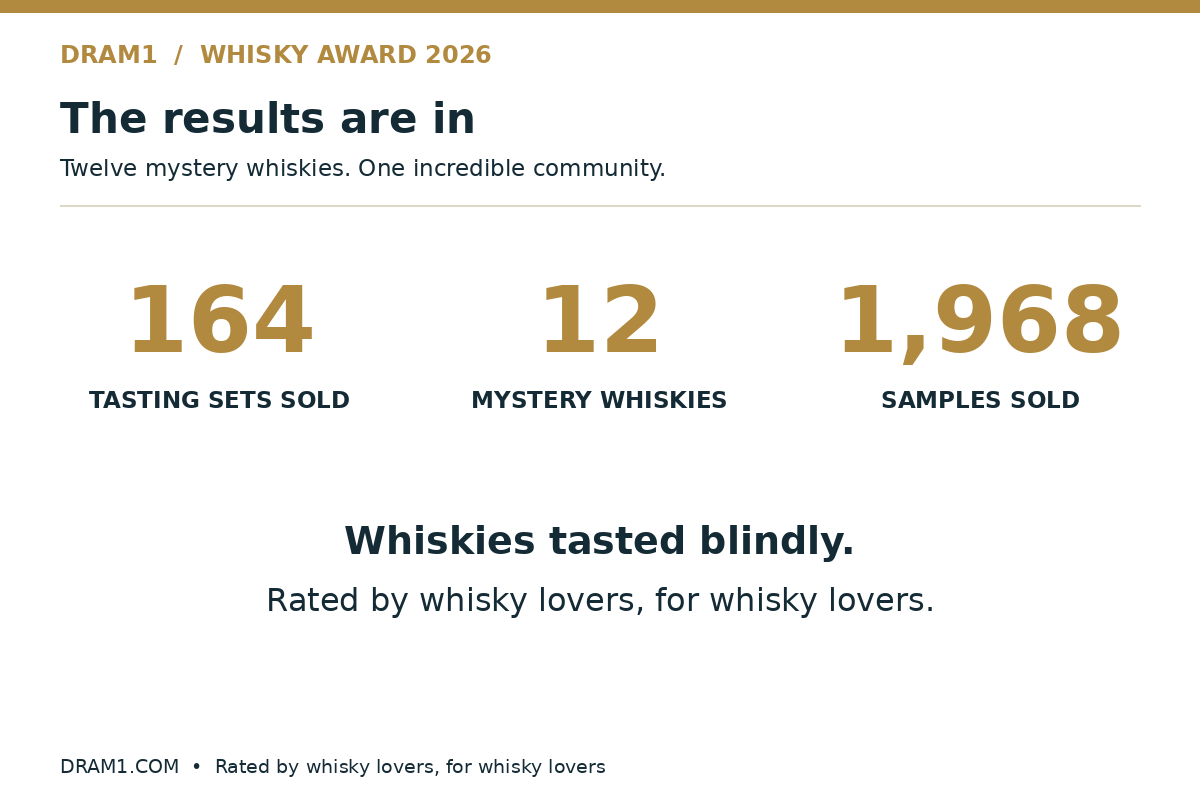
The DRAM1 Whisky Award 2026 delivered plenty of those moments. With 164 tasting sets sold, twelve whiskies from five different countries and an international community of whisky enthusiasts taking part, this year’s competition has been an absolute pleasure to organise. On Sunday, 29 November, we gathered at Café ZILT in Amsterdam to finally reveal the identities of our twelve mystery drams and announce the winners.
A Dutch single malt came within a fraction of a point of winning silver, a €35 bottle received more scores of 90 points or higher than any other whisky in the competition, and a famously powerful sherry bomb became the favourite among people who normally prefer their whisky below 50% ABV. There are some wonderful stories hidden within this year’s results.
Before we get to those results, however, I want to thank every single person who participated. Your enthusiasm, curiosity, tasting notes and honest opinions are what give this award its meaning.
Whiskies tasted blindly, rated by whisky lovers, for whisky lovers.
An Award Built Around the Whisky Community
There are plenty of prestigious whisky competitions around the world, many of them judged by incredibly knowledgeable industry professionals. Their expertise deserves enormous respect, but what has always fascinated me is what happens when you put those same whiskies in front of the people who actually buy them, open them, share them with friends and enjoy them at home.
That is the idea behind the DRAM1 Whisky Award. I wanted to create a competition where everyone could have their say, regardless of how long they have been drinking whisky or how extensive their collection might be. Someone who discovered whisky six months ago has just as much right to enjoy a dram as someone who has spent thirty years exploring the distilleries of Scotland.
Our panel this year included whisky lovers from across Europe. We had peatheads, sherry lovers, bourbon enthusiasts, fans of Irish whiskey and people with a particular soft spot for Dutch whisky. Some of you regularly spend more than €100 on a bottle, while others take great pleasure in discovering hidden gems at a fraction of that price.
With 164 tasting sets sold, a total of 1,968 whisky samples made their way into the whisky community. I love the thought of all those evenings spent exploring the same twelve mystery drams, whether you tasted them quietly at home, alongside your partner or during a tasting evening with your whisky friends.
This year’s line-up focused on whiskies with a reference retail price below €100. As much as I enjoy exploring rare and unusual releases, I wanted this award to help people discover whiskies they could realistically add to their own collections.
Each whisky was assessed on its nose, palate and finish, with all three categories contributing equally to its final score. Without knowing the identity, age, price or reputation of the whisky, our panel members were free to judge each dram on its own merits.
The Big Reveal: Which Whisky Was in Your Glass?
For weeks, twelve little numbered bottles have been keeping their secrets. Some of you may have your original tasting notes sitting next to you as you read this. Others have probably been waiting impatiently to find out which bottle they need to buy.
Either way, the wait is finally over.
Here are the identities of all twelve mystery whiskies from the DRAM1 Whisky Award 2026, in their original tasting order.
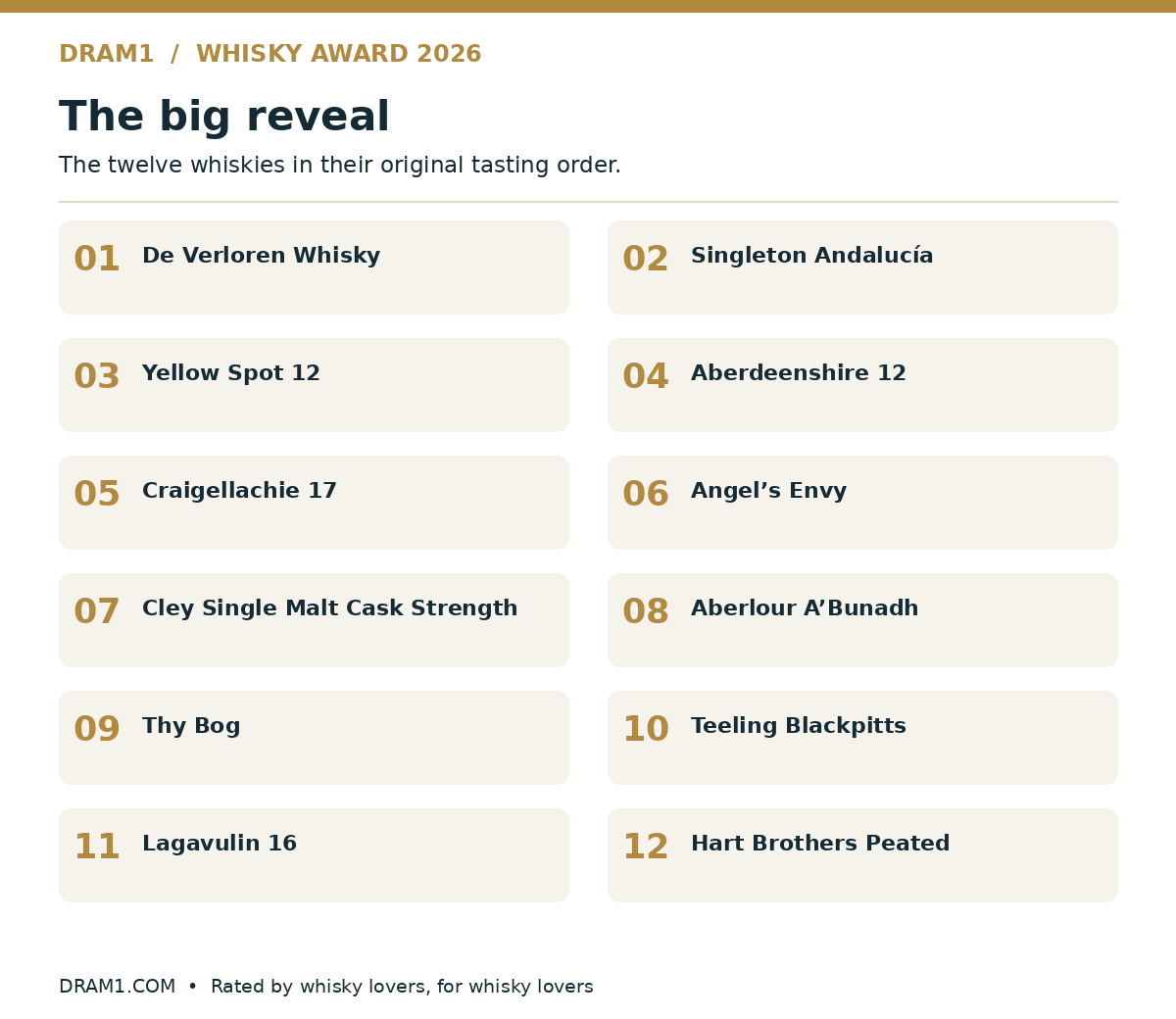
How many did you recognise? Did your favourite turn out to be something you already knew and loved, or have you discovered something completely new? Perhaps you gave a surprisingly modest score to a whisky you have been enjoying for years, or that mysterious Scotch you thought you recognised turned out to have been distilled in Rotterdam.
I would genuinely love to hear about your biggest surprises in the comments below. There is something particularly entertaining about comparing your original tasting notes with the identities of the whiskies afterwards, especially when you were absolutely convinced you knew what you were drinking.
The DRAM1 Whisky Award 2026 Winners
Gold Medal: Lagavulin 16 Year Old
GOLD MEDAL · SAMPLE 11
79.55 / 100
Islay, Scotland
16 years old · 43% ABV
I have to admit that seeing Lagavulin 16 emerge as the winner of this year’s competition put a rather big smile on my face. It is a whisky I have loved for years, and one that I still find myself returning to despite the seemingly endless number of exciting new releases entering the whisky market.
There is something wonderfully comforting about its combination of rich, earthy peat smoke, maritime character, dried fruits and that long, warming finish. It has become something of a benchmark for Islay single malt, and for many whisky enthusiasts it was the bottle that first introduced them to the joys of heavily peated whisky.
Of course, none of that reputation meant anything during our blind tasting. Without its recognisable green bottle or the knowledge that the whisky had spent sixteen years maturing, Lagavulin had to earn every single point.
| Tasting category | Average score |
|---|---|
| Nose | 79.07 |
| Palate | 80.41 |
| Finish | 79.17 |
| Overall | 79.55 |
Lagavulin 16 won all three individual tasting categories. Its palate was the only individual category in the entire competition to receive an average score above 80 points. It also received the highest individual overall score of the award, with one particularly enthusiastic panel member awarding it 97 points.
It was the favourite among our intermediate and advanced whisky drinkers, peat lovers and single malt enthusiasts. Rather amusingly, it was also the highest-rated whisky among people who indicated a preference for cask-strength whisky, despite being bottled at 43% ABV.
In an industry where there is always another limited release, another unusual cask finish or another exciting new distillery to explore, it is rather reassuring to see an established classic perform so convincingly.
A thoroughly deserved gold medal for Lagavulin 16, the winner of the DRAM1 Whisky Award 2026.

Silver Medal: Aberlour A’Bunadh
SILVER MEDAL · SAMPLE 08
78.70 / 100
Speyside, Scotland
Sherry matured · Cask strength
Aberlour A’Bunadh is one of those whiskies that has managed to build an almost cult-like following among sherry enthusiasts. Its generous dried fruit character, rich spices and considerable intensity make it a wonderful example of the sort of whisky many of us affectionately refer to as a sherry bomb.
Judging by its performance in this year’s competition, there was certainly no shortage of appreciation for that character. Aberlour performed remarkably consistently across all three tasting categories and achieved the highest median overall score of the entire competition, at 82.33 points.
| Tasting category | Average score |
|---|---|
| Nose | 78.67 |
| Palate | 78.87 |
| Finish | 78.55 |
| Overall | 78.70 |
As you might expect, it was the favourite among sherry-cask enthusiasts and people who generally prefer unpeated whisky. It was also the highest-rated whisky among bourbon enthusiasts, which I found considerably more surprising.
My favourite discovery, however, was that A’Bunadh won among participants who specifically indicated a preference for whisky bottled below 50% ABV. This group awarded the famously high-strength single malt an average of 82.88 points.
I wonder how many of them will be reconsidering their preferred alcohol percentage after discovering what was hiding in sample number eight.
Congratulations to Aberlour on a wonderful result and a well-deserved silver medal.

Bronze Medal: Cley Single Malt Cask Strength
BRONZE MEDAL · SAMPLE 07
78.62 / 100
Rotterdam, Netherlands
Dutch single malt · Cask strength
Of all the results in this year’s competition, this is perhaps the one I am most excited to share. A single malt whisky from Rotterdam went up against some of the biggest names in the international whisky industry and came within less than a tenth of a point of winning the silver medal.
As someone who has followed the development of Dutch whisky with great interest, I find that absolutely fantastic.
| Tasting category | Average score |
|---|---|
| Nose | 78.73 |
| Palate | 78.86 |
| Finish | 78.26 |
| Overall | 78.62 |
What makes Cley’s achievement even more impressive is that it received more outright first-place votes than any other whisky in the competition. Had we decided the winner by counting how many people considered each whisky their personal favourite, rather than calculating the average scores, the gold medal would have stayed right here in the Netherlands.
Cley was also the favourite among participants aged sixty and over, blended whisky enthusiasts and people who generally prefer Irish single pot still whiskey. Among our Dutch panel members, it came within just 0.05 points of beating Lagavulin 16.
Dutch whisky still has a relatively modest international reputation compared with Scotch or Irish whiskey, but results like these demonstrate just how seriously it deserves to be taken. I sincerely hope that Cley’s performance encourages more people to explore what Dutch distilleries have to offer. There is some genuinely exciting whisky being produced in our little corner of the world.
Congratulations to the entire team at Cley. You have every reason to be proud of this achievement.

The Complete DRAM1 Whisky Award 2026 Results
The competition was remarkably close, particularly towards the top of the leaderboard. Just 0.0833 points separated our silver and bronze medal winners, and less than two and a half points separated the first seven whiskies.
Here are the complete results, based on the validated blind-tasting scores submitted by our panel members.
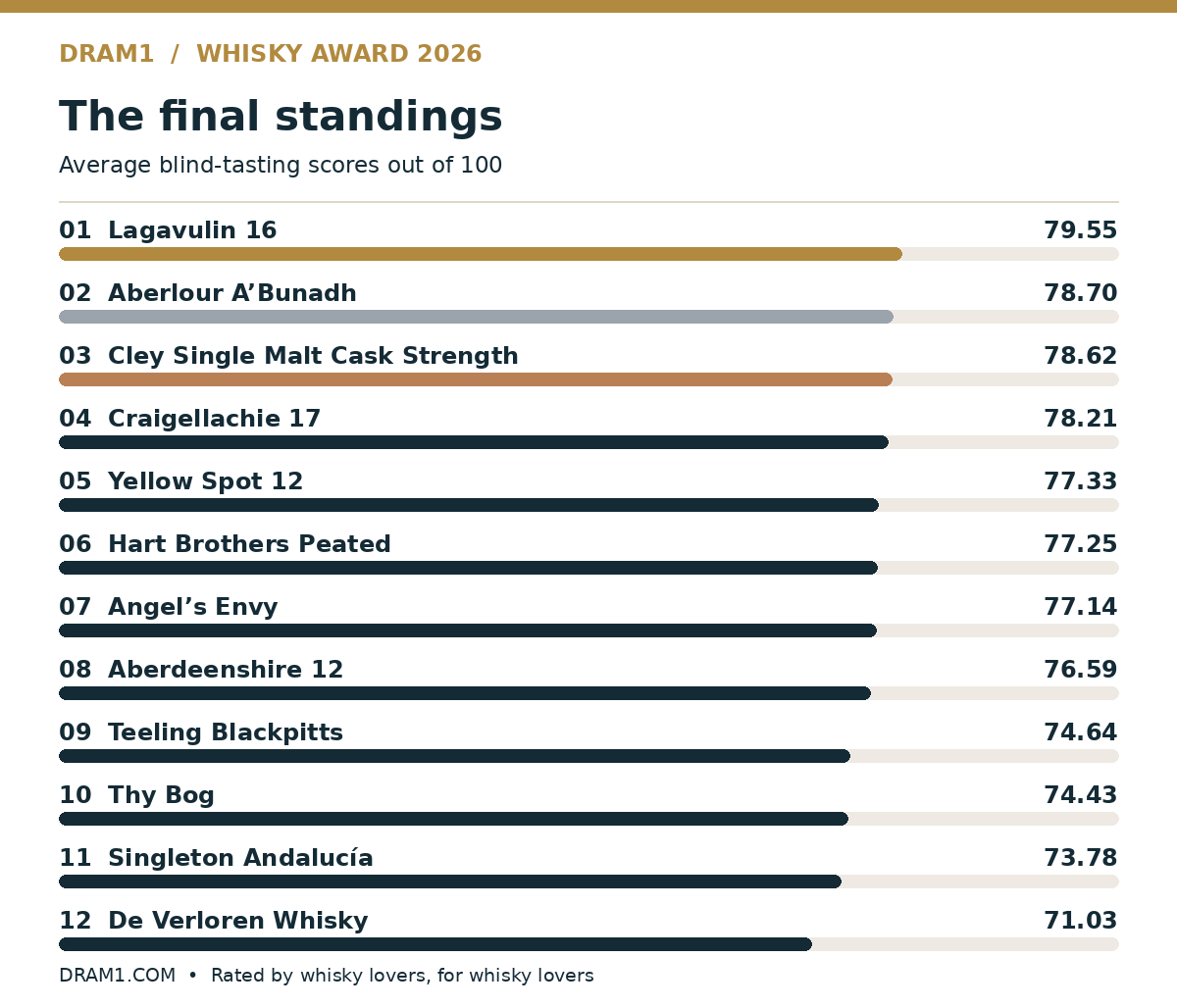
While these scores determine our official medal winners, I would be doing the other nine whiskies a considerable disservice if I simply left it there. Once I started exploring the individual results, I discovered some fascinating achievements that would never have been apparent from looking at the overall ranking alone.
Best Whisky Under €50: Hart Brothers Peated
BEST WHISKY UNDER €50
77.25 / 100
Reference retail price: €34.99
Sample 12 · Sixth overall
If there is one whisky in this year’s competition that deserves a little extra attention from bargain hunters, it is Hart Brothers Peated. With a reference retail price of just €34.99, this blended malt Scotch whisky finished sixth overall and earned the title of Best Whisky Under €50.
Perhaps even more impressive is that it received more individual overall scores of 90 points or higher than any other whisky in the competition. Seven panel members awarded it at least 90 points, and eleven considered it their outright favourite.
I have always enjoyed discovering whiskies that offer exceptional value for money, particularly in recent years when whisky prices have become a rather frequent topic of conversation. Hart Brothers Peated is a wonderful reminder that there are still some excellent discoveries to be made without spending a fortune.
Congratulations to Hart Brothers!

Beyond the Podium: Eight More Whiskies Worth Celebrating
Craigellachie 17 Year Old – The Connoisseur’s Choice
Sample 05 · Fourth place
78.21 / 100
Favourite among our most experienced whisky drinkers.
Craigellachie 17 may have narrowly missed out on a medal, but it earned one of the most interesting distinctions of the competition. Among our most experienced whisky drinkers, those who taste more than fifty different whiskies per year, Craigellachie was the overall winner.
It was also the whisky that divided opinions the least, recording the lowest variation in scores of all twelve contenders. Interestingly, it didn’t receive a single individual overall score of 90 or higher. Its fourth-place finish was instead achieved through remarkably consistent appreciation across the panel.
Craigellachie’s distinctive, weighty spirit character, associated with its traditional worm-tub condensers, has long made it a favourite among enthusiasts who appreciate a more old-fashioned style of Scotch whisky. It is rather fitting that this particular whisky found such appreciation among our most experienced panel members.

Yellow Spot – A Whisky That Kept Getting Better
Sample 03 · Fifth place
77.33 / 100
Improved at every stage of the tasting.
Yellow Spot was one of the whiskies whose average scores improved at every stage of the tasting. The palate was rated more highly than the nose, and the finish received an even higher score. It is always a pleasure to encounter a whisky that continues to reveal more of itself as you work your way through the glass.
This twelve-year-old Irish single pot still whiskey is matured using bourbon, sherry and Málaga wine casks, giving it a rather interesting connection to Spain.
Rather appropriately, Yellow Spot was also the favourite of our Spanish panel member. More than half of its validated individual overall scores reached at least 80 points, demonstrating just how much appreciation there was for this particular Irish whiskey.

Angel’s Envy – A Bourbon Among the Malts
Sample 06 · Seventh place
77.14 / 100
Second among our most experienced whisky drinkers.
Our American contender brought an entirely different flavour profile to the competition. Angel’s Envy combines Kentucky bourbon with the influence of port wine barrels, making it an interesting departure from the single malts that dominated this year’s line-up.
Angel’s Envy came second among our most experienced whisky drinkers, finishing just 0.13 points behind Craigellachie 17 in that category. Five panel members awarded it at least 90 points, and it was the favourite of our Austrian participant.
For a bourbon competing in a line-up dominated by malt whisky, that is a particularly impressive achievement.

Aberdeenshire 12 Year Old – The Palate Surprise
Sample 04 · Eighth place
76.59 / 100
Biggest improvement from nose to palate.
Aberdeenshire 12 delivered the biggest improvement from nose to palate of any whisky in the competition. Its average palate score was almost 1.8 points higher than its nose score, suggesting that many panel members found even more to enjoy once they took their first sip.
It is always nice when a whisky exceeds the expectations established by its aroma. I am sure quite a few of you recognise that experience of initially being a little unsure about a dram, only to find yourself increasingly enjoying it as the tasting progresses.

Teeling Blackpitts – The Adventurous Irishman
Sample 10 · Ninth place
74.64 / 100
Four individual scores of 90 or higher.
Triple-distilled peated Irish single malt matured in bourbon and Sauternes wine casks is hardly the most conventional combination in the whisky world, which is precisely what makes Teeling Blackpitts such an interesting addition to a blind tasting.
It received four individual scores of 90 points or higher, more than either our gold or silver medal winner. Like Yellow Spot, it also improved with every stage of the tasting.
Perhaps most amusingly, it was the favourite of our self-described beginner. So much for the assumption that newcomers to whisky should always start with something gentle and unpeated.

Thy Bøg – The Whisky That Started a Conversation
Sample 09 · Tenth place
74.43 / 100
Favourite among our German panel members.
Every good tasting needs a whisky that gets people talking, and Thy Bøg was certainly ours. The Danish single malt, produced by a farm distillery with a strong focus on organic grain and agricultural provenance, generated the widest variation in scores of the entire competition.
But the most fascinating discovery was its popularity among our German panel members. Had the DRAM1 Whisky Award been decided solely by their scores, Thy Bog would have won the gold medal, with an average of 84.08 points. It was also the favourite of our Polish participant.
Finishing tenth overall while achieving the highest average score among our German participants is quite a remarkable result. Thy Bog has a distinctive identity, and for those who connect with its character, it clearly offers something very special.

Singleton Andalucía – A Little Luxury Without the Price Tag
Sample 02 · Eleventh place
73.78 / 100
The most affordable whisky in the competition.
With a reference retail price of €24.99, Singleton Andalucía was the least expensive whisky in this year’s competition. It nevertheless earned plenty of appreciation, including an individual overall score of 90 points.
It also shared first place with Lagavulin 16 and Teeling Blackpitts in the scores submitted by our Danish participant.
I rather enjoy seeing a whisky costing less than €25 hold its own in a blind tasting against bottles costing three times as much. It is easy to become a little too accustomed to associating higher prices with better whisky, and Singleton Andalucía offered a welcome reminder that enjoyment doesn’t always follow the price tag.

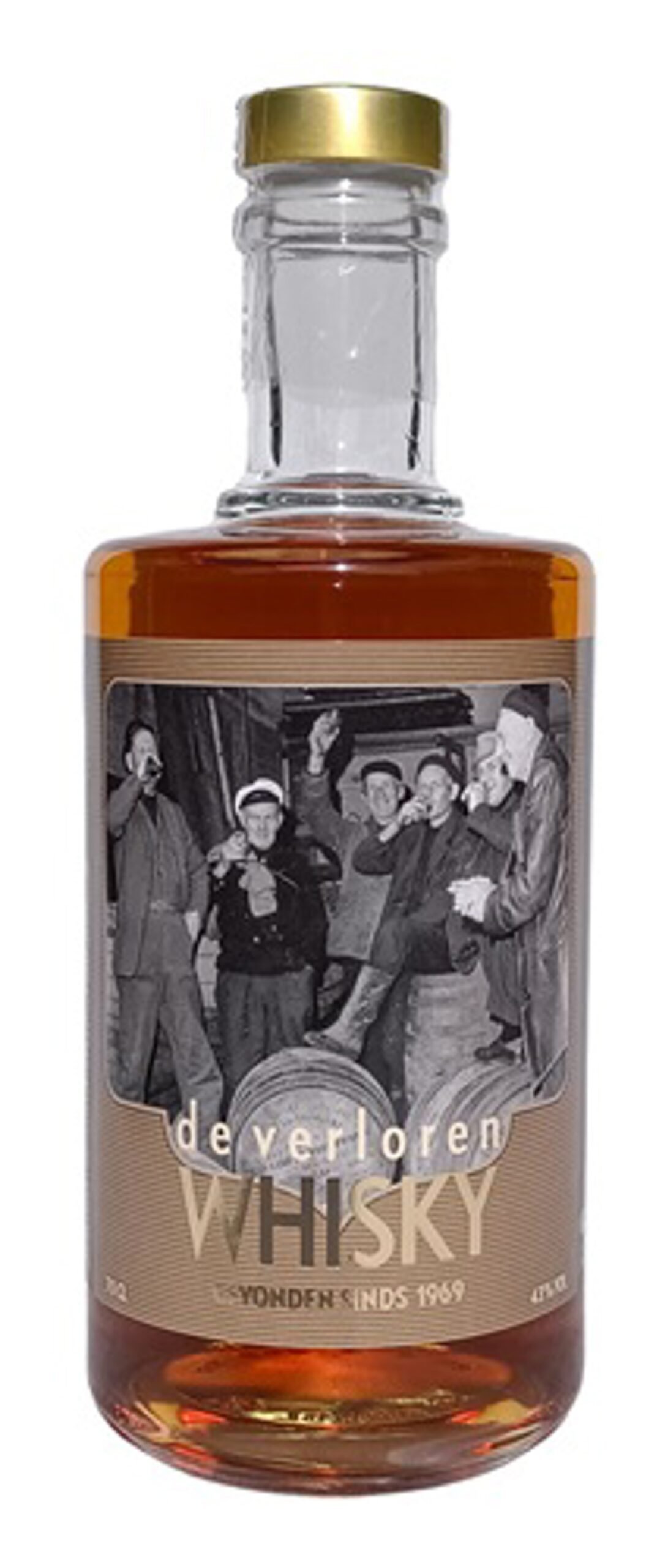
De Verloren Whisky – Every Whisky Has Its Champion
Sample 01 · Twelfth place
71.03 / 100
Somebody’s favourite whisky of the entire competition.
De Verloren Whisky finished twelfth in the overall ranking, but there is a statistic that I find considerably more interesting than its position on the leaderboard. It was somebody’s favourite whisky of the entire competition.
One panel member awarded it an impressive 91.67 points, and more than twenty individual overall scores reached at least 80 points.
As one of the most affordable whiskies in the line-up, De Verloren faced some formidable competition. Yet it still managed to deliver an experience that at least one person preferred to every other whisky, including our three medal winners.
If that person is reading this article, I hope you continue to enjoy De Verloren every bit as much as you did when it was simply known as sample number one. You certainly don’t need a gold medal to tell you that you have found a whisky you love.
What Happens When We Look Beyond the Overall Scores?
One of my favourite parts of organising the DRAM1 Whisky Award is sitting down with the results afterwards and exploring the relationship between people’s stated preferences and their actual blind-tasting scores.
As whisky enthusiasts, we tend to develop a fairly strong sense of what we enjoy. We know our favourite regions, preferred cask types, distilleries and alcohol percentages. We might describe ourselves as peatheads, sherry lovers or bourbon enthusiasts, and those preferences naturally influence the bottles we buy.
Having the opportunity to compare those preferences with the scores awarded during a blind tasting is absolutely fascinating, particularly when the results challenge some of the assumptions we make about whisky.
The Most Experienced Whisky Drinkers Would Have Crowned a Different Winner
Lagavulin 16 was particularly popular among intermediate and advanced whisky drinkers. However, our most experienced group produced an entirely different podium.
| Experience level | Favourite whisky | Score |
|---|---|---|
| Beginner | Teeling Blackpitts | 81.33 |
| Intermediate | Lagavulin 16 | 77.57 |
| Advanced | Lagavulin 16 | 82.51 |
| Seasoned | Craigellachie 17 | 79.81 |
Our seasoned whisky enthusiasts would have awarded gold to Craigellachie 17, silver to Angel’s Envy and bronze to Aberlour A’Bunadh.
Given that Angel’s Envy finished seventh in the overall competition, its performance among our most experienced drinkers is particularly noteworthy.
I wouldn’t necessarily recommend buying your next bottle based solely on the results of the most experienced group, though. One of the things I appreciate about having such a diverse panel is that the results reflect a broad range of tastes. Experience may change the way we approach a whisky, but it certainly doesn’t give anyone a monopoly on good taste.
The Netherlands and Germany Had Completely Different Podiums
The DRAM1 Whisky Award has become an increasingly international affair, and it was wonderful to see scores arriving from whisky enthusiasts across Europe. There is something quite special about knowing that people in different countries have been sitting down with exactly the same twelve mystery whiskies.
Our Dutch and German panel members produced particularly interesting results.
🇳🇱 Netherlands
🥇 Lagavulin 16 — 79.16
🥈 Cley — 79.11
🥉 Craigellachie 17 — 78.12
🇩🇪 Germany
🥇 Thy Bøg — 84.08
🥈 Aberlour A’Bunadh — 83.83
🥉 Hart Brothers — 81.50
Not a single whisky appeared on both podiums. The Dutch participants came remarkably close to crowning a whisky from their own country, while the German participants showed a particularly strong appreciation for the unconventional character of Thy Bøg.
Elsewhere, our Spanish participant preferred Yellow Spot, our Austrian participant chose Angel’s Envy and our Hungarian participant favoured Aberlour A’Bunadh.
| Country | Highest-rated whisky |
|---|---|
| Netherlands | Lagavulin 16 |
| Germany | Thy Bog |
| France | Lagavulin 16 |
| Czech Republic | Lagavulin 16 |
| Spain | Yellow Spot |
| Austria | Angel’s Envy |
| Hungary | Aberlour A’Bunadh |
| Poland | Thy Bøg |
| Denmark | Singleton, Teeling and Lagavulin (tie) |
Some of these countries were represented by just one or two participants, so I certainly wouldn’t go as far as suggesting that we have discovered the national whisky preferences of nine European countries. Nevertheless, these results provide some delightful individual stories.
To everyone who participated from outside the Netherlands, a particularly warm thank you for helping the DRAM1 Whisky Award reach beyond our borders. I hope we can welcome even more whisky enthusiasts from around the world in future editions.
Do We Really Know What Kind of Whisky We Like?
Before tasting the whiskies, panel members indicated which styles of whisky they generally prefer. Comparing those answers with their blind-tasting results revealed some of my favourite statistics from this year’s award.
| Stated preference | Highest-rated whisky |
|---|---|
| Single malt | Lagavulin 16 |
| Peated whisky | Lagavulin 16 |
| Cask-strength whisky | Lagavulin 16 |
| Sherry-cask matured whisky | Aberlour A’Bunadh |
| Unpeated whisky | Aberlour A’Bunadh |
| Bourbon | Aberlour A’Bunadh |
| Whisky below 50% ABV | Aberlour A’Bunadh |
| Bourbon-cask matured whisky | Craigellachie 17 |
| Irish single pot still whiskey | Cley Cask Strength |
| Blended whisky | Cley Cask Strength |
Some of these results make perfect sense. Peat lovers choosing Lagavulin and sherry enthusiasts choosing Aberlour are hardly groundbreaking discoveries. Others are a little more surprising, particularly when you consider that we had a finished bourbon and an actual Irish single pot still whiskey in the competition.
I recognise myself in some of these results. Having spent a considerable amount of time exploring whisky, I have developed a fairly clear idea of the styles I enjoy. I have a particular weakness for Clynelish, a good heavily peated Islay single malt and the wonderfully distinctive character of Springbank. Those preferences inevitably influence my buying decisions, yet blind tastings continue to introduce me to whiskies I might otherwise have overlooked.
Perhaps the most useful thing we can take away from these results is that our preferences should help us discover whisky rather than prevent us from doing so.
A Whisky for Every Generation
There were some interesting differences between the age groups represented in our panel, too.
| Age group | Favourite whisky | Score |
|---|---|---|
| 18–30 | Lagavulin 16 | 82.06 |
| 31–45 | Craigellachie 17 | 78.15 |
| 45–60 | Lagavulin 16 | 82.05 |
| 60+ | Cley Cask Strength | 80.83 |
Curiously, our youngest age group and those aged between 45 and 60 awarded Lagavulin almost identical average scores, with just 0.01 points separating them.
Meanwhile, our oldest group preferred a whisky from one of the younger whisky-producing nations represented in the competition. It seems that a long-standing appreciation of whisky doesn’t necessarily translate into a preference for the most established distilleries.
Does Spending More Mean Enjoying Whisky More?
Our panel members’ usual spending habits also produced some interesting results.
| Usual bottle budget | Favourite whisky |
|---|---|
| Below €50 | Aberlour A’Bunadh |
| €50–€75 | Lagavulin 16 |
| €75–€100 | Craigellachie 17 |
| Above €100 | Aberlour A’Bunadh |
Aberlour A’Bunadh managed the rather unusual achievement of being the favourite among both our lowest-budget and highest-budget groups. Although some of these groups were relatively small, it is an entertaining result nonetheless.
Looking at the reference retail prices and overall scores of our twelve whiskies, the more expensive whiskies generally performed well. There were, however, some rather interesting exceptions.
Hart Brothers Peated, in particular, finished ahead of several whiskies costing more than twice as much. For anyone who has ever stood in a whisky shop wondering whether spending another €40 will actually make them enjoy their next bottle more, these results offer some encouraging food for thought.
The Highest-Rated Whisky Wasn’t Necessarily the Most Loved
One of the most fascinating things about analysing the results was discovering how differently the competition would have ended if we had counted personal favourites instead of calculating average scores.
While Lagavulin 16 achieved the highest overall average, Cley Single Malt Cask Strength received more outright first-place votes than any other whisky.
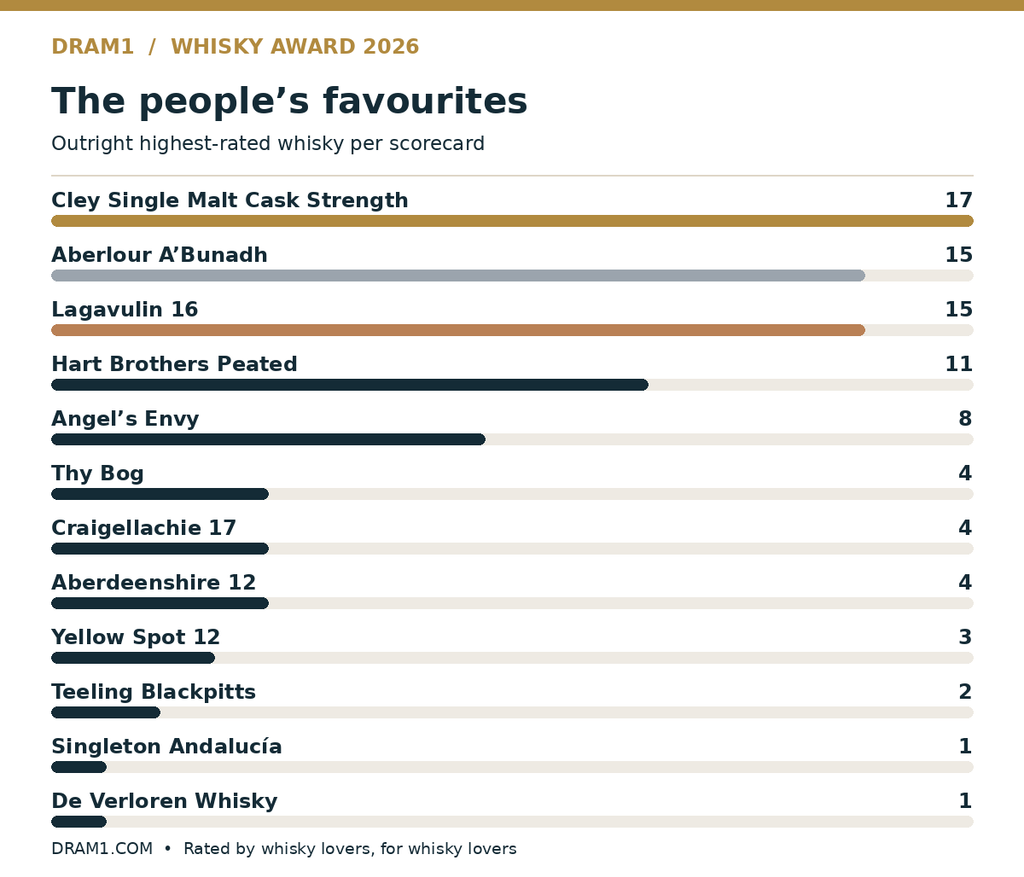
Hart Brothers Peated, meanwhile, received the most individual scores of 90 points or higher. Considering its price and its sixth-place finish overall, that is a statistic I find particularly impressive.
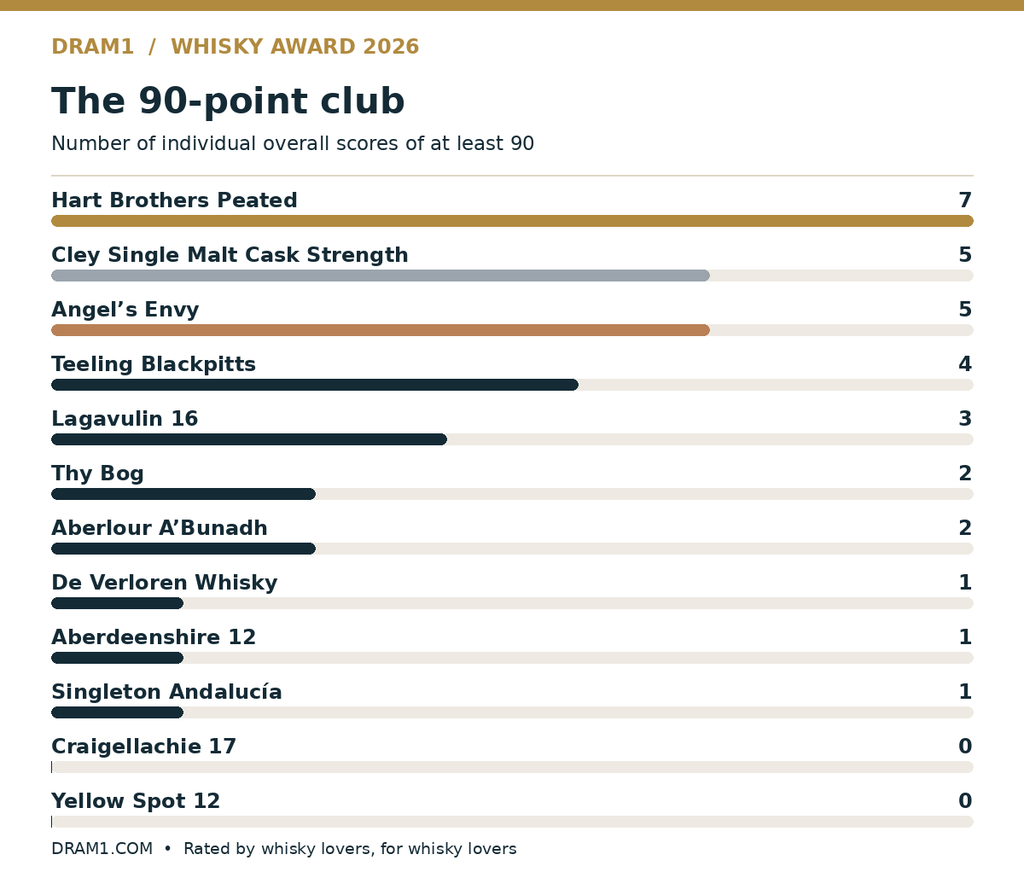
Craigellachie 17 presents an interesting contrast. Despite finishing fourth overall, it didn’t receive a single individual overall score of 90 or higher. Instead, it earned its position through remarkably consistent appreciation across the panel.
It is interesting to consider which of these achievements you would value most if you were producing whisky yourself. Would you rather create something that almost everyone appreciates, or something that a smaller number of people absolutely fall in love with? I suspect there are quite a few distillers who would happily settle for either.
The Most Divisive Whisky and the One We Could All Agree On
If you have ever attended a whisky tasting with friends, you will probably recognise the moment when someone announces that the whisky you are absolutely loving is the worst thing they have tasted all evening.
Thy Bog and Craigellachie 17 provide a particularly interesting comparison in this regard. While Craigellachie generated the most consistent scores across the panel, Thy Bog produced the widest variation.
Neither achievement is inherently better than the other. Some of my own favourite whiskies are ones that I would hesitate to recommend to absolutely everyone. Their distinctive character is precisely what makes them so appealing to me, even if someone sitting next to me at a tasting feels entirely differently.
Besides, a whisky tasting where everyone agrees on everything would probably make for a rather boring evening.
Every Whisky Found Its Champion
Of all the statistics I discovered while analysing this year’s results, there is one that I keep coming back to.
Every single whisky in the competition was somebody’s outright favourite.
All twelve of them. Even the whisky that finished last in the overall ranking managed to provide someone with more enjoyment than any of the other eleven contenders.
I think that is a rather beautiful result, particularly in a hobby where we spend so much time discussing scores, rankings, awards and the opinions of people whose palates we respect.
If your personal favourite finished tenth, eleventh or twelfth in this year’s competition, I sincerely hope that discovering the results hasn’t changed your opinion of it. You tasted the same whiskies as everyone else, without knowing what they were, and you discovered something that brought you genuine enjoyment. Surely that is one of the best possible outcomes of taking part in a blind tasting.
By all means, explore the medal winners if you haven’t already done so. But if sample number one was your favourite, buy yourself a bottle of sample number one. Enjoy it, share it with friends and don’t feel the slightest need to justify your choice.
There is no medal, review or numerical score that can make a whisky taste better to you than it already does.
A Heartfelt Thank You to Every DRAM1 Whisky Award Panel Member
Organising the DRAM1 Whisky Award takes quite a bit of time. Selecting the whiskies, preparing the samples, putting together the tasting sets, answering questions, collecting the scores and eventually sitting down to analyse all those results is quite an undertaking. But every year, the enthusiasm of the people taking part reminds me exactly why I enjoy doing it so much.
To everyone who purchased a tasting set, thank you. To those of you who carefully worked your way through all twelve whiskies, took the time to write tasting notes and shared your scores with me, thank you. To everyone who organised a tasting evening with friends, introduced someone else to the competition, shared their experiences on social media or helped spread the word about the award, thank you.
I have genuinely enjoyed reading your tasting notes, including the wonderfully detailed descriptions, the unexpected flavour associations, the enthusiastic recommendations and the occasional brutally honest assessment. I appreciate the time you invested in this competition, and I hope you had as much fun discovering these whiskies as I had putting the line-up together.
I also want to thank the team at Café ZILT for providing a home for this year’s award show, and everyone who joined us in Amsterdam to celebrate the results.
The DRAM1 Whisky Award may carry the DRAM1 name, but its success belongs to the community behind it. I can select twelve whiskies, put them into little numbered bottles and send them out into the world, but without your participation there is no competition, no podium and none of the wonderful stories I have been able to share in this article.
You are the judges. You are the people who decide which whiskies deserve recognition. Every single one of you has helped shape this year’s award, and I hope you feel a genuine sense of ownership over these results.
Seeing 164 tasting sets find their way into the whisky community is something I could only have hoped for when I first started DRAM1. What makes me even happier is knowing that those tasting sets have brought people together, encouraged conversations about whisky and hopefully introduced quite a few of you to some new favourites.
Congratulations once again to Lagavulin, Aberlour, Cley and Hart Brothers, and to all twelve whisky producers that made this year’s competition such an interesting and enjoyable experience.
Most importantly, congratulations to our panel members. You have made the DRAM1 Whisky Award 2026 a success, and I am incredibly grateful to have you as part of this community.
I already find myself looking forward to selecting the whiskies for the next edition, and I sincerely hope you will join me again.
Whiskies tasted blindly. Rated by whisky lovers, for whisky lovers. That is what the DRAM1 Whisky Award is all about.
Slàinte mhath!
Martijn – DRAM1
What was your favourite whisky of the DRAM1 Whisky Award 2026? Did you recognise any of the mystery drams, and were there any results that genuinely surprised you? Let me know in the comments below. I would love to hear your personal experiences with this year’s competition.
About the results: Overall scores are calculated from validated blind-tasting submissions, with nose, palate and finish weighted equally. Subgroup results describe the participating respondents and should not be interpreted as representative of entire countries, generations or whisky-drinking populations.