
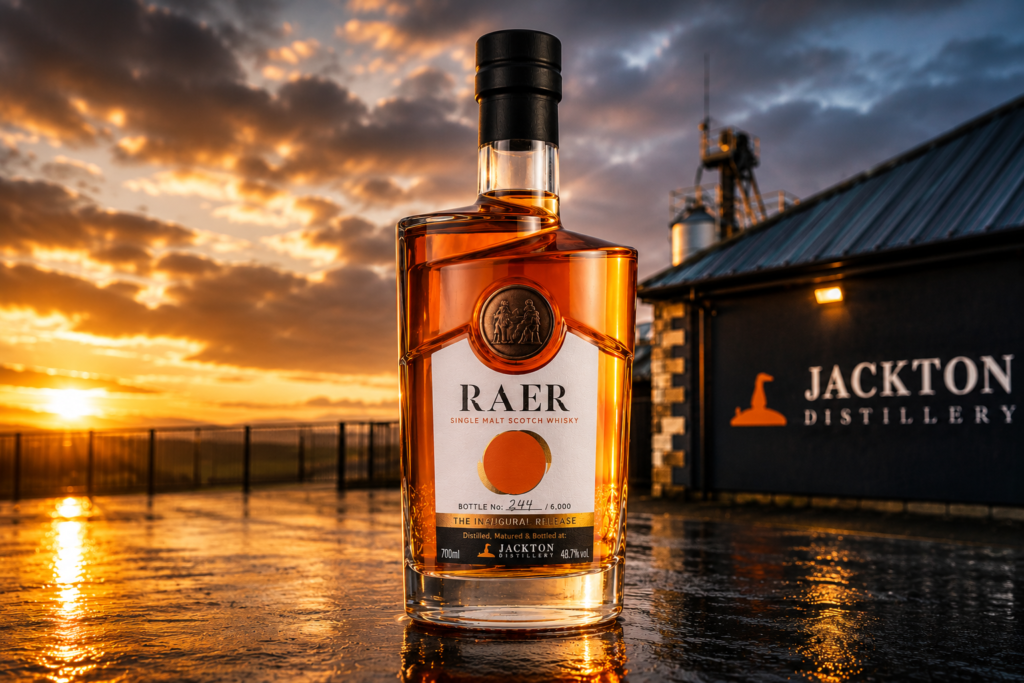
RAER Inaugural Release: Jackton Distillery’s First Single Malt at a Fascinating Time for Scotch Whisky
There are few milestones more important for a young whisky distillery than the moment it can finally put its own single malt into a bottle. For Jackton Distillery, that moment has now arrived with the announcement of RAER Single Malt Scotch Whisky – The Inaugural Release, the first single malt to carry the RAER name and the culmination of a journey that began when the family-owned Lowland distillery filled its first casks in February 2020. Six years later, those early years of production are finally ready to meet whisky drinkers, although they are doing so in a market that looks remarkably different from the one into which Jackton was born.
The inaugural RAER Single Malt is limited to 6,000 individually hand-numbered bottles and has been bottled at 48.7% ABV, at natural colour and without chill filtration. The whisky brings together maturation in bourbon, Pedro Ximénez, Amontillado and Oloroso casks and carries a recommended price of £68, with pre-orders already open ahead of shipping beginning on 4 September 2026. On paper, there is quite a lot here that immediately appeals to me. A healthy bottling strength, no unnecessary colouring or chill filtration, several genuinely different styles of sherry cask and, perhaps most importantly, a price that doesn’t use the words Inaugural Release as an excuse to wander unnecessarily into three figures.
That last point might actually be more important than it initially appears. Over the past decade we have watched the first releases from new distilleries almost become a category of their own, often accompanied by elaborate packaging, tiny allocations and prices based as much on the possibility of future collectability as on the whisky inside the bottle. RAER could quite easily have followed that route, particularly with only 6,000 bottles available. Instead, £68 puts this within relatively normal premium single malt territory, allowing Jackton’s first whisky to be approached as something to open and drink rather than something destined to spend the next decade gathering dust in somebody’s collection. I think that is exactly where a young distillery should want its whisky to be.
What Is The RAER Inaguaral Release Single Malt?
RAER’s first single malt has been assembled from whisky matured in bourbon, Pedro Ximénez, Amontillado and Oloroso casks, giving the team four quite different components with which to build the final release. The distillery describes fruitcake, fig and sultana on the nose, followed by dark fruits, treacle and roasted nuts on the palate, before toffee, sweet spice and soft oak appear through a long and mellow finish. It sounds like a deliberately rich introduction to the Jackton spirit, although the inclusion of bourbon maturation alongside three different styles of sherry cask should hopefully prevent the whisky from simply becoming another heavily cask-driven young sherry malt.
There is certainly plenty of potential in that combination. Pedro Ximénez can bring the darker, sweeter and almost syrupy side of sherry maturation, while Oloroso generally provides nuttier and more oxidative flavours and Amontillado can offer something considerably drier and more delicate. Bourbon casks underneath those components should give the spirit a little more room to breathe. Of course, I haven’t tasted the final release yet, so I’m not going to pretend that an attractive specification automatically translates into a great whisky, but I do like the choices Jackton has made here. 48.7% ABV also strikes me as a particularly sensible strength: enough to retain texture and character without joining the increasingly common assumption that every enthusiast-focused whisky needs to arrive somewhere north of 55%.
Perhaps the thing I like most about the specification, though, is that it feels designed primarily for drinking. Natural colour and non-chill filtration will please the enthusiast audience Jackton inevitably needs to reach, but neither is being used to justify an extravagant price. At £68 this is obviously not an everyday budget whisky, yet it remains accessible enough for curious drinkers to actually open the bottle. For a distillery trying to establish what its name means, getting liquid into glasses rather than collections is going to matter enormously.
From a Family Farm to Jackton Distillery
Jackton Distillery sits on the Kean family’s farm in South Lanarkshire, close to Glasgow, and is led by Managing Director Jaynie Kean alongside her siblings Claragh and Jacob. The first cask was filled on 12 February 2020, which, with the benefit of hindsight, was not exactly ideal timing for beginning the next chapter of a young spirits business. Within weeks the pandemic had brought much of the world to a standstill, with Jackton even turning part of its attention towards producing sanitiser for the local community. Whisky production continued, however, and the spirit laid down during those extraordinary early years is now beginning to emerge as RAER Single Malt.
What makes Jackton particularly interesting to me is that there appears to be a much broader ambition behind the distillery than simply buying barley, making spirit and finding interesting casks in which to mature it. The Kean family grows barley on the farm and has invested in bringing malting on site, moving Jackton closer towards genuine control of the production journey from field to bottle. Whisky has become increasingly fond of words such as provenance and terroir over the past decade, but relatively few Scotch whisky distilleries actually control everything from growing their own barley through malting, fermentation, distillation, maturation and eventually bottling. If Jackton continues moving in that direction, it gives RAER a potentially compelling identity in an increasingly crowded landscape.
The distillery itself has also been built with considerable flexibility in mind. Alongside traditional whisky production, Jackton has equipment capable of producing other spirits and has experimented with different production methods, grains and maturation styles. Its warehouses already contain whisky in a variety of casks, while the partnership with Château de Chambord in France gives Jackton access to oak from the estate for future maturation projects. All of this suggests that RAER’s inaugural release is unlikely to be followed by a predictable procession of slightly older versions of essentially the same whisky. There appears to be genuine curiosity behind the project, and I suspect experimentation will become an important part of RAER’s identity as those warehouses continue to mature.
A First Single Malt Arriving in a Very Different Whisky Market
This is also where the RAER story becomes much more interesting than simply another inaugural release, because Jackton Distillery began making whisky during one of the most extraordinary periods of growth the category had experienced in decades. For much of the 2010s and early 2020s, whisky appeared almost unstoppable. Premiumisation was everywhere, bottle prices climbed rapidly, auction records became increasingly absurd and new distilleries appeared across Scotland, England, Ireland and much further afield. Investors were willing to put enormous amounts of money into an industry where the product might not generate meaningful revenue for years because the underlying assumption was that global appetite for premium whisky would simply continue to grow.
Six years later, that assumption looks considerably less comfortable. Scotch whisky exports have endured a difficult period, premium bottles are moving more slowly and retailers are becoming increasingly cautious about what they put on their shelves. From my own experience working within the industry, that change is impossible to ignore. Consumers haven’t suddenly stopped liking whisky, but they have become considerably more selective about where they spend their money. A limited bottle is no longer guaranteed to sell simply because somebody printed a number on the label, while independent bottlings and premium single casks that might once have disappeared almost immediately can now remain available for months.
For established producers, that creates headaches. For a new distillery releasing its first whisky, however, it creates an entirely different challenge. Jackton has spent six years producing spirit, filling casks and waiting patiently for the whisky to mature, only to arrive at the starting line just as the market has become considerably harder to penetrate. That is one of the peculiar realities of whisky production: the decisions you make today are often based on assumptions about a market you won’t actually sell into for many years. A distillery can increase production when demand is booming, fill warehouses with confidence and discover half a decade later that consumers have moved in another direction entirely.
The Challenge Facing Whisky’s New Generation
That delayed response makes younger distilleries particularly vulnerable during a downturn because they simply don’t have the inventory available to react in the same way as established producers. If drinkers suddenly rediscover their appetite for 12-, 15- and 18-year-old age statements, a distillery founded in 2020 cannot simply decide to release one. If consumers become tired of expensive young limited editions, the whisky sitting in the warehouse doesn’t magically become ten years older. Established producers can dig into decades of inventory, adjust their ranges and lean heavily on brands consumers already recognise, whereas younger distilleries need to persuade someone standing in front of an increasingly crowded whisky shelf to take a chance on a name they may never have tasted before.
I see that challenge increasingly clearly from the sales side of the industry. Retailers have limited shelf space and, understandably, they want confidence that the bottles occupying it will actually move. Consumers meanwhile have more choice than perhaps ever before, with established Scotch distilleries competing not only against one another but against independent bottlers, new Scottish distilleries and an increasingly impressive selection of whisky from England, Ireland, Europe, Asia and beyond. Being new was once enough to generate excitement. I don’t think it is anymore. A distillery needs to explain why it deserves attention, and ultimately the whisky itself needs to justify coming back for bottle number two.
That might sound like a rather bleak environment in which to launch a first single malt, but I actually think there is another side to the current downturn that could ultimately be very healthy for whisky. The easy money has largely disappeared, and with it some of the assumption that scarcity itself creates value. During the boom years, an attractive bottle, a romantic story and a sufficiently small number printed on the label could sometimes do an extraordinary amount of the selling. Today’s consumer seems much more inclined to ask what is actually inside the bottle, why it costs what it does and what makes one young distillery meaningfully different from the many others asking for their attention.
Those are good questions for whisky drinkers to ask, even if they make life considerably harder for producers. The distilleries that come through this period successfully may ultimately be stronger because they have been forced to build genuine communities rather than customer lists, establish recognisable house styles rather than rely endlessly on unusual casks and price their whisky according to what people are genuinely prepared to pay. If RAER can produce distinctive whisky, maintain sensible pricing and give drinkers a reason to become invested in Jackton beyond the novelty of owning an inaugural bottle, there is absolutely room for it to grow.
Why Jackton May Be Better Positioned Than Some
There are also several aspects of Jackton’s approach that could prove particularly valuable in the current market, beginning with diversification. The distillery wasn’t built around the assumption that it would simply produce single malt, wait several years and then rely entirely on whisky sales. RAER already exists as a broader spirits brand, with blended Scotch, gin and vodka giving the company products to sell while its own whisky matured. Jackton’s flexible production setup provides further options, which could become increasingly important if the wider whisky slowdown continues.
That flexibility shouldn’t be underestimated. One of the biggest dangers facing the generation of distilleries created during the boom years is becoming trapped by the assumptions on which their original business plans were based. If those plans require production to increase every year, premium prices to continue climbing and consumers to enthusiastically collect every limited release, the current market becomes uncomfortable very quickly. A distillery capable of adapting production, experimenting with different spirits and generating revenue from tourism and other activities has considerably more room to manoeuvre.
Jackton’s location and visitor experience could become another important part of that equation. Distillery tours, tastings, accommodation and events allow the company to create something that is increasingly difficult to manufacture through traditional marketing: an emotional connection between a drinker and the whisky. I’ve experienced this countless times myself. The whiskies we remember most aren’t necessarily the ones that would score highest in a blind tasting; they are often the bottles connected to a particular place, person or memory. If Jackton can turn visitors into people who genuinely care about what happens next at the distillery, those relationships could ultimately prove much more valuable than selling an inaugural bottle to somebody who simply hopes it becomes collectible.
What Can We Expect From RAER Next?
Perhaps the most exciting thing about any inaugural whisky is that it isn’t really the finished product. It is a snapshot of a distillery at the earliest stage at which Scotch whisky regulations allow us to begin understanding what it might eventually become. Jackton’s warehouses are getting older every day, while the work being done with different barley, malting techniques and maturation styles gives RAER plenty of directions to explore over the coming years. The presence of Fino, PX, Amontillado and other casks already points towards further experimentation, while the Château de Chambord partnership could eventually produce something genuinely unusual.
What I will be particularly interested to discover is how clearly Jackton’s own spirit character begins to emerge as the whisky gets older. This inaugural release uses a fairly broad combination of active cask types, which makes complete sense when building complexity around relatively young spirit, but eventually I want to know what Jackton itself tastes like. Not Jackton covered in PX sweetness or transformed by an unusual French oak cask, but the fundamental character created by its barley, fermentation and stills. A relatively straightforward bourbon-led release somewhere down the road could therefore be every bit as interesting to me as the more experimental bottlings, because establishing a recognisable distillery character is what ultimately separates an exciting new whisky producer from a company simply releasing an endless succession of interesting casks.
If Jackton can establish that identity while continuing to explore its grain-to-glass ambitions, RAER could become a genuinely interesting name to follow. There is enough flexibility in the distillery to experiment, enough control over production to develop a meaningful story around provenance and, importantly, enough restraint in the pricing of this inaugural release to suggest that the company understands bottles need to be opened if a new distillery is going to build a following.
Final Thoughts
RAER Single Malt Scotch Whisky – The RAER Inaugural Release arrives at one of the most fascinating moments in recent whisky history. Jackton began laying down spirit when confidence in premium whisky seemed almost limitless and releases its first single malt into a world where sales have slowed, retailers are more cautious and consumers have become much more selective. That undoubtedly makes the road ahead harder, but it also means RAER has an opportunity to build its reputation on something considerably more sustainable than the speculative excitement that surrounded many inaugural releases during the height of the whisky boom.
From what we know so far, I like the direction. £68 for a limited release of 6,000 bottles at 48.7% ABV, natural colour and non-chill filtered feels sensible, while the combination of bourbon, PX, Amontillado and Oloroso casks provides enough intrigue without making the specification feel unnecessarily theatrical. More importantly, Jackton’s work with its own barley, on-site malting, flexible production and experimental maturation suggests that there is a much bigger story waiting behind this first bottle.
The difficult reality is that the next generation of whisky distilleries won’t succeed simply because whisky enthusiasts want new distilleries to succeed. Shelf space is finite, disposable income is finite and our enthusiasm for yet another limited inaugural release probably has limits as well. New producers will have to give drinkers a genuine reason to care, return and eventually choose their whisky over established names. That is a much tougher environment in which to build a distillery, but perhaps it is also exactly the environment needed to discover which of whisky’s new generation has something genuinely distinctive to offer.
For Jackton Distillery, RAER Single Malt Scotch Whisky – The Inaugural Release represents the end of a six-year wait. For those of us watching the distillery develop, however, this feels much more like the beginning.