
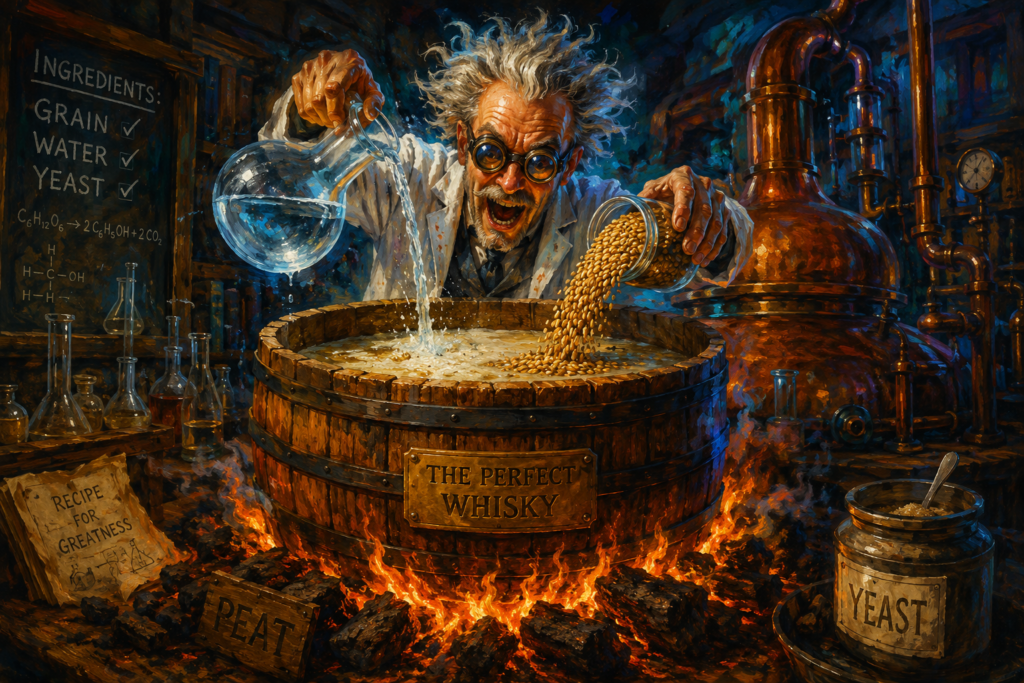
Whisky Officially Has 3 Ingredients. I Think It Has 5
Whisky officially contains only three ingredients: grain, water and yeast.
At least, that is what distilleries, regulations and whisky textbooks will tell you.
And technically, they are right. Strip whisky all the way back to its legal foundations and that really is the entire recipe. Grain provides the sugars, yeast converts them into alcohol, and water quietly carries the whole process from mash tun to bottling hall.
Simple.
Almost suspiciously simple, really, considering whisky can smell like grilled pineapple, old leather chairs, damp campfire ash, polished oak furniture, walnut cake, cigar boxes or the inside of a weather-beaten fishing boat engine room.
And that is where the tidy little “three ingredients” explanation starts falling apart for me.
Because after years of drinking whisky from Scotland, Ireland, Japan, India and Kentucky, I have become increasingly convinced that two of whisky’s biggest flavour contributors are missing from the official definition entirely.
Peat.
And casks.
Legally, they are not ingredients. I understand that argument perfectly well. But flavour does not care much about legal definitions, and once peat smoke embeds itself into barley while oak slowly infuses spirit with spice, tannin, vanilla and dried fruit over decades, it becomes difficult to pretend these are merely background influences.
At some point they stop feeling like production methods and start feeling very much like ingredients.
Officially, whisky may still have three ingredients.
But in the glass, I would argue it has five.
The Official 3 Whisky Ingredients
- Grain
- Yeast
- Water
The 2 Unofficial Ingredients
- Peat
- Casks
Grain — The Foundation Beneath Every Whisky Ever Made
Every whisky begins with grain, though that statement hides far more complexity than people sometimes realise. Grain is not simply raw material for alcohol production. It shapes texture, sweetness, spice and weight long before oak ever enters the equation. In many ways, the grain bill already determines whether a whisky will eventually lean elegant, oily, creamy or aggressively spicy before the stills are even switched on.
Barley remains whisky’s spiritual home, particularly in Scotland where single malt Scotch whisky must legally be made from 100% malted barley at a single distillery. That requirement alone creates an entirely different style of spirit compared to bourbon or rye. Malted barley tends to produce oily, cereal-rich new make filled with biscuit notes, orchard fruit and nutty depth, which is why even young Speyside malts often carry that familiar apple-and-shortbread softness underneath the oak.
Corn pushes whisky somewhere else entirely. Bourbon’s legally required minimum of 51% corn creates much of the category’s signature sweetness before the whiskey has even touched a barrel. Vanilla pudding, burnt sugar, maple syrup, buttered popcorn — those flavours do not suddenly appear after maturation. The grain itself is already laying the foundation.
We explored this more deeply in:
Bourbon Explained
Rye, meanwhile, can make whisky feel almost architectural in its sharpness. Pepper spice, dry herbs, cracked black pepper and that firm angular edge some people adore while others bounce off immediately. Wheat softens spirit in the opposite direction, creating something creamier and more rounded.
And then there is rice, which whisky still cannot quite decide what to do with. Depending on where you are in the world it is either classified as a grain or technically considered a grass, yet rice whisky undeniably exists and has carved out its own identity in parts of Asia. Whisky has always been surprisingly flexible once distillers start making genuinely interesting spirit. Rules tend to loosen when flavour gets compelling enough.
Even colouring circles back to grain in an oddly amusing way. Caramel colouring, controversial as it may be among enthusiasts, is itself derived from grain sugars. So even when producers artificially darken whisky for consistency, the process still traces back to cereal origins.
We explored the wider world of whisky grains in much greater detail here:
Whisky Grains Explained: Barley, Mashbills & Heritage Cereals
Still, grain alone cannot explain whisky’s astonishing range of flavours. Not even close.
For that, we have to look at fermentation.
Yeast — The Ingredient Whisky Drinkers Ignore Until They Suddenly Don’t
For decades, yeast barely featured in whisky conversations at all. Distilleries talked endlessly about casks, still shapes and warehouse locations while yeast was treated as little more than an invisible workforce quietly converting sugar into alcohol before disappearing from the story entirely.
Modern whisky thinking has changed that.
Or at least, it should have by now.
Because yeast creates flavour. A huge amount of it.
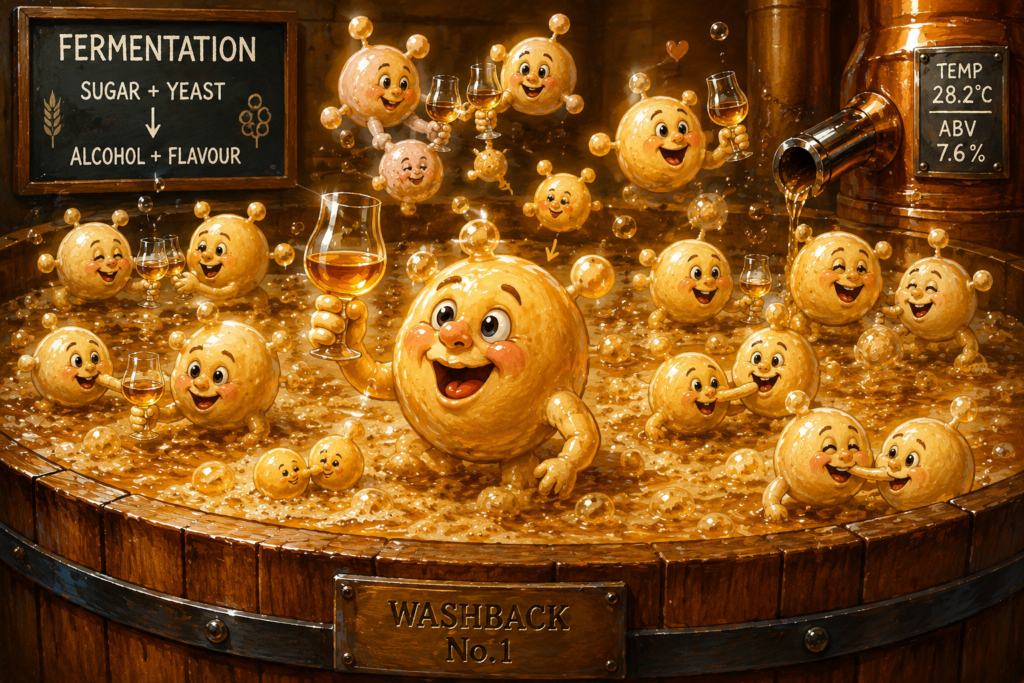
During fermentation, yeast produces esters, acids, alcohols and aromatic compounds that shape spirit character long before maturation begins. Fruity whiskies, floral whiskies and even certain oily or spicy profiles often owe far more to fermentation than most drinkers realise. The idea that flavour begins inside the cask has always felt slightly misleading to me. Some of the most important character development happens bubbling away inside washbacks while nobody is paying attention.
And once distilleries start experimenting intentionally, things become fascinating very quickly.
At Chichibu Distillery Spotlight, fermentation borders on obsession. The use of mizunara washbacks subtly alters the interaction between yeast and wort itself, adding another layer of flavour development before distillation has even started. It sounds almost eccentric on paper, admittedly, but then you taste the spirit and realise just how many microscopic details contribute to whisky character.
Four Roses perhaps demonstrates this even more clearly:
Four Roses Distillery Spotlight
The distillery famously works with multiple yeast strains alongside different mashbills, effectively building an entire flavour matrix before the whiskey ever sees oak. One recipe bursts with ripe red fruit while another leans floral and delicate despite emerging from the same distillery using the same stills.
Scotland traditionally remains more conservative, relying heavily on distillers yeast, though some producers still incorporate brewers yeast for additional texture and complexity. Even there, however, longer fermentations and evolving yeast management are increasingly being treated as flavour tools rather than simply functional processes.
And honestly, fermentation probably still does not receive enough attention among whisky enthusiasts. People obsess over cask types because casks are easy to understand and easy to market. Yeast is invisible. You cannot photograph fermentation flavour for Instagram.
But you can absolutely taste it.
Water — Essential to Whisky, Less Essential to Flavour?
Few things in whisky are wrapped in more mythology than water.
Distilleries love talking about ancient springs and hidden Highland burns as though the water itself contains some secret magical property impossible to replicate elsewhere. Entire marketing campaigns have been built around mineral-rich aquifers and untouched mountain sources.
And honestly, I have always remained slightly skeptical.
That is not to say water does not matter. Of course it matters. Distilleries require enormous quantities of it. Water is needed for steeping barley, creating wort, cooling condensers, generating steam, cleaning equipment and maintaining virtually every stage of production. Older distilleries especially were almost always built beside reliable water supplies because nineteenth-century infrastructure simply was not capable of moving industrial-scale volumes efficiently through remote landscapes.
But flavour-wise? I think whisky people sometimes romanticise water because it sounds more poetic than admitting the cask is doing most of the heavy lifting.
Mineral composition can certainly influence fermentation and yeast behaviour. Certain minerals may help shape how fermentation develops, which in turn can alter flavour creation during the process itself. But minerals themselves do not distill. Most remain behind inside the still, and when whisky is eventually reduced to bottling strength, major whisky-producing countries generally require demineralised water for proofing down.
The idea that a Highland spring somehow survives distillation intact into your glass has always felt more romantic than scientific.
Important? Absolutely.
Direct flavour contributor? Probably far less than many distilleries would like you to believe.
Peat and casks, however, are much harder to dismiss.
Because unlike still shapes or warehouse humidity, they physically transfer themselves into the whisky itself.
Peat — Whisky’s Unofficial Fourth Ingredient
Legally speaking, peat is not considered an ingredient. It is merely a fuel source used during the drying of malted barley.
But spend enough time with heavily peated whisky and that distinction starts feeling almost silly.
When peat smoke rises through damp barley, phenolic compounds embed themselves directly into the grain. Those compounds survive fermentation, survive distillation and eventually emerge inside the finished whisky as smoke, ash, iodine, seaweed, tar and medicinal intensity. That is not simply environmental influence. That is flavour infusion.
Very much like a teabag suspended in hot water, peat transfers itself into the whisky.
And not all peat behaves the same way either, which is where things become genuinely fascinating. One of the biggest misconceptions among newer whisky drinkers is that smoke is somehow a singular flavour. It is not. Different peat sources create entirely different aromatic profiles depending on vegetation, soil composition and geography.
Some Islay whiskies smell like damp bandages left beside a beach bonfire.
Others lean toward earthy moss, fireplace ash or the oily smoke of extinguished cigars. Certain mainland peated whiskies carry a drier, sootier character that feels closer to old coal dust than maritime iodine.
We explored this in much greater depth here:
Smoky Whisky Explained
Remove peat from Laphroaig or Ardbeg and you fundamentally change the identity of the whisky itself. The stills may remain identical. The casks may remain identical. Yet the spirit becomes something entirely different.
At that point, calling peat merely part of the “process” starts feeling like semantics.
Casks — The Ingredient Quietly Doing Most of the Work
If peat is whisky’s unofficial fourth ingredient, casks are unquestionably the fifth.
In fact, I would go even further than that.
Casks probably contribute more flavour to whisky than anything else after distillation itself, and sometimes I think the industry still understates just how transformative oak really is.
Fresh new make spirit can be surprisingly raw. Even beautifully fruity spirit often feels incomplete, carrying flashes of promise rather than full maturity. Then the cask steps in and starts rewriting the whisky over years or decades.
And the complexity goes far beyond simply saying a whisky was “aged in oak”.
What type of oak? American or European?
Heavy char or light char?
Aggressive toast or gentle toast?
First-fill or refill?
Fresh oak or exhausted wood?
Did the barrel previously hold bourbon, sherry, port, rum, Madeira or wine?
Every one of those decisions changes the whisky.
A whisky cask is less like a container and more like a slow-moving ingredient infusion system.
Sherry casks, for example, can flood spirit with dense dried-fruit richness that sometimes smells like walnut cake, old cigar boxes and Christmas pudding warming beside a fireplace:
Sherry Casks in Whisky Explained
Modern cask finishing has pushed this concept even further:
Industry Insight: Cask Finishes
Bourbon follows a completely different philosophy again. By law, bourbon must mature in virgin American oak barrels, meaning every bourbon begins life interacting with completely fresh wood. Yet even there, tiny differences in toast and char levels dramatically alter flavour extraction. One barrel may lean heavily into vanilla cream and coconut while another pushes smoke, espresso bitterness and burnt sugar.
And sometimes distillers decide one cask simply is not enough.
Woodford Reserve Double Oaked Review is perhaps one of the clearest examples of how additional oak maturation can fundamentally reshape a whiskey while still remaining legally bourbon. The second heavily toasted barrel adds another layer of roasted sweetness and dark spice that feels every bit as transformative as adding another ingredient to a recipe.
Because in many ways, that is exactly what the cask is doing.
It is not merely storing whisky.
It is feeding it.
So How Many Ingredients Does Whisky Really Have?
Officially, whisky still begins and ends with grain, water and yeast. The regulations remain wonderfully simple and stubbornly traditional.
But whisky itself has never been simple.
It absorbs smoke from ancient peat bogs. It pulls flavour from sherry-soaked oak that may once have rested in Andalusian bodegas for decades. It evolves through oxidation, climate, evaporation and time until the liquid emerging from the barrel barely resembles the raw spirit that first entered it years earlier.
Somewhere between the mash tun and the final pour into a glass, whisky becomes more than the sum of its official parts.
And perhaps that is exactly why whisky continues to fascinate people so deeply.
Because from only a handful of ingredients — whether you believe there are three or five — humanity somehow created a drink capable of smelling like an orchard, a bakery, a shipyard, an old library, a beach bonfire or a forgotten dunnage warehouse full of mouldering oak and history.
Love all of the information published here. I have been a whisky drinker for almost 30 years. I attend whisky tastings on a regular basis and gain an enormous amount of information about specific whisky’s. Your email enhances that information much more by your detail and analysis of the process. I also agree with your ‘five’ ingredient theory! Thank you.😊🥃
Thank you for the kind words and for being part of the whisky community for so many years. It’s great to hear that the articles add value alongside the tastings you attend. And I’m glad you agree with the five-ingredient theory—it certainly sparks some interesting conversations! Slàinte and thanks for reading.