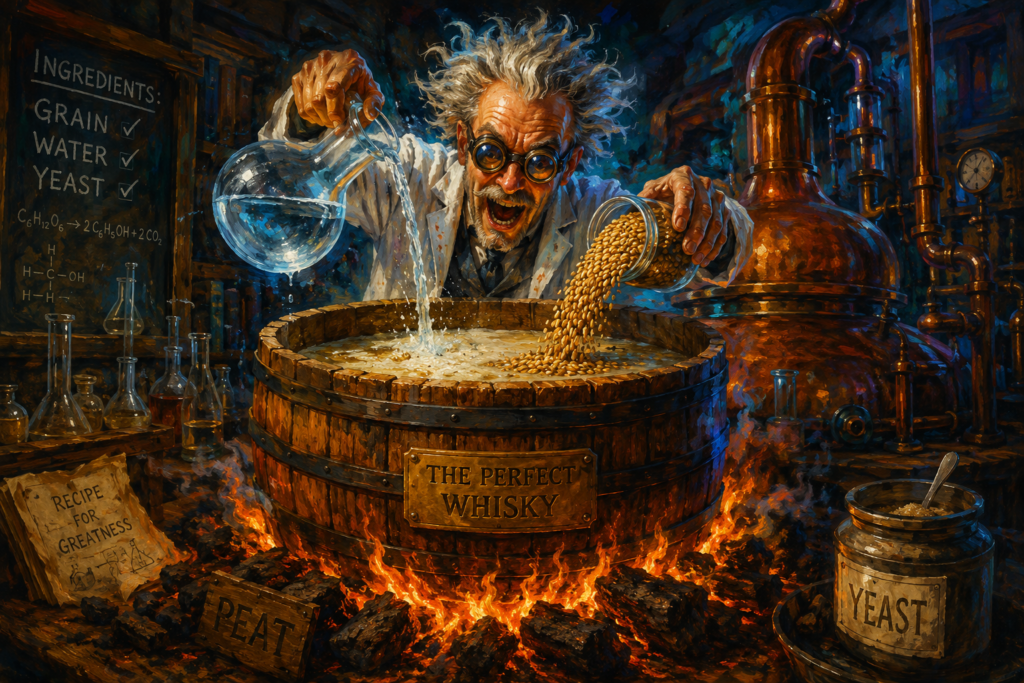
Fermentation Explained: The Stage That Quietly Shapes Whisky More Than Most People Realise
When whisky fans talk about flavour, the conversation almost always drifts toward casks eventually.
Sherry butts. Bourbon barrels. Virgin oak. Peat levels. Still shapes. Worm tubs. Everybody loves talking about the dramatic stuff because it’s easy to taste and easy to picture in the glass. A first-fill sherry cask announces itself immediately. Heavy peat smoke doesn’t exactly hide either. Even still shape has become part of whisky folklore at this point, with distilleries proudly pointing toward giant onion-shaped stills or unusually long lyne arms as if they’re revealing trade secrets.
Fermentation, meanwhile, rarely gets the same attention. It tends to sit quietly in the background of distillery tours, mentioned briefly between mashing and distillation before everybody moves on toward the still house and warehouse where the more cinematic parts of whisky production live.
And honestly, I think that’s a mistake.
Because the longer you spend around distilleries, the more you notice many distillers become strangely animated when fermentation comes up in conversation. Sometimes more animated than when they talk about casks. The discussion suddenly becomes less polished, less rehearsed and far more opinionated.
Part of that is because fermentation still retains a degree of unpredictability. Distilleries can control temperatures, monitor yeast performance and follow carefully designed production schedules, but fermentation is still fundamentally biological. Living organisms are involved. Tiny environmental changes matter. Bacterial activity matters. Timing matters. And unlike cask maturation, where flavour development unfolds slowly over years, fermentation happens quickly, violently and often somewhat chaotically.
Which makes it fascinating.
Because before oak adds vanilla or spice, before peat smoke wraps itself around the spirit and before copper stills shape texture and weight, there’s a giant tank full of warm sugary liquid and billions of microscopic organisms effectively deciding what kind of whisky this is eventually going to become.
For more whisky production deep dives, you can explore the full Whisky Academy section on Dram1.
What Actually Happens During Whisky Fermentation?
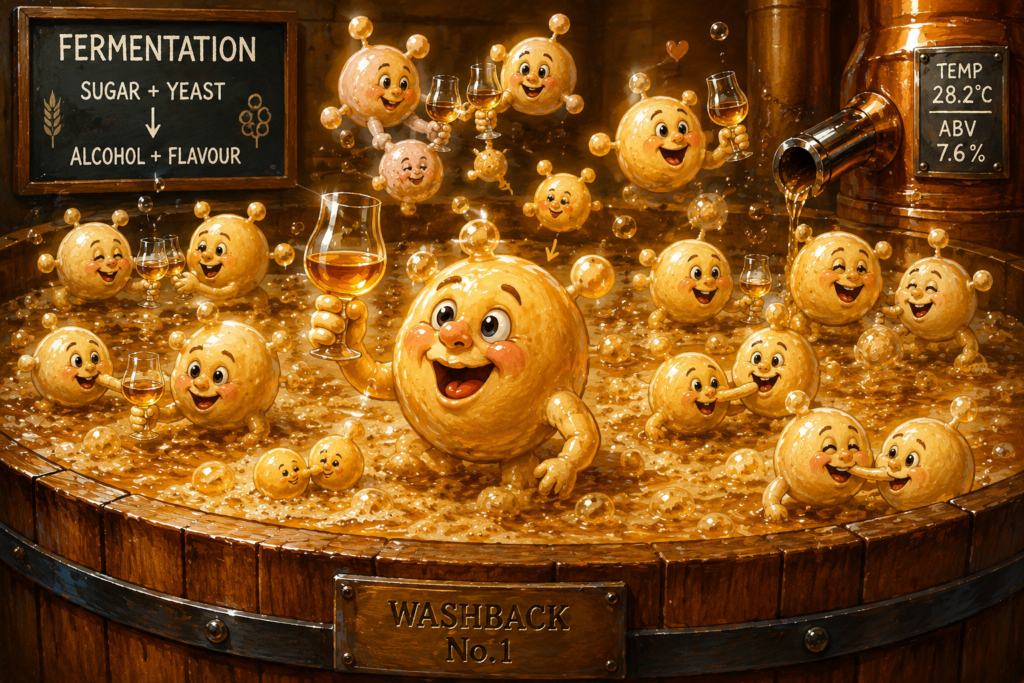
At its simplest, fermentation is the process where yeast consumes sugar and converts it into alcohol.
But reducing fermentation to that single sentence feels a little like describing cooking as “heating food until edible.” Technically accurate perhaps, but it misses almost everything interesting about what is actually happening.
Before fermentation even begins, the distillery first creates a sugary liquid called wort during the mashing stage. Hot water is passed through milled grain — usually malted barley in single malt production — extracting fermentable sugars that will eventually feed the yeast. The resulting liquid looks deceptively innocent at this stage. Sweet, warm and cereal-forward, with more resemblance to malted breakfast drink than anything most people would associate with whisky.
That wort is then cooled and pumped into large fermentation vessels called washbacks.
Technically speaking, washbacks and fermenters are essentially the same thing. Scotch whisky distilleries simply prefer the older terminology because whisky as an industry tends to cling affectionately to historical language long after other industries have modernised theirs. In the United States, you’ll more commonly hear the resulting liquid referred to as distiller’s beer, which honestly makes perfect sense because whisky production up to this stage is remarkably similar to brewing beer.
The major difference is simply that whisky wash contains no hops and is never intended to be consumed as-is. Instead, it becomes the raw material for distillation.
Then the yeast goes in.
And this is where the calm, orderly production process suddenly starts feeling alive.
If you’ve ever stood inside a working fermentation room during active production, you’ll know it immediately. Washbacks do not quietly bubble away like gentle little science experiments. They hiss. They churn. Thick foam climbs aggressively up the sides of the tanks while carbon dioxide blasts out of the liquid in heavy waves. The room itself changes too. Heat builds rapidly, the air turns humid and sticky, and the smell shifts constantly from warm cereal sweetness toward overripe fruit, fresh bread dough, yoghurt and green apples depending on the distillery.
It’s one of the few stages in whisky production that genuinely feels volatile.
And yes, the warnings about not leaning too far over a washback are absolutely real. Carbon dioxide is heavier than air and can accumulate surprisingly quickly around active fermentation tanks. Distillery workers are not being theatrical when they tell visitors to avoid sticking their heads too deep into the foam.
The Strange Life Cycle Of Yeast
There’s something oddly poetic about the life of a yeast cell inside a washback.
It begins surrounded by abundance. Sugar everywhere. Warm temperatures. Ideal conditions for rapid reproduction. The yeast immediately starts feeding aggressively, converting sugars into alcohol and carbon dioxide while multiplying at remarkable speed. For a while the system almost feeds itself in a perfect upward spiral. More yeast creates more alcohol. More activity creates more heat. More yeast consumes more sugar.
Until eventually the yeast creates an environment toxic to its own survival.
At a certain point the alcohol concentration simply becomes too hostile for the yeast to function efficiently any longer. Most distilling strains begin struggling somewhere around 15% ABV, although most whisky distilleries never allow fermentation to continue anywhere near that level anyway.
And that’s where the commercial realities of whisky production start colliding with flavour development.
Because distilleries absolutely could chase slightly higher alcohol yields if they wanted to. The issue is not necessarily capability. The issue is efficiency. The first major portion of alcohol develops relatively quickly, often within a couple of days. But every additional percentage point after that takes increasingly more time to achieve.
Meanwhile your washback is occupied the entire time.
And distilleries hate idle equipment.
A washback tied up for days chasing marginal alcohol gains is a washback unavailable for the next production cycle. For large-scale operations especially, that becomes commercially unattractive very quickly. Most Scotch malt distilleries therefore ferment somewhere around 7–10% ABV wash strength before moving on to distillation.
But here’s the really important part: when distilleries intentionally choose longer fermentation times, they generally are not doing it because they desperately want slightly more alcohol.
Casks mature whisky, but fermentation decides whether the spirit was interesting to begin with.
They’re doing it because longer fermentations often taste noticeably different.
The longer you speak to distillers, the more you realise fermentation is not viewed internally as some minor technical stage awkwardly sitting between mashing and distillation. Many quietly see it as the foundation of spirit character itself. The Scotch Malt Whisky Society once noted that “up to 80 per cent of the character of new-make spirit comes courtesy of fermentation,” which suddenly makes all those conversations about washback material and fermentation time feel a lot less niche. Scotch Malt Whisky Society
Why Longer Fermentations Create More Fruity Spirit
This is where fermentation starts becoming genuinely fascinating from a flavour perspective.
A relatively short fermentation can produce a perfectly good wash. Efficient, reliable and cereal-forward. Plenty of distilleries operate this way very successfully. But when fermentation extends beyond that initial efficient alcohol-production window, other things begin happening inside the washback besides straightforward ethanol creation.
Yeast behaviour changes. Secondary reactions begin developing more heavily. Bacterial influence becomes more noticeable. Ester production continues evolving. And slowly the wash itself starts becoming more complex and expressive.
This is where many of those bright fruity notes people associate with certain distilleries begin emerging. Pineapple. Pear drops. Banana foam sweets. Papaya. Guava. Sometimes even that slightly creamy tropical acidity that feels almost rum-like in character.
The interesting thing is that many of these flavours can already be found in the wash itself before distillation has even happened.
And once you start noticing that, fermentation becomes impossible to ignore.
Some distilleries openly obsess over fermentation length because of this. Others barely discuss it publicly at all, which honestly only adds to the mystique surrounding the subject. Part of the reason is that fermentation is incredibly difficult to isolate scientifically in whisky production. If a spirit tastes tropical, how much of that character comes specifically from fermentation rather than still shape, yeast strain, cut points or maturation?
The frustrating answer is usually: all of it.
And that’s partly what makes fermentation so difficult to pin down properly. Whisky production rarely allows you to isolate one variable cleanly for very long.
Stainless Steel Fermenters vs Wooden Washbacks
Few fermentation topics create more debate among whisky enthusiasts than the question of stainless steel versus wooden washbacks.
Modern distilleries love stainless steel for obvious reasons. Steel is hygienic, durable, easier to clean and dramatically simpler to maintain over long production cycles. It also allows greater temperature consistency during fermentation, which matters because active yeast creates a surprising amount of heat inside the washback.
From a production standpoint, stainless steel makes enormous sense.
And distilleries using steel fermenters will usually tell you roughly the same thing: steel is cleaner, more efficient and shouldn’t influence flavour at all.
Distilleries still using wood tend to agree with the first two points.
Just not the last one.
Because wooden washbacks create a fermentation environment that stainless steel simply can’t replicate. Wood is porous. Microorganisms live inside it. Bacteria interact with the wash in ways that become impossible inside a perfectly sanitised steel vessel.
Now, bacterial influence in whisky is a slightly awkward subject because the word “bacteria” immediately sounds negative to most people. But in alcohol production, controlled bacterial activity can sometimes be hugely beneficial. Rum production embraces this idea very openly, particularly in Jamaica where bacterial fermentation contributes enormous flavour complexity. Whisky distilleries tend to discuss the subject more cautiously, but the underlying principle absolutely exists there too.
And honestly, I suspect some distilleries privately believe fermentation influences flavour far more heavily than they publicly admit.
Partly because proving it definitively is difficult.
Partly because whisky marketing still prefers talking about casks.
Chichibu’s Mizunara Washbacks Feel Slightly Unhinged — In A Good Way
One of the most fascinating examples is Chichibu Distillery in Japan.
Chichibu installed washbacks made from mizunara oak, which from a practical perspective sounds almost completely irrational. Mizunara is notoriously difficult wood. Expensive. Fragile. Porous. Difficult to work with even for cask production, never mind giant fermentation vessels that constantly deal with heat, liquid and microbial activity.
But that’s precisely why Chichibu became interested in it.
Because mizunara’s porous structure potentially allows additional bacterial interaction within the wood itself, which may encourage the formation of highly fruity esters during fermentation. Whether that theory fully explains Chichibu’s spirit character is impossible to say with certainty, but the resulting whisky often does display those vivid tropical fruit notes people associate with the distillery: pineapple, guava, papaya and bright exotic acidity that occasionally feels almost rum-adjacent.
Could all of that come solely from the washbacks? Probably not.
Distilleries generally don’t make production harder and vastly more expensive for themselves unless they genuinely believe it changes the spirit in a meaningful way.
The Ardnamurchan Comparison I Wish I Could Have Tried
When I visited Ardnamurchan Distillery a few years ago, they still operated both wooden and stainless steel washbacks at the time.
Which immediately caught my attention because opportunities like that are surprisingly rare in modern whisky production. Very few distilleries operate both systems simultaneously under otherwise similar production conditions. And from a whisky geek perspective, that creates the possibility of a genuinely fascinating comparison.
Could you actually taste the difference in the resulting new make spirit?
Unfortunately, I never got the chance.
The wooden washbacks eventually became too impractical to maintain. They leaked repeatedly, required constant upkeep and were eventually phased out in favour of stainless steel. Operationally, the decision made complete sense. Romanticism tends to lose eventually when maintenance costs keep climbing.
Still, part of me genuinely regrets missing the opportunity to taste those spirits side-by-side because fermentation remains one of the hardest variables in whisky production to pin down precisely.
Its influence feels obvious once you start paying attention to it.
Quantifying that influence with certainty is much harder.
Fermentation Is Probably More Important Than Most Whisky Drinkers Realise
Cask maturation will probably always dominate whisky conversations because it’s visible, dramatic and easy to explain. Everybody understands the basic idea that wood changes flavour over time.
Fermentation is messier than that.
It’s biological. Slightly chaotic. Sometimes inconsistent. Distilleries can follow nearly identical production processes and still end up with noticeably different spirit character depending on tiny variations in yeast behaviour, fermentation duration, bacterial influence or temperature management.
But without fermentation there is no spirit character waiting for oak to mature later.
No fruity esters.
No creamy texture.
No floral compounds.
No tropical notes hiding underneath the cask influence years later.
Just sugary grain water waiting for something interesting to happen.
And the next time you find yourself standing inside a distillery watching a washback foam violently while the room fills with heat, fruit and carbon dioxide, it’s worth remembering that this loud, messy and slightly chaotic stage may well shape the future flavour of the whisky more than most people in the building realise.
Final Thoughts
The deeper you dive into whisky production, the harder it becomes to view fermentation as just a technical step sitting awkwardly between mashing and distillation.
It’s messy. Temperamental. Sometimes inconsistent. Distilleries can monitor temperatures, select carefully engineered yeast strains and follow tightly controlled production schedules, yet fermentation still retains an element of unpredictability that makes it feel strangely alive compared to many other parts of whisky making.
And maybe that’s exactly why it matters so much.
Because long before oak starts layering on vanilla, spice or dried fruit, fermentation is already building the foundations of texture, fruitiness and character underneath it all. In many ways, the cask is amplifying a conversation fermentation already started days earlier inside the washback.
That’s also what makes the debates around fermentation so fascinating. Stainless steel versus wood. Long fermentation versus short fermentation. Controlled consistency versus slightly chaotic complexity. There often isn’t a completely right answer, only different philosophies about what kind of spirit a distillery wants to create.
Personally, the more distilleries I visit, the more I find myself paying attention to the fermentation room. Not because it’s the prettiest part of whisky production — it usually isn’t — but because it might quietly be the most important. The smells, the heat, the foam climbing up the washbacks, the sharp sting of carbon dioxide hanging in the air… it’s one of the few moments in whisky making where the process genuinely feels alive.
And once you start noticing how much flavour is already being created there, it becomes impossible to look at fermentation as just another production stage again.
Further Reading
For more whisky production deep dives:
Additional external resources worth exploring: