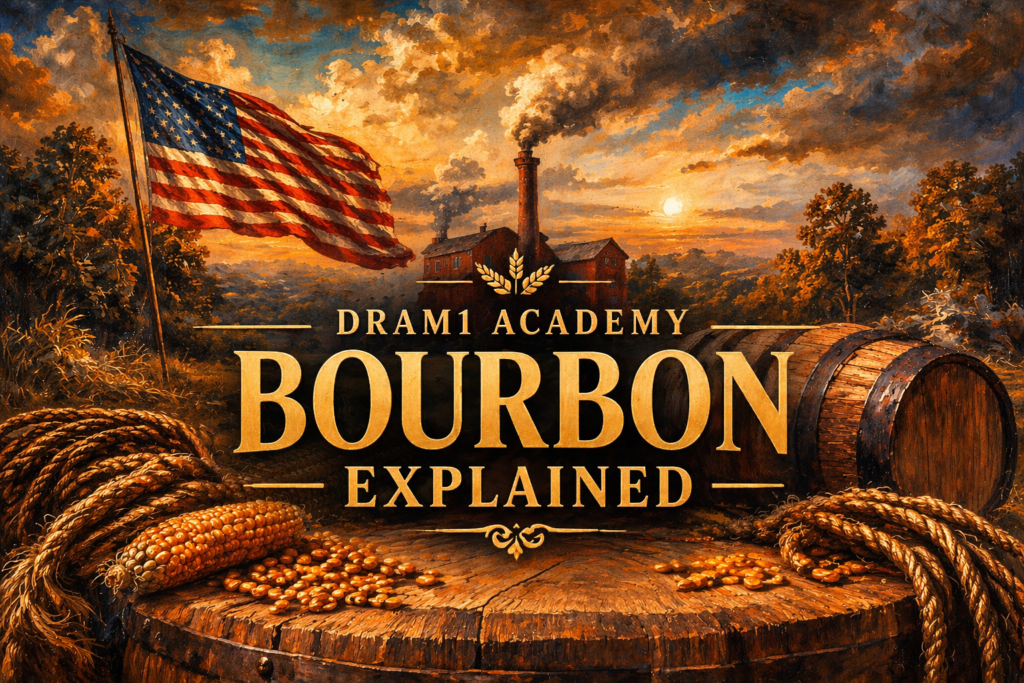
Bourbon Explained: What It Is, How It’s Made, and Why It Tastes So Distinct
There’s a reason bourbon feels instantly recognisable, even to people who are just starting their whisky journey. That first sip—rich, sweet, layered with vanilla and spice—doesn’t really behave like Scotch, Irish whiskey, or anything else on the shelf.
And that’s not by accident.
Bourbon is one of the most tightly regulated whisky categories in the world, yet at the same time one of the most expressive. The rules define it. The details shape it. And once you understand both, the flavour suddenly makes perfect sense.
What Is Bourbon?
Legally speaking, bourbon is defined by a strict set of requirements laid out in U.S. law. According to the U.S. Code of Federal Regulations, bourbon must:
- Be made in the United States
- Contain at least 51% corn in the mashbill
- Be distilled to no more than 160 proof (80% ABV)
- Enter the barrel at no more than 125 proof (62.5% ABV)
- Be aged in new, charred oak containers
- Be bottled at a minimum of 80 proof (40% ABV)
- Contain no additives
You can verify the official definition here:
👉 https://www.ecfr.gov/current/title-27/chapter-I/subchapter-A/part-5/subpart-I/section-5.143
That last rule—no additives—is crucial. Bourbon is always natural colour, which means every shade in the glass comes directly from the barrel.
The Real Source of Bourbon’s Sweetness
Corn gets all the credit, but it shouldn’t.
Yes, corn brings a soft, slightly sweet foundation—but it’s not responsible for that signature bourbon profile. The real source of bourbon’s richness is the new charred oak barrel.
Because these barrels are used only once, they’re incredibly active. The charring process breaks down wood compounds, releasing:
- Vanillin → vanilla sweetness
- Caramelised sugars → toffee, brown sugar
- Oak lactones → coconut notes
- Spice compounds → clove, cinnamon
The result is a whisky that often feels almost dessert-like, even when the recipe itself isn’t particularly sweet.
If you compare this to Scotch—where casks are reused—you immediately understand why bourbon feels more intense, more forward, more “in your face.”
A Rule Shaped by Industry (and Why It Still Exists)
There’s a long-standing story in bourbon history that the requirement for new oak barrels didn’t just happen for flavour—it was also driven by the American cooperage and lumber industries.
By the late 1800s, the use of fresh barrels had become common practice, and formalising it ensured a constant demand for American oak. Whether or not it came directly from a “lumberjack union bill” in the way it’s often told, the economic incentive was very real.
And today, that rule is untouchable.
There are occasional discussions about allowing reused barrels to reduce costs or environmental impact, but the reality is simple:
👉 remove new oak, and bourbon stops tasting like bourbon.
The identity of the category is tied directly to that decision.
Mashbill Matters: The Grains Behind the Flavour
Every bourbon starts with at least 51% corn—but everything beyond that is where distillers define their style.
If you want to dive deeper into how grains shape flavour, this connects directly to your foundation here:
👉 https://dram1.com/whisky-grains-explained-barley-mashbill-heritage-cereals/
The Core Grains
Corn (51%+)
Provides sweetness and body, forming the backbone of the spirit.
Rye
Adds spice, structure, and dryness. Often described as peppery or herbal.
Wheat
Softens the profile, creating a smoother, rounder whisky.
Malted Barley
Usually a small percentage, primarily used to aid fermentation.
High-Rye vs Wheated Bourbon
This is where bourbon becomes incredibly versatile:
- High-rye bourbon → spicy, bold, more aggressive
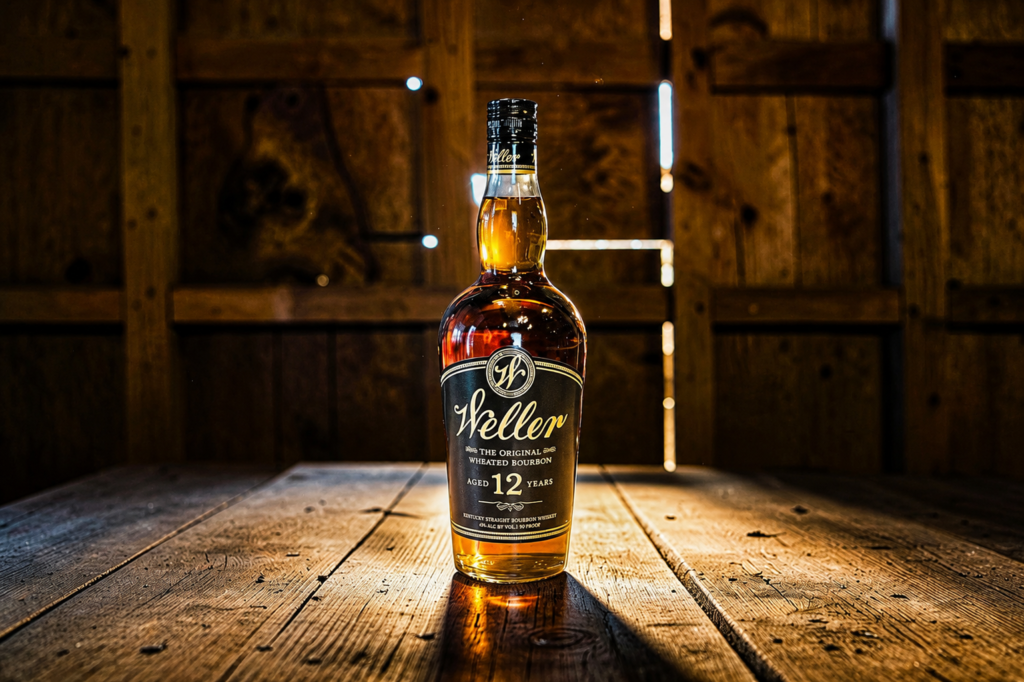
- Wheated bourbon → soft, smooth, approachable
Same legal category, completely different experience in the glass.
That flexibility is part of what keeps bourbon interesting—it’s not just one flavour profile, it’s a framework for many.
Climate: Why Bourbon Ages Differently
Kentucky’s climate plays a huge role in how bourbon develops. Though nowadays Bourbon is made all across the United Sates so depending on the Bourbon this can differ. But the vast majority still comes from Kentucky.
Unlike Scotland’s relatively stable conditions, Kentucky experiences:
- Hot summers
- Cold winters
- Large seasonal swings
This causes the spirit to expand into the wood during heat and contract during cold, pulling flavour compounds in and out of the barrel repeatedly.
The result is:
- Faster maturation
- More intense extraction
- Bigger, bolder flavours at a younger age
It also increases evaporation—known as the angel’s share:
👉 https://dram1.com/angels-share-explained/
Bourbon vs Tennessee Whiskey
This is one of those distinctions that confuses a lot of people.
Legally, Tennessee whiskey meets all the requirements of bourbon. The difference comes down to one additional step:
👉 The Lincoln County Process
This involves filtering the spirit through charcoal before it goes into the barrel.
For example, Jack Daniel’s could technically be labelled as bourbon—but chooses not to, because that charcoal filtration is central to its identity.
You can read more about this process here:
👉 https://en.wikipedia.org/wiki/Lincoln_County_Process
So in simple terms:
- All Tennessee whiskey qualifies as bourbon
- Not all bourbon is Tennessee whiskey
The Barrel Rule (and Its Limitations)
The “new oak only” rule defines bourbon—but it also limits it.
Unlike Scotch, bourbon can’t be finished in wine, port, or sherry casks without losing its classification.
The moment you do that, it’s no longer bourbon.
There are rare exceptions that stay within the rules, like:
👉 https://dram1.com/woodford-reserve-double-oaked/
In that case, the whisky is transferred into a second new oak barrel, intensifying flavour while remaining legally compliant.
Proof vs ABV: Understanding the Numbers
In the U.S., alcohol strength is often listed as proof rather than ABV.
The formula is simple:
👉 Proof = 2 × ABV
So:
- 50% ABV = 100 proof
- 60% ABV = 120 proof
If you want a deeper breakdown:
👉 https://dram1.com/whisky-proof-abv-explained/
Higher proof bourbons tend to carry more intensity—more flavour, more texture, more heat.
Bourbon Label Terms Explained (Quick Guide)
Bourbon label terms describe how the whisky is made, aged, and bottled, with designations like Straight, Bottled in Bond, and Single Barrel indicating specific legal standards and production methods.
If you’ve ever wondered what terms like “Bottled in Bond” or “Single Barrel” actually mean, here’s a quick breakdown:
- Straight Bourbon – Aged at least 2 years, with no additives. If aged under 4 years, the age must be stated on the label.
- Kentucky Straight Bourbon – Straight bourbon that is distilled and aged in Kentucky.
- Bottled in Bond – Produced by one distiller, in one distillery, during a single season, aged at least 4 years, and bottled at exactly 100 proof. Defined under the Bottled-in-Bond Act of 1897 (regulated by the Alcohol and Tobacco Tax and Trade Bureau).
- Single Barrel – Whisky bottled from one individual barrel, meaning each release can vary slightly in flavour.
- Barrel Proof (Cask Strength) – Bottled directly from the barrel without dilution, resulting in higher strength and more intense flavour.
- Sour Mash – A production method where part of a previous batch is reused to stabilise fermentation and maintain consistency.
A Brief History: From Frontier Spirit to Global Icon
Bourbon’s origins trace back to early American settlers, many of whom brought distilling traditions from Scotland and Ireland.
Corn was abundant, easy to grow, and quickly became the grain of choice. Kentucky, with its limestone-filtered water and ideal climate, emerged as the centre of production.
Then came Prohibition (1920–1933).
The industry nearly collapsed. Most distilleries closed, and many never reopened. A small number survived by producing “medicinal whiskey,” which could legally be prescribed by doctors.
After Prohibition ended, bourbon had to rebuild—but it came back stronger, more regulated, and more clearly defined.
Today, it’s protected as a distinctive American product, even recognised internationally through trade agreements:
👉 https://americangrain.stream/on-bourbon-treaties/
Where to Go Next
If you want to see how all of this translates into actual bottles:
👉 https://dram1.com/category/whisky-reviews-and-tasting-notes/bourbon-rye/
And if you want to explore one of the most influential producers:
👉 https://dram1.com/buffalo-trace-distillery-spotlight/
FAQ Bourbon Explained
Is all bourbon made in Kentucky?
No—but a big part of the world’s supply comes from there.
Does bourbon have to be aged?
Not technically. But to be called straight bourbon, it must be aged for at least two years.
Why are bourbon barrels only used once?
Because the law requires new charred oak, maximising flavour extraction and defining the category.
Can bourbon be smoky?
It usually isn’t in the traditional sense. It doesn’t traditionally use peat like some Scotch whiskies.
Why does bourbon taste sweeter than Scotch?
Primarily due to the interaction with new charred oak, not just the corn content.
Final Thoughts on Bourbon Explained
Bourbon is a perfect example of how rules can shape flavour.
Take away the new oak, and it loses its identity. Change the mashbill, and it becomes something entirely different. Adjust the proof, and the experience shifts again.
It’s structured, but never restrictive. Defined, but still creative.
And once you understand what’s happening behind the scenes—the grains, the climate, the barrels—you stop just tasting bourbon… and start understanding it.