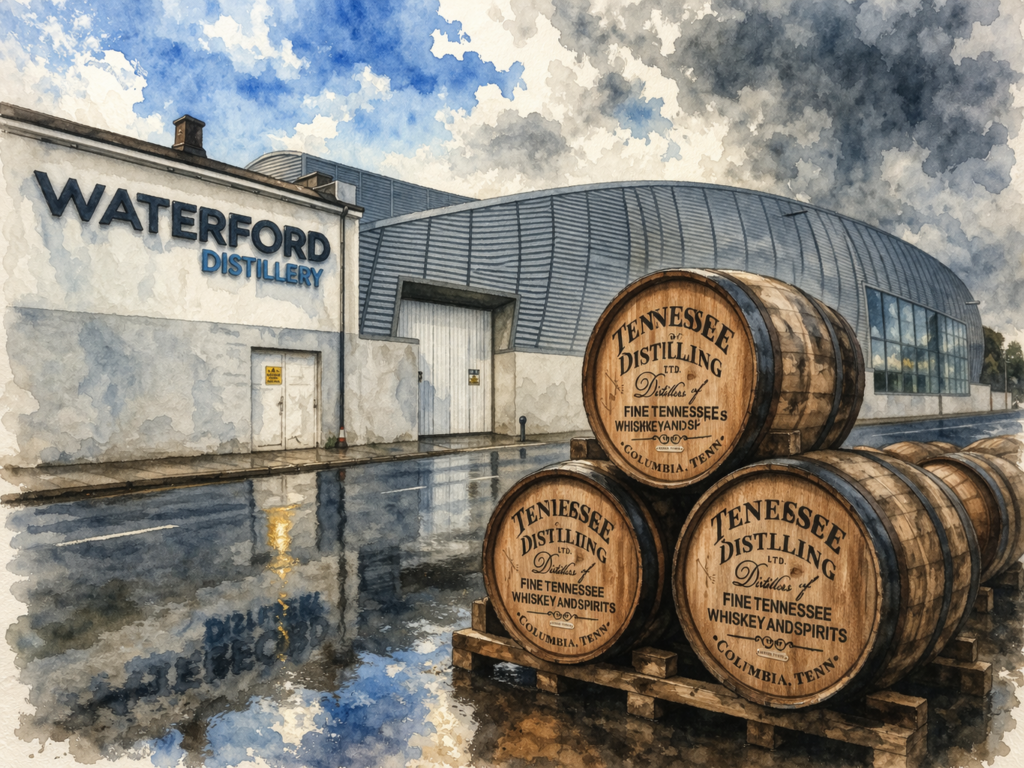
Waterford Distillery Returns: A Second Chance for Ireland’s Most Thought-Provoking Whisky Project
There are very few distilleries I’ve walked through where the conversation stayed with me longer than the whisky itself—and Waterford Distillery has always been one of them.
So seeing confirmation that the distillery has been acquired by Tennessee Distilling Group (TDG) lands as something quietly reassuring. After entering receivership in late 2024 and formally declaring insolvency that November, Waterford’s future looked uncertain for far too long. Now, with a deal in place covering the distillery and its intellectual property—while maturing stock is being sold separately—there’s at least a clear path forward again.
The financial details remain undisclosed, and the final signatures are still subject to regulatory approval, but the key point is simple: Waterford Distillery is not being lost to time.
Built on an Idea Most Distilleries Avoid
When Mark Reynier founded Waterford in 2015—after his work at Bruichladdich—he didn’t try to replicate what Ireland was already doing well.
Instead, he pushed in a direction most distilleries tend to sidestep: variability.
Single farm origin releases, full traceability of barley, fermentation and distillation designed to highlight differences rather than smooth them out. Waterford Distillery wasn’t chasing consistency—it was chasing clarity.
That approach made the distillery fascinating to follow, even when it divided opinion. Some saw it as the natural evolution of whisky; others questioned how scalable—or even necessary—it really was.
But it was never forgettable.
Visiting Waterford was the inspiration for me to dive deeper into the influence of different types of barley in my whiskies, if you’d like to learn more about my findings on the subject feel free to check out my Whisky Grains Explained article!
Walking Through It Changed How I Taste Whisky
My own visit to Waterford Distillery still feels unusually vivid.
Not because of spectacle—there isn’t much of that—but because everything feels deliberate. You’re not being guided through a polished narrative; you’re stepping into a working theory.
There’s a kind of focus to the place. No shortcuts, no distractions, just a very clear idea being tested at every stage of production.
The Nano Cuvée session was where it really clicked. Sitting there, blending different farm-origin distillates, you start to notice how the building blocks shift depending on where the barley came from. Not dramatically in every case, but enough to change direction, texture, emphasis.
It’s a rare moment where whisky stops being abstract and becomes something you can actively shape and question.
That’s why the thought of Waterford Distillery disappearing felt like more than just another business closure—it would have been the loss of a genuinely different perspective.
A New Owner With a Very Different Scale
Tennessee Distilling Group enters the picture from almost the opposite end of the spectrum.
Established in 2014 and based in Columbia, Tennessee, TDG operates at significant scale—multiple production campuses, extensive warehousing, and a strong footprint in contract distillation. Their portfolio includes collaborations with brands such as Heaven’s Door Spirits and Uncle Nearest.
From a structural point of view, they bring stability and capacity—two things Waterford clearly needed.
But culturally, it’s an interesting pairing.
Waterford Distillery has always been about detail and distinction. TDG is built around flexibility and volume. Whether those two approaches complement each other or pull in different directions will define what comes next.
The Releases That Deserve Continuation
Among Waterford’s many bottlings, the heritage barley series remains the most compelling expression of what the distillery set out to prove.
Releases like Heritage Hunter and Goldthorpe weren’t just concept-driven—they delivered flavour profiles that felt genuinely distinct, grounded in raw material rather than cask dominance.
Those are the projects that feel worth protecting.
Not because they represent the past, but because they point toward something whisky still hasn’t fully explored.
Feel free to check out my Waterford Heritage Hunter review to see why I loved this expression so much!
What Happens to the Philosophy?
That’s the question sitting underneath all of this.
The distillery is secured. The brand name survives. But the philosophy—the focus on terroir, on farm-level variation, on transparency—doesn’t automatically carry over with a change in ownership.
It could be preserved, adapted, or quietly set aside.
At this stage, there’s no indication which direction TDG will take.
Final Thoughts
Waterford Distillery always occupied an unusual space in Irish whiskey.
Not traditional, not mainstream, but not experimental for the sake of it either. It felt considered. Intentional. Willing to challenge assumptions without losing sight of drinkability.
Seeing it continue, even under new ownership, is something I’m genuinely pleased about.
Because whisky doesn’t need more of the same—it needs distilleries willing to ask different questions.
Waterford Distillery has always done exactly that. The next chapter will show whether those questions are still being asked.
Read more about the TDG purchase of Waterford at The Spritits Business and about the 2024 receivership at The Drinks Business.