Waxy Highland Soul & Wildcat Spirit
There are distilleries whose whiskies whisper rather than shout — and Clynelish Distillery is a master of that quiet confidence. Set on the rugged northern Highland coast near Brora, Clynelish produces a spirit that feels elemental and precise at the same time. Saline air, cool temperatures, and an unwavering commitment to character come together to create one of Scotch whisky’s most distinctive profiles: coastal, textural, and unmistakably waxy.
This is not a distillery built on spectacle. It’s built on feel. On mouthfeel. On the kind of nuance that rewards patience and repeated visits to the glass.
From Early Clynelish to a Modern Highland Icon
The story begins in 1819, when the original Clynelish Distillery was founded by the Marquis of Stafford. Its location — close to water, exposed to North Sea winds, and far from urban distraction — shaped a spirit that quickly became valued for both quality and consistency. For much of its early life, Clynelish’s output was destined primarily for blends, quietly underpinning some of Scotland’s most famous names.
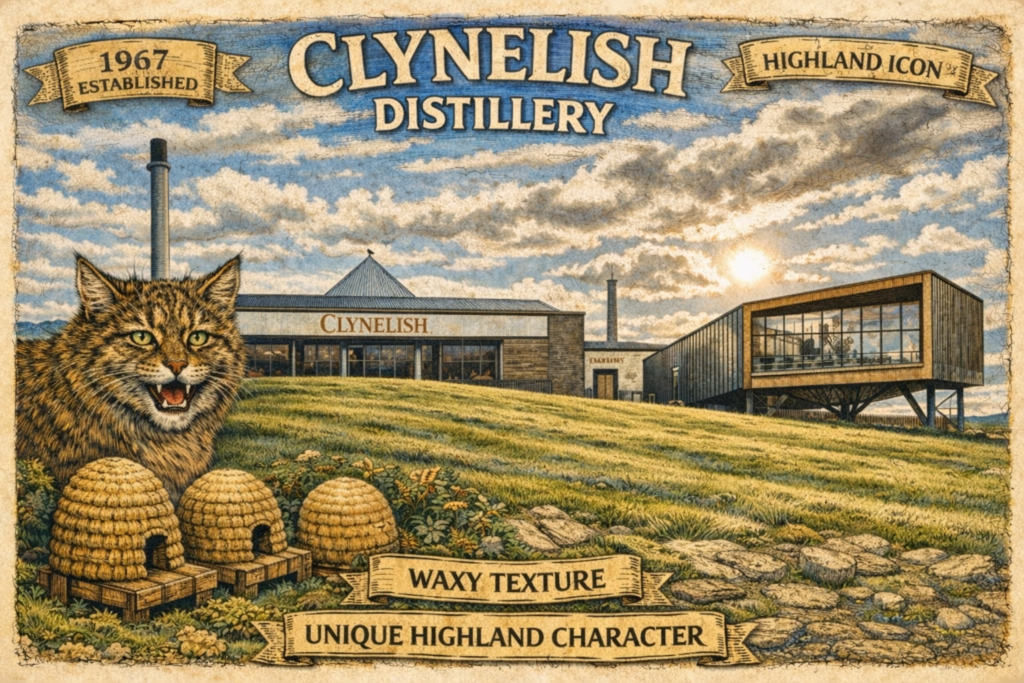
By the 1960s, demand had outgrown the original site. A new, larger distillery was constructed right beside it and began production in 1967. For a short time, both sites operated under the same name — an arrangement that couldn’t last. In 1969, the original distillery was renamed Brora Distillery, while the newer facility retained the Clynelish name.
That moment would shape Highland whisky history in ways few could have predicted.
Brora: The Legendary Sister Distillery
Brora is not just a neighbour to Clynelish — it is its past. As the original Clynelish distillery, Brora carries the DNA of the site in its walls. During the 1970s, Brora took on a radically different role, producing heavily peated whisky intended to substitute Islay malts during periods of shortage. Later, it shifted again, creating elegant, lightly peated Highland spirit before closing its doors in 1983.
Those Brora years became legend. Scarcity, quality, and the distillery’s long silence elevated its whiskies to near-mythical status among collectors. When Brora was finally revived decades later, it felt less like a reopening and more like the return of a long-lost chapter in Scotch whisky history.
Clynelish and Brora, standing side by side, tell a rare story: one site, two distilleries, and a shared legacy that continues to shape how we talk about Highland whisky today.
The Wildcat and the Spirit of the Place
Clynelish Distillery is often associated with the Highland wildcat — elusive, resilient, and perfectly adapted to the harsh terrain of the far north. The wildcat has become a symbol of the distillery’s character: untamed but controlled, muscular yet elegant. Whether viewed as folklore or metaphor, it fits remarkably well.
There’s something feral beneath Clynelish’s refinement. A tension between polish and rawness. It’s a whisky that doesn’t try to be universally liked — and is better for it.
The Waxiness: Accident, Discovery, and Preservation
Ask almost any experienced whisky drinker what defines Clynelish and the answer is immediate: wax.
Not sweetness. Not peat. Texture.
What makes this story particularly compelling is that the waxy character was once diminished — not through recipe changes, but through cleanliness. During routine maintenance, it was discovered that when certain vessels, particularly spirit receivers and feints tanks, were cleaned too thoroughly, the resulting spirit lost some of its signature waxy mouthfeel.
The conclusion was quietly radical: the build-up of fatty acids and residues in these vessels played a meaningful role in shaping Clynelish’s texture. Today, those tanks are cleaned carefully, but the residues are deliberately reintroduced. It’s a rare example of a distillery recognising that imperfection — or rather, controlled imperfection — is essential to identity.
Combined with long fermentation times, unusual still proportions, and precise cut points, this practice helps preserve the tactile, oily structure that makes Clynelish instantly recognisable.
Clynelish in the Glass
A classic Clynelish profile unfolds with restraint rather than drama:
- Nose: citrus peel, apple skin, honeyed wax, and a gentle coastal breeze
- Palate: oily and layered, with soft spice, orchard fruit, subtle brine, and that unmistakable waxy glide
- Finish: long, drying, mineral-tinged, and quietly persistent
It’s a whisky that rewards time and attention — one that changes with air, temperature, and mood.
Visiting Clynelish Today
Clynelish remains a working distillery first and foremost, still producing spirit that forms a vital part of major blends while quietly nurturing its single malt reputation. Visiting the distillery offers more than a tour — it offers context. Standing between Clynelish and Brora, you feel the continuity of Scottish whisky history in a very real, physical way.
Frequently Asked Questions
Why is Clynelish described as “waxy”?
Because of its distinctive oily mouthfeel, created through a combination of fermentation, distillation practices, and the deliberate retention of wax-contributing residues in the production process.
What is the relationship between Clynelish and Brora?
Brora was the original Clynelish distillery. When a new distillery was built in the late 1960s, the original site was renamed Brora, while the newer one continued as Clynelish.
Is Clynelish mainly a blending whisky?
Historically, yes — but its single malt releases have become cult favourites in their own right, prized for texture and nuance.
Did Clynelish really lose its waxy character at one point?
Yes, briefly. When production vessels were cleaned too thoroughly, the waxy texture diminished. Adjustments were made to preserve that defining character.
Final Thoughts
I’ll admit it without hesitation: Clynelish is one of my absolute favourite distilleries out there.
There’s an honesty to it that I find endlessly compelling. It doesn’t chase trends or shout for attention. Instead, it offers a whisky that trusts the drinker — one built on texture, patience, and place. The waxiness, the coastal edge, the shared history with Brora — it all adds up to a distillery that feels deeply rooted and quietly confident.
For anyone who values character over gimmicks and nuance over noise, Clynelish isn’t just worth exploring. It’s worth returning to, again and again.