Kavalan Solist Vinho Barrique Review – A Taste of the Wider Whisky World
I have my wife to thank for quite a few things in life, although I’m not entirely sure she realised what she was getting herself into when she bought me a Kavalan Podium and a GlenAllachie 10 Year Old Cask Strength Batch 4 all those years ago. I was already thoroughly enjoying whisky, but most of my drinking revolved around more affordable expressions, and she thought it would be nice to introduce me to something a little more adventurous. A perfectly innocent gesture, really, although considering how much of my life now revolves around whisky, I occasionally wonder whether she regrets encouraging me.
The GlenAllachie introduced me to a level of richness and intensity I hadn’t encountered very often before, but the Kavalan taught me something rather different. Until then, my whisky explorations had largely revolved around Scotland, Ireland, the United States, Japan and Canada. Taiwan wasn’t somewhere I’d seriously considered looking for exceptional whisky, and suddenly here was a bottle challenging that rather limited view of the world. The amusing thing is that I didn’t particularly enjoy it. As I admitted in my Kavalan Podium review, I found it intensely woody, spicy and rather demanding, but it left me curious about a whisky-producing country I knew precious little about.
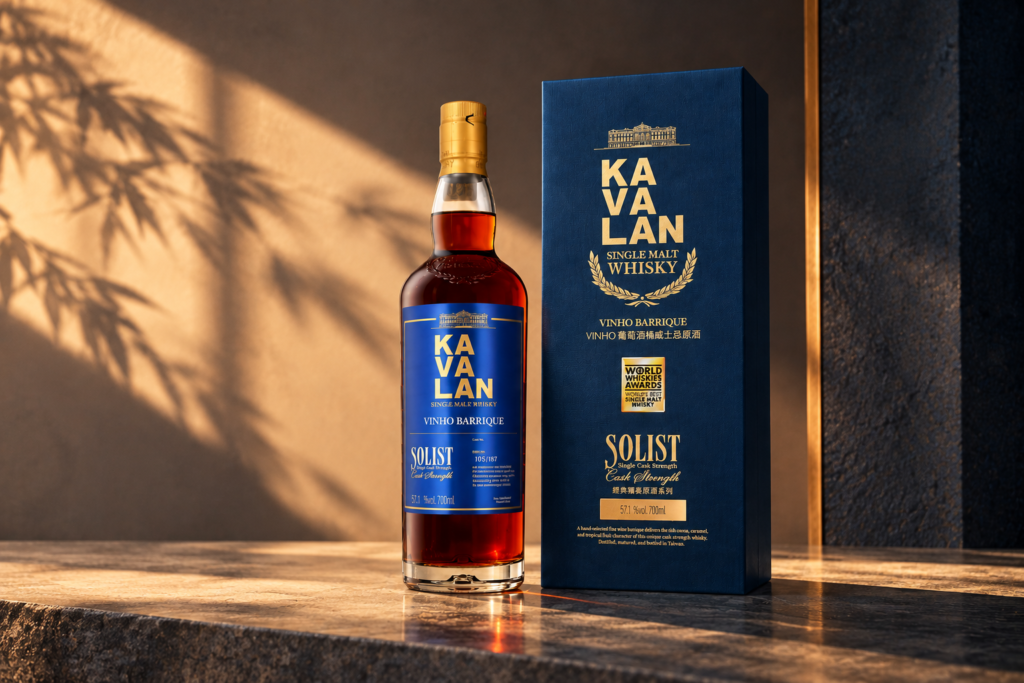
Which brings me back to Kavalan, a distillery enjoying another remarkable year. At the 2026 International Whisky Competition, its Peatist Oloroso Sherry Cask was named Whisky of the Year, following the Solist Fino Sherry Cask’s victory in 2025. Today, however, I’m revisiting one of the expressions that helped establish Kavalan’s international reputation in the first place: the Solist Vinho Barrique, named World’s Best Single Malt Whisky at the 2015 World Whiskies Awards.
The particular bottle in front of me comes in at 57.1% ABV, and considering how assertive I found that original Podium, I’m curious to discover what happens when Kavalan combines Taiwan’s subtropical maturation with a specially treated wine cask. Hopefully the oak has learned a few manners in the meantime.
Kavalan and the Art of Tropical Maturation
When Kavalan began distilling in Taiwan’s Yilan County in 2006, it faced a rather different maturation environment from the cool warehouses of Scotland. Taiwan’s subtropical climate brings considerable heat and humidity, encouraging intensive interaction between spirit and oak while also causing substantial evaporation losses. It’s sometimes suggested that whisky simply matures faster in warmer climates, although I think that’s a rather simplistic way of looking at it. A young Taiwanese single malt isn’t necessarily equivalent to an older Scotch; the different conditions produce their own distinctive results, and that’s considerably more interesting than trying to work out how many Scottish years a Taiwanese year might be worth.
The late Dr. Jim Swan played an important role in Kavalan’s development, particularly through the STR technique used for the Vinho Barrique. Short for shaved, toasted and recharred, the process involves treating American oak wine barrels to modify how they interact with the spirit. Shaving removes part of the wine-influenced inner surface, toasting develops aromatic compounds within the oak, and recharring changes how the wood contributes to maturation.
The idea is to retain some of the richness associated with wine casks while encouraging the vanilla, caramel and spice of treated American oak. Combine that with Taiwan’s climate and you have the potential for an enormously expressive whisky, although the balance between spirit and wood remains rather important. Considering the reputation of this particular expression, I’m looking forward to finding out whether the result lives up to its considerable collection of accolades.
Listen to the review:
Tasting Notes: Kavalan Solist Vinho Barrique
Stats
Distillery: Kavalan
Type: Taiwanese Single Malt Whisky
Age: NAS
ABV: 57.1%
Cask Type: STR American Oak Wine Barrique
Country: Taiwan
Flavour Profile: Sherry Velvet
The Solist range consists of individual single cask releases bottled at cask strength, meaning that the character can vary between bottlings. This particular Vinho Barrique comes in at 57.1%, with a deep reddish-amber colour that certainly looks promising, although I’ve learned not to judge a whisky by its appearance. Usually immediately after doing precisely that.
Nose
Dried plums are the first thing I notice, bringing a rich, concentrated fruitiness that reminds me of the slightly sticky ones you sometimes find at the bottom of a bag of dried fruit. They’re quickly joined by candied strawberries and fresh cherries, and I particularly like the contrast between the darker, almost jam-like plums and the brighter red fruit. The strawberries have that sugary sweetness of old-fashioned confectionery, while the cherries feel considerably fresher, almost as though somebody has just removed the stones and left a bowl of them on the kitchen counter.
Cinnamon begins to develop underneath, accompanied by walnuts and a wonderfully familiar caramel sweetness that takes me straight back to Werther’s Originals. Not simply caramel, but that particular combination of butter, cooked sugar and something almost creamy that makes those little sweets so recognisable. It works remarkably well with the walnuts, which introduce a slightly earthy, gently bitter quality that prevents the nose from becoming an uninterrupted parade of sugary fruit.
There’s a lovely richness to the whole thing, although what surprises me most is how comfortably the different aromas sit alongside one another. The dried plums and candied strawberries could easily have become rather excessive, but the fresher cherries, cinnamon and walnuts provide enough contrast to keep me returning to the glass. It’s sweet, certainly, but there’s considerably more character here than simply describing it as fruity would suggest.
Palate
The first sip immediately reminds me of my mother’s homemade blackberry marmalade. There’s something wonderfully familiar about that deep, cooked blackberry flavour, with its combination of concentrated fruit, sweetness and just enough tartness to stop it becoming cloying. It’s the sort of taste that brings back a memory before you’ve even had time to think about what you’re drinking, and for a moment I’m considerably more interested in that than in analysing the whisky.
Redcurrants begin appearing alongside the blackberries, bringing a sharper, brighter fruitiness that cuts through the richness beautifully. Then something rather unexpected develops underneath: liquorice root tea, specifically the kind my grandfather used to drink. It has that unmistakable earthy, woody sweetness of liquorice root, quite different from the black liquorice sweets I might ordinarily associate with whisky. There’s something almost herbal about it, with a gentle bitterness that makes the fruit taste considerably less straightforward than it initially appeared.
Dark chocolate gradually joins the proceedings, followed by freshly ground espresso beans. I particularly like the coffee here, because it isn’t simply the bitterness of a finished espresso; there’s something more aromatic and slightly oily about it, like opening a freshly ground bag of dark-roasted beans. Combined with the chocolate and liquorice root, it brings a welcome depth to the blackberry marmalade, while the 57.1% bottling strength gives everything plenty of weight without making the alcohol the most interesting thing in the glass.
What I appreciate most is how the whisky develops beyond that initial burst of fruit. The redcurrants introduce acidity, the liquorice root brings an earthy herbal character, and the chocolate and coffee add bitterness. There’s plenty of richness, but each new flavour seems to pull the whisky in a slightly different direction, which makes it considerably more enjoyable than a straightforward exercise in wine-cask sweetness.
Finish
The dark chocolate continues into the finish, becoming slightly more bitter as the fruit begins to fade. Liquorice root tea remains particularly noticeable, with that familiar earthy sweetness lingering alongside the cocoa and a little residual coffee. It’s a combination I find surprisingly comforting, although the whisky certainly hasn’t finished showing off.
A little raspberry zing suddenly appears, bringing a fresh, almost mouthwatering sharpness that I hadn’t quite expected after the darker flavours of the palate. It’s followed by cardamom and nutmeg, with the cardamom adding a fragrant, slightly citrusy warmth while the nutmeg brings something softer and more rounded. Together they create a wonderfully aromatic afterglow that gradually takes over from the fruit and chocolate.
The finish is long and warming, with the liquorice root and spices lasting particularly well. I rather like how the whisky moves from the rich blackberry marmalade of the palate towards something more herbal and gently spiced, leaving behind considerably more than the sweetness I initially expected.
Food Pairing
With the blackberry marmalade, dark chocolate and liquorice root running through this Kavalan Solist Vinho Barrique, I’d be tempted to pair it with duck breast, preferably served with a slightly tart redcurrant sauce. The richness of the meat should complement the whisky’s darker flavours, while the acidity of the sauce would pick up beautifully on those sharper redcurrant and raspberry notes.
An aged Gouda would be another interesting option, particularly one with plenty of nutty character and those wonderfully crunchy protein crystals. The saltiness should provide some contrast to the fruit, while the cheese’s richness could work rather nicely with the Werther’s Originals sweetness from the nose.
Although I suspect a good dark chocolate tart with a few fresh raspberries would also be rather difficult to resist. Just keep the chocolate properly bitter and the sugar under control, because the whisky has already brought plenty of sweetness to the table.
Who Is Kavalan Solist Vinho Barrique For?
If you enjoy rich, fruit-forward single malts with plenty of character, the Vinho Barrique is certainly worth exploring. The dried plums, candied strawberries and cherries on the nose lead into blackberry marmalade, redcurrants, dark chocolate and espresso, but it’s the liquorice root and fragrant spices that make the experience particularly interesting. There’s enough sweetness to satisfy fans of expressive wine cask maturation, without everything tasting like variations on the same dessert.
For someone who prefers delicate, cereal-driven whisky, this might be rather more demanding. The wine cask has clearly contributed a great deal, and at 57.1% there’s no shortage of intensity. But if you’re interested in discovering how differently single malt can develop outside Scotland, Kavalan offers a fascinating place to start.
Verdict
The Kavalan Solist Vinho Barrique is a wonderfully expressive whisky, and considerably more enjoyable to me than that original Podium which first introduced me to the distillery. The nose offers a lovely combination of dried plums, candied strawberries, fresh cherries, cinnamon and buttery caramel, but it’s the palate that really wins me over. My mother’s blackberry marmalade and my grandfather’s liquorice root tea aren’t flavours I expected to encounter together in a Taiwanese single malt, yet they work remarkably well alongside the redcurrants, dark chocolate and freshly ground coffee.
What impresses me is how the whisky manages to move from the almost confectionery sweetness of the nose to those earthy, herbal flavours on the palate without losing the richness that made it so appealing in the first place. The finish continues that progression beautifully, with raspberry, cardamom and nutmeg providing a brighter, more aromatic conclusion than I initially expected.
I can certainly understand why the Vinho Barrique made such an impression when it was named World’s Best Single Malt Whisky back in 2015. It has plenty of power, but there’s also a surprisingly enjoyable interplay between fruit, herbs and spice that makes me want to return to the glass. And while the wine cask has clearly contributed a great deal to its character, I don’t find myself fighting through the oak in the way I did with that original Podium.
Would I call it the world’s best single malt? That’s a rather impossible question, particularly when we’re talking about individual casks and personal preferences. But I would happily pour myself another glass, and considering how my first encounter with Kavalan went, that’s a rather satisfying outcome.
Final Thoughts
There’s something rather wonderful about finding familiar memories in an unfamiliar whisky. I certainly wasn’t expecting a Taiwanese single malt to remind me of my mother’s blackberry marmalade or the liquorice root tea my grandfather used to drink, but those were the flavours that stayed with me long after I’d stopped thinking about cask treatments, maturation climates and international awards.
Perhaps that’s one of the reasons whisky continues to fascinate me so much. We spend an extraordinary amount of time learning about distilleries, production methods and the influence of different casks, yet sometimes a single flavour can take us somewhere entirely unexpected. You can know everything about how a whisky was made and still be surprised by what it reminds you of.
And that’s something I’d love more people to discover for themselves. Whisky doesn’t have to be about chasing prestigious bottles or memorising production statistics; sometimes the greatest pleasure comes from pouring something unfamiliar and discovering a connection you couldn’t possibly have anticipated. I certainly never expected a Taiwanese whisky to bring back memories of my family, particularly one from a distillery whose first bottle left me rather unimpressed.
But perhaps that’s the beauty of continuing to explore. You never quite know what you’ll find in the next glass, or where it might take you. Sometimes, apparently, all the way back to your mother’s kitchen.