Two Simple Words That Become Surprisingly Complicated the Moment You Cross a Border
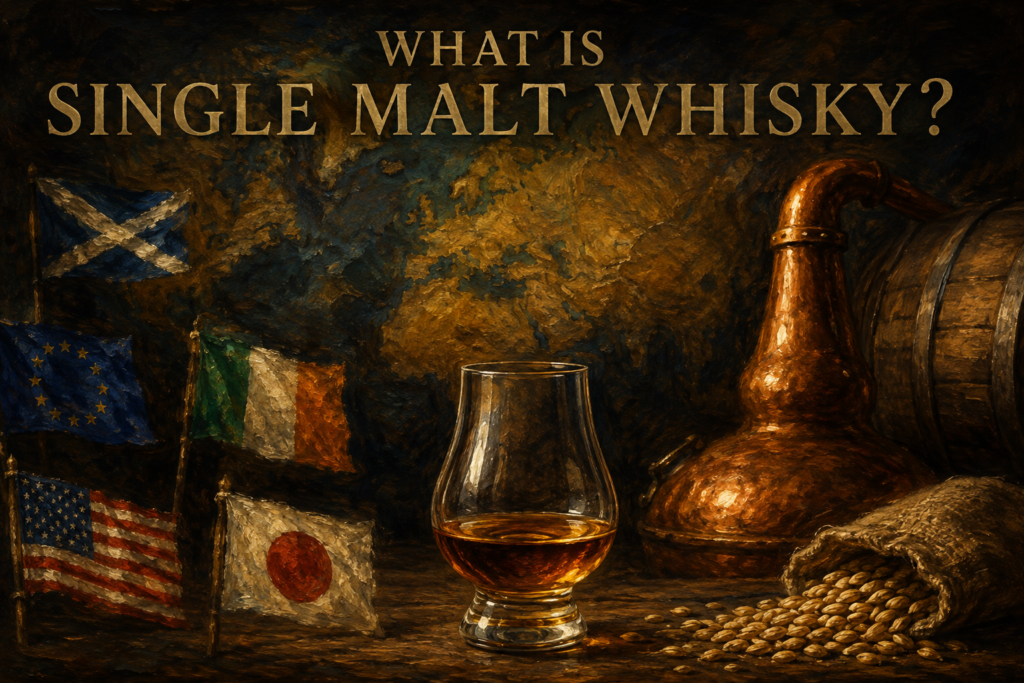
Single malt whisky. It might be the most recognisable term in the entire whisky world. Walk into almost any liquor store and there it is, printed proudly across bottles from Scotland, Ireland, Japan, India, Taiwan, the Netherlands and increasingly just about anywhere else people have decided that fermenting barley and putting the resulting spirit into wooden casks is a good use of several years of their lives.
Most whisky drinkers also have a pretty good idea of what single malt means. It is whisky made from malted barley at one distillery. Simple enough, and if that is all you ever remember after reading this article, you are already most of the way there.
The problem — and naturally the bit I find much more interesting — is that this definition isn’t quite as universal as it sounds.
Ask what Single Malt Scotch Whisky is and the answer includes pot stills. Make single malt here in the European Union and suddenly those pot stills aren’t compulsory at all. Cross over to Ireland and pot stills are back in the equation. Head across the Atlantic and American single malt plays by another set of rules again, including a completely different approach to maturation.
Same two words on the label. Different rules underneath them.
And that is exactly why I wanted to write this article.
I have already covered the basics of single malt in my Whisky 101 guide, while my Single Malt vs Blended Scotch Whisky article goes much further into the difference between single malt, single grain, blended malt, blended Scotch and single cask whisky. I don’t particularly fancy writing either of those articles all over again.
Instead, I want to take two words we all throw around incredibly casually and see what they actually mean. Because, as so often happens with whisky, something that seems incredibly simple becomes wonderfully nerdy once you start asking one or two questions too many.
And I happen to enjoy asking one or two questions too many.
Listen to this DRAM1 Academy Article:
Let’s Start With “Single”
This is probably the most misunderstood half of the term, although thankfully it is also the easiest one to explain. In single malt, single refers to the distillery. It does not mean one cask, one still, one batch, one year of production or one particularly lonely barrel sitting by itself in the corner of a warehouse.
A standard single malt can contain whisky from dozens or even hundreds of casks. Those casks may have been filled in different years, matured in different warehouses and previously contained completely different things. Bourbon barrels can meet sherry butts, refill hogsheads can meet wine casks, and younger whisky can be married with considerably older stock. Provided the whisky meets the relevant single malt rules and originates from the same distillery, it can all end up in the same bottle.
This is actually one of the things I love about the category. The word single makes it sound incredibly restrictive, while the reality inside the bottle can be enormously complex.
If a 12-year-old single malt contains whisky from 100 different casks, it remains a single malt. If one of those casks contains 18-year-old whisky, that is fine too. The 12 on the label simply tells us that nothing in the bottle can be younger than 12 years. I have already disappeared down that particular rabbit hole in The Age of Whisky, so I will resist doing it again here.
Take whisky from another distillery and add it to the vat, however, and that word single suddenly disappears. In Scotch it would become a blended malt if both components were single malt whiskies. That distinction is covered extensively in my Single Malt vs Blended Scotch Whisky article, and it is worth reading if the terminology still feels like whisky bingo.
For our purposes here, remember one thing: single means one distillery.
Mostly.
Welcome to whisky. There is always another footnote coming.
And Then There’s “Malt”
Malt seems straightforward too. Single malt is made from malted barley, and across the major definitions we are discussing here, that means 100% malted barley rather than a mashbill containing corn, wheat, rye or unmalted barley.
What interests me more is how much information is hidden inside that seemingly boring requirement.
Barley isn’t simply an alcohol delivery system. The variety of barley, where it was grown, its starch content, how it was malted, whether peat was used during kilning, how the wort was extracted and how fermentation was handled can all influence the spirit long before anybody starts discussing whether the cask once contained bourbon or oloroso.
I think whisky marketing has occasionally done grain a bit of a disservice because oak is so much easier to sell. You can photograph a beautiful sherry butt, write “first-fill Pedro Ximénez” across a box in gold lettering and people immediately understand that something interesting has happened. Barley variety and fermentation efficiency don’t quite have the same shelf appeal.
They are fascinating nonetheless, and I have gone much deeper into that side of things in Whisky Grains Explained and Whisky Ingredients Explained.
For this article, the important bit is simply this: when we talk about single malt, we are talking about malted barley.
It is what happens next that makes the geography so interesting.
Scotland: The Definition That Became the Default
When most of us picture single malt production, there is a good chance we’re subconsciously picturing Scotland. Malted barley goes into a mash tun, yeast does its thing in the washbacks and eventually that fermented liquid reaches a pair — or perhaps several pairs — of beautiful copper pot stills. Spirit comes off the still, goes into oak and several years later somebody wearing a suspiciously expensive gilet tells us it tastes of heather.
I joke because I love.
More importantly, that traditional image isn’t merely romantic Scottish whisky imagery. A substantial part of it is actually written into law.
Under the Scotch Whisky Regulations 2009, Single Malt Scotch Whisky must be produced at a single distillery from water and malted barley without the addition of other cereals, and it must be distilled in one or more batches in pot stills. The wider Scotch rules also require maturation in Scotland for at least three years in oak casks no larger than 700 litres, with the whisky eventually bottled at a minimum of 40% ABV.
That pot-still requirement is particularly important because it has become so closely associated with single malt that many drinkers assume it is part of the definition everywhere.
It isn’t.
Scotland has simply been so successful at defining the image of single malt that we sometimes confuse the rules for Single Malt Scotch Whisky with the rules for single malt whisky.
Those aren’t necessarily the same thing.
Read the Scotch Whisky Regulations 2009
Now Bring That Same Whisky Idea to the European Union
This is where the nerd in me starts getting excited.
The European Union has its own legal definition of whisky under Regulation (EU) 2019/787. Whisky has to originate from a fermented cereal mash, every distillation has to take place below 94.8% ABV so that the resulting distillate retains aroma and taste from the raw materials, and the spirit must mature for at least three years in wooden casks no larger than 700 litres. It must ultimately contain at least 40% alcohol by volume.
So far, nothing particularly shocking.
Then we reach the sentence dealing specifically with single malt. Under EU law, the legal name whisky or whiskey may be supplemented by single malt only when the whisky has been distilled exclusively from malted barley at a single distillery.
And that’s it.
No pot still requirement.
No batch-distillation requirement.
No insistence that the still has to look remotely like the beautiful bulbous copper stills you photographed during your last distillery holiday.
That means single malt produced in the Netherlands, France, Germany, Belgium or elsewhere under the general EU whisky rules does not have to follow the Scottish distillation model. A distiller can use a still incorporating a rectifying column or employ continuous distillation and, provided all the other requirements are met — including remaining below the 94.8% distillation ceiling — the resulting whisky can still legally be called single malt whisky.
I find that absolutely fascinating.
Not because I desperately want everybody to start making single malt on column stills tomorrow, but because it exposes how easily tradition becomes confused with definition.
If you took 100% malted barley in Scotland and continuously distilled it, you could not call the resulting whisky Single Malt Scotch Whisky. Under Scotch classification, a Scotch produced at one distillery that does not meet the single malt definition falls into the single grain category — meaning you can even encounter 100% malted-barley Single Grain Scotch Whisky, something I discussed in much greater detail in my article on Single Malt vs Blended Scotch Whisky.
Make malt whisky using continuous distillation in an EU country such as the Netherlands, however, and the general EU definition does not automatically prevent it from being called single malt.
Same barley. Same broad idea. Completely different category implications because somebody moved the distillery across a border.
Whisky nerdiness doesn’t get much better than that.
Read the EU spirit drinks regulation on EUR-Lex
Does the Type of Still Actually Matter?
Legally, clearly it does depending on where you are. From a flavour perspective, however, this becomes much more interesting than simply declaring pot still good, column still bad and going home.
Still design influences reflux, copper contact, the concentration of different congeners and ultimately which compounds make their way into the spirit. But even within the supposedly simple world of pot distillation there is enormous variation. Tall stills behave differently from short, squat ones. Boil balls, lyne-arm angles, condensers, charge sizes, heating methods and cut points all alter the resulting spirit. Stick a rectifying section onto a pot still and suddenly even the distinction between “pot still” and “column still” becomes less satisfying than it first appeared.
That is why I don’t particularly like using single malt as shorthand for a flavour profile.
Single malt tells us something about ingredients and origin. Depending on the jurisdiction, it can also tell us something about distillation equipment. It does not tell us whether the whisky will be light, heavy, fruity, sulphury, waxy, floral, meaty, smoky or smell faintly like somebody extinguished a bonfire with seawater and then stored the ashes inside an old engine room.
That part is considerably more fun, and considerably less legal.
Ireland: Pot Stills Return
Cross over to Ireland and things change again. The Irish Whiskey Technical File defines Malt Irish Whiskey as whiskey made from a mash of 100% malted barley, fermented by yeast and distilled in pot stills in a manner that leaves the resulting distillate with aroma and flavour derived from the raw materials.
In that respect, Irish malt whiskey sits much closer to Scotland than to the broader EU single malt definition. Pot distillation isn’t merely a common production choice; it is part of what legally defines Irish malt whiskey.
That doesn’t mean Irish malt whiskey is simply Scotch with an E attached. Ireland has its own production traditions and, perhaps most importantly, its wonderful Single Pot Still category using both malted and unmalted barley. That alone should warn us against trying to force every country’s whisky traditions into Scottish-shaped boxes.
There is something I increasingly appreciate about world whisky here. Countries can borrow knowledge from one another without having to copy one another. The point of whisky spreading around the world shouldn’t be to build hundreds of miniature Scotlands.
Give me Dutch whisky that tastes Dutch, American malt whisky that could only have come from America and Irish whiskey that proudly refuses to behave like Scotch.
That’s much more exciting.
Read the official Irish Whiskey Technical File
America Finally Decides What American Single Malt Is
For years, American distillers were making whisky they quite reasonably called American single malt without the United States actually having a federal Standard of Identity specifically defining what those words meant. Producers themselves did much of the work establishing the category before the regulations caught up.
That finally changed in January 2025, when the new federal American Single Malt Whisky standard came into effect.
And I am glad the Americans didn’t simply photocopy the Scottish regulations.
American Single Malt Whisky has to be made from a fermented mash of 100% malted barley and mashed, distilled and aged in the United States, with distillation taking place entirely at one distillery. The distillation ceiling is 160 proof, or 80% ABV, considerably lower than the 94.8% ceiling used in the broader European whisky definition. It is matured in oak barrels with a maximum capacity of 700 litres, and American rules allow producers to work with used oak, new charred oak and new uncharred oak rather than forcing the category into the familiar bourbon requirement of new charred oak.
The important point for our discussion is that pot stills are not mandatory.
Again, single malt does not automatically equal pot-distilled whisky.
Perhaps even more strikingly for European drinkers, American Single Malt Whisky does not simply inherit our familiar three-year maturation rule. America has built its own category around American whisky production rather than trying to recreate Single Malt Scotch Whisky on American soil.
I think that is exactly how it should be.
If single malt is going to become a genuinely global category, I would much rather see different countries establish meaningful rules that protect identity and quality while leaving enough room for their distillers to develop their own character. Otherwise world whisky becomes little more than a very expensive exercise in imitation.
Single Malt Is a Category, Not a Quality Award
This is probably worth saying somewhere because single malt still carries an extraordinary amount of prestige.
Single malt is not automatically better whisky.
It never was.
Calling something single malt tells you how that whisky fits within a particular production and legal category. It does not tell you whether the fermentation was well managed, whether the cuts were sensible, whether the spirit suited its cask, whether the cask was any good in the first place or whether the person putting the final whisky together knew what they were doing.
There are spectacular single malts and painfully boring single malts. There are cheap blends I would happily drink all evening and expensive single malts I have absolutely no desire to taste twice.
That isn’t an attack on single malt. Quite the opposite. I adore single malt whisky.
I just think whisky becomes much more enjoyable when categories stop being treated as rankings.
A great blender combining whisky from multiple distilleries isn’t practising some lesser form of whisky making. They are simply solving a different puzzle. I covered that particular misconception extensively in Single Malt vs Blended Scotch Whisky, so I won’t drag the poor blend through another trial here.
Judge the liquid.
The label can tell you what happened before it reached your glass. It cannot tell you whether you’re going to love it.
Perhaps “Single Malt” Tells Us Less Than We Think
This was probably my biggest takeaway while researching this article.
Single malt feels like an incredibly descriptive term. In reality, once we leave one specific jurisdiction behind, it becomes more of a framework.
It tells us malted barley is fundamental. It tells us the whisky originates from one distillery. After that, we need to know where the whisky was made before we can confidently start filling in the rest of the production story.
A Single Malt Scotch brings pot stills and at least three years in Scottish oak maturation into the picture. An EU single malt still requires at least three years in wood, but doesn’t inherit Scotland’s pot-still restriction. Irish malt whiskey brings pot stills back again. American Single Malt sets its own distillation ceiling and maturation framework.
And honestly, I rather like that.
Whisky would be terribly boring if everybody had to make it exactly the same way.
The interesting part isn’t that these definitions disagree. It is that every regulatory framework quietly tells us something about what that whisky culture considers important enough to protect.
Scotland protects its traditional pot-distilled malt method. Ireland protects its own pot-distillation traditions. Europe protects the basic relationship between malted barley, one distillery and spirit character while leaving distillation technology more open. America has deliberately created enough space for its young malt-whisky category to figure out what American single malt wants to become.
The words might be identical.
The philosophy behind them isn’t.
Frequently Asked Questions About Single Malt Whisky
What does single malt whisky actually mean?
At its broadest and most useful, single malt means whisky produced exclusively from malted barley at one distillery. The exact additional requirements depend on the country or protected whisky category involved, which is why Single Malt Scotch Whisky and an EU single malt whisky can legally be produced using different types of distillation equipment.
Does “single” mean one cask?
No. The word single refers to a single distillery, not a single cask. A normal single malt may be assembled from many different casks, ages and maturation types. Whisky bottled from one individual cask is normally identified separately as single cask or single barrel whisky.
Does single malt have to be made from 100% malted barley?
Under the Scotch, Irish malt, EU single malt and American Single Malt definitions discussed in this article, yes. It is worth remembering that whisky terminology isn’t globally harmonised, however, so I am always wary of making absolute statements about every bottle produced in every country on Earth.
Does single malt have to be distilled in pot stills?
No, and this is probably the most important misconception in this entire article. Single Malt Scotch Whisky must be pot distilled, and Irish Malt Whiskey must also be pot distilled. The general EU single malt definition does not require pot stills. American Single Malt Whisky doesn’t require them either.
Can single malt whisky be made using a continuous still?
Yes, in jurisdictions where the relevant definition allows it. The EU single malt definition requires exclusive use of malted barley at one distillery but does not prescribe pot distillation. The broader EU whisky rules instead require every distillation to occur below 94.8% ABV while retaining aroma and taste derived from the raw materials. Such spirit could therefore qualify as EU single malt while an equivalent continuously distilled spirit in Scotland could not qualify as Single Malt Scotch Whisky.
Can single malt contain whisky from different years?
Absolutely. Most single malt whisky is a marriage of multiple casks and those casks do not necessarily have to originate from the same production year. If an age statement appears on the bottle, however, that number refers to the youngest whisky included. You can read much more about that in The Age of Whisky.
Is single malt whisky always at least three years old?
Not worldwide. Scotch Whisky, Irish Whiskey and whisky falling under the EU whisky definition have three-year maturation requirements, but you should never assume that a rule belonging to one jurisdiction automatically applies to every whisky carrying similar terminology elsewhere.
Is single malt better than blended whisky?
Absolutely not. Single malt and blended whisky describe different categories and production approaches, not different levels of quality. Some of the greatest whiskies I have tasted have been single malts, and some of the greatest have not. Your tongue is blissfully unaware of the marketing hierarchy printed on the box.
Is single malt always Scotch?
Not even remotely. Single malt whisky is now produced all over the world, from Ireland and continental Europe to America, India, Taiwan, Australia and beyond. Scotland may have made the category famous, but it certainly doesn’t own the idea of making whisky from malted barley at one distillery.
Final Thoughts
I started this article with what sounded like an embarrassingly simple question: what is single malt whisky?
The easy answer remains perfectly useful. It is whisky made from malted barley at one distillery.
But I think the longer answer tells us something much more interesting about whisky itself.
We spend an enormous amount of time talking about flavour, casks, age statements and distilleries, yet the language printed on a whisky label is shaped just as much by geography, tradition and legislation. Move the same basic production idea from Scotland to the Netherlands and the equipment you are legally allowed to use changes. Move it to America and the maturation framework changes. Move it to Ireland and another whisky tradition takes over.
None of those approaches is automatically better.
They’re simply different answers to the same wonderfully nerdy question: if we take malted barley, ferment it, distil it and give it time in wood, what kind of whisky do we want to make?
That is the part of whisky I never get bored with.
The more you learn, the fewer genuinely simple answers there seem to be. One little word on a label leads to barley varieties, still design, reflux, fermentation, maturation, geographical indications, hundred-page regulations and inevitably an argument between whisky nerds somewhere on the internet.
And somehow, at the end of all that, we still get to pour ourselves a dram.
Which is considerably more enjoyable than reading EU legislation.