
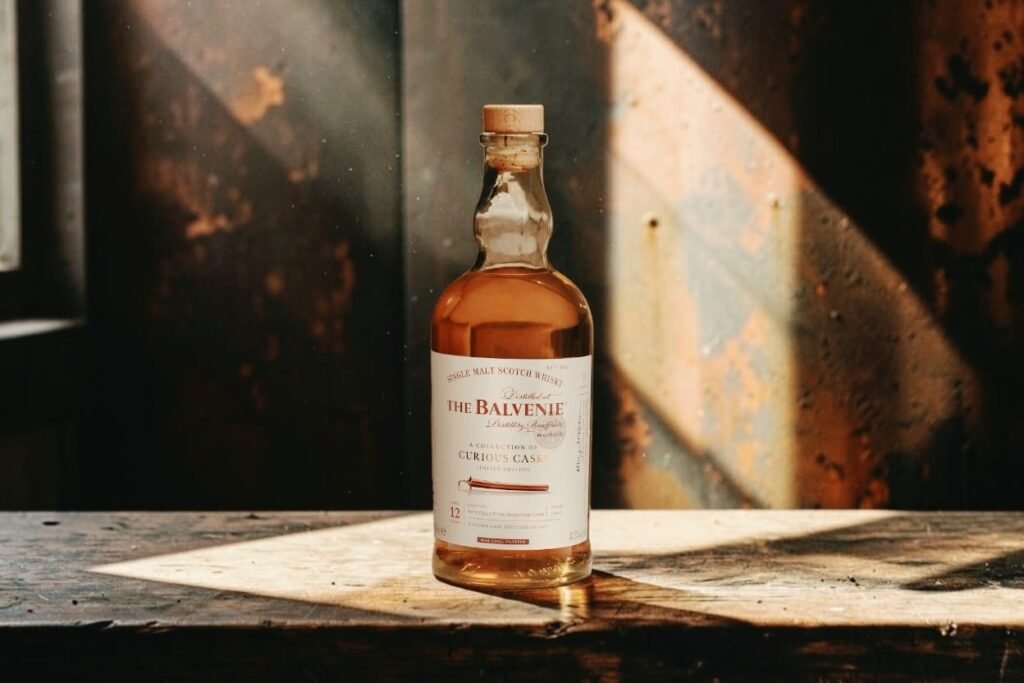
The Balvenie 12 Year Old Montilla Wine Cask Review – A Collection of Curious Casks
There are certain distilleries where you more or less know what you are looking for before the cork has even left the bottle. The Balvenie is one of those for me. Honey, malt, orchard fruit and that wonderfully soft, rounded Speyside character form such a recognisable foundation that the real fun often lies in seeing what happens when you start playing around with the cask. It is probably one of the reasons why Balvenie and interesting wood have always made rather good bedfellows, and why A Collection of Curious Casks immediately caught my attention.
The series is an extension of the storytelling approach Balvenie has embraced with its Stories range, but this time the spotlight falls firmly on some of the more unusual casks hiding away in the distillery’s warehouses. These are the sorts of experiments and oddities that can easily disappear among thousands upon thousands of barrels, only to be rediscovered years later and prompt the rather important question: what on earth have we got here? For whisky geeks, that is a pretty irresistible premise.
This particular release is the Balvenie 12 Year Old Montilla Wine Cask, distilled in 2012 and matured in European oak previously seasoned with sweet wine from Montilla in Andalusia. It was selected as part of the Curious Casks project involving Balvenie’s Malt Master Kelsey McKechnie and Samples Coordinator George Paterson, with the series essentially giving us a glimpse into the more experimental corners of Balvenie’s stock.
Before we get anywhere near the whisky, though, there is one little bit of wine geekery worth clearing up, because Montilla wine is not the same thing as Amontillado sherry. The similarity in the names makes that an incredibly easy assumption to make, but Montilla refers here to the wines of Montilla-Moriles, an Andalusian wine region around Córdoba where Pedro Ximénez is the dominant grape. The region produces everything from young white wines to Fino, Amontillado, Oloroso and wonderfully concentrated sweet PX wines. In fact, the word Amontillado essentially means “in the style of Montilla”, rather than Montilla being some abbreviated form of Amontillado.
Pedro Ximénez is particularly fascinating here because we tend to associate PX almost exclusively with those dark, syrupy dessert wines that can practically coat the inside of a glass. In Montilla-Moriles, however, the grape is far more versatile. For its famous sweet expression, ripe PX grapes are laid out beneath the Andalusian sun to partially dehydrate, dramatically concentrating their sugars before pressing. It is precisely that world of concentrated fruit, sweetness and spice that makes the prospect of combining Montilla-seasoned European oak with Balvenie’s naturally fruity malt rather exciting.
And, as it turns out, the nose makes one hell of a first impression.
Listen to this Balvenie 12 Year Old Montilla Wine Cask Review:
Tasting Notes: Balvenie 12 Year Old Montilla Wine Cask
Stats
- Distillery: The Balvenie
- Region: Speyside, Scotland
- Type: Single Malt Scotch Whisky
- Series: A Collection of Curious Casks
- Age: 12 Years Old
- Vintage: 2012
- Cask: European oak seasoned with Montilla wine
- ABV: 47.3%
- Natural Colour: Yes
- Non-Chill Filtered: Yes
- Flavour Profile: Fruit Orchard Symphony
At 47.3% ABV, natural colour and non-chill filtered, the presentation is immediately something I can get behind. It is high enough in strength to give the whisky a little extra texture and presence without pushing it into cask-strength territory, while leaving the whisky alone in terms of colour and filtration allows that cask influence to speak for itself.
Nose
This is very sweet from the outset, but thankfully not in a clumsy or syrupy way. There is enough of Balvenie’s familiar malt character underneath to keep everything beautifully rounded, and the first few minutes in the glass are dominated by a basket of ripe orchard fruit. Juicy pear leads the charge, followed closely by Golden Delicious apple, while softer flashes of yellow plum and nectarine gradually begin to appear around the edges. It feels ripe rather than fresh and crisp; think fruit that has been sitting in the bowl for a few days and has reached that perfect point where the sugars seem to have doubled.
What I particularly enjoy is what happens underneath all that fruit. There is a lovely malty backbone of freshly milled barley and warm bread rolls, almost as though you have walked into a bakery just as the first batch has come out of the oven. It stops the Montilla influence from completely taking over and, more importantly, still makes this unmistakably feel like Balvenie.
Give it a little longer and the darker sweetness starts creeping in. Dates, perhaps a touch of sultana and something approaching barley sugar sit alongside freshly grated nutmeg and fragrant cardamom. The spices are beautifully judged on the nose; they do not fight the fruit but instead wrap themselves around it. There is a warmth here that makes me think of an autumn fruit tart before it has even gone into the oven, with the pastry, fruit and spice all still individually identifiable.
It is easily my favourite part of the whisky. There is a lot happening, but nothing feels forced.
Palate
The arrival continues exactly where the nose left off, with another generous burst of orchard fruit. Pear and Golden Delicious apple once again take centre stage, only this time they are sweeter, almost lightly caramelised, and joined by cinnamon and soft brown sugar. Then comes a flavour that immediately sends me somewhere very specific: rum-soaked raisins, or boerenjongens for the Dutchies among us. That combination of plump raisins, alcohol and brown sugar works beautifully with the malt and gives the opening of the palate a wonderfully comforting richness.
There is more fruit waiting behind it. Dried apricot brings a slightly denser sweetness while a flicker of lemon zest provides just enough citrus freshness to stop proceedings becoming too heavy. For a moment, everything seems to be heading exactly where I hoped it would: ripe fruit, malt, baking spice and concentrated wine sweetness all playing rather nicely together.
And then the oak decides it would like a word.
The change is surprisingly pronounced. The juicy fruit gradually dries out and the whisky becomes considerably more tannic, with liquorice root, wooden popsicle sticks and freshly sharpened pencil shavings beginning to push their way forward. There is something quite fascinating about the transition because it gives the whisky considerably more structure than the nose suggests, but I am not entirely convinced it improves it. I find myself wanting to go back to those pears, apricots and rum-soaked raisins while the European oak is busy sharpening another pencil.
That said, the 47.3% ABV works extremely well. There is enough weight to carry those flavours and the alcohol itself is nicely integrated, giving the whisky a pleasantly oily texture without ever becoming hot or aggressive.
Finish
The finish is medium-long and initially rather lovely. A big, luscious Werther’s Original note appears almost immediately, bringing creamy caramel and buttery sweetness alongside candy apples and golden sultanas. For a moment it feels as though the whisky has found its way straight back onto my wavelength after the more tannic second half of the palate.
Unfortunately, there is another turn coming.
A rather assertive combination of aniseed, fresh mint and black liquorice begins to build, becoming one of the most prominent flavours on the finish. This will absolutely be a matter of personal taste, but it is the one part of this Balvenie Montilla Cask that I struggle with. I have never been particularly fond of that medicinal black-liquorice character when it becomes too dominant in whisky, and here it hangs around long enough to slightly spoil what had been a beautifully sweet and fruity journey.
Thankfully, the whisky has one final trick up its sleeve. Once the liquorice and mint eventually begin to fade, a gorgeous piece of candied orange peel emerges, sweet, citrusy and ever so slightly bitter. It is a much more pleasing final impression and almost feels like the whisky apologising for that liquorice detour before disappearing.
I forgive it.
Food Pairing
With so much orchard fruit, caramel, dried fruit and baking spice going on, I would keep the pairing firmly in dessert territory. An apple tarte tatin would be my first choice, particularly because the caramelised apple should echo both the fruit on the palate and that wonderful Werther’s Original character on the finish. A warm bread-and-butter pudding with raisins would work beautifully too, especially if you wanted to lean into those boerenjongens notes.
I would avoid anything excessively sweet, though. There is already plenty of sweetness in the whisky itself, and part of what keeps this interesting is the tension between that sweetness and the increasingly dry, tannic oak.
Who Is This For?
If you already enjoy the classic Balvenie profile but want to see it pushed into slightly stranger territory, the Montilla Wine Cask is exactly the sort of release the Curious Casks series should be producing. The distillery character is never completely lost beneath the wine influence, particularly on that gorgeous malt-driven nose, yet there is enough going on from the European oak and Montilla seasoning to make this feel distinctly different from the core range.
It should also appeal to whisky drinkers who enjoy wine-cask maturation but have grown a little tired of seeing the same handful of sherry and wine styles repeated over and over again. Montilla brings something genuinely interesting to the conversation, and I would much rather see established distilleries digging around in their warehouses for experiments like this than simply putting another familiar finish into a fancy box.
Verdict
There is a lot I like about the Balvenie 12 Year Old Montilla Wine Cask. In fact, for the first half of the experience I was pretty convinced I had found a little gem. The nose is excellent: rich without becoming heavy, beautifully fruity, wonderfully malty and layered with just enough spice to keep me going back for another sniff. The opening of the palate follows suit, with those pears, apples, brown sugar, cinnamon and rum-soaked raisins making for exactly the kind of comforting Balvenie profile I hoped the Montilla cask might produce.
It is only once the oak begins to assert itself that things become slightly more difficult for me. The popsicle-stick and pencil-shaving tannins are noticeable but manageable; the combination of aniseed, mint and black liquorice on the finish is harder to ignore. That is an intensely personal criticism, though. Someone with a greater fondness for liquorice-driven flavours might actually find that contrast one of the most interesting parts of the whisky.
For me, it stops a very good Balvenie from becoming a great one.
Final Thoughts
What I ultimately appreciate most about this whisky is that A Collection of Curious Casks actually feels curious. That might sound ridiculously obvious, but there are plenty of supposedly experimental whisky releases where the experiment amounts to little more than swapping one fashionable wine cask for another. A 12-year-old Balvenie matured in European oak seasoned with Montilla wine feels different enough to make me want to understand what that cask has done, and tasting it becomes considerably more interesting because of it.
It also demonstrates just how robust the Balvenie house style can be. Even underneath the Montilla sweetness, dried fruit, spice and increasingly assertive European oak, I can still find the pears, honeyed malt and warm cereal character that make Balvenie so recognisable. The cask adds rather than completely disguises, even if towards the finish it adds a little more liquorice than I personally ordered.
Would I happily pour another dram? Absolutely. Mostly because I could spend an unreasonable amount of time with my nose buried in the glass before actually drinking it. And sometimes whisky does not need to be flawless to be fascinating. In a series devoted to curious casks, I would argue that being fascinating is rather the point.
