Cadenhead’s: Scotland’s Oldest Independent Whisky Bottler
There are plenty of independent whisky bottlers I love. Some are exciting because they are new, some because they have a knack for finding spectacular casks, and others because they seem determined to bottle whisky in ways the larger companies simply cannot. Cadenhead’s is different. Cadenhead’s is part of the reason we have an independent bottling scene to talk about in the first place.
Founded in 1842, William Cadenhead Ltd is Scotland’s oldest independent bottler, with a history stretching back more than 180 years. That alone makes the company important, but reducing Cadenhead’s to its age would be doing it a disservice. Through enormous changes in the Scotch whisky industry, changing fashions, distillery closures, consolidation and the increasingly polished world of modern whisky marketing, Cadenhead’s has somehow retained an approach that feels wonderfully straightforward: find interesting whisky, bottle it when it tastes right and don’t mess around with it unnecessarily.
Today its home is Campbeltown, where Cadenhead’s sits within the same J&A Mitchell family as Springbank and Mitchell’s Glengyle, home of Kilkerran. It is difficult to imagine a more appropriate home for it. Campbeltown and Cadenhead’s both feel like survivors from an older whisky world, yet neither exists merely as a museum piece. They are alive, enormously relevant and, judging by the enthusiasm surrounding them, perhaps appreciated more today than they have been for decades.
Last May, I had the opportunity to experience that connection properly when I visited Campbeltown aboard the Thalassa during our whisky voyage around Scotland. Our Cadenhead’s Warehouse Tasting, expertly guided by Sophia McLean, became one of the highlights of an already rather ridiculous week of whisky.
It also reminded me why Cadenhead’s matters so much.
The History of Cadenhead’s: From Aberdeen to Campbeltown
The story actually begins without anybody called Cadenhead.
In 1842, George Duncan established a wine and spirits business in Aberdeen, operating as a vintner and distillery agent from Netherkirkgate. A little over a decade later he was joined by his brother-in-law, William Cadenhead, who eventually acquired the business in 1858 and, as was customary at the time, put his own name above the door.
That name proved remarkably durable.
William Cadenhead himself seems to have been quite a character. Whisky history has a wonderful habit of producing people whose biographies sound as though somebody has embellished them after several drams, and Cadenhead fits the tradition nicely. Besides his involvement in the wine and spirits trade, he was also involved in local politics and was a poet. His nephew Robert Duthie eventually joined the business and took control following William’s death in 1904.
For roughly 130 years the company traded from essentially the same premises in Aberdeen. During that period Cadenhead’s developed a reputation for spirits sold with remarkably little interference, something which sounds entirely normal to enthusiasts today but was far less commonplace during an era when blending and consistency increasingly dominated Scotch whisky.
The company’s Aberdeen chapter finally came to a rather dramatic end in the early 1970s. Following the death of Robert Duthie’s sisters, the business was placed in the hands of an employee who apparently had little appetite for selling the enormous stocks accumulated in its warehouses. Eventually the situation became unsustainable and, in October 1972, much of Cadenhead’s stock was sent to auction at Christie’s in London.
Then Campbeltown entered the story.
The Strangest Reason to Buy a Whisky Company?
One of my favourite pieces of Cadenhead’s history concerns the reason J&A Mitchell became involved in the first place.
J&A Mitchell, owners of Springbank Distillery, acquired Cadenhead’s after the 1972 auction under the stewardship of Hedley Wright. That acquisition secured the future of a company that had already been trading for 130 years, but apparently there was another attraction.
Bottles.
There was a shortage of glass bottles at the time, and Wright understood that Cadenhead’s still possessed a supply. Buying the remaining business therefore offered J&A Mitchell the chance to acquire both a historic wine and spirits merchant and some desperately needed glass.
Except, according to Cadenhead’s own history, the bottles never arrived.
Nobody seems to know what happened to them.
So one of Scotland’s most historically important independent bottlers entered the modern era partly because a Campbeltown whisky company wanted some spare bottles, which subsequently disappeared anyway. Whisky history really can be magnificent.
The acquisition nevertheless proved rather more useful than the missing glass. Cadenhead’s became part of J&A Mitchell, moved its centre of gravity to Campbeltown and began the chapter of its history that whisky drinkers recognise today.
You can read Cadenhead’s own account of its remarkable history on the official Cadenhead’s website.
Why Cadenhead’s Matters to Scotch Whisky
To understand the significance of Cadenhead’s, it helps to understand why independent bottlers matter at all.
A distillery’s official range gives us its interpretation of its whisky. An independent bottler can show us something completely different.
Perhaps it is a distillery normally associated with sherry casks presented from a refill bourbon barrel. Perhaps it is a distillery whose whisky usually disappears almost entirely into blends suddenly appearing as a twenty-year-old single malt. Sometimes it is a single cask at natural strength; sometimes an unusual reracking transforms a familiar spirit into something completely unexpected.
Independent bottlers turn Scotch whisky into exploration.
Cadenhead’s has been doing that for generations.
Its current philosophy remains pleasingly simple. The company says it does not bottle whisky merely because it has reached a particular age, because the distillery name happens to be fashionable or because a sales calendar demands another release. Casks are selected and bottled because the team believes the whisky is ready. Cadenhead’s bottlings are also presented without chill filtration or artificial colouring.
That might sound like fairly standard whisky-geek language in 2026, but there is an important difference between adopting those principles because today’s enthusiast market likes them and having them embedded within a company whose history stretches back to the middle of the nineteenth century.
Cadenhead’s did not need to invent an old-fashioned image.
It is old-fashioned.
And I mean that as an enormous compliment.
Cadenhead’s and Campbeltown: A Perfect Match
There are few places in Scotland where whisky history feels as tangible as it does in Campbeltown.
Once described as the whisky capital of the world, the town was home to dozens of distilleries during its Victorian heyday. Ships, barrels, coal, barley and whisky turned this relatively small town on the Kintyre peninsula into one of the great centres of Scotch production. Then came the collapse. Changing tastes, questionable quality from some producers, economic pressures and Prohibition in the United States all contributed to a spectacular decline.
By the late twentieth century, Campbeltown’s once enormous whisky industry had been reduced to a tiny fraction of its former self.
Yet whisky never completely left.
Springbank survived. Glen Scotia survived. Glengyle eventually returned to production in 2004, resurrected by J&A Mitchell after decades of silence, and its whisky is now familiar to us as Kilkerran. More recently, the region has once again attracted investment and plans for additional distilleries, bringing a sense that Campbeltown whisky is entering another chapter.
Cadenhead’s belongs naturally within that story.
All of its products are bottled locally in Campbeltown, while its warehouses contain whisky from distilleries scattered across Scotland and, increasingly, from considerably further afield. In an industry where whisky can sometimes feel surprisingly detached from the communities that created it, there is something reassuringly physical about Cadenhead’s presence here.
The whisky comes to Campbeltown. It matures here. It is sampled here. It is selected here. It is bottled here.
And when you visit, you can drink it here.
Inside the Cadenhead’s Warehouse Tasting
Which brings me back to May.
Visiting Campbeltown is always special, but arriving during a whisky voyage aboard the Thalassa gave the trip another dimension entirely. After days of distilleries, ridiculous scenery, excellent whisky and the particular sort of camaraderie that seems to develop remarkably quickly when you put a group of whisky lovers on a sailing ship together, we made our way into the Cadenhead’s warehouse.
If you are expecting polished marble, touchscreen displays and a carefully choreographed luxury experience, you have misunderstood Cadenhead’s rather badly.
This is whisky territory.
Casks, warehouse smells and glasses of liquid that you are unlikely to find sitting on the shelf of your local supermarket. The emphasis is where I want it to be: on what is inside those casks.
Our tasting was guided by Sophia McLean, who did an absolutely fantastic job of taking us through the whiskies without ever making the experience feel like a lecture. There is a huge difference between somebody reciting specifications and somebody who understands why whisky enthusiasts get excited about what is in front of them. Sophia very clearly falls into the latter camp.
That matters particularly with Cadenhead’s because the fun lies in the variety. One cask can take you to a familiar distillery in a completely unfamiliar direction, while the next might come from somewhere you have barely paid attention to before. There is no need for every whisky to fit neatly into a brand identity because the whole point is discovering what that particular cask has to say.
The current Cadenhead’s Warehouse Tasting offers six cask-strength whiskies drawn from different distilleries, with the opportunity to purchase selected whiskies directly from the cask afterwards. There is then another dram waiting in the Cadenhead’s Tasting Room. For anybody planning a whisky trip to Campbeltown, I struggle to think of many better ways of spending an hour or two.
You can find the latest details and booking information through the official Cadenhead’s Warehouse Tasting page.
The Ben Nevis I Brought Home From Campbeltown
One whisky from our tasting deserves a special mention.
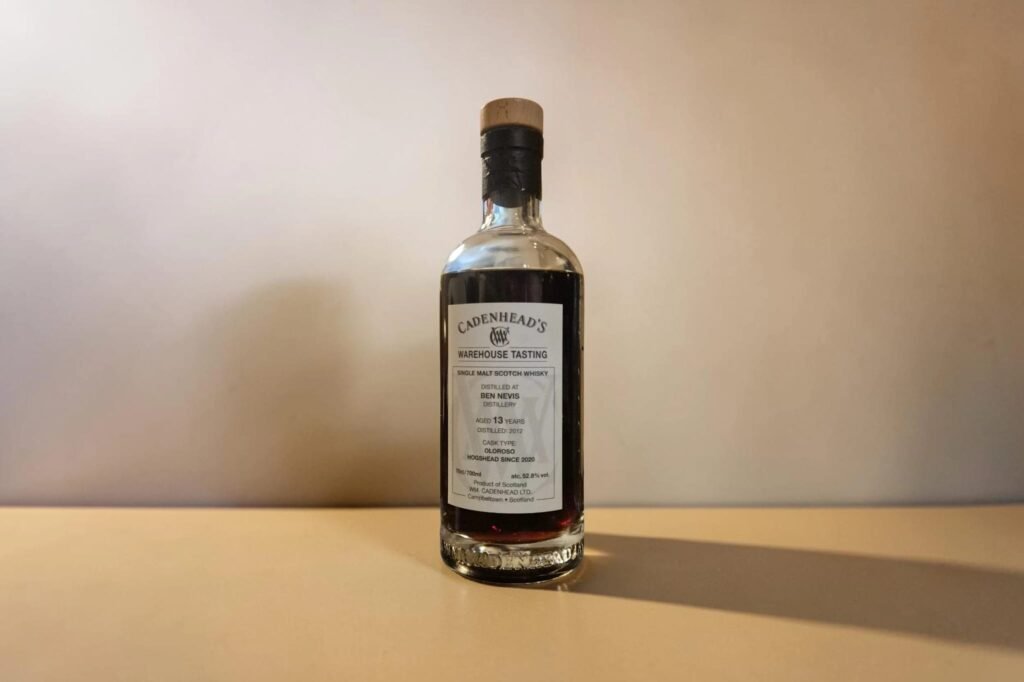
A 13-year-old Ben Nevis from an Oloroso hogshead, bottled at 52.8% ABV, was exactly the sort of whisky that explains the appeal of Cadenhead’s better than several paragraphs of whisky theory ever could.
It was dark, muscular and wonderfully old-school, packed with dried plums, dates, treacle, leather, dark chocolate, espresso and enough savoury character to stop all that sherry richness becoming remotely one-dimensional. It tasted considerably older than its thirteen years and was the kind of whisky I kept returning to during the tasting.
I loved it.
Apparently Brad and Shelby noticed.
They were two of the guests travelling with us aboard Thalassa, and at the end of the trip they surprised me by giving me a bottle as a thank you for being their whisky guide during the week. It remains one of the loveliest whisky gifts I have ever received, not because of its rarity or monetary value, but because every pour immediately takes me back to that warehouse and that week aboard the ship.
I have since written a full Cadenhead’s Ben Nevis 13 review, although calling it merely a review feels slightly inadequate. Some bottles eventually become containers for memories as much as containers for whisky. This is one of mine.
So another huge thank you to Brad and Shelby for the bottle. You really didn’t need to do it, but I’m very glad you did.
And, of course, a special thank you to Sophia McLean for guiding us through such a fantastic tasting. It was one of my favourite stops of the voyage.
What Kind of Whisky Does Cadenhead’s Bottle?
Trying to describe a typical Cadenhead’s whisky is almost missing the point.
The company has access to a broad inventory and releases whisky through several different ranges, allowing everything from relatively approachable 46% bottlings to properly nerdy single-cask releases at natural strength.
The Original Collection is perhaps the easiest entry point. These whiskies are selected specifically to work at 46% ABV and can feature malts from a broad selection of distilleries. They are not simply watered-down versions of cask-strength releases; according to Cadenhead’s, the whisky is deliberately chosen because the team believes 46% is the strength at which it works best.
The Authentic Collection moves closer to classic independent-bottler territory, with single-cask whiskies bottled at cask strength and sold through Cadenhead’s own shops. For enthusiasts who enjoy seeing familiar distilleries stripped of their normal house presentation, this is where things can become dangerously tempting.
Then there is Enigma, which might be the most appropriately named whisky range in Scotland. These releases can be single casks, multi-cask vattings, blends or blended malts, and the identity of the distillery can sometimes remain deliberately mysterious. There are also World Whiskies and occasional releases drawn from the late Hedley Wright’s Chairman’s Stock.
In other words, browsing a Cadenhead’s release list is rather like opening a whisky lucky dip curated by people with access to a very serious warehouse.
You can explore the current ranges through Cadenhead’s official whisky pages.
Cadenhead’s 7 Stars: Independent Bottling Is Not Just About Single Casks
There is another side to Cadenhead’s that deserves more attention.
7 Stars is a blended Scotch whisky, and its existence says quite a lot about how the company approaches whisky. The name itself is not a modern marketing invention but the revival of a historic Cadenhead’s blend. The modern version combines whiskies from around Scotland before finishing the blend in Oloroso sherry casks, and it is bottled at 46% without chill filtration or added colouring.
I particularly like that Cadenhead’s continues to take blending seriously.
Single casks naturally attract whisky enthusiasts because they are unique, but great blending requires just as much skill. Arguably more. Instead of finding one excellent cask, you need to understand how different whiskies interact and create something greater than their individual parts.
We included Cadenhead’s 7 Stars in the DRAM1 Whisky Award 2025, where more than 150 whisky lovers tasted the competition blind. It scored an impressive 79 points, placing it among the strongest whiskies in the entire field.
That matters to me because nobody tasting it knew they were drinking Cadenhead’s. Reputation, history and that famous name on the label could do absolutely nothing to help it. The liquid had to earn the score.
It did.
You can read the full DRAM1 panel review of Cadenhead’s 7 Stars or see how it performed against the complete field in the DRAM1 Whisky Award 2025 results.
More Than 180 Years of Doing Things Differently
The independent whisky landscape has changed dramatically.
There are now scores of independent bottlers releasing beautiful single casks, elaborate finishes and increasingly sophisticated ranges. That competition is fantastic for drinkers, and some of the most exciting whiskies I taste each year come from independent bottlers.
But Cadenhead’s occupies a position nobody else can replicate.
You cannot manufacture 1842.
More importantly, you cannot manufacture the continuity that followed. Cadenhead’s has survived while the Scotch whisky industry transformed around it, from the rise of blending and the Victorian whisky boom through crashes, wars, consolidation, distillery closures, single malt’s rise to global prominence and the extraordinary whisky boom of the early twenty-first century.
The company has changed, of course. It would be absurd to pretend otherwise. Yet the basic attraction feels remarkably consistent: whisky selected because somebody believes it deserves to be bottled.
There is something increasingly valuable about that simplicity.
We live in a whisky market filled with luxury positioning, limited-edition storytelling, elaborate packaging and bottles designed as much for Instagram photographs as for drinking. None of those things automatically make the whisky bad, but they can occasionally distract us from why we became interested in this stuff.
Cadenhead’s drags the attention back towards the cask.
What distillery is it from? What happened during maturation? Why did they choose this cask? What does it taste like? Would a different strength make it better?
Those are whisky questions.
And after more than 180 years, Cadenhead’s still seems unusually interested in answering them.
Why Whisky Lovers Should Explore Cadenhead’s
If you have never bought an independently bottled whisky before, Cadenhead’s is one of the names I would encourage you to remember.
Not because every bottle is automatically brilliant. No independent bottler can make that claim, and part of the joy of single casks is precisely that they are individual. Some will suit your palate far more than others.
Instead, explore Cadenhead’s because it can teach you something about whisky.
Try a distillery you already know in a cask you would never normally associate with it. Buy something from a distillery you have previously ignored. Compare an Original Collection release at 46% with one of the cask-strength Authentic bottlings. Try 7 Stars and remind yourself that blended Scotch can still be serious whisky.
Better yet, go to Campbeltown.
Walk through a town where whisky history seems to seep out of the buildings, visit Springbank, wander into the Cadenhead’s shop and book that warehouse tasting. Sit among the casks and allow somebody to pour you something you weren’t expecting.
That sense of discovery is one of the things I love most about whisky.
Cadenhead’s has been bottling it since 1842.
Frequently Asked Questions About Cadenhead’s
Is Cadenhead’s the oldest independent whisky bottler in Scotland?
Yes. William Cadenhead Ltd was founded in Aberdeen in 1842 and is widely recognised as Scotland’s oldest independent bottler. The business later became part of J&A Mitchell & Co Ltd in 1972 and is now based in Campbeltown.
Does Cadenhead’s own a whisky distillery?
Cadenhead’s itself operates as an independent bottler rather than a distillery. However, it is owned by J&A Mitchell & Co Ltd, the company that also owns Springbank Distillery and Mitchell’s Glengyle Distillery, where Kilkerran single malt is produced.
Where is Cadenhead’s based?
Cadenhead’s is based in Campbeltown, Scotland, where its whisky is matured and bottled. The company also operates Cadenhead’s shops in Campbeltown, Edinburgh and London.
Does Cadenhead’s chill filter its whisky or add colouring?
No. Cadenhead’s states that its whiskies are bottled without chill filtration and without artificial colouring, allowing the whisky to remain closer to its natural presentation from the cask.
What is the Cadenhead’s Original Collection?
The Original Collection consists of whiskies specifically selected for bottling at 46% ABV. Rather than simply reducing every whisky to the same standard strength, Cadenhead’s says the whiskies in this collection are chosen because the team believes they work particularly well at 46%.
What is the Cadenhead’s Authentic Collection?
The Authentic Collection consists primarily of single-cask, cask-strength Scotch whiskies and includes bottlings from active and closed Scottish distilleries. These releases are exclusive to Cadenhead’s shops and are often produced in very limited numbers.
What happens during a Cadenhead’s Warehouse Tasting?
The Warehouse Tasting takes place in Campbeltown and currently includes six cask-strength whiskies selected from Cadenhead’s warehouse, with an opportunity to purchase available whiskies directly from the cask. Guests can then visit the Cadenhead’s Tasting Room for a seventh dram. Line-ups naturally change as casks are emptied and replaced.
Is the Cadenhead’s Warehouse Tasting worth doing?
For me, absolutely. My visit in May 2026 with Thalassa was one of my favourite whisky experiences of the trip. The combination of unusual casks, Campbeltown’s atmosphere and Sophia McLean’s excellent guidance made it exactly the sort of tasting I enjoy: informative without becoming clinical and geeky without losing sight of the fact that whisky is supposed to be fun.
What is Cadenhead’s 7 Stars?
Cadenhead’s 7 Stars is a blended Scotch whisky based on a historic Cadenhead’s brand. The current interpretation brings together whiskies from across Scotland and finishes the blend in Oloroso sherry casks. It is bottled at 46% ABV without chill filtration or artificial colouring.
Where can I learn more about Cadenhead’s?
The best starting point is the official Cadenhead’s website, which includes its history, current whisky ranges, bottling archive and information about visiting Campbeltown.
Final Thoughts
I started this series because I think independent bottlers deserve more attention. They are among the great explorers of the whisky industry, opening casks that allow us to taste distilleries outside the carefully controlled boundaries of their official ranges.
With Cadenhead’s, though, it feels slightly strange to talk about giving independent bottling more attention.
They have been doing this since 1842.
Long before whisky blogs, secondary-market auctions, online bottle drops, Instagram hype and the modern obsession with single-cask releases, Cadenhead’s was buying and selling spirits. It survived the rise and fall of whisky companies, moved from Aberdeen to Campbeltown, became part of one of the most fiercely traditional whisky businesses in Scotland and somehow entered the twenty-first century without losing the sense that the liquid should remain the most important part of the conversation.
Standing in that warehouse last May brought all of that history together for me. There I was in Campbeltown, tasting whisky from casks belonging to Scotland’s oldest independent bottler, aboard a trip that had already reminded me several times why I fell in love with whisky in the first place.
Then Brad and Shelby went and gave me that Ben Nevis.
Now, whenever I pour it, I don’t just taste treacle, dark fruit, leather, espresso and old-school sherry. I see the warehouse again. I think of Sophia guiding us through the casks. I think of Brad and Shelby, the rest of our fantastic Thalassa group and a week spent sailing around Scotland in pursuit of whisky.
That is what the best whisky does.
It gives you something interesting to drink, certainly, but occasionally it manages to preserve a place, a person and a moment as well.
Cadenhead’s has spent more than 180 years filling bottles with whisky.
I suspect it has filled rather a lot of them with memories too.