Loch Lomond Distillery Spotlight: The Distillery That Broke the Rules
If somebody handed you a glass of tropical Inchmurrin, followed it with a heavily peated Croftengea and then finished with a single grain whisky, you would probably assume they came from three different distilleries. The reality is far more surprising. All three can be produced at Loch Lomond.
That simple fact explains why Loch Lomond remains one of the most misunderstood distilleries in Scotland.
Whisky drinkers tend to prefer simple stories. Ardbeg makes smoky whisky. GlenDronach makes sherried whisky. Loch Lomond, meanwhile, produces enough distinct spirit styles to fill an entire portfolio on its own. For decades many enthusiasts struggled to understand exactly what was happening behind the doors of its Alexandria distillery, and perhaps that complexity explains why the distillery has never quite enjoyed the cult-like following of some of its Highland rivals.
The irony is that while Loch Lomond is often described as innovative, much of what makes it remarkable comes from combining traditional whisky-making practices with an almost obsessive desire for production flexibility. Floor maltings sit alongside modern drum maltings. Traditional worm tubs work alongside shell-and-tube condensers. Pot stills share the site with a continuous grain distillation plant. Few Scotch distilleries embrace both tradition and innovation so completely.
The result is not simply a distillery that makes several whiskies. It is a distillery capable of creating entirely different whisky personalities before a cask ever enters the conversation.
A Distillery Unlike Any Other
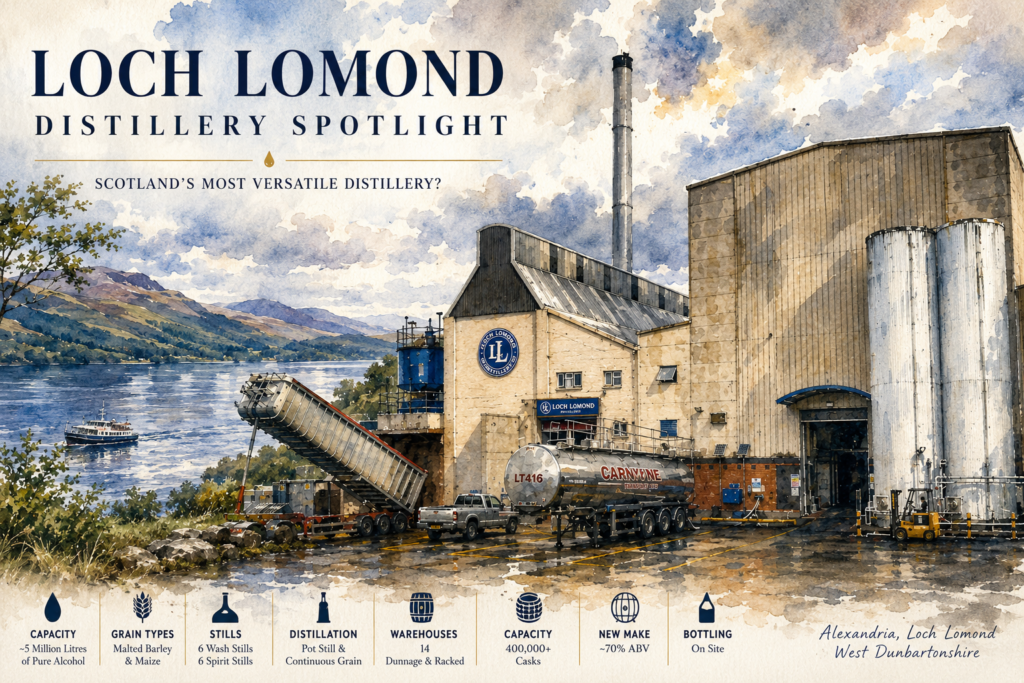
Founded in 1964 in Alexandria at the southern end of Loch Lomond, the distillery has grown into one of Scotland’s most technically fascinating whisky-making operations. Today it produces around 5 million litres of pure alcohol annually, using water drawn from both Loch Lomond and the Glen Douglas spring.
Unlike the vast majority of Scotch distilleries, Loch Lomond processes both malted barley and maize, allowing it to produce single malt whisky, single grain whisky and blended Scotch whisky on the same site. That distinction alone places it in a very small group of producers, but it is only part of the story.
One of the most overlooked aspects of Loch Lomond is that maturation is not its primary tool for creating diversity. At most distilleries, spirit character remains broadly consistent and cask selection does much of the heavy lifting. Loch Lomond turns that model on its head. Here, diversity begins in the still house.
That distinction matters because many of the whiskies produced at Loch Lomond can mature in similar casks, spend similar periods in warehouses and still emerge with dramatically different personalities.
The Many Faces of Loch Lomond
One of the reasons Loch Lomond can feel confusing to newcomers is that the distillery produces a range of spirit styles that are often treated almost as separate brands. Independent bottlers have spent decades releasing names such as Croftengea, Inchfad and Inchmurrin as though they were standalone distilleries, meaning many whisky drinkers have likely tasted Loch Lomond without realising it.
In many ways, Loch Lomond has spent years competing with itself.
Loch Lomond
The flagship range showcases the distillery’s signature style, often balancing orchard fruits, honey, citrus and gentle spice. Depending on the release, it can also demonstrate just how broad the Loch Lomond flavour spectrum truly is.
Inchmurrin
Arguably the most distinctive spirit produced at the distillery, Inchmurrin is famous for its vibrant tropical fruit profile. Pineapple, melon, pear drops and floral notes regularly appear in both official bottlings and independent releases, creating a style that feels remarkably exotic for a Highland whisky.
Inchmoan
A peated style that balances smoke with fruit rather than overwhelming the spirit’s natural character. Expect bonfire embers, citrus zest and sweet malt beneath the peat.
Inchfad
A medium-peated style that sits comfortably between Inchmoan and the heavier peat levels found elsewhere in the portfolio.
Croftengea
The powerhouse of the family. Heavily peated, earthy and robust, Croftengea often appears through independent bottlers and has developed a loyal following among peat enthusiasts.
Craiglodge
Another heavily peated spirit style that demonstrates how different cut points and production parameters can create entirely different flavour profiles despite originating from the same distillery.
Glen Douglas
A rarely seen unpeated style that occasionally appears through independent bottlers and offers a lighter, more delicate expression of Loch Lomond’s spirit.
Old Rhosdhu
Traditionally associated with elegant, floral and lighter spirit characteristics, Old Rhosdhu remains one of the more obscure names in the distillery’s catalogue.
Loch Lomond Single Grain
Produced using the distillery’s continuous grain distillation plant, Loch Lomond Single Grain showcases vanilla, coconut, citrus and sweet oak notes while highlighting another side of the operation rarely discussed by whisky enthusiasts.
Loch Lomond Blended Scotch & Single Blended Scotch
Because Loch Lomond produces both malt whisky and grain whisky on-site, it can create blended Scotch entirely from spirit distilled at the same location. This allows the distillery to produce Single Blended Scotch Whisky, a category that remains exceptionally rare within Scotch whisky.
The Most Interesting Still House in Scotland?
Much of this versatility begins with a still room unlike any other in Scotch whisky.
Loch Lomond operates six wash stills and six spirit stills, all constructed from copper and heated using steam coils. Some are traditional swan-neck pot stills familiar to whisky drinkers across Scotland. Others are the distillery’s famous straight-neck stills, a design that remains unique within the Scotch whisky industry.
These stills contain rectifying plates within the neck, effectively introducing an additional stage of refinement during distillation. Cooling rings can also be used to increase reflux, forcing heavier compounds back into the still while lighter vapours continue their journey towards condensation.
What makes this particularly important is that Loch Lomond is not simply using unusual equipment for the sake of being different. The system allows the distillery to manipulate spirit character with remarkable precision.
Many whisky enthusiasts focus on casks when discussing flavour creation, but at Loch Lomond some of the biggest flavour decisions are made long before oak enters the equation.
It is one of the few distilleries where understanding the still room arguably tells you more about the whisky than understanding the warehouse.
Alongside the pot stills sits a continuous grain distillation plant producing single grain whisky. This gives Loch Lomond another advantage rarely discussed online. Because it produces both malt whisky and grain whisky on-site, it can create every component required for a blended Scotch without sourcing spirit from another producer.
Very few Scotch distilleries can make that claim.
From Maltings to Fermentation
The distillery’s versatility begins even earlier than distillation.
Loch Lomond remains one of the relatively small number of Scotch distilleries to operate its own maltings, combining traditional floor maltings with modern drum maltings. The malt is kilned using natural gas before passing through a traditional Porteus mill, a piece of equipment increasingly disappearing from Scotch whisky production.
Mashing takes place in a stainless-steel semi-lauter mash tun with a capacity of approximately eight tonnes before the wort moves into eight closed stainless-steel washbacks, each capable of holding around 30,000 litres.
Fermentation lasts between 72 and 92 hours using dried distillers yeast, with external cooling jackets helping maintain consistent temperatures throughout the process.
This is another area where Loch Lomond often receives less attention than it deserves. The discussion around the distillery usually centres on still design, but long fermentation times play an important role in developing the fruity and estery characteristics that appear throughout much of the range.
In other words, Inchmurrin’s tropical fruit character does not begin with the stills. It begins days earlier.
Why Condensers Matter More Than You Think
One of the least discussed aspects of Loch Lomond’s production is its use of both shell-and-tube condensers and traditional worm tubs.
Most distilleries choose one system and build their spirit character around it. Loch Lomond uses both.
Shell-and-tube condensers generally encourage greater copper contact, often resulting in lighter and fruitier spirit. Worm tubs tend to preserve heavier compounds and can contribute additional weight and texture.
Viewed in isolation this may seem like a small detail. Viewed alongside the maltings, fermentation regime, still designs and grain distillation plant, it becomes clear that almost every stage of production at Loch Lomond has been designed to maximise flexibility.
That is the recurring theme of the entire operation.
Maturing More Than 400,000 Casks
Once distilled, new make spirit leaves the stills at approximately 70% ABV before being reduced to a cask filling strength of around 63.5% ABV.
The whisky is matured on-site in a combination of traditional dunnage warehouses and modern racked warehouses. Across fourteen warehouses the distillery can store more than 400,000 casks, providing substantial stocks for both official bottlings and future releases.
With an annual angel’s share of roughly two percent, Loch Lomond maintains one of the larger integrated maturation operations in Scotland. Unlike many producers, it also bottles on-site, maintaining control over the whisky’s journey from grain through to the finished bottle.
Visiting Loch Lomond
For many years one of the oddities of Loch Lomond was that such a large and technically fascinating distillery remained largely inaccessible to visitors.
While the production site itself is not generally open to the public, the opening of the Loch Lomond Whisky Experience at Luss Distillery has finally given whisky enthusiasts a dedicated destination through which to explore the brand. Located on the shores of Loch Lomond, the experience combines tastings, education and immersive exhibits designed to tell the story of one of Scotland’s most complex whisky producers.
For those hoping to understand the many faces of Loch Lomond without stepping inside the main distillery, it is currently the closest thing to a visitor centre the brand has ever had.
Loch Lomond and The Open
Loch Lomond’s partnership with The Open Championship has helped elevate the distillery’s profile internationally, introducing the brand to audiences well beyond traditional whisky circles.
As the official spirit of golf’s oldest major, the distillery releases annual limited editions celebrating iconic courses and moments from the tournament’s history. Recent releases, including the Open Course Collection and The Open Special Edition bottlings, have become increasingly popular among both whisky enthusiasts and collectors.
The partnership feels fitting. Much like golf itself, Loch Lomond combines tradition with technical precision, delivering results that often appear effortless despite the complexity behind them.
FAQ Loch Lomond Distillery
Where is Loch Lomond Distillery located?
Loch Lomond Distillery is located in Alexandria, West Dunbartonshire, at the southern end of Loch Lomond in the Scottish Highlands.
What makes Loch Lomond Distillery unique?
Loch Lomond can produce single malt whisky, single grain whisky and blended Scotch whisky on the same site. Its combination of traditional pot stills, unique straight-neck stills, continuous grain distillation and multiple spirit styles makes it one of the most versatile distilleries in Scotland.
What whiskies are made at Loch Lomond Distillery?
Loch Lomond produces Loch Lomond, Inchmurrin, Inchmoan, Inchfad, Croftengea, Craiglodge, Glen Douglas and Old Rhosdhu spirit styles, alongside single grain whisky, blended Scotch and Single Blended Scotch Whisky.
Does Loch Lomond make peated whisky?
Yes. The distillery produces several peated spirit styles, including Inchmoan, Inchfad, Craiglodge and the heavily peated Croftengea.
Does Loch Lomond produce grain whisky?
Yes. Unlike most single malt distilleries, Loch Lomond operates a continuous grain distillation plant and produces its own single grain Scotch whisky.
What is a Single Blended Scotch Whisky?
A Single Blended Scotch Whisky combines malt whisky and grain whisky produced at the same distillery. Loch Lomond is one of the few Scotch producers capable of creating every component required for this category on one site.
Can you visit Loch Lomond Distillery?
The main production site is not generally open to the public. However, visitors can explore the Loch Lomond Whisky Experience at Luss Distillery.
Final Thoughts
The irony of Loch Lomond is that its greatest strength may also be the reason it remains underestimated.
Whisky drinkers love simple stories, and Loch Lomond has never been simple. It is easier to understand a distillery that produces one style exceptionally well than one capable of producing ten. Yet the deeper you look into its maltings, still house, condensers and warehouses, the harder it becomes to find another Scotch producer operating with quite the same level of flexibility.
Loch Lomond is often described as one of Scotland’s most versatile distilleries. After spending time exploring how it actually makes whisky, that description almost feels too modest.
It may be the closest thing Scotch whisky has to a complete whisky-making laboratory—and that is precisely what makes it so fascinating.
Sources
- Loch Lomond Distillery Technical Information & Production Overview
https://www.lochlomondwhiskies.com/pages/distillery - Scotch Whisky Association – Scotch Whisky Categories Explained
https://www.scotch-whisky.org.uk - ScotchWhisky.com Distillery Profile: Loch Lomond
https://scotchwhisky.com/whiskypedia/1877/loch-lomond/ - Loch Lomond Whisky Experience at Luss Distillery
https://lussdistillery.com/pages/loch-lomond-whisky-experience - Dram1 – Luss Distillery Opens Its Doors
https://dram1.com/news-luss-distillery-opens/ - Dram1 – Loch Lomond Open Course Editions 2026
https://dram1.com/loch-lomond-open-course-editions-2026/