
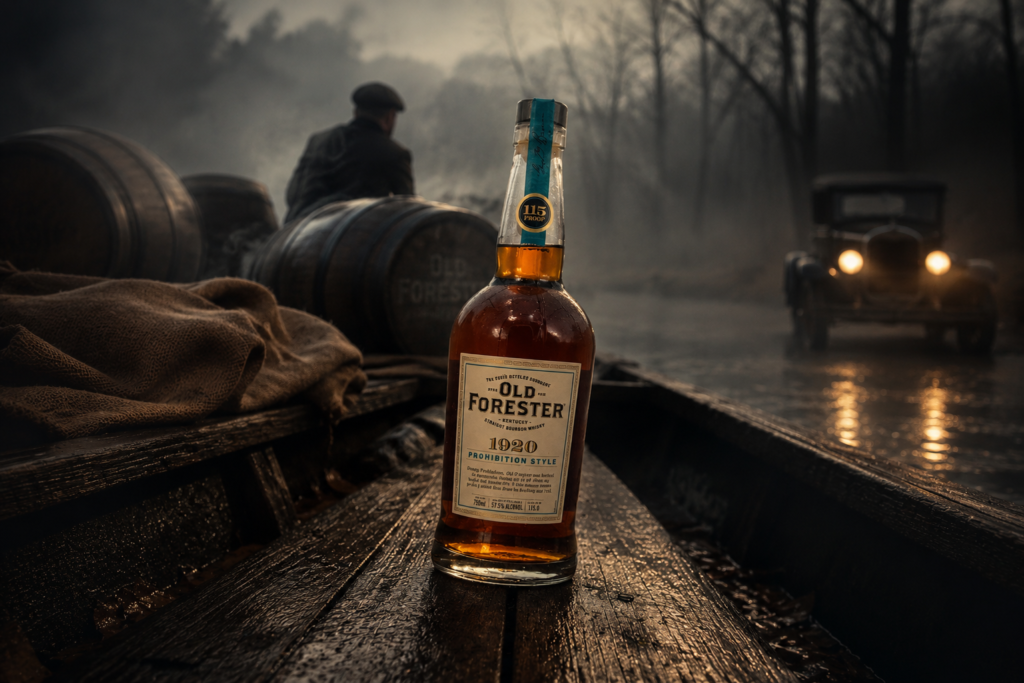
Old Forester 1920 Review: One of Bourbon’s Boldest Modern Classics
In this Old Forester 1920 Prohibition Style review, we explore whether this legendary high-proof Kentucky bourbon still deserves its reputation as one of the most characterful modern bourbons available today. Bottled at 57.5% ABV and inspired by the Prohibition era, Old Forester 1920 combines dense dark sweetness, heavy oak spice and classic American whiskey character in a way few modern bourbons manage. Years after first discovering it at a Whiskybase Gathering festival, it remains one of the bourbons I return to most often and, honestly, every time I revisit it, I remember exactly why it caused such a stir the first time I tasted it.
There are certain whiskies that stay with you because of the moment attached to them. Not just the flavour, not just the bottle, but the setting, the people around the glass, and the feeling that you’ve stumbled onto something genuinely special. For me, Old Forester 1920 will always be tied to one of a visit of mine to the Whiskybase The Gathering festival, standing at my dear friend Norbert Terbart’s Whisky4All stand while the room buzzed with whisky geeks weaving between tables, hunting for the next unforgettable dram. I still remember Norbert pouring me a glass with the kind of quiet confidence that immediately tells you somebody knows exactly what they’re handing over. One sip later, I understood why.
Whisky4All
At the time, bourbon still felt strangely underrepresented in Europe compared to Scotch and Japanese whisky. You could find the occasional bottle, but the deeper world of American whiskey — proper barrel proof bourbons, rye whiskey with real character, heritage brands with centuries of history — remained frustratingly difficult to explore in The Netherlands. Norbert was one of the few people truly championing it here.
Through Whisky4All and now also via Spirits4All as an importer, he has helped bring more serious American whiskey to Dutch enthusiasts, something that remains incredibly welcome because many excellent bourbons and ryes are still surprisingly hard to come by here. In fact, for this review, I had to source my bottle of Old Forester 1920 from Germany, which says quite a lot about the strange European bourbon landscape and how inconsistent availability can still be depending on where you live.
Before diving deeper into this review, if you’re still exploring the world of American whiskey, have a look at our guide: Bourbon Explained
What Is Old Forester 1920?
Old Forester is one of the most historic names in bourbon. Founded in 1870 by pharmaceutical salesman George Garvin Brown, it became the first bourbon sold exclusively in sealed glass bottles, a major quality guarantee during an era filled with counterfeit whiskey and inconsistent blends. The “1920” name references the Prohibition era, when most distilleries were forced to shut down while Old Forester secured one of the rare licenses allowing it to continue producing whiskey for medicinal purposes. The Whiskey Row Series celebrates important moments in the brand’s history, and 1920 specifically recreates the richer, more intense style of whiskey associated with that period.
Bottled at 115 proof, Old Forester 1920 is intentionally bold. This is not soft, easy-drinking bourbon designed to disappear quietly in the background. It is rich, dark and unapologetically full-bodied, yet what continues to impress me years later is how controlled that intensity feels. Even now, I still think it noses better than quite a few allocated bourbons costing significantly more, which is probably why enthusiasts keep returning to it despite the constantly changing bourbon hype cycle.
Tasting Notes: Old Forester 1920
Stats
- Age: NAS
- ABV: 57.5% (115 Proof)
- Distillery: Old Forester / Brown-Forman
- Region: Kentucky, USA
- Flavour Profile: Dessert Delight
- Chill–Filtration: No
- Colouring: No
Nose
The first thing that hits me is dark cherry syrup poured over warm brownies fresh from the oven, followed immediately by charred oak and a thick wave of caramelised brown sugar. This is not subtle bourbon. It arrives with real weight and presence, yet the longer it sits in the glass, the more complexity starts revealing itself. Burnt orange peel, cinnamon bark, pecan pie and maple syrup slowly emerge alongside something that always reminds me of walking past an old fashioned candy shop as a kid.
There’s a dusty sweetness underneath the oak that keeps the nose from becoming overly heavy, while a few drops of water pull out even darker fruit notes, drifting toward blackberry jam spread over toasted raisin bread.
And then there’s this faint cola syrup note that keeps appearing every single time I pour a glass. Once I noticed it years ago, I’ve never been able to unnotice it. Altogether, it smells luxurious, rich and just slightly dangerous for something bottled at 57.5% ABV.
Palate
This is where Old Forester 1920 completely won me over years ago and honestly, it still does today. The arrival is huge, delivering thick waves of dark caramel, chocolate fudge, toasted oak and black cherry cola almost immediately, but what makes this bourbon so memorable is how well it balances that intensity with sweetness. Many high-proof bourbons become hot, bitter or aggressively tannic once the initial impact fades, whereas 1920 somehow keeps everything tightly together from beginning to end.
That said, the first sip still drinks hotter than I expect every single time. Not unpleasantly hot, but properly alive. You immediately know this is 57.5% ABV bourbon. Beneath that heat sits layer after layer of flavour: roasted peanuts, espresso crema, burnt Demerara sugar and a deep leathery spice that feels surprisingly mature despite the lack of an age statement. There’s also a thick oily texture here that coats the tongue beautifully and gives the whiskey a real sense of density.
What I personally love about Old Forester 1920 is the way it constantly swings between dessert richness and dry oak spice. One sip leans heavily into pecan pie drenched in maple syrup, while the next suddenly turns toward tobacco leaf, clove, old leather chairs and heavily charred barrel staves. Some people genuinely find it too oak-heavy, but personally, that’s part of its charm. It tastes mature, slightly rugged and confidently old-school in a way many modern bourbons no longer do.
Finish
The finish is long, warming and deeply satisfying, carrying dark cocoa, cinnamon, old oak, clove oil and lingering cherry sweetness for ages before a final wave of burnt sugar and rye spice slowly fades away. Even twenty minutes later, traces of dark chocolate and toasted oak still linger on the palate, which is part of what makes this such a memorable bourbon to sit with over the course of an evening. It refuses to disappear quietly and instead keeps evolving long after the sip itself is gone.
Food Pairing
Old Forester 1920 works brilliantly with sticky barbecue ribs, pecan pie, dark chocolate desserts or smoked brisket, although honestly, my favourite pairing remains something far simpler: a leather chair, rain hitting the windows and enough time to properly sit with the glass without distractions. This is contemplative bourbon, the kind of whiskey that rewards slowing down rather than rushing through it.
Who Is This Whisky For?
This bourbon is for drinkers who want real weight and personality in their glass. If you enjoy cask strength Scotch, heavily sherried whiskies or oak-forward drams, Old Forester 1920 offers a fantastic bridge into premium bourbon territory while still feeling unmistakably American in character. Beginners may initially find it intense, but experienced whisky drinkers will probably fall for it very quickly because beneath the power sits a whiskey with genuine balance and structure.
Old Forester 1920 vs Wild Turkey Rare Breed
This comparison comes up constantly among bourbon enthusiasts because both bottles occupy a similar premium high-proof category, yet they deliver very different experiences. Wild Turkey Rare Breed leans spicier and drier, with more rye-forward structure and herbal notes, while Old Forester 1920 focuses far more heavily on dark sweetness, chocolate richness and dense oak character. Rare Breed feels more rustic and untamed, whereas Old Forester 1920 comes across darker, richer and slightly more decadent on the palate. Personally, I find 1920 more luxurious overall, while Rare Breed delivers more raw energy and spice.
Is Old Forester 1920 Worth It?
Absolutely. In a bourbon market increasingly dominated by impossible-to-find allocated bottles and inflated secondary pricing, Old Forester 1920 still delivers exceptional value. The level of flavour concentration, texture and complexity here rivals bourbons that cost significantly more, and honestly, I would buy this over quite a few modern hype bourbons without hesitation. That becomes even more impressive considering how many newer releases now rely more on scarcity marketing than genuinely memorable whiskey.
Is Old Forester 1920 Allocated?
Not officially in the same way as bottles like Blanton’s Original Single Barrel or Stagg, but availability varies heavily depending on region. In Europe especially, bottles can still be surprisingly difficult to source consistently, which is exactly why many enthusiasts import bottles from neighbouring countries whenever stock appears.
Best Way To Drink Old Forester 1920
Neat is absolutely the best place to start. A few drops of water can open up additional dark fruit and chocolate notes beautifully, but this bourbon has enough texture and balance to handle its 57.5% ABV remarkably well without dilution. It also makes a phenomenal Old Fashioned if you want a cocktail with serious richness and oak presence behind it.
What Makes Old Forester 1920 Stand Out?
What separates Old Forester 1920 from many competitors is its ability to feel both powerful and controlled at the same time. A lot of barrel-proof bourbons chase intensity alone, whereas Old Forester 1920 delivers structure. The sweetness, oak, spice and texture all feel deliberate rather than chaotic, creating a bourbon that remains engaging from beginning to end instead of simply overwhelming the palate.
There’s also a distinctly old-fashioned character to it. While some modern bourbons lean heavily into sweetness, 1920 carries enough dryness, char and spice to maintain complexity throughout the experience. It feels authentic, which is perhaps fitting for a whiskey inspired by one of the most fascinating eras in American whiskey history.
What Do Others Write About This Whisky?
- Dramface Review praises the bourbon’s balance between sweetness and oak spice while highlighting its dense flavour delivery.
- Breaking Bourbon Review describes it as one of the stronger expressions in the Whiskey Row Series thanks to its bold profile and layered complexity.
- The Whiskey Wash Review highlights the bourbon’s rich dessert-like notes alongside its robust proof.
Verdict
Strengths
- Exceptional richness and texture
- Beautiful balance between sweetness and oak
- One of the best high-proof bourbons widely available
- Complex enough for experienced whisky drinkers
- Outstanding value compared to many allocated bourbons
Weaknesses
- Can be difficult to find in parts of Europe
- High ABV may overwhelm newcomers
- Oak-forward profile will divide some drinkers
Final Thoughts
Years after first discovering Old Forester 1920 at Norbert’s Whisky4All stand during Whiskybase Gathering, it still feels like one of the most complete modern bourbons I’ve tasted. It has intensity without chaos, sweetness without becoming cloying, and enough oak-driven structure to keep seasoned whisky drinkers deeply interested from first sip to final finish.
In a market increasingly dominated by impossible-to-find hype bottles and inflated secondary prices, Old Forester 1920 remains refreshingly honest. It is bold Kentucky bourbon made with confidence, heritage and genuine personality, and even after tracking a bottle down across borders just to revisit it properly for this review, I can safely say it was absolutely worth the effort.