Worm Tubs: Why This Old-School Method Still Matters More Than Ever
There’s a certain shift that happens in whisky conversations — not loud or dramatic, but subtle enough that you only notice it if you’re paying attention. Someone mentions fermentation length, another brings up still shape, and then, almost casually, the phrase worm tubs lands on the table… and suddenly the tone changes.
Not because it’s a buzzword, but because it isn’t.
Worm tubs feel like they belong to a different era of whisky-making, one where efficiency wasn’t the driving force and flavour wasn’t engineered into neat, predictable lines. And in a modern whisky landscape that often leans toward polish and precision, that contrast makes them quietly fascinating.
I’ll admit it — I’m drawn to them every time.
Not because they guarantee better whisky, but because they often point to something I personally value more: weight, texture, and a kind of character that doesn’t feel overly managed. The kind of whisky that doesn’t just sit neatly on the palate, but moves, shifts, and lingers in a way that feels a little more alive.
If you are only just starting out on your whisky journey Worm Tubs might not mean much to you, and while this article may remain interesting to you, I’d highly recommend starting with my Whisky 101 article!
What Are Worm Tubs In Whisky?
At its core, a worm tub is simply a traditional condenser — the stage in whisky production where alcohol vapour cools and returns to liquid form. But the way it does this is what makes all the difference.
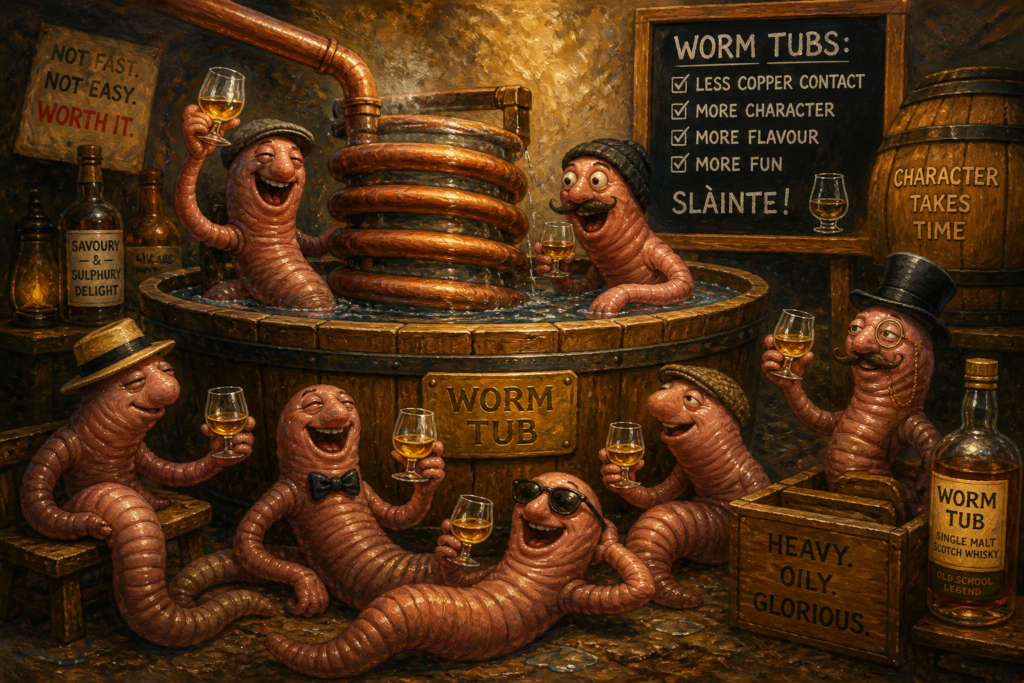
Instead of relying on modern, compact systems, worm tubs use a long copper pipe coiled into a spiral — the “worm” — submerged in a large tank of cold water. As vapour travels through that coil, it gradually cools, condenses, and emerges as spirit.
It’s a design that feels almost disarmingly simple, yet the implications are anything but.
Because the journey through that coiled copper isn’t just about temperature — it’s about contact. Specifically, how much contact the spirit has with copper as it condenses. And that interaction plays a crucial role in shaping the final character of the whisky.
Worm Tubs vs Modern Condensers: A Question Of Character
Modern shell-and-tube condensers are designed for control. They maximise copper contact, cool vapour quickly, and produce a cleaner, lighter spirit that’s easier to manage and replicate at scale.
Worm tubs sit firmly at the other end of that spectrum.
Slower, less efficient, and undeniably more awkward to maintain, they resist that kind of precision — and in doing so, they allow more of the heavier compounds in the spirit to survive the process. That’s not a flaw. It’s a stylistic choice, whether intentional or inherited.
This shift toward modern condensers happened gradually across the 20th century, largely for practical reasons, as outlined in this Whisky Advocate article:
https://whiskyadvocate.com/the-worm-tub-an-old-school-method-but-not-a-vanished-art
But what’s telling is that some distilleries chose not to follow that path completely. They held onto worm tubs not out of nostalgia, but because they recognised what would be lost if they didn’t.
How Worm Tubs Shape Whisky Flavour
Trying to pin worm tubs down to a single flavour note misses the point slightly. What they influence isn’t just flavour — it’s structure.
Whiskies produced using worm tubs often carry a sense of weight that feels immediately noticeable. The texture tends to be oilier, the palate broader, and the overall experience more grounded. There’s often a savoury edge, sometimes a waxy or mineral quality, and occasionally a subtle thread of sulphur that adds depth rather than detracts from it.
ScotchWhisky.com touches on this well, noting that reduced copper interaction allows more sulphur compounds to remain in the spirit, contributing to a fuller, more robust profile:
https://scotchwhisky.com/magazine/features/worm-tubs-the-inside-story/
That word “sulphur” tends to divide opinion, but in the right hands it becomes part of the whisky’s identity — not something that needs to be removed, but something that adds tension and complexity.
And that’s really the defining characteristic here. Worm tub whisky rarely feels overly refined. It has edges, layers, and a kind of tactile presence that makes it feel less curated and more organic.
Personally, that’s where it becomes most compelling.
A Brief History Of Worm Tubs
Long before modern condensers reshaped the industry, worm tubs were simply the standard. There was nothing niche or romantic about them at the time — just a practical way of turning vapour back into liquid using copper, water, and time.
As distillation technology evolved, however, efficiency became harder to ignore. Shell-and-tube condensers offered consistency, scalability, and easier maintenance, and gradually they replaced worm tubs across much of the Scotch whisky industry.
By the late 20th century, worm tubs had become relatively uncommon.
But not obsolete.
And that distinction matters, because the distilleries that continued using them did so with intent. They understood that changing the condenser wouldn’t just tweak the process — it would alter the spirit itself.
Which Distilleries Still Use Worm Tubs?
Today, worm tubs are still part of the production process at a select group of distilleries, many of which are known for producing whiskies with real presence and depth.
These include Mortlach, Craigellachie, Talisker, Old Pulteney, Springbank, Dalwhinnie, Benrinnes, Glen Elgin, Speyburn, Oban and Royal Lochnagar.
A well-maintained overview can be found here:
https://www.edinburghwhiskyacademy.com/blogs/feature/the-scotch-whisky-distilleries-using-worm-tub-whisky-condensers
What’s interesting isn’t that these distilleries produce similar whiskies — they don’t — but that their spirits often share a certain density and structure that sets them apart.
Why Whisky Lovers Gravitate Toward Worm Tubs
The appeal of worm tubs isn’t just rooted in tradition or technical curiosity. It comes down to what ends up in the glass.
There’s a sense that whiskies produced using worm tubs haven’t been overly smoothed out. They retain a bit of friction, a bit of unpredictability, and a bit of individuality that can sometimes feel missing in more refined styles.
They suggest a whisky that hasn’t been optimised purely for ease of drinking, but for character.
And in a landscape where many releases lean heavily on cask influence and sweetness, that distinction becomes more noticeable — and, for many enthusiasts, more desirable.
Are Worm Tubs Better For Whisky?
Not inherently, and it’s worth being clear about that.
Great whisky isn’t defined by a single piece of equipment, and some of the most elegant, complex malts in the world are produced using modern condensers.
But worm tubs offer something different.
They introduce a degree of resistance into the process — a slight refusal to streamline everything — and in doing so, they help preserve elements of the spirit that might otherwise be softened or removed.
For me, that’s where their value lies. Not in superiority, but in contrast.
My Take: Whisky Needs More Of This, Not Less
I don’t want every whisky to be heavy, savoury, or textured to the point of intensity.
But I do want those styles to exist — and more importantly, to remain relevant.
Because without them, whisky risks becoming too uniform, too polished, too predictable. Worm tubs, in their own quiet way, push against that. They preserve a style of spirit that feels grounded, slightly unruly, and unmistakably individual.
And if I’m honest, those are often the whiskies I find myself returning to.
Not because they’re perfect, but because they’re memorable.
FAQ: Worm Tubs In Whisky
What is a worm tub in whisky?
A worm tub is a traditional condenser consisting of a coiled copper pipe submerged in cold water, used to cool alcohol vapour and turn it back into liquid spirit.
How do worm tubs affect whisky flavour?
Worm tubs typically create a heavier, oilier spirit with more texture and depth due to reduced copper interaction during condensation.
Which distilleries use worm tubs?
Distilleries such as Mortlach, Craigellachie, Talisker, Old Pulteney and Springbank are known for using worm tubs.
Are worm tubs better than modern condensers?
Not necessarily — they produce a different style of spirit, often heavier and more robust, but overall quality depends on the full production process.
Why do whisky enthusiasts like worm tubs?
Because they are associated with richer, more characterful whiskies that feel less polished and more distinctive.
Final Thoughts
Worm tubs aren’t efficient, and they’re certainly not the easiest option available to distilleries today. But that’s precisely what makes them interesting.
They represent a set of choices — decisions that prioritise character over convenience, texture over precision, and individuality over uniformity.
And in a whisky world that can sometimes feel a little too carefully refined, that kind of character stands out more than ever.
Worm tubs don’t guarantee greatness.
But when everything else is aligned, they help create the kind of whisky that doesn’t just taste good in the moment — it leaves an impression long after the glass is empty.