Why Is Whisky So Expensive? (And Why Prices Are Finally Coming Down Again)
For the better part of the last decade, whisky seemed to be on a one-way trajectory: up. Prices climbed, limited editions multiplied, and bottles that once sat quietly on shelves suddenly became objects of speculation. Personally, I found myself wondering more than once: Why is whisky so expensive?
If you’ve also found yourself staring at a familiar bottle and wondering when it quietly doubled in price, you’re not alone. The story of whisky pricing is one of ambition, hype, genuine cost increases—and now, something far more interesting: a correction.
Because for the first time in years, the market is shifting again.
Whisky became more expensive due to rising production costs, global demand, and a strategy known as premiumisation, where brands focused on higher-priced releases. However, as demand has recently softened and supply increased, prices for many core bottles are now stabilising—or even falling—marking a shift in the whisky market.
Why Is Whisky So Expensive?
Whisky became more expensive due to rising production costs, global demand, and a strategy known as premiumisation, where brands focused on higher-priced releases. However, as demand has recently softened and supply increased, prices for many core bottles are now stabilising—or even falling—marking a shift in the whisky market.
The Rise of Premiumisation
To understand where we are now, you need to understand one word: premiumisation.
Across the whisky industry, brands deliberately moved upmarket. The logic was simple: sell fewer bottles, but at higher margins. It worked—exceptionally well.
Distilleries leaned into this hard:
- More limited releases
- More special cask finishes
- More storytelling
- And, crucially, higher price tags
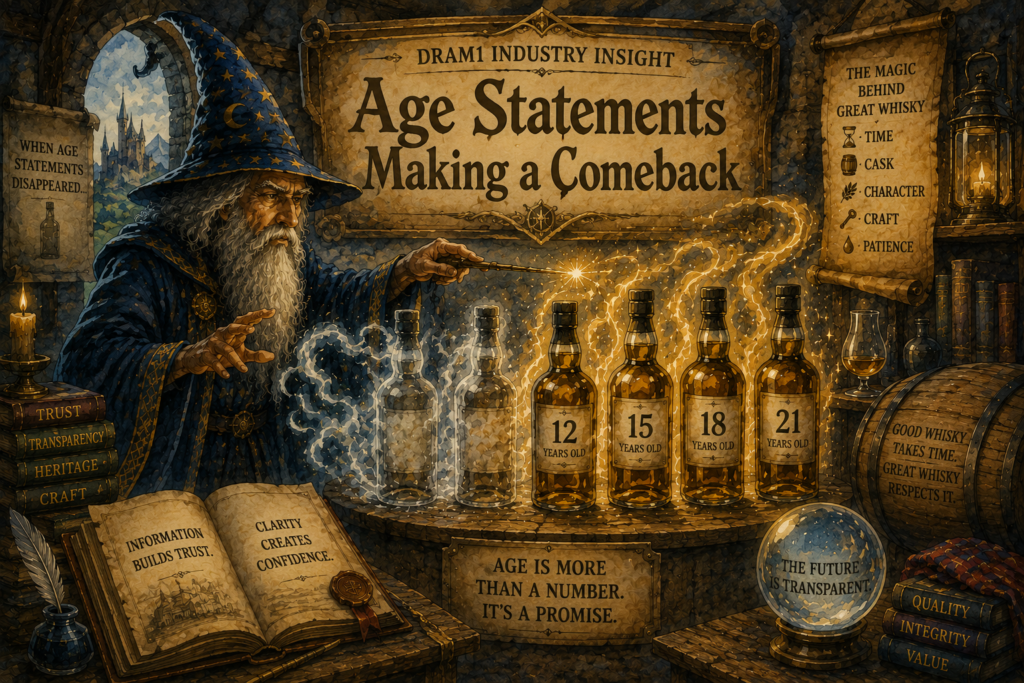
At the same time, age statements quietly disappeared, replaced by NAS bottlings that often cost just as much—or more.
If you want a deeper breakdown of the mechanics behind this, this article is worth a read:
👉 https://dram1.com/whisky-price-explained/
For broader industry context, organisations like International Wine & Spirits Research track how premium whisky has been one of the fastest-growing segments in spirits over the past decade.
The Boom Years (And the Bubble)
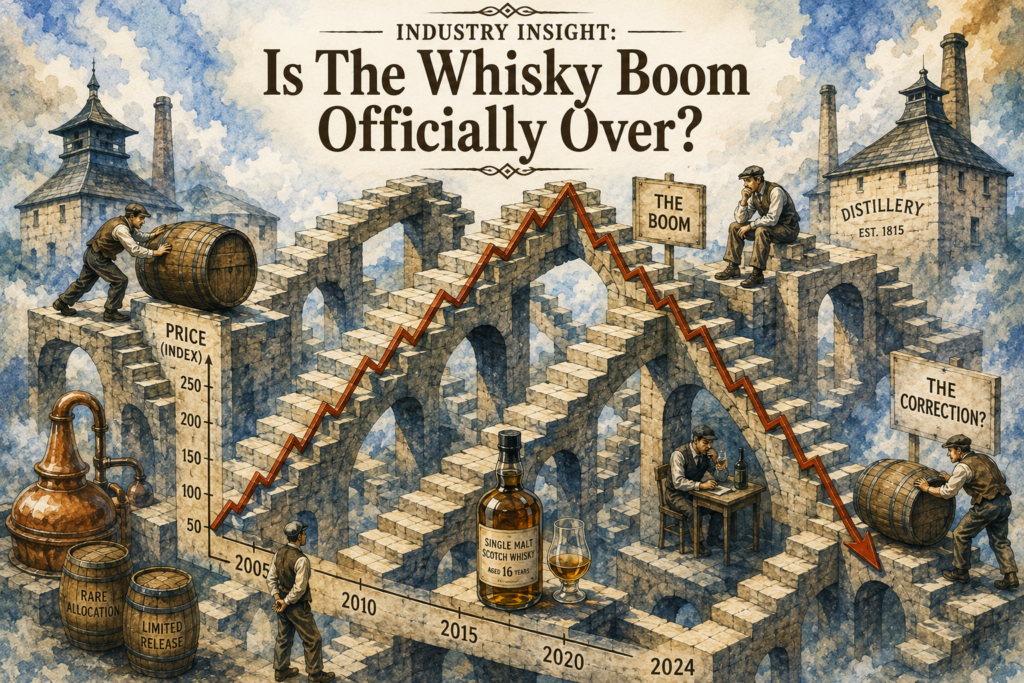
Between roughly 2020 and 2023, whisky didn’t just become more expensive—it became investable.
Collectors entered the market. Flippers followed. Auction prices soared.
Coverage from Financial Times and Bloomberg during this period highlighted whisky as an alternative investment—something that, in hindsight, helped fuel the surge.
But that kind of growth rarely sustains itself.
By 2024 and into 2026, cracks started to appear:
- Auction values began to drop
- High-end bottle sales slowed
- Investors became more cautious
Data from Whisky Auctioneer and WhiskyStats shows that secondary market values have cooled significantly after peaking.
The Turning Point: Demand Slows, Supply Builds
One of the most telling shifts has been the emergence of oversupply.
Whisky is a long game. Decisions made 10–15 years ago are hitting shelves now—regardless of current demand.
And right now, demand is softer.
Not collapsing. Not crashing. But clearly no longer chasing every premium release.
According to industry reporting and export commentary from the Scotch Whisky Association, global Scotch exports have faced pressure in recent years due to shifting economic conditions and changing consumer behaviour.
Why Whisky Prices Are Dropping in 2026
After years of relentless increases, we’re now seeing something we haven’t had in a while: price corrections.
Core range staples—once creeping into uncomfortable territory—are becoming more accessible again:
- Lagavulin 16 Year Old
- Blanton’s Original
- Independent bottlers like Signatory Vintage
These aren’t isolated cases. They reflect a broader reality: retailers and distributors are adjusting to slower demand.
If you’ve read our reviews, you’ll know exactly where these bottles sit:
- 👉 https://dram1.com/review-lagavulin-16/
- 👉 https://dram1.com/blantons-original-vs-blantons-gold/
- 👉 https://dram1.com/signatory-linkwood-30-review/
And increasingly, they’re starting to feel like value again.
But Not Everyone Is Backing Down
While some parts of the market are correcting, others are doubling down.
Distilleries like The Macallan and The GlenDronach continue to lean heavily into the premium segment.
Their strategy is clear:
- Maintain brand prestige
- Focus on high-margin releases
- Target collectors and luxury buyers
Even as the broader market softens, these brands are betting that the top end will hold.
So… Is Whisky Still Too Expensive?
The honest answer is: it depends on where you’re looking.
At the peak of the boom, pricing often felt disconnected from reality. Bottles were valued as much for scarcity and hype as for what was actually in the glass.
Now, things are rebalancing.
We’re moving into what could best be described as a buyer’s market, where prices are stabilising and, in some cases, dropping back to more reasonable levels.
But that doesn’t mean everything is suddenly affordable.
Premiumisation hasn’t disappeared—it’s just become more selective.
What This Means for You as a Drinker
This shift creates something we haven’t had in a while: choice without urgency.
You no longer need to:
- Chase every limited release
- Panic-buy before prices rise again
- Assume expensive automatically means better
Instead, you can take a step back and ask a much better question:
Is this whisky actually worth what I’m paying for it?
And increasingly, the answer is becoming clearer.
Where This Leaves the Whisky Industry
The whisky world isn’t collapsing. Far from it.
Long-term demand is still expected to grow, but the pace has changed.
What comes next looks more balanced:
- Slower, more sustainable growth
- More scrutiny from drinkers
- And a clearer divide between genuine quality and marketing
Frequently Asked Questions About Whisky Prices
Why is whisky so expensive now?
Whisky prices increased due to a mix of higher production costs, global demand, and premiumisation strategies where brands focused on selling higher-priced bottles rather than larger volumes.
Are whisky prices going down in 2026?
Yes, in many cases. Core range bottles and some independent releases are becoming more affordable again as demand slows and supply increases, although premium brands are still holding higher price points.
Why are some brands still so expensive?
Brands like The Macallan and The GlenDronach continue to target the luxury market, focusing on prestige and exclusivity rather than competing on price.
Is expensive whisky always better?
Not necessarily. Price often reflects branding, scarcity, and positioning as much as quality. As the market stabilises, value is becoming easier to find again.
Should I wait to buy whisky?
If you’re not chasing limited releases, there’s less urgency than before. The current market gives buyers more time to choose carefully rather than rushing purchases.
Final Thoughts
Whisky got expensive because it could.
It became desirable, collectible, and global. Distilleries responded by pushing prices higher—and for a while, the market kept up.
But markets always correct.
And right now, we’re in that correction.
Not a crash. Not a collapse. Just a return to something closer to reality.
For drinkers, that’s not bad news at all.