How to Taste Whisky Properly: A DRAM1 Whisky Academy Guide
There’s a point in every whisky journey where things quietly start to change.
At first, it’s all fairly straightforward. You pour a dram, take a sip, maybe enjoy it, maybe not, and move on. You read tasting notes that talk about orchard fruits, polished oak, distant smoke drifting across a shoreline… and if you’re honest, you’re thinking: I’m just getting whisky.
And then, one evening, without really planning it, something shifts. You slow down a little. You pay attention. And suddenly the same whisky you’ve had before feels different — not because it changed, but because you did.
That’s really what this is about. Not learning how to taste “properly” in a strict sense, but learning how to notice more. Whisky has always had those layers. You’re just giving yourself the chance to find them.
Before we get into it, one small thing that genuinely makes a bigger difference than most people expect:
👉 If you’re not sure which glass you’re using and why it matters, have a look here:
A good glass doesn’t make whisky better, but it does make it easier to understand.
What Tasting Whisky Really Means
One of the most important realisations — and one that usually comes a bit later — is that learning how to taste whisky isn’t really about your tongue.
It’s about your nose, your memory, and the way those two interact.
That’s why whisky can feel flat in the beginning. It’s not that there’s nothing there, it’s that your brain hasn’t yet learned how to interpret what it’s picking up. Once that connection starts forming, everything you’ve read in articles like How Is Whisky Made?, Whisky Grains Explained, or Sherry Casks and Whisky suddenly becomes tangible. You’re no longer reading about flavour — you’re experiencing it.
And the only thing that unlocks that is time and attention.
Step 1: The Look
Before you even bring the glass to your nose, there’s already something happening in front of you — and it’s worth giving it a moment.
Hold the whisky up to the light, not because you’re trying to analyse it in a technical sense, but because it sets the tone. A pale, straw-like colour carries a different expectation than something deep and coppery, even if, as you’ll know from Natural Colour in Whisky, that colour doesn’t always tell the full story.
Then give the glass a gentle swirl and watch how the whisky moves. It clings to the sides, gathers, and eventually forms those slow-moving droplets — the tears, or legs.
It’s one of those details that seems almost decorative at first, but once you start paying attention, it becomes part of the conversation. When those legs are thick and slow, the whisky often has a certain weight to it, a richness you’ll likely feel later on the palate. When they fall quickly, more lightly, you’re often dealing with something a bit leaner, a bit more delicate.
It’s not something to overanalyse, but it’s a quiet first impression — the whisky telling you, in its own way, what kind of experience it might offer.
Step 2: The Nose
If there’s one part of learning how to taste whisky that changes everything, it’s this.
And it’s also the part most people rush.
Bring the glass towards your face, but don’t go straight in. If you push your nose too far into the glass, all you’ll get is alcohol — and once that takes over, it drowns out everything else. Instead, hover just above the rim and let the aromas come to you gradually.
Then start to explore a little.
Move your nose slightly around the glass — not in a dramatic way, just enough to notice that the whisky doesn’t smell the same everywhere. At the top of the rim, you’ll often find lighter, brighter notes — fruits, florals, those fleeting aromas that lift easily. Lower down, closer to the liquid, heavier elements tend to settle — spice, oak, sometimes smoke.
It’s a small adjustment, but it changes the experience completely. You stop smelling “whisky” as one thing, and start discovering it as layers.
There are a few little techniques that feel almost unnecessary until you try them, and then you wonder why you didn’t do it sooner. Keeping your mouth slightly open while nosing softens the alcohol and allows more aroma to come through. Breathing gently through both your nose and mouth at the same time can amplify that effect even further, drawing more nuance out of the glass.
And then there’s the one that always gets a reaction — putting a drop of whisky on your hands, rubbing them together, and letting the alcohol evaporate. What’s left behind is often softer, rounder, and sometimes reveals notes you didn’t catch in the glass.
Just make sure your hands are clean. I learned that the hard way during a bachelor party that had just come back from a mud run — and let’s just say the whisky didn’t stand much of a chance against that kind of background.
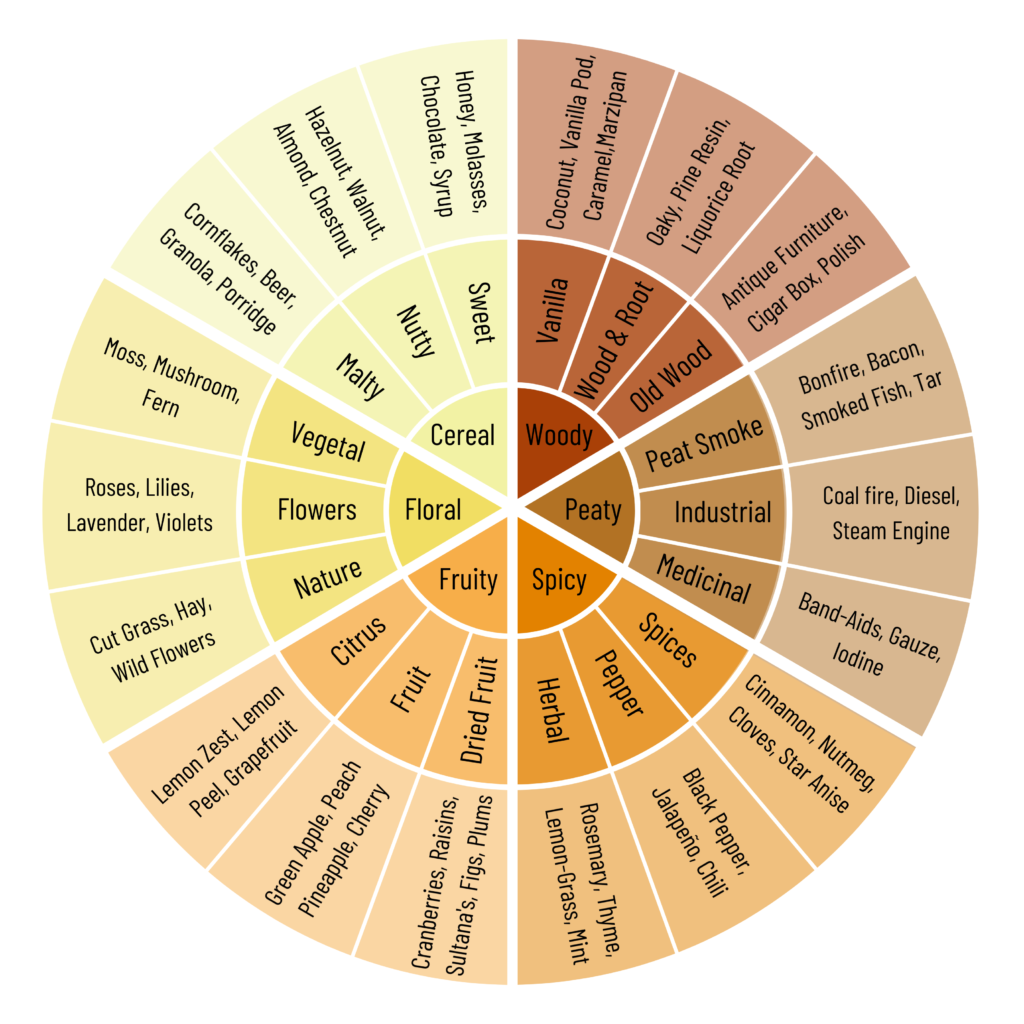
What really matters here, though, is not just what you smell, but that you start to remember it. Writing things down might feel unnecessary at first, but it’s one of the fastest ways to build familiarity. The more you note, the easier it becomes to recognise those same aromas the next time they appear. If you ever feel stuck trying to describe something, using an aroma wheel like the one in this article, or reading more about whisky nosing in Scotch Whisky’s guide (https://scotchwhisky.com/magazine/features/9549/the-science-of-tasting-whisky/) can help give shape to what you’re already sensing.
Step 3: The First Sip
The first sip is often misunderstood.
People expect it to deliver flavour immediately, but in reality, it’s doing something much more subtle. It’s preparing your palate.
Take a small sip and let it move slowly across your mouth, almost like you’re rinsing rather than drinking. Not aggressively, just enough to coat your tongue, the sides of your mouth, the back of your palate.
What you’re doing here is letting your senses adjust to the alcohol. Whisky, especially at higher strengths, can overwhelm everything else if you go straight in expecting clarity. This step softens that initial impact and creates the conditions for the next sip to actually reveal something.
It’s less about tasting, more about getting ready to taste.
Step 4: The Second Sip
This is where things start to open up.
Take another sip, slightly more deliberate this time, and let it travel across your palate. Notice not just what you taste, but how the whisky behaves — the texture, the weight, the way it seems to settle in different parts of your mouth.
You can introduce a small amount of air, gently, in a way that’s sometimes used with wine. With whisky, the effect is more restrained, and if you get a bit too enthusiastic, the alcohol will quickly remind you that you’re dealing with something stronger than it looks.
What matters far more than technique at this stage is trust.
It’s very easy to start searching for flavours you’ve read about — vanilla, caramel, dried fruit — but that often pulls you away from your own experience. Instead, pay attention to what comes to mind naturally. A memory, a smell, something familiar that you can’t quite name at first.
That’s where your tasting notes come from.
Write them down, even if they feel imprecise. Especially if they feel imprecise. Over time, those fragments begin to connect, and what once felt vague becomes something you recognise almost instantly. A flavour wheel, like the one in this article, or reading more about tasting whisky from sources like Whisky Advocate (https://whiskyadvocate.com/Learn-to-Taste-Whiskey-Like-a-Professional), can help give structure if you need it, but it should never replace your own perception. All of this will help you learn how to taste whisky even faster!
Step 5: Add Water
At some point, it’s worth stepping slightly outside the first impression and seeing what happens when you change the whisky just a little.
Adding a few drops of water might seem insignificant, but it can shift the entire profile. Alcohol softens, aromas expand, and flavours that were previously tucked away can come forward more clearly. This is particularly noticeable with higher ABV whiskies, something that becomes more obvious once you’ve spent time with Whisky Proof & ABV Explained.
The key here isn’t whether water is “better,” but whether it shows you something new.
Taste the whisky as it is. Then add a few drops and go back again — to the nose, to the palate, to the finish. The contrast is often where the most interesting discoveries happen.
Step 6: The Finish
One of the most overlooked parts of learning how to taste whisky is what happens after you’ve swallowed.
There’s a tendency to move on too quickly, to take another sip or shift your attention elsewhere, but if you stay with it for a moment, you’ll notice that the whisky hasn’t actually finished yet.
The flavours continue, sometimes subtly, sometimes quite dramatically. They might fade gently, or evolve into something entirely different — a sweetness giving way to spice, a fruit note drying into oak, a lingering warmth that slowly settles.
What you’re really paying attention to here is time. How long does it last? How does it change? What disappears, and what appears in its place?
These are the details that often separate a good whisky from a memorable one, and they’re worth noting just as much as anything you picked up on the nose or palate.
How to Build Your Palate Over Time
There isn’t a shortcut to this, and honestly, that’s part of the appeal.
Your palate builds quietly, without you really noticing at first. One whisky starts to feel different from another. Certain aromas become easier to recognise. Flavours that once felt vague begin to stand out more clearly.
Comparing different styles helps — moving between something smoky, like what you explored in What Really Makes a Whisky Smoky?, and something lighter or more fruit-driven. Revisiting the same bottle weeks later often reveals more than the first time you opened it.
And throughout all of it, those small notes you’ve been taking start to matter more and more.
You’re not just drinking whisky anymore. You’re building a reference point.
Common Mistakes to Avoid
It’s very easy, once you start learning more about how to taste whisky, to feel like there’s a right and wrong way to approach it.
There isn’t.
Whisky is, at its core, about enjoyment — about taking a moment, slowing down, and letting yourself get lost in it for a while. However you reach that point is the right way for you.
That said, understanding how different choices affect the whisky can help you shape that experience. Ice, for example, will lower the temperature and can mute aromas and flavours, sometimes flattening what the whisky has to offer. A few drops of water, on the other hand, can open it up, making it more expressive.
But these are tendencies, not rules.
What works beautifully for one whisky might not work at all for another, and what you prefer one evening might feel completely different the next. The only way to find out is to experiment — and to trust your own experience as you do.
FAQ – How to Taste Whisky
Do I need to follow all of this every time I drink whisky?
Not at all. These steps are there when you want to explore a whisky more deeply, not when you just want to relax and enjoy a dram.
Why does whisky still taste like alcohol to me?
Because your senses are still adjusting. Give it time, slow things down, and focus more on the nose — that’s where most of the detail lives.
Is the glass really that important?
It makes a difference, especially when it comes to aroma. A narrower opening helps concentrate what you’re smelling, which makes everything easier to pick up.
Should I always add water?
No, but it’s always worth trying. Sometimes it changes very little, and sometimes it completely transforms the whisky.
How long does it take to develop your palate?
It happens gradually. The more you taste, compare, and revisit, the more natural it becomes.
Final Thoughts
At some point, without really noticing when it happened, learning how to taste whisky becomes less about trying to find flavours and more about recognising them when they appear.
It’s a quieter kind of progression. Less about learning something new, more about becoming familiar with what was already there.
And once you reach that point, even a simple dram can hold your attention far longer than it used to — not because it changed, but because you finally gave it the space to show you what it had all along.