Edradour Distillery Spotlight: the tiny Highland distillery that bottles whisky with a big, uncompromising voice
If you’ve ever sipped a dram and thought, how is this so small a distillery… and yet so unmistakably loud in flavour? — welcome to Edradour Distillery.
This is one of those rare places where the romance isn’t marketing. It’s baked into the kit, the pace, the scale, and the choices. Edradour doesn’t try to be sleek or modern. It leans hard into traditional production, weighty spirit, and maturation that’s often unapologetically sherried, frequently single-cask, and nearly always memorable.
And then there’s Ballechin — the distillery’s peated alter ego — which takes that naturally chunky Edradour character and drags it through smoke until it purrs like a bonfire in a damp Highland forest.
Let’s get properly stuck in.
Where Edradour Distillery began: from farm-scale whisky to a name that stuck
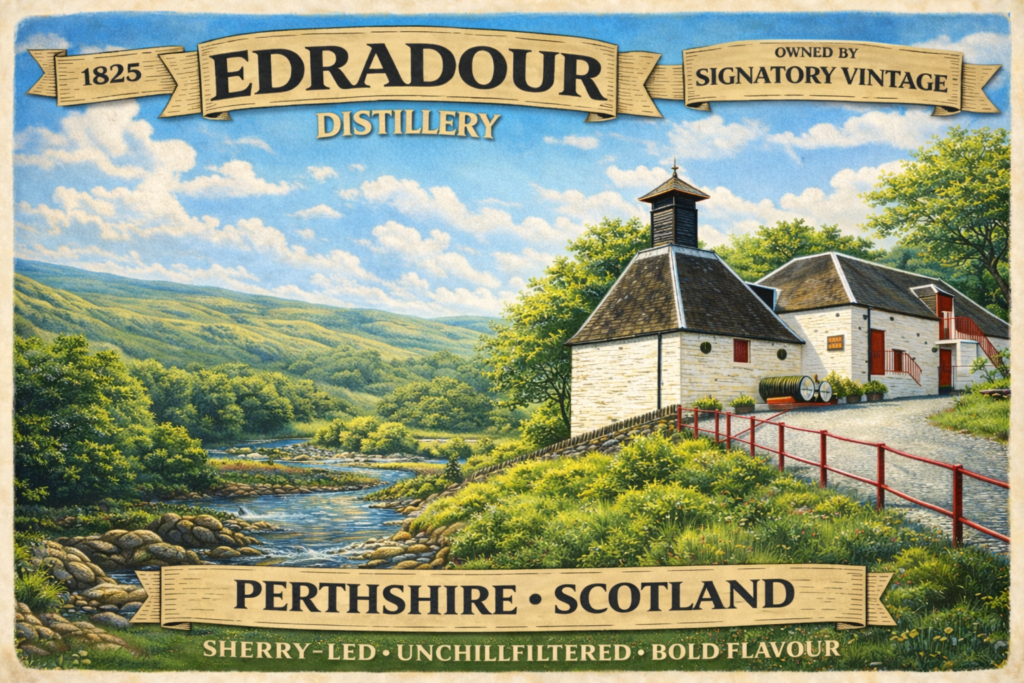
The Edradour story is often told as “founded in 1825”, but the nuance matters.
Officially, the roots trace back to the early legal era of Scotch whisky: a farming community distilling locally, with licensing tied to the 1820s shift toward regulated production. Early records point to a small, rural operation associated with local farmers and an original name often cited as Glenforres before Edradour appears in the historical record.
By 1837, the distillery at the current site is firmly in the timeline, founded by a group of local farmers. In 1841, the collective formalised operations as John MacGlashan & Co — one of those deliciously old-school details that makes Edradour feel like it never fully left the 19th century behind.
From there, ownership moved through notable phases:
- 1886: acquired by John McIntosh & Co
- 1933: sold to William Whiteley & Co
- 1982: bought by Campbell Distilleries (Pernod Ricard)
- 1986: Edradour’s first official single malt release arrives
- 2002: purchased by Andrew Symington of Signatory Vintage for £5.4m
That 2002 sale is the pivot point. It didn’t just change who owned Edradour Distillery — it changed what Edradour was allowed to become.
The machinery of character: how Edradour makes spirit that tastes like it has shoulders
Edradour’s flavour isn’t accidental. It’s structural.
On the distillery’s own production walk-through, you’ll see the hallmarks of a “keep it traditional” mentality:
- Morton Refrigerator cooling the wort (the distillery notes it as the last of its kind still working in the whisky industry)
- Oregon pine washbacks (the distillery notes two, both over 50 years old)
- Copper pot stills paired with worm tubs
Those worm tubs matter. They tend to promote heavier spirit character compared with more modern condensers — and Edradour already starts from a naturally weighty place.
Even the still sizes reinforce the point. Edradour’s equipment is famously compact: sources commonly cite a wash still around 3,000L and a spirit still around 2,200L, with the distillery describing the spirit still as the smallest traditional still in Scotland.
Put it all together and you get a spirit that likes to show up as:
- dense malt and toasted cereals
- dark fruit when sherry is involved
- a rich, oily mouthfeel
- spice, nuttiness, and cocoa tones that feel “built-in”, not “added on”
This is why Edradour can handle active casks without collapsing into wood soup. The distillate has the muscle for it.
Read more about distillation techniques in my Whisky 101 article!
Maturation at Edradour Distillery: why sherry is often the main character (and wine casks are the plot twist)
Plenty of distilleries use sherry casks. Edradour commits to them.
A great example is the Edradour 10 Year Old Distillery Edition (46%), which the distillery describes as aged 100% in Oloroso sherry casks, bottled unchillfiltered at 46% ABV.
That’s not a gentle “kiss” of sherry. That’s a full-on embrace — and it’s a big part of why Edradour has such a devoted following among people who want richness, colour, and flavour density.
Then you’ve got the wine-cask side of Edradour — releases finished or matured in things like Burgundy and other wine styles — which can be spectacular when it clicks, and wonderfully argumentative when it doesn’t. (Edradour is not a “safe” distillery. That’s a compliment.)
Read more about Sherry Cask maturation in my Sherry Casks and Whisky article!
Ballechin: Edradour’s smoky twin, born in the 2000s
Ballechin is not a branding exercise. It’s a deliberate expansion of the house style into peat.
Modern Ballechin production began in 2003, and the distillery describes it as a heavily peated version of Edradour, made with a minimum phenol content of 50 ppm.
That’s serious peat — especially for a mainland (non-island) whisky — and what makes it special is how it lands on Edradour’s naturally thick distillate. The smoke doesn’t feel thin or sharp; it feels embedded.
And Ballechin maturation is intentionally varied: the distillery explicitly frames it as matured in a “wide variety of wood types.”
The Signatory Vintage effect: how ownership changed Edradour — and why “Signatory Edradour” can feel like an official bottling
You can’t talk about Edradour Distillery in 2026 without talking about Signatory Vintage.
Signatory is a major independent bottler — and since 2002, it has also been the owner of Edradour.
That matters for two reasons:
1) Signatory didn’t just buy a distillery — it moved its centre of gravity
ScotchWhisky.com notes that after acquiring Edradour, Signatory moved operations north and built warehousing and a bottling plant at the Perthshire site (keeping the architecture in tune with the place).
In other words, Edradour became both a distillery and the beating heart of a bottling operation that already had deep cask inventory and a serious reputation among enthusiasts.
2) Why some drinkers treat Signatory Edradour as “official enough”
In whisky culture, “official bottling” usually means “released under the distillery brand.” But Edradour is unusual: the owner is also one of the world’s best-known independent bottlers, and they bottle a lot of Edradour stock under the Signatory name.
So while Signatory-labelled Edradour sits in the “independent bottling” lane on paper, it often functions like an extension of the distillery’s output — selected, matured, and released by the same ownership group that runs the distillery itself.
That grey area is part of the fun. It also means there’s an unusually deep bench of Edradour whisky to explore beyond the core distillery-labelled bottles.
Must-try bottles: where to start with Edradour and Ballechin
Here are bottles that reliably tell the Edradour story (without requiring you to hunt unicorns).
Must-try Edradour Distillery bottles
- Edradour 10 Year Old Distillery Edition (46%) – a modern calling card, with the distillery stating 100% Oloroso sherry cask maturation and unchillfiltered bottling.
- Edradour 10 Year Old Small Batch PX – Check out my full Edradour 10 Small Batch PX Review to see the tasting notes.
- Edradour “Straight From The Cask” / single-cask style releases – this is where Edradour becomes addictive: intense spirit, bold wood, and that house weight doing the heavy lifting (often with wine-cask experiments in the mix).
Must-try Ballechin bottles
- Ballechin 10 Year Old (46%) – the flagship peated expression; widely described as made from malt peated to around 50 ppm, with maturation commonly framed around ex-bourbon plus a sherry “top dressing.”
- Ballechin 18 Year Old Cask Strength (Batch releases) – for when you want the peat with more maturity and heft, often showing how well Ballechin handles time and oak.
- Ballechin Madeira Cask Matured (older releases) – a great example of the “varied wood types” philosophy: smoke plus sweetness plus a distinct wine-cask accent.
Bonus: Signatory Edradour that many enthusiasts treat as “semi-official”
Look for Signatory series like:
- Un-Chillfiltered Collection (Edradour) – frequently sherry-forward, often priced like an indie, and sometimes delivering the kind of richness people wish every OB would bottle.
Why Edradour Distillery belongs on your radar
Edradour isn’t trying to be everybody’s whisky. It’s trying to be Edradour.
It’s small-scale enough that the production choices actually feel tactile, and bold enough in maturation that you can track the distillery’s personality through different casks like chapters in a book. Add Signatory’s ownership — and the sheer volume of interesting Edradour spirit that ends up in Signatory clothing — and you’ve got one of the most enthusiast-friendly ecosystems in Scotch.
If you want whisky that tastes like it was made with intent (not committee), Edradour Distillery is the kind of place you end up returning to — not because every bottle is perfect, but because almost none of them are forgettable.