The Whisky That Punched Me in the Face — Then Quietly Became the Reason I Fell in Love with Whisky
Some whiskies ease you in gently.
They hold your hand, smile politely, and make sure you’re comfortable before asking anything of you.
Laphroaig Distillery did the opposite.
My first dram wasn’t love at first sip — it was shock. Confusion. Rejection. It tasted like smoke, iodine, seaweed, tar, bandages, and coastal madness poured into a glass. I remember thinking it was wrong. Aggressively so. Why would anyone drink something that tasted like this on purpose?
And yet… it wouldn’t leave me alone.
I kept thinking about it. About how vivid it was. How unapologetic. How it didn’t feel designed — it felt alive. Somewhere between that first grimace and a later, quieter dram, something shifted. The smoke started to make sense. The medicinal edge became coastal poetry. The chaos revealed structure.
Laphroaig didn’t just grow on me.
It rewired me.
This is the distillery that made me fall in love with whisky — not as a drink, but as a lifelong fascination. And today, Laphroaig bottles sit among my most treasured possessions, not because they’re rare or fashionable, but because they remind me why whisky matters in the first place.
This is not just my favourite distillery.
This is the one that changed everything.
Islay: where flavour stops apologising and starts shouting
You can’t talk about Laphroaig Distillery without talking about Islay — because Islay isn’t a backdrop. It’s a co-author.
This small Hebridean island is battered by Atlantic weather, soaked in salt air, and laced with peat bogs that smell like ancient memory. Whisky here doesn’t gently reflect its surroundings — it absorbs them, aggressively.
Laphroaig sits on Islay’s south coast, exposed and defiant, staring straight into the sea. Warehouses inhale salt spray. Damp air seeps into casks. Peat smoke curls low and heavy, clinging to everything it touches.
If Islay is whisky with the volume turned up, Laphroaig is the distortion pedal kicked all the way in.
From farm whisky to cult icon
Founded in 1815 by brothers Alexander and Donald Johnston, Laphroaig Distillery began life the way many great distilleries did: as a practical extension of farming. Barley grown for cattle feed found a more profitable destiny once fermented and distilled.
But even in its early years, Laphroaig wasn’t interested in blending in.
While other distilleries chased smoother profiles and broader appeal, Laphroaig leaned hard into peat, smoke, and personality. It didn’t try to be liked. It tried to be itself. That decision — radical then, rare now — would define the distillery forever.
Laphroaig didn’t become iconic by accident.
It became iconic by refusing to change.
Ian Hunter: obsession, innovation, and whisky warfare
If Laphroaig Distillery has a guardian spirit, it’s Ian Hunter.
Hunter took control in the early 20th century and became famously protective — some would say obsessive — about Laphroaig’s flavour. At a time when blending demand encouraged lighter, more neutral spirit, Hunter doubled down on intensity. More peat. More weight. More character.
He also changed Scotch whisky forever by pioneering the use of ex-bourbon barrels for maturation. Long before American oak became industry standard, Hunter recognised that bourbon casks amplified Laphroaig’s smoke, iodine, and coastal notes rather than smothering them.
That decision didn’t just shape Laphroaig — it reshaped Scotch.
Hunter was also deeply secretive. Production details were guarded like state secrets. And with good reason.
Rivalries, sabotage, and Islay intrigue
Laphroaig’s history isn’t just smoky — it’s deliciously dramatic.
One of the most infamous rivalries in Scotch whisky history involved Mackie & Co., owners of Lagavulin. Desperate to replicate Laphroaig’s distinctive flavour for blending, they tried everything. They poached workers. Copied equipment. Even attempted to recreate the distillery layout stone by stone.
Nothing worked.
There are tales — some documented, others gleefully exaggerated — of water supplies being interfered with, peat access restricted, and legal battles fought over flavour itself. Ian Hunter fought relentlessly to protect Laphroaig’s identity, even if it meant burning bridges along the way.
The lesson is simple:
Laphroaig’s flavour wasn’t stumbled upon. It was defended. Ferociously.
Bessie Williamson: the calm hand on the tiller
Then came Bessie Williamson — and it’s impossible to talk about Laphroaig Distillery without pausing here.
She arrived in the 1930s as a temporary secretary. She stayed. She learned. She absorbed everything. When Ian Hunter’s health declined, Bessie stepped in — quietly, competently, and without fuss.
In 1954, she officially became the owner.
At a time when women leading distilleries was almost unheard of, Bessie Williamson ran Laphroaig with intelligence, restraint, and deep respect for its whisky. She modernised where necessary but never compromised the spirit’s soul.
Without Bessie, Laphroaig might have survived.
Because of her, it thrived.
Peat done properly (and why it matters)
Laphroaig’s flavour begins with peat — but not peat as a gimmick. Peat as philosophy.
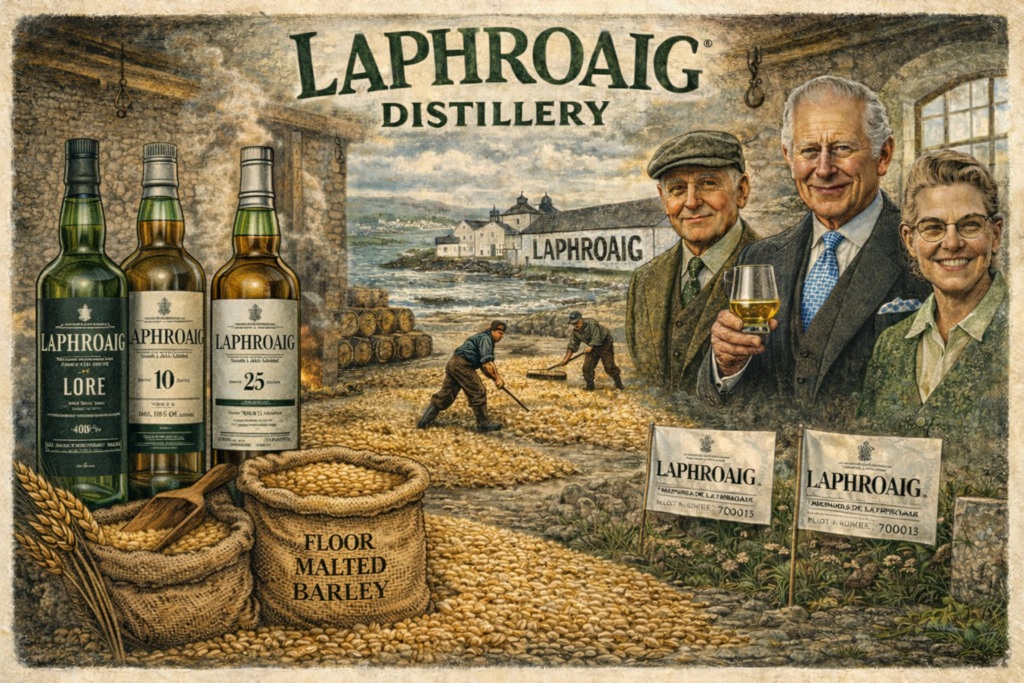
The distillery cuts peat from its own bogs, dense with moss, heather, and centuries of compressed organic matter. A portion of its barley is still floor-malted on site, where peat smoke rises unevenly through traditional kilns, clinging differently to every grain.
That inconsistency is the point.
It creates layers: smoke, iodine, seaweed, damp earth, bonfire ash. This isn’t sweet peat. It’s medicinal, maritime, and challenging — the kind that makes people recoil or fall hopelessly in love.
Laphroaig doesn’t polish this away.
It preserves it.
A whisky that smells like an argument
Describing Laphroaig to someone who’s never tasted it is always risky.
You might say:
- iodine and bandages
- peat smoke and coastal brine
- seaweed, tar, and liquorice
- charred citrus and damp earth
And watch them hesitate.
But then they taste it.
And suddenly it’s either perfect — or utterly not. There is no middle ground. Laphroaig is a whisky that chooses its drinker. I hated my first dram. Now I chase them.
That journey is the magic.
Prohibition, “medicine”, and beautiful loopholes
During Prohibition in the United States, Laphroaig Distillery found a way to survive while many others vanished.
Thanks to its unmistakably medicinal character, Laphroaig was approved for sale as medicinal whisky — one of the very few Scotch whiskies to earn that status. Prescribed by doctors. Dispensed by pharmacists. Entirely legitimate.
Officially.
Unofficially, it became a delicious loophole. If your “medicine” happened to taste like peat smoke and rebellion, well — that was between you and your doctor.
Even when whisky was banned, Laphroaig found a way to keep burning.
Royal favour and a very Islay kind of prestige
Laphroaig Distilery holds a distinction no other whisky distillery can claim.
It is the only Scotch whisky to hold a Royal Warrant from the Prince of Wales. King Charles III has long declared Laphroaig his favourite whisky, granting the warrant in 1994.
He didn’t stop there.
The King also owns a personal plot of land at Laphroaig Distillery — making him, quite literally, a tiny Islay landowner. It’s wonderfully fitting: a fiercely individual whisky endorsed not for elegance, but for honesty.
Laphroaig didn’t chase prestige.
Prestige came to it.
Friends of Laphroaig
Royalty aside, Laphroaig’s real magic lies with its people.
Through Friends of Laphroaig, buying a bottle earns you a one-square-foot plot of land on Islay, complete with a numbered certificate. Visit the distillery, and you can even collect “rent” — traditionally paid as a dram.
It’s charming. It’s slightly mad. And it’s perfect.
You don’t just drink Laphroaig.
You become part of its story.
Lore, legends, and beautifully strange truths
Laphroaig Distillery doesn’t just have history — it has mythology.
There are stories of workers identifying Laphroaig warehouses blindfolded, guided only by smell. Of Atlantic sea spray creeping through stone walls, quietly shaping maturation in ways no lab could ever fully explain.
Peat recipes are guarded like family secrets. Some swear ancient seaweed beds beneath the bogs infuse the smoke with iodine-rich notes. Scientifically provable or not, it feels true — and with Laphroaig, feeling matters.
And then there’s the truest legend of all:
Laphroaig is not a whisky you learn to love.
It waits.
Many of its most devoted fans hated their first dram. I certainly did. That initial resistance is part of the journey. Laphroaig doesn’t flatter you. It challenges you.
And once it gets you, it never really lets go.
The core range: icons, not compromises
Laphroaig’s core range reads like a manifesto:
- Laphroaig 10 Year Old – the benchmark. Medicinal, smoky, coastal, and uncompromising.
- Quarter Cask – sweeter oak, thicker texture, amplified intensity.
- Lore – layered, complex, and steeped in tradition.
- 10 Cask Strength – raw, powerful, and thrilling.
- 25 Year Old – proof that time doesn’t tame Laphroaig; it deepens it. Mature smoke, refined iodine, extraordinary balance.
No matter the age or expression, the DNA never disappears.
Laphroaig Distillery FAQ
Why does Laphroaig taste so medicinal?
That signature iodine-led character comes from heavily peated barley, traditional floor malting, and Islay’s coastal environment. The peat smoke, sea air, and fermentation choices combine to create those bandage, seaweed, and maritime notes that make Laphroaig instantly recognisable.
Is Laphroaig the smokiest whisky?
Not necessarily the smokiest by numbers, but certainly one of the most assertive. Laphroaig’s peat feels medicinal and coastal rather than sweet or ashy, which makes it seem more intense than many higher-PPM whiskies.
Why was Laphroaig sold as medicine during Prohibition?
Because it genuinely tasted like it. Its strong medicinal profile allowed it to be approved as medicinal whisky in the United States, meaning it could be legally prescribed and sold while most whisky was banned.
What is Friends of Laphroaig?
A loyalty programme where buying a bottle earns you a symbolic one-square-foot plot of land on Islay. Members can even collect “rent” in the form of a dram when visiting the distillery.
Does age mellow Laphroaig?
Age doesn’t remove Laphroaig’s character — it refines it. Older expressions like the 25 Year Old trade raw aggression for depth, balance, and elegance, while still remaining unmistakably Laphroaig.
Why is Laphroaig so divisive?
Because it refuses to compromise. Laphroaig isn’t designed to be universally liked — it’s designed to be unmistakable. That honesty is exactly why it inspires such fierce loyalty.
Final thoughts: the whisky that made me fall in love with whisky
Laphroaig Distillery matters because it refuses to apologise.
It doesn’t smooth itself out. It doesn’t chase trends. It believes — stubbornly and brilliantly — that whisky should taste like a place, a process, and the people who fought to protect it.
I hated it at first.
Now I treasure it.
That journey — from rejection to obsession — is exactly why Laphroaig is special. It doesn’t aim to be your favourite whisky on the first sip.
It aims to be the one you never forget.
And for me, that made all the difference.