Yeats Irish Whiskey Unveils Its Inaugural Release — A Story Told Through Spirit
There’s a certain kind of whisky that asks very little of you at first. It doesn’t try to impress immediately, doesn’t lean on bold claims or exaggerated provenance. Instead, it reveals itself more gradually, through the choices behind it — the way it’s built, the ideas it carries, and the feeling it leaves behind once you’ve had time to sit with it.
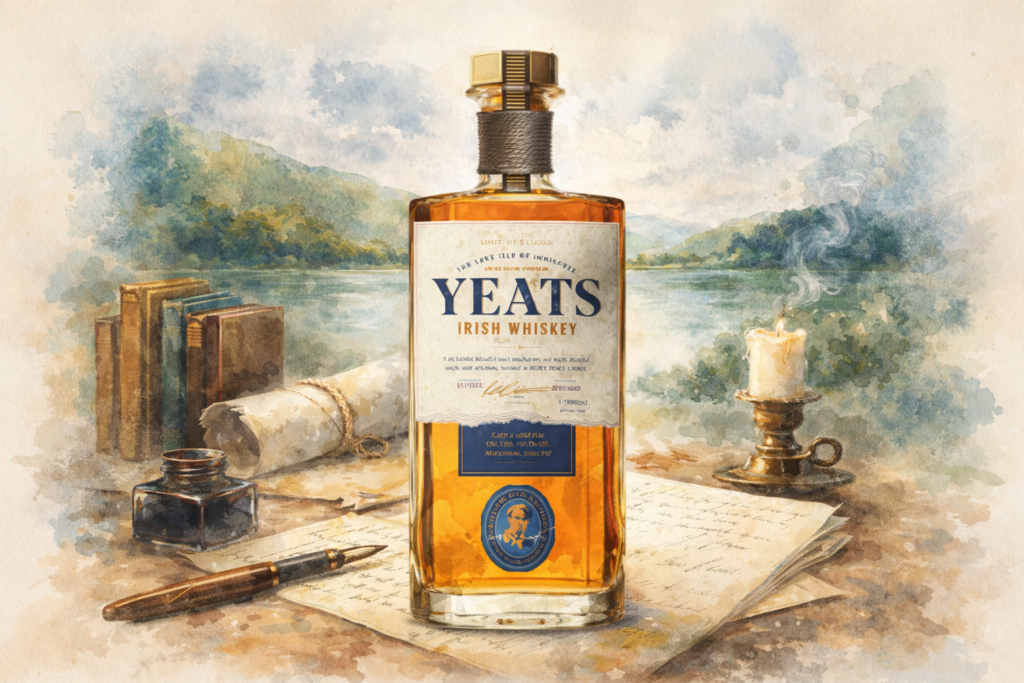
Yeats Irish Whiskey arrives in that quieter space. Its first release, The Lake Isle of Innisfree, feels less like a brand trying to establish itself quickly, and more like something that has taken its time deciding what it wants to be. The connection to W.B. Yeats is not just a surface reference, but something that runs through the identity of the whiskey itself — rooted in Sligo, shaped by landscape, and deliberately tied to a sense of place that goes beyond the liquid in the glass.¹
For those of us who tend to drift towards whisky as much for the atmosphere as for the flavour, that approach lands naturally. Whisky has always carried stories, whether we choose to engage with them or not. Here, that relationship is simply brought a little closer to the surface.
A Composition That Feels Considered Rather Than Engineered
The structure of the whisky is, in many ways, familiar — a blend built from aged Irish grain and malt, matured between five and seven years, and bottled at 43% ABV. But it’s in the proportions and the restraint that it begins to feel more intentional.
Grain whisky forms the backbone, matured in first-fill ex-Bourbon casks, bringing softness and that steady, rounded sweetness that Irish blends often carry so well. Alongside it sits a smaller portion of triple-distilled malt finished in Ruby Port casks, adding a layer of darker fruit and texture, while a trace of peated malt is included almost quietly, not to stand out but to hold things together.
Even in the way the brand describes it, there’s a sense of alignment between composition and intent — “warm vanilla and honey sweetness… hints of red berries… gentle spice”² — a profile that reads less like a list of flavours and more like something meant to unfold slowly.
That choice of Port casks is worth pausing on. It’s not the most common route in Irish Whiskey, and when it’s used with restraint rather than dominance, it tends to bring depth without tipping into excess. Early coverage of the release has pointed to that same balance — a layering of fruit and sweetness that supports rather than defines the blend.
Where the Story Actually Matters
It’s easy to be sceptical when whisky brands talk about storytelling. It’s one of those words that has been stretched thin over time, often used to fill space rather than add meaning.
But here, it feels tied to something more concrete.
The brand itself describes the whisky as being “born as a tribute to the poet W.B. Yeats and the landscapes that inspired him”¹ — and that idea of landscape comes up again and again, from Lough Gill and Innisfree to the wider sense of Sligo as a place that shaped both the poetry and now the whisky.
Even the inclusion of lines from the poem on the packaging — “I will arise and go now…”¹ — is less about decoration and more about setting a tone.
And maybe that’s where it connects most naturally with whisky as a whole. Because when you strip everything else away, whisky has always been tied to place in a way that few other spirits are. The grain, the water, the cask, the climate — they all leave their mark, whether the label tells you about it or not.
What Yeats is doing is choosing to centre that idea, rather than letting it sit in the background.
A First Chapter, Not a One-Off Release
Only 4,000 bottles of this first edition have been released, positioned clearly as a limited batch rather than a mass-market entry.¹
But what gives it more weight is that it’s framed as the beginning of something ongoing. Future releases are expected to draw from other poems, building a series that develops over time rather than repeating the same formula.
That sense of continuity matters. It suggests a willingness to let the identity of the brand evolve slowly, instead of trying to define everything in a single release.
Why This Will Land with the Right Drinkers
Irish whiskey is in a strong place right now — growing, expanding, experimenting — but with that comes a certain sameness at times. A lot of releases chase attention through cask finishes or louder flavour profiles, which can be exciting, but don’t always leave much behind once the novelty fades.
What Yeats offers is something quieter and, in a way, more familiar.
Not because it’s doing nothing new, but because it’s focusing on something that has always been there: the idea that whisky is not just made, but shaped — by decisions, by place, and by the intention behind it.
For drinkers who tend to sit with a dram rather than rush through it, that’s often where the real connection happens.
Final Thoughts
Spending time with a release like this, what stays with you isn’t any single element — not the cask choice, not the blend breakdown, not even the literary reference on its own.
It’s the way everything seems to move in the same direction.
There’s a sense of restraint to it, but also a kind of confidence in that restraint — an understanding that it doesn’t need to push too hard to make an impression.
And maybe that’s what makes it interesting.
Not because it’s trying to redefine Irish whiskey, but because it’s comfortable sitting within it, drawing from something deeper, and letting that shape the experience.
If that approach carries through the next releases, then this first bottle will feel less like a standalone launch and more like the beginning of something that takes its time to unfold.
Footnotes
¹ Yeats Irish Whiskey official site
² Yeats Irish Whiskey official tasting notes