
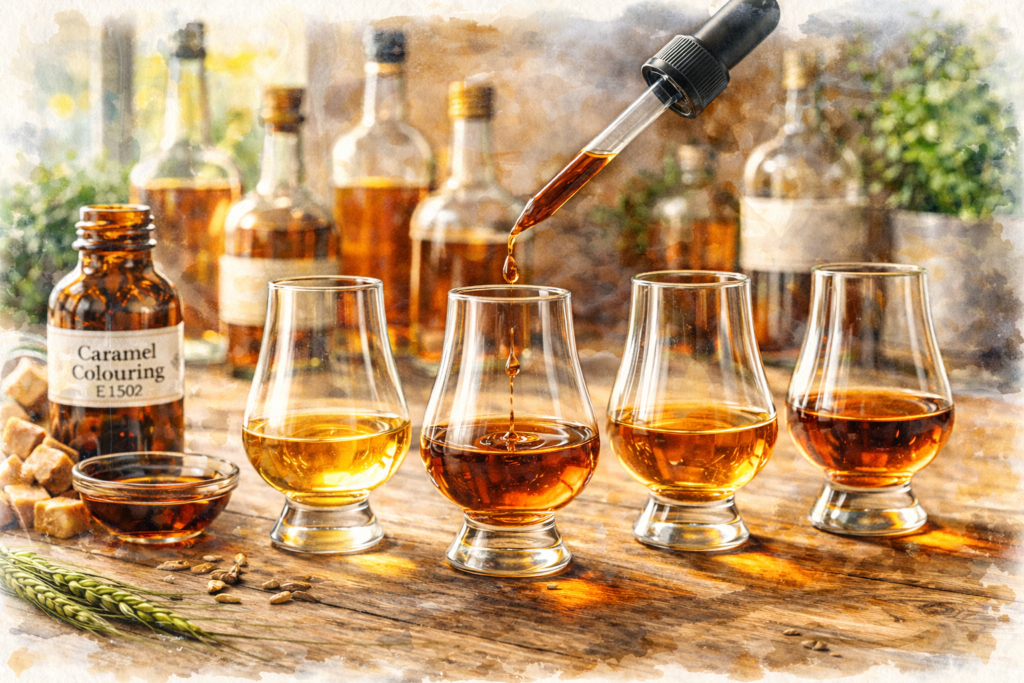
What’s in Your Glass, and Why It Looks the Way It Does
Whisky is, at its core, a remarkably natural product.
At the start of its life, your dram is made from just grain, yeast, and water. That’s it. The grain might be influenced by peat smoke, the spirit shaped by copper stills, and the flavour transformed by years in oak — sometimes oak that previously held wine, sherry, or bourbon.
So with all that natural craftsmanship, you’d be forgiven for assuming whisky always reaches the bottle exactly as nature intended.
But surprisingly often, it doesn’t.
Why Whisky Doesn’t Always Keep Its Natural Colour
Before whisky is bottled, some producers add caramel colouring, also known as E150a.
This doesn’t change the alcohol content. It doesn’t change the age. And — at least in theory — it doesn’t change the flavour.
What it changes is appearance.
What Is E150a (Caramel Colouring)?
E150 is one of the most widely used food colourings in the world. It appears in everything from soft drinks to sauces. Whisky, however, is only allowed to use Class I caramel colouring, known as E150a.
That classification matters.
E150a:
- Contains no ammonium or sulphite compounds
- Is often called plain or caustic caramel
- Is made by heating sugars until they darken and caramelise
In other words, it’s made much the same way you’d make caramel at home — just on an industrial scale.
Only a very small amount is permitted in whisky, and it’s added solely to adjust colour, usually to create consistency between batches.
One interesting footnote: caramel colouring has a shelf life of roughly two years. Over time, even a coloured whisky will slowly drift back toward its natural hue.
Why Distilleries Add Colour in the First Place
I still remember the moment I learned that some whisky contains colouring.
I was already deep into my whisky journey — reading, tasting, obsessing — and it genuinely shocked me. Whisky has rules for everything. Why would something so regulated allow colouring at all?
The uncomfortable answer is: because of us.
As consumers, we’ve trained ourselves to associate darker whisky with higher quality. Not just that — we expect consistency. When we buy a bottle we love and the next one looks noticeably lighter, many of us instinctively distrust it.
Producers know this.
Caramel colouring became a tool to:
- Make whisky look like it’s worth its price
- Ensure visual consistency across batches
- Prevent customers from assuming something went wrong
It’s not about deception for the sake of deception. It’s about avoiding misplaced doubt.
Why Is Colouring Allowed at All?
When you look at how strict Scotch whisky regulations are, this part feels… odd.
The Scottish Whisky Association enforces incredibly precise rules. At one point, Compass Box even had a whisky temporarily ruled non-compliant because it used additional oak staves during maturation.
Add more wood to a barrel? Not allowed.
Add caramel colouring? Perfectly fine.
Strange — until you consider the trade-off.
Colouring offers consistency, avoids consumer confusion, and (crucially) has negligible impact on flavour. From a regulatory standpoint, the benefits outweighed the downsides.
Is Colouring Always Declared on the Label?
Not always.
Some countries — Germany, for example — require producers to state whether colouring has been used. In many other markets, there’s no such obligation.
That’s why transparency has become so important.
As interest in natural presentation has grown (natural colour, non-chill-filtered), many producers now proudly state when they don’t add colouring. If a bottle says “natural colour”, you can safely assume no E150a was used.
If it doesn’t say anything at all? You simply don’t know.
Who Allows Colouring (and Who Doesn’t)?
Scotch allows E150a. So do Irish and Canadian whiskies. Japan’s updated whisky regulations also permit it.
In fact, most whisky-producing countries allow caramel colouring in some form.
Except — sort of — the Americans.
Bourbon, and other straight American whiskeys (straight rye, straight corn), may not contain added colour. It’s forbidden.
American Single Malt, however? Different story. Colouring is allowed there.
So maybe it’s less “God bless America” and more accurately:
God bless Bourbon.
FAQ: Natural Colour in Whisky
Does caramel colouring affect whisky flavour?
In most cases, no. The amount used is extremely small, and blind tastings often show little to no detectable flavour difference.
Is whisky with added colour lower quality?
Not necessarily. Some excellent whiskies contain E150a. Colouring affects appearance, not craftsmanship.
Why do whisky fans prefer natural colour?
Because it shows the whisky exactly as it came from the cask — no adjustments, no cosmetics, just honesty.
Can I tell if a whisky has colouring added?
Only if the label says “natural colour” (meaning none was added), or if local regulations require disclosure. Otherwise, there’s no reliable visual way to know.
Does darker whisky mean older whisky?
No. Colour depends on cask type, previous fills, and wood influence — not just age.
Is natural colour better for beginners?
It doesn’t make a whisky easier or harder to drink, but it does offer a more transparent experience if you’re learning what casks actually do.
Final Thoughts: Honesty, Context, and Choice
Let’s be completely honest.
Do some of my favourite whiskies contain added colour?
Yes.
Does that colouring meaningfully change the flavour?
No.
Do I understand why distilleries value consistency?
Absolutely.
Is adding colouring full transparency?
No — and that’s the heart of the debate.
For whisky aimed at enthusiasts, I’ll always give extra points for natural colour. I want to admire what the cask did, not what E150a adjusted.
For whiskies aimed at a wider audience? I get it. If colouring helps protect a distillery’s reputation, keeps prices reasonable, and prevents good whisky from being ignored on a shelf — I can live with that.
Natural colour isn’t about snobbery.
It’s about choice and openness.
And the fact that we’re even having this conversation? That’s a sign whisky culture is healthier than ever.
If you want to dig deeper into the psychology of colour and perception, I can highly recommend “Let’s End Colour Prejudice” by Cara Laing — it’s thoughtful, provocative, and well worth your time.
Thanks for reading — and if you’ve got more questions, feel free to browse the rest of the Whisky Academy!
I’m not fond of e150 in whiskey myself, but do enjoy some that have it.
Having done blind tasting which picks out non-caramelised offerings I do think added e150 has a taste difference.
On a final note e150 whiskey tends to be on the cheaper side & I can’t always afford a €100+ unicorn bottle.
That would be a very interesting tasting to do! Do you remember which whiskies you tasted? I’d love to do a tasting like that myself someday.
Indeed price always factors into play, so I’m happy to see more and more “affordable” bottles feature natural colour. Arran (for example) has some great, affordable, offerings!