
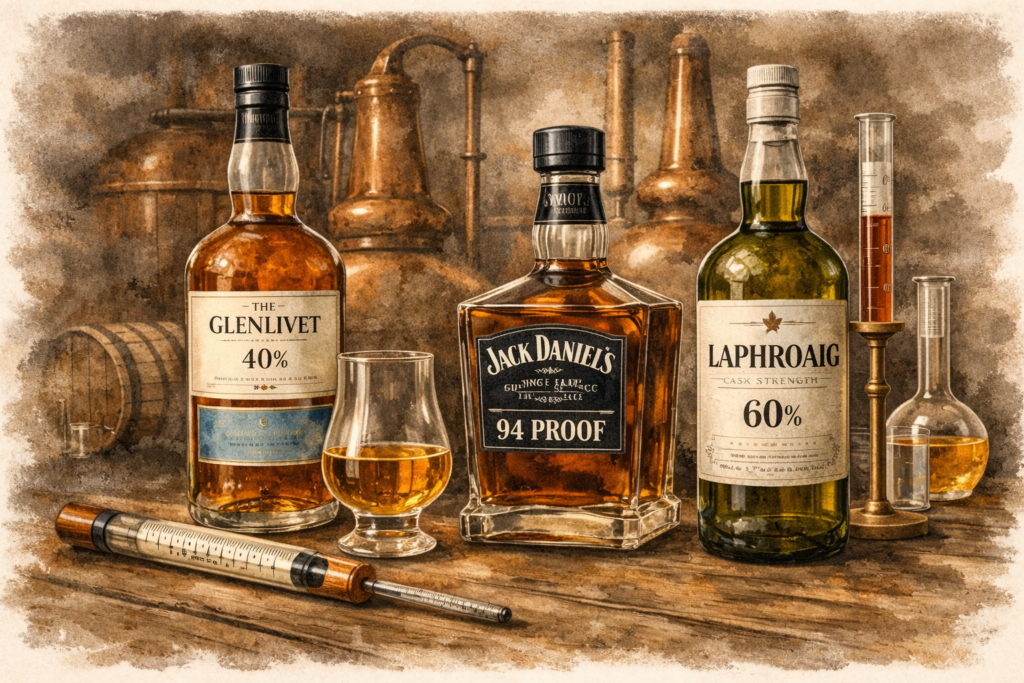
Why Proof Might Be the Most Important Number on the Bottle
If whisky labels came with subtitles, ABV would be written in bold.
It’s right there on the front of the bottle, usually ignored, occasionally feared, and very often misunderstood. Newcomers tend to see it as a warning sign — higher means harsher, lower means safer. Seasoned drinkers sometimes treat it like a status symbol.
The truth sits comfortably in between.
ABV isn’t about bravado or burn. It’s about flavour, texture, intention, and choice. And once you understand what that number really represents, you’ll never look at a whisky bottle the same way again.
What Is ABV (and Why 40% Is the Starting Line)
ABV — Alcohol by Volume — tells you what percentage of your dram is pure alcohol.
By law, anything sold as whisky must be bottled at a minimum of 40% ABV. Dip below that, and it’s no longer whisky. Simple as that.
But here’s the crucial part for anyone starting their whisky journey:
40% isn’t a target. It’s a threshold.
It’s the lowest point at which whisky is legally allowed to exist, not necessarily the point at which it shines.
ABV vs Proof: Two Ways of Saying the Same Thing
You’ll often hear whisky strength discussed in proof, especially when American whiskies enter the conversation.
In the U.S., proof is simply double the ABV:
- 40% ABV = 80 proof
- 50% ABV = 100 proof
- 60% ABV = 120 proof
The UK used proof too, once upon a time, but calculated it differently and officially switched to ABV in 1989. You’ll still spot old-school proof markings now and then, mostly as a nod to history.
For practical purposes, though: ABV is the language of modern whisky.
How Strong Can Whisky Get, Really?
Most people think of high-strength whisky as something in the 55–65% range — cask strength territory.
But whisky can go far beyond that.
There are rare bottlings out there pushing close to 80% ABV. They’re legally whisky, but they’re also extreme edge cases. Fascinating, yes. Representative? Not even close.
To understand why most whisky lives well below that range, we need to talk about rules.
The Rules: Why Whisky Strength Is Controlled
Whisky laws aren’t there to suffocate creativity. They exist to protect clarity, tradition, and — whether we like it or not — quality.
Different styles have different rules, so let’s look at two key ones.
Scotch Whisky ABV Rules (The Big Picture)
For a whisky to be called Scotch, it must:
- Be distilled and matured in Scotland
- Be aged in oak casks for at least three years
- Be bottled at a minimum of 40% ABV
- Be distilled to no more than 94.8% ABV
There’s no fixed barrel-entry strength written into Scotch law, but tradition and flavour science have guided distillers to very similar practices for generations.
Bourbon ABV Rules (Famously Strict)
Bourbon plays by an even tighter rulebook. To qualify, it must:
- Be made in the United States
- Contain at least 51% corn
- Be distilled to no more than 80% ABV
- Enter the barrel at no more than 62.5% ABV
- Be bottled at a minimum of 40% ABV
That barrel-entry limit matters more than it seems — and it ties directly into flavour.
Climate: Why Whisky Gains or Loses Strength Over Time
Here’s a detail that surprises a lot of people.
In Scotland’s cool, damp climate, whisky tends to lose alcohol as it ages. Alcohol evaporates faster than water, slowly pulling the ABV down year after year. For very old Scotch, this can become a real problem — dip below 40%, and the whisky literally stops being whisky.
In much hotter, drier climates — like Kentucky or Texas — the opposite can happen. Water evaporates more readily than alcohol, meaning the ABV in the barrel can actually increase over time.
So while Scottish distillers sometimes worry about strength dropping too low, some bourbon producers have to make sure it doesn’t climb too high.
Same spirit. Same wood. Totally different outcome.
How ABV Shapes Flavour (This Is Where It Gets Exciting)
Alcohol isn’t just there to get the job done — it’s a flavour carrier.
Before the Barrel
Most distillers choose a barrel-entry strength around the low 60s because that’s where alcohol is most effective at pulling desirable compounds from the wood without dragging too much bitterness along for the ride.
This is no accident. It’s the result of centuries of trial, error, and tasting.
After Maturation
Once the whisky is mature, producers usually add water to reach a final bottling strength. This is where philosophy enters the equation.
Here’s a fascinating practical reality: many single malts are bottled at 46% ABV because that’s the point at which skipping chill-filtration doesn’t cause cloudiness. If you want to understand why that matters visually — and how it affects texture and mouthfeel — check out my deep dive on chill-filtered whisky here: https://dram1.com/chill-filtered-whisky/.
So while 46% often feels deliberate and flavour-driven, there’s a real technical reason behind it.
And here’s the point that matters most for newcomers:
40% is often the most affordable legal option — not necessarily the flavour-led one.
At higher strengths, even a little bit more alcohol can unlock layers of aroma and mouthfeel that stay muted at the minimum.
Same Whisky, Different Strength: A Perfect Example
Few comparisons illustrate this better than Laphroaig 10 versus Laphroaig 10 Cask Strength.
At 40%, Laphroaig 10 is smoky, medicinal, unmistakably Islay — and undeniably enjoyable. It’s friendly, accessible, and widely available.
But the cask strength version? That’s the same DNA turned up to eleven. Thicker texture. Louder peat. More citrus, more ash, more coastal chaos. It doesn’t replace the standard bottling — it reveals another layer of the same whisky.
Neither is “better” in absolute terms. They simply tell different parts of the story.
Cask Strength: Freedom in Liquid Form
Cask strength whiskies are bottled exactly as they come out of the barrel, without dilution after maturation.
That doesn’t mean they were never watered down — the spirit almost certainly was before ageing — but once the whisky is ready, the distiller steps back and hands you the reins.
This is why cask strength is so beloved.
With one bottle, you can:
- Sip it neat to experience full intensity
- Add a splash of water to open up aromas
- Gradually bring it down until you find the point where the whisky truly sings for you
You’re not locked into someone else’s decision. You’re free to explore, adjust, and discover the version of that whisky that works best for your palate.
That’s something no 40% bottling can offer.
So… What ABV Should You Choose?
If you’re new to whisky, here’s a simple way to think about it:
- 40–43%: Approachable and easy, but sometimes restrained
- 46–50%: Often the sweet spot for flavour, texture, and balance — and a practical choice because it avoids chill haze while still delivering depth
- 50%+: Bold, expressive, and incredibly rewarding when taken slowly
There’s no universal “best” strength. There’s only the strength that fits your moment, your mood, and your palate.
FAQ: Whisky ABV & Proof Explained
What does ABV mean in Whisky
ABV stands for Alcohol by Volume and tells you what percentage of a whisky is pure alcohol. In whisky, ABV affects flavour, mouthfeel, aroma, and intensity — not just strength.
Why must whisky be bottled at at least 40% ABV?
By law, whisky must be bottled at a minimum of 40% ABV to retain its legal status as whisky. Below that threshold, it can no longer be sold as whisky.
Is higher ABV better in whisky?
Not necessarily. Higher ABV often means more intensity and flavour potential, but balance matters more than raw strength. Some whiskies shine at 46%, others at cask strength, and some work perfectly well at lower levels.
Why are so many whiskies bottled at 46% ABV?
Many whiskies are bottled at 46% because, at this strength, chill-filtration does not cause cloudiness. This allows producers to preserve mouthfeel and flavour while keeping the whisky visually clear.
What is the difference between ABV and proof?
ABV measures alcohol as a percentage, while proof is mostly used in the United States and equals twice the ABV. For example, a whisky bottled at 50% ABV is 100 proof.
What does cask strength whisky mean?
Cask strength whisky is bottled at the same strength it comes out of the barrel, without dilution after maturation. This gives drinkers full control to enjoy it neat or gradually add water to find their preferred balance.
Does whisky gain or lose alcohol as it ages?
That depends on climate. In cooler, wetter climates like Scotland, whisky usually loses ABV over time. In hotter, drier climates, whisky can actually gain strength as water evaporates faster than alcohol.
Is 40% whisky bad quality?
No. A 40% whisky can still be well-made and enjoyable. However, 40% is often chosen because it’s the most affordable legal bottling strength, not because it delivers the fullest flavour.
Final Thoughts: ABV Is the Whisky’s Volume Knob
ABV doesn’t tell you how good a whisky is.
It tells you how loudly it speaks.
Sometimes you want a whisper. Sometimes you want a full-blown monologue. The beauty of whisky is that it offers both — if you know what you’re looking at.
So next time you pick up a bottle, don’t treat ABV like a footnote. Treat it like a clue. Then pour a dram, give it time, and let it tell you its story.
And if you’re in the mood for another one after that — well, the DRAM1 library is always open.