Whisky or Whiskey: Why One Little “E” Still Matters
If you spend enough time around bottles, back bars, and whisky nerds, you will eventually run into one of the most argued-over letters in drinks culture: the “e”.
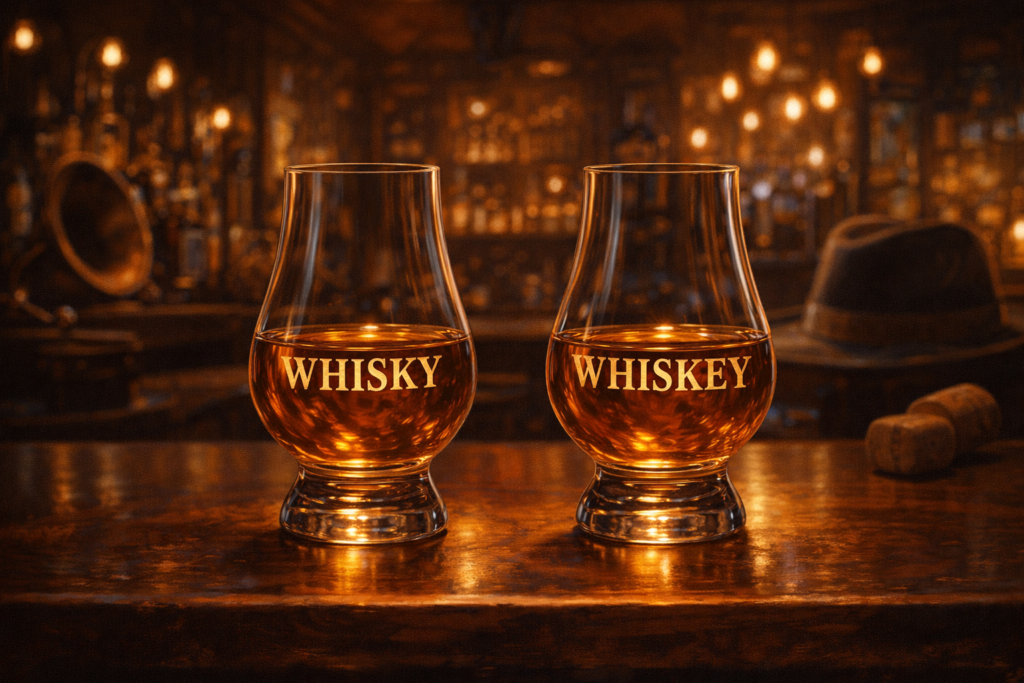
Is it whisky or whiskey?
The frustrating answer is that both are correct. The more interesting answer is that the spelling tells a story about rivalry, identity, migration, marketing, and even the long shadow of Prohibition. What looks like a tiny difference on a label is actually a clue to where a spirit comes from, who influenced it, and how producers wanted the world to see it.
For anyone trying to understand the difference, here is the key idea: Scotland, Canada, Japan and most of the whisky-producing world use “whisky” without the e, while Ireland and most of the United States use “whiskey” with the e. That broad split is recognised by the Scotch Whisky Association, and Irish industry sources also note that Irish producers historically used the extra letter as a point of distinction.
But that is only the surface level. The real story is much richer.
The word itself came from “water of life”
Before there was a spelling debate, there was a phrase.
The English word we now write as whisky or whiskey traces back to the Gaelic expression for “water of life”: in Irish, uisce beatha; in Scottish Gaelic, uisge beatha. Over time, those phrases were shortened and anglicised until they became forms like usky, whiskie, whisky, and eventually whiskey. Merriam-Webster traces the modern word to those Irish and Scottish Gaelic roots, both literally meaning “water of life.”
That matters because it explains something important right away: neither spelling is fake, modern, or wrong. Both grew out of the same linguistic family tree. For a long time, spelling was inconsistent anyway. Distillers, merchants, newspapers and official documents often used different versions interchangeably. The neat division we know today came later.
Why Scotland kept “whisky” without the e
Scotland largely standardised around whisky without the e, and that spelling became closely tied to Scotch as the category grew in international prestige. Today, the Scotch Whisky Association uses “whisky” as the accepted spelling for Scotch and notes that many other producing countries, including Japan, Wales and Canada, also follow the no-e form.
Why did Scotland keep that spelling? Partly because it reflected established Scottish usage, and partly because once Scotch became a major global export, the spelling on the label became part of its identity. In other words, “whisky” stopped being just a spelling and became a badge of origin.
That is why most of the rest of the world ended up following Scotland rather than Ireland. Scotch became the dominant international reference point for the category, so countries that developed whisky industries later often inherited the Scottish convention. Canada uses Canadian whisky. Japan uses Japanese whisky. Much of the modern world learned the category through Scotch, so the spelling without the e became the global default.
Why the Irish started using “whiskey” with the e
This is where the story gets more heated.
Irish industry sources say Irish distillers historically adopted “whiskey” with an e as a way to distinguish their product from Scotch, particularly at a time when they wanted to separate Irish whiskey from what they regarded as inferior Scotch output on the market. Drinks Ireland states this plainly: Irish distillers adopted the e “as a point of distinction” from then low-quality Scotch whisky. The Irish Whiskey Museum likewise says the difference was mainly chosen for clearer differentiation.
That context matters. In the 19th century, Irish whiskey had a huge reputation and was often viewed by its supporters as the premium article. At the same time, changes in production technology, especially the spread of column still distillation and the rise of blends, altered the Scotch market. Many Irish distillers looked at some of those products with suspicion or outright contempt. So spelling became a branding weapon.
That means the extra “e” was not random. It was a statement.
It said: this is Irish, not Scotch. It said: this is our way, not theirs. And just as importantly, it said: this product belongs to a different tradition.
There is one useful nuance here. Even today, Irish rules do not absolutely require the “e” in every case. The Irish Whiskey technical documentation and industry guidance allow both forms, although “whiskey” is described as the customary term. So while “Irish whiskey” is the dominant and culturally expected spelling, the broader legal reality is a little more flexible than many people assume.
Why American whiskey adopted the Irish spelling
American whiskey did not invent the “e” on its own. It largely inherited it.
A key reason commonly given for the American preference is the influence of Irish immigration and Irish distilling culture. The Scotch Whisky Experience notes that American “whiskey” is spelled with an e as a result of Irish immigration to America. Other industry explanations echo the same point: as Irish immigrants settled in the United States and brought their distilling traditions with them, the Irish spelling gained traction and became the familiar American form.
This makes perfect sense historically. The United States was shaped by multiple streams of distilling heritage, including Scottish, Scots-Irish and Irish influences. But in everyday branding and popular usage, the Irish-style spelling became especially strong. Over time, that spelling attached itself to bourbon, rye and the broader American category.
That said, the American picture is not completely tidy. U.S. federal regulations allow the word to be spelled either “whisky” or “whiskey”, and the current standards of identity explicitly say both are acceptable. That is why you still see American exceptions like Maker’s Mark using whisky without the e. So the common rule is “America uses whiskey,” but the legal and historical truth is more interesting: America prefers the e, rather than absolutely requiring it.
Why most of the world spells it without the e
The short version is influence, not grammar.
Most countries spell it whisky because Scotland’s global success shaped the language of the category. Scotch became the world’s most visible whisky export and one of the most influential spirits traditions on earth. When newer whisky-producing nations built their identities, many naturally followed the Scottish model in spelling as well as style language. That is why Canadian, Japanese, English and Welsh producers generally write whisky rather than whiskey.
This is also why the no-e version often feels “international,” while the e version feels specifically Irish or American. It is less about a technical production difference and more about which heritage line a producer is signalling.
And that is worth stressing: the spelling does not automatically tell you how the spirit was made or whether it is better. Scotch Whisky Association guidance is clear that what matters legally is how the spirit is produced and defined, not whether the word includes an extra letter. U.S. regulations say the same thing in their own way by recognising both spellings.
So no, the “e” does not mean smoother, older, purer, better, more authentic, or more expensive. It mainly tells you which naming tradition a bottle belongs to.
Where Prohibition fits into the story
Prohibition did not create the spelling divide, but it helped harden the American side of it.
National Prohibition in the United States lasted from 1920 to 1933, after the Eighteenth Amendment and the Volstead Act banned the manufacture, sale and transportation of intoxicating liquor. It proved difficult to enforce, fuelled bootlegging and speakeasies, and ended with repeal in 1933 through the Twenty-first Amendment.
So what does that have to do with whiskey spelling?
Quite a lot, indirectly.
During Prohibition, legal whiskey production in the United States was devastated. Some medicinal whiskey survived under licence, but the broader drinks culture was pushed underground. When the American whiskey industry re-emerged after repeal, brands had to rebuild identity, trust and recognition in a market that had been disrupted for more than a decade. In that rebuilding process, familiar category language mattered. “American whiskey” was already the established popular term, and post-Prohibition brand culture helped cement it even more firmly in the public imagination.
Prohibition also sharpened the difference between American whiskey and imported Scotch whisky in the minds of consumers. Once legal drinking resumed, imported Scotch would return as a distinct prestige category, while domestic producers rebuilt bourbon and rye under the American “whiskey” banner. In simple terms, the era did not invent the spelling split, but it helped reinforce it by forcing the American drinks industry to re-establish its own identity after repeal.
There is another angle too. Prohibition turned alcohol into a matter of politics, law, taxation and public morality in a way that left long-lasting marks on American drinks culture. Categories became more formalised, labels more important, and distinctions more marketable. In that climate, “whiskey” was no longer just how Americans happened to spell the word. It became part of how American spirits presented themselves after surviving one of the most chaotic periods in their history.
The exceptions that keep the debate alive
This would be a boring topic if everyone followed the rules perfectly. They do not.
Ireland mostly uses whiskey, but both spellings can appear in Irish documentation and tradition. The United States mostly uses whiskey, but federal rules allow both, and some famous American producers choose whisky. Meanwhile the rest of the world mostly uses whisky, but branding choices can still break expectations.
That is why the debate never really dies. People want the spelling to be a clean line in the sand, but history is messy. Traditions overlap. Immigration changes language. Export markets reshape labels. Rivalries become branding. And once enough people repeat a convention for long enough, it starts to feel like eternal truth even when it began as a practical choice.
So which spelling should you use, is it Whisky or Whiskey?
The safest rule is this:
- Use whisky for Scotch, Canadian, Japanese and most world whiskies.
- Use whiskey for Irish whiskey and most American whiskey.
- If a producer uses a specific spelling on the label, follow the producer.
That last point matters more than people think. In drinks writing, respecting the bottle is usually the smartest move.
Final thoughts
The difference whether it’s whisky or whiskey is not just a spelling quirk. It is a surviving trace of old Gaelic roots, 19th-century rivalry, Irish self-positioning, American immigration, and the market forces that shaped modern spirits culture.
Ireland embraced the e to set itself apart and defend a premium identity. America largely adopted that spelling through Irish influence and carried it into bourbon and rye culture. Scotland kept the older no-e form, and because Scotch became so globally influential, much of the rest of the world followed suit. Prohibition then helped reinforce the American use of whiskey by pushing the U.S. industry through a dramatic break and rebuild.
So the next time someone says it is “just spelling,” they are technically right in the smallest possible sense and wildly wrong in the bigger one.
That single letter carries a surprising amount of history.