Whisky Grains: From Barley Orthodoxy to Forgotten Fields
When people first step into the world of whisky, grain is often treated as a fixed rule rather than a creative choice. Scotch equals barley. Bourbon equals corn. Rye equals rye. Case closed.
But grain is not a checkbox. It is the agricultural foundation of whisky, and one of the most quietly influential variables in how a spirit is shaped long before it ever sees a cask. In recent years, grain has moved from background assumption to active discussion, driven by distillers who are questioning not just which grains they use, but which versions of those grains, and why.
In this Dram1 Whisky Academy deep dive, we’ll explore how whisky can be made from many different grains, why most styles rely on mashbills rather than single grains, where heritage cereals fit into the picture, and why grain matters deeply—without ever acting alone.
What Is Grain in Whisky, Really?
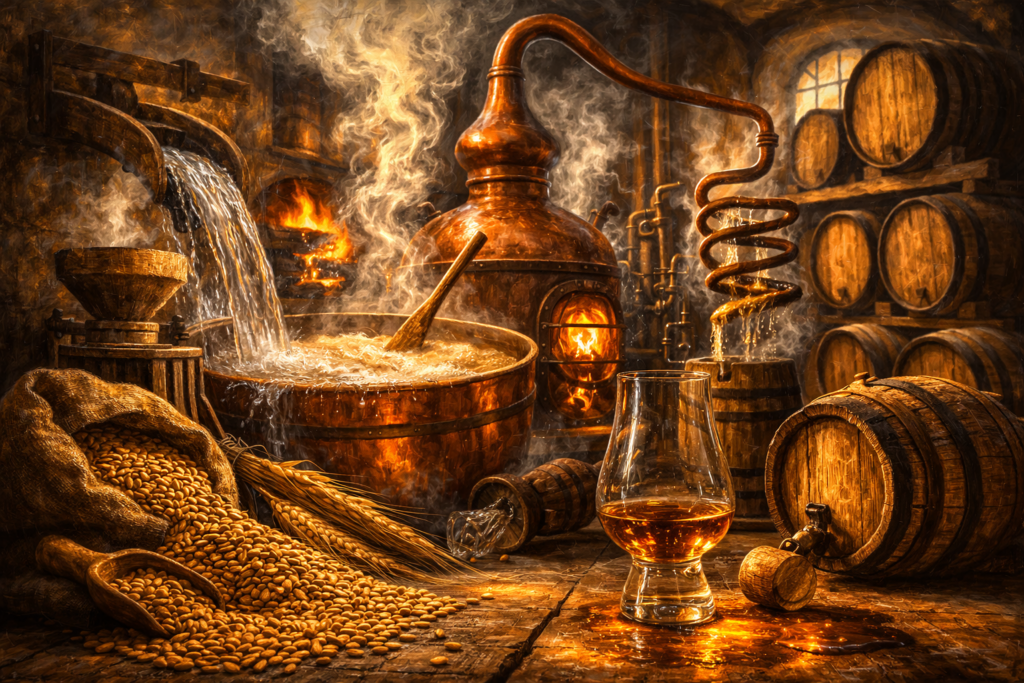
At its core, whisky is distilled fermented grain. Grain provides starch, starch becomes sugar, sugar becomes alcohol, and alcohol becomes whisky through distillation and maturation.
Crucially, whisky can be made from any cereal grain capable of conversion into fermentable sugar. This includes:
- Barley
- Corn (maize)
- Rye
- Wheat
- Oats
- Rice
- Spelt
- Sorghum
- Millet
What differs between whisky styles is not what can be used, but what traditions, regulations, and practical realities have encouraged distillers to use.
Most whisky styles around the world rely on multiple grains working together, not single-grain purity. In fact, the idea that one grain alone defines flavour is often misleading.
Mashbills: The Rule, Not the Exception
Bourbon and Rye Whisky (USA)
American whisky is built on the concept of the mashbill: a recipe of multiple grains, each contributing something different.
- Bourbon must be at least 51% corn, but almost always includes rye or wheat for spice or softness, and barley for enzymes.
- Rye whisky must be at least 51% rye, but is rarely 100% rye in practice.
Barley is typically included not for flavour, but because it provides enzymes that help convert starches from corn or rye into fermentable sugars.
This multi-grain approach isn’t about compromise. It’s about balance, manageability, and flavour control.
Irish Pot Still: A Style Built on Mixed Grains
Irish Pot Still whisky is another crucial example of grain diversity. Traditionally made from a mix of malted and unmalted barley, and sometimes including small amounts of other grains, it exists precisely because of grain combination.
Unmalted barley brings:
- A distinctive oily texture
- Peppery spice
- Earthy cereal notes
Malted barley contributes enzymes and fermentability, while the pot still distillation amplifies weight and mouthfeel. The style exists because of grain interplay, not despite it.
Single Malt: The Barley Exception
Single Malt Scotch stands apart because it is legally and stylistically defined by 100% malted barley at a single distillery using pot stills.
This makes single malt the exception rather than the rule in global whisky. It is not more “pure” than other styles—just more narrowly defined.
Even here, the barley itself is rarely discussed beyond peat levels or provenance. Modern single malt overwhelmingly uses high-yield barley varieties selected for efficiency, not flavour.
Barley: Famous, Flexible, and Quietly Standardised
Barley dominates single malt whisky for three main reasons:
- Strong enzymatic power, making sugar conversion efficient
- Climate suitability, especially in Scotland and Ireland
- Neutral spirit profile, allowing fermentation, distillation, and maturation to shine
What’s often overlooked is that most modern barley is bred almost exclusively for:
- Yield
- Disease resistance
- Predictable performance
Flavour is not the priority. This is where heritage grains begin to challenge assumptions.
Corn, Rye, and Wheat: What They Really Do
Corn (Maize)
Corn is often described as sweet, especially in bourbon. But this is one of whisky’s most persistent misconceptions.
The sweetness in bourbon does not come from the corn.
Corn produces a soft, round spirit with body and approachability. The vanilla, caramel, toffee, and brown sugar flavours associated with bourbon come overwhelmingly from new charred oak casks, not the grain itself.
Corn sets the stage; wood writes the melody.
Rye
Rye contributes intensity, dryness, and spice, but it is also technically challenging. Rye mashes become extremely viscous, making fermentation and distillation difficult.
This is why 100% rye whisky is rare, even in rye-forward traditions. One notable exception is Millstone, which has successfully produced a 100% rye whisky. Achieving this requires specialised equipment and careful handling, as the mash can become so sticky that it risks clogging pot stills.
Most rye whiskies include barley or corn simply to keep the process workable.
Wheat
Wheat softens whisky. It reduces spice, enhances mouthfeel, and allows oak sweetness to present more clearly. It is rarely dominant, but often essential.
Rice in Whisky: Possible, Legal, and Still Questioned
Yes, whisky can be made from rice. And yes, it already has been.
Rice ferments cleanly and produces a light, delicate spirit. The scepticism surrounding rice whisky is not technical, but cultural. Many drinkers associate whisky with robust cereal weight, while rice tends to be subtle and restrained.
As whisky production expands into new regions, rice will likely become more common. Whether it is embraced will depend on perception, not legality.
The Rarer Grains: Spelt, Oats, and Forgotten Cereals
Spelt is an ancient wheat variety that predates modern agriculture. It has lower yields, tougher husks, and inconsistent growth—exactly why it fell out of favour.
In whisky, spelt can bring:
- Nutty cereal tones
- Dry, biscuit-like notes
- A firm, textured mouthfeel
Other rare grains include:
- Oats – Creamy, weighty, difficult to mash
- Millet – Light, grassy, mineral
- Sorghum – Dry, earthy, robust
These grains are challenging, inefficient, and expensive. Which brings us to heritage grains.
Heritage Grains: Flavour Before Yield
Heritage grains are older cereal varieties abandoned by industrial farming in favour of high-yield modern strains.
They are lower yielding, harder to grow, and less predictable—but potentially richer in flavour.
Advocates argue that older grains may offer:
- Greater aromatic complexity
- More expressive fermentation character
- A stronger sense of place
This thinking mirrors the shift in wine toward site-specific viticulture.
Distilleries Championing Heritage Barley
Several distilleries are already committed to this approach:
- Waterford has built its identity around barley provenance, bottling whiskies by farm, soil, and barley variety.
- Ardnamurchan integrates local and heritage barley into its sustainability-led production. Check out the flavours of heritage barley in my Ardnamurchan Heritage Barley Review.
- Ironroot Republic Distilling works extensively with heritage corn and rye, exploring old genetics under extreme maturation conditions.
- Bruichladdich has long highlighted barley origin, variety, and farming practice as core to flavour.
- Kilchoman combines farm-grown barley with traditional production to close the loop between field and bottle. Read more about the Kilchoman distillery in my Kilchoman Distillery Spotlight.
What unites these producers is not nostalgia, but intent. They are choosing flavour complexity over industrial efficiency.
From Grain Library to Whisky Batch
Reviving heritage grain is a long-term commitment.
It often starts with only a few surviving seeds stored in a grain library or seed bank. These are planted in tiny plots, harvested, and replanted year after year.
The scale-up process usually follows:
- Seed multiplication plots
- Small field trials
- Expanded test fields
- Full-scale barley crops sufficient for malting
This process can take five to ten years before a single mash is produced. Along the way, distillers must adapt to unfamiliar enzyme levels, unpredictable yields, and challenging malting behaviour.
It is slow, expensive, and risky. But for some, it is the only way forward.
What Grain Actually Contributes to Flavour
Grain affects:
- Texture and mouthfeel
- Spirit weight
- Fermentation-derived aromas
- Subtle cereal and earthy notes
Grain does not directly produce vanilla, caramel, or smoke. Those come from cask interaction, yeast behaviour, distillation choices, and maturation.
Grain is the structure of the whisky, not the seasoning.
Two whiskies made from the same grain can taste radically different. Grain matters—but never in isolation.
FAQ – Dram1 Whisky Academy
Can whisky be made from any grain?
Yes. Any cereal grain capable of fermentation can be used, depending on local regulations.
Why do most whiskies use multiple grains?
Because mashbills balance flavour, fermentability, and practicality. Single-grain whiskies are the exception.
Is rye whisky usually 100% rye?
No. Pure rye is difficult to work with and rare, with only a few distilleries attempting it.
Why is single malt only barley?
By legal definition. It is a stylistic choice, not a technical necessity.
Does grain determine sweetness?
No. Sweetness primarily comes from oak, not grain.
Are heritage grains better?
Not better—different. They prioritise flavour diversity over efficiency.
Final Thoughts
Grain has long been treated as whisky’s silent partner, overshadowed by casks, peat, and age. But as whisky becomes more transparent and more curious, grain is finally being reconsidered as a source of character rather than just alcohol.
Mashbills, heritage varieties, and forgotten cereals won’t replace modern production. But they remind us that whisky begins in the field, not the warehouse.
And sometimes, the most interesting flavours are the ones agriculture left behind.