Teaspooning in Whisky Explained: Why a Tiny Drop Changes a Whisky’s Identity
Whisky hides its most interesting stories far from the label. Behind every bottle are decisions made in warehouses, boardrooms, and legal frameworks that quietly shape what ends up in your glass. Few of those decisions are as misunderstood — or as quietly influential — as teaspooning.
Despite the name, teaspooning has nothing to do with how you drink whisky. It isn’t about adding water, opening up aromas, or softening alcohol. Instead, it’s a behind-the-scenes practice where a very small amount of whisky from another distillery is added to a cask of single malt, permanently changing how that whisky can be classified and sold.
In this Dram1 Whisky Academy guide, we’ll explore what teaspooning really is, why it exists, how it’s used by distilleries and independent bottlers, famous examples of teaspooned whiskies, and what respected whisky writers have to say on the subject.
What Is Teaspooning in Whisky?
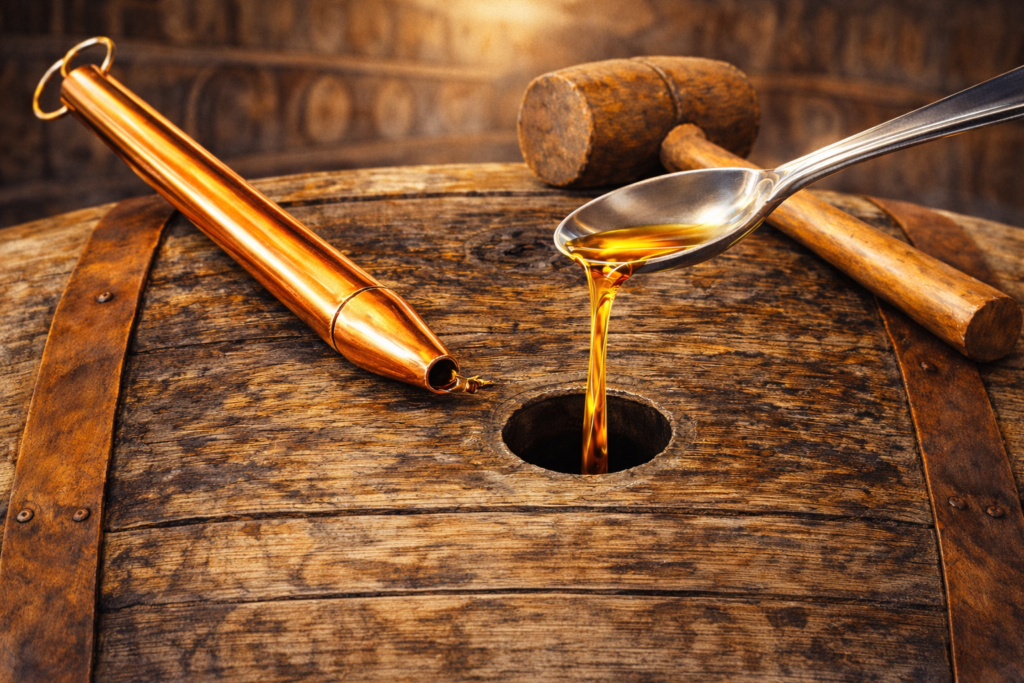
Teaspooning is the practice of adding a very small amount of whisky from a different distillery into a cask that otherwise contains whisky from a single distillery.
The amount added is tiny — often described figuratively as “a teaspoonful” — and is chosen specifically so it does not meaningfully affect flavour, aroma, or mouthfeel. However, from a legal standpoint, this small addition has an outsized effect.
Once a cask contains whisky from more than one distillery, it can no longer be labelled or marketed as a single malt. Instead, it must be classified as a blended malt whisky. This change is permanent and irreversible.
Teaspooning is therefore not a flavour decision. It is a legal and commercial one.
Why Do Distilleries Teaspoon Whisky?
Teaspooning exists primarily as a form of brand protection.
Single malt whisky is tightly regulated. It must be made from malted barley, distilled in pot stills at one distillery, matured in oak casks, and contain only spirit from that distillery. Even the smallest addition from another distillery immediately disqualifies it.
Distilleries invest heavily in their reputation and house style. When casks are sold to brokers or independent bottlers, there is a risk that those casks could be bottled and sold under the distillery’s name in a way that doesn’t align with official standards — whether that’s age, cask type, or overall presentation.
By adding a tiny amount of whisky to a cask before it leaves their control, a distillery ensures:
- Its name cannot legally appear on the bottle
- The whisky must be sold as a blended malt
- Independent bottlers retain freedom to bottle the whisky
- The distillery’s brand remains protected
This allows distilleries to monetise surplus or non-core casks without compromising their public image.
How Much Whisky Is Actually Added?
Despite the evocative name, teaspooning is rarely a literal kitchen-spoon measurement. The term is symbolic rather than technical.
In practice:
- The added whisky represents a negligible fraction of the total cask
- The goal is legal reclassification, not flavour change
- The impact on taste is almost always imperceptible
In a cask holding hundreds of litres, the added spirit exists purely to satisfy regulatory definitions. The whisky remains, for all practical sensory purposes, the original distillery’s spirit.
Teaspooning and Independent Bottlers
Teaspooning is most commonly encountered through independent bottlings.
Independent bottlers purchase casks, mature them further, and release them under their own brands. Some distilleries allow their name to be used freely. Others prefer tighter control over how their whisky appears on shelves.
Teaspooning allows distilleries to:
- Sell casks without granting naming rights
- Prevent unofficial releases competing with core expressions
- Maintain long-term brand consistency
For independent bottlers, teaspooned casks:
- Provide access to high-quality spirit from famous distilleries
- Allow creative branding and storytelling
- Often offer excellent value, as famous names cannot be used
The result is a category of whiskies that behave like single malts in the glass, but not on the label.
Blended Malt: Not a Compromise
One reason teaspooning causes confusion is the assumption that “blended” implies lower quality. In reality, blended malt whisky can be:
- Made entirely from malt whisky
- Drawn from a single cask
- Bottled at cask strength
- Non-chill filtered and natural colour
The only defining difference is that the whisky legally contains spirit from more than one distillery — even if that second contribution is minuscule.
Teaspooning highlights the gap between legal categories and actual drinking experience.
Famous Examples of Teaspooned Whiskies
Over time, certain teaspooned whiskies have become well known among enthusiasts. These names act as open secrets — signalling lineage without naming the distillery outright.
Burnside
One of the best-known teaspooned names, Burnside is widely understood to be whisky primarily from Balvenie, with a small addition from Glenfiddich to prevent it being sold as a single malt.
Wardhead
Often described as the counterpart to Burnside, Wardhead is generally associated with Glenfiddich spirit that has been teaspooned with a small amount of Balvenie.
Westport
Typically linked to Glenmorangie, Westport is believed to be teaspooned with spirit from Glen Moray, allowing the whisky to be bottled independently while retaining a recognisable house style.
Williamson
Commonly associated with heavily peated Islay whisky believed to originate from Laphroaig, Williamson is a frequent reference point in discussions about teaspooned malts.
Blairfindy
Often linked to Glenfarclas, Blairfindy is another example of a whisky that retains its distillery character while being legally classified as a blended malt.
Kildalton
Associated with southern Islay spirit, Kildalton is widely cited as a teaspooned alternative linked to Ardbeg, allowing bottlers to release peated Islay whisky without using the distillery name.
These names function as coded identifiers, understood by informed drinkers and quietly embedded in independent bottling culture.
Does Teaspooning Affect Flavour?
In almost all cases, no.
Because the added whisky represents such a tiny proportion of the total cask, its influence on aroma and flavour is negligible. Differences between teaspooned whiskies and official single malts are far more likely to stem from:
- Cask selection
- Length of maturation
- Warehouse conditions
- Bottling strength
Teaspooning is an administrative act, not a blending technique designed to shape taste.
Teaspooning vs Traditional Blending
It’s important not to confuse teaspooning with conventional blending.
Traditional blending:
- Uses significant volumes from multiple distilleries
- Is flavour-driven and consistency-focused
- Aims to create a defined house style
Teaspooning:
- Uses a trace amount of secondary spirit
- Exists to alter legal classification
- Is not flavour-led
Both produce blended malt whisky, but the intent could not be more different.
Why Teaspooning Matters to Whisky Drinkers
Understanding teaspooning helps drinkers:
- Read labels more critically
- Recognise high-quality whisky behind unfamiliar names
- Avoid assuming blended malt equals lower quality
- Appreciate how regulation and branding shape the whisky market
Once you understand teaspooning, many “mystery” bottlings suddenly make sense.
FAQ: Teaspooning in Whisky
Is teaspooning legal?
Yes. It fully complies with whisky regulations.
Does teaspooning reduce quality?
No. Quality depends on spirit, cask, and maturation, not classification.
Can a teaspooned whisky ever become a single malt again?
No. Once spirit from another distillery is added, the classification cannot be reversed.
Is teaspooning always disclosed?
No. It is usually implied through the blended malt designation rather than stated explicitly.
Is teaspooning common?
It’s not universal, but it is well-established, particularly in cask sales to independent bottlers.
What Other Whisky Writers Say About Teaspooning
- What Is Teaspooned Whisky? — The Whisky Shop
An overview of why distilleries use teaspooning to protect their brand when selling casks, with explanations of well-known teaspooned names such as Burnside and Wardhead.
https://www.whiskyshop.com/blog/what-is-teaspooned-whisky - What Is a Teaspooned Whisky? — StillSpirit.com
A clear, enthusiast-friendly explanation of how teaspooning works, why it exists, and why the resulting whisky is legally a blended malt despite being nearly identical to a single malt.
https://www.stillspirit.com/en-eu/blogs/world-of-whisky/what-is-a-teaspooned-whisky - What Are Teaspooned Whiskies? — Whiskipedia
A detailed reference article exploring teaspooning definitions, legal implications, and a broad list of teaspooned malt names used across the industry.
https://whiskipedia.com/fundamentals/teaspooning
Final Thoughts
Teaspooning is one of those whisky practices that sounds trivial until you understand it — and then it reshapes how you view entire shelves of bottles. A tiny addition, often undetectable in the glass, permanently changes how a whisky can be named, marketed, and perceived.
For curious drinkers, teaspooned whiskies are not compromises. They are opportunities: high-quality spirit, freed from brand constraints, waiting to be judged purely on what’s in the glass.
Once you understand teaspooning, you don’t just taste whisky differently — you read it differently too.