The Whisky That Refuses to Behave
Some distilleries make great whisky.
Springbank Distillery makes whisky that gets under your skin.
This is the kind of distillery you don’t just like — you end up defending it in group chats, hunting bottles like a deranged truffle pig, and quietly judging bars that don’t stock at least one expression. For me, Springbank Distillery isn’t just one of my favourites. It’s a benchmark. A mood. A reminder of why I fell in love with Scotch whisky in the first place.
Messy. Oily. Coastal. Occasionally awkward. Often breathtaking. Always unmistakably Springbank.
And somehow, against all modern whisky logic, it’s still doing things the hard way — because that’s the only way it knows.
Campbeltown: small region, big attitude
Springbank Distillery doesn’t make sense without Campbeltown.
Once upon a time, this small coastal town was the whisky capital of the world. Dozens of distilleries pumped spirit into the glens and out to the globe. Then tastes changed, money moved, and Campbeltown collapsed into near-obscurity.
What survived is arguably better for it.
Today, Campbeltown is Scotland’s smallest whisky region — and its most stubborn. The whiskies here are oily, salty, slightly industrial, and unapologetically old-school. And Springbank is the beating heart of it all. If Campbeltown has a soul, Springbank is where it lives.
A distillery that never sold its soul
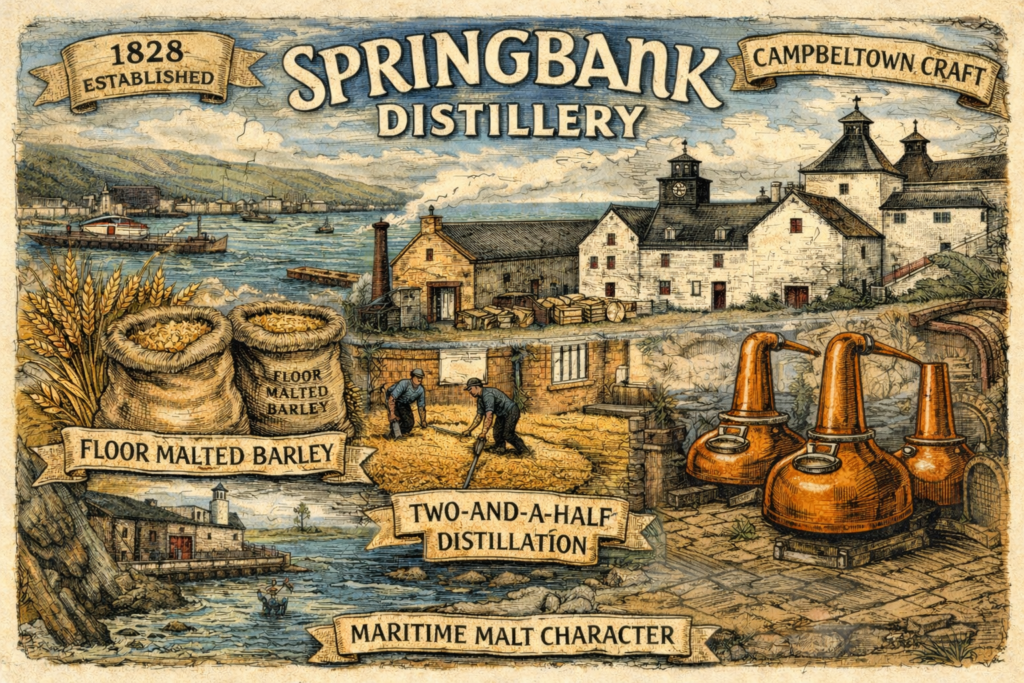
Founded in 1828, Springbank Distillery has been in the hands of the Mitchell family (via J&A Mitchell & Co.) for generations. That continuity matters. This isn’t a brand rebuilt by consultants or shaped by quarterly targets. This is a distillery that does things because that’s how they’ve always done them — and because they believe the whisky is better for it.
While much of the Scotch industry chased efficiency, scale, and uniformity, Springbank quietly went the opposite direction. Less automation. More hands-on work. More variables. More risk.
And more character.
The Springbank philosophy: do everything, control everything
Springbank Distillery is famously one of the last distilleries in Scotland to do almost everything on site:
- Floor malting
- Kilning
- Distilling
- Maturation
- Bottling
That’s not nostalgia — it’s control. Control over flavour, texture, peat level, fermentation quirks, and spirit weight. It also means inconsistency creeps in… and Springbank is completely fine with that.
This is whisky with fingerprints on it.
Floor malting (yes, really)
Springbank still floor malts a significant portion of its barley by hand. It’s back-breaking, inefficient, and wildly unscalable. It also contributes to that slightly earthy, cereal-forward, old-world backbone that runs through the range.
Direct-fired stills
Another pain-in-the-neck decision that adds depth and weight to the spirit. Direct firing can encourage richer flavours and subtle caramelisation. It also demands skill and attention. Springbank leans into that responsibility instead of running from it.
Worm tubs and weight
Springbank spirit isn’t light, fruity, or polite. It’s oily, chewy, and built to last. Worm tubs help preserve those heavier compounds, giving Springbank whisky that unmistakable mouthfeel — a texture you feel before you even start analysing flavours.
One distillery. Three completely different whiskies.
Here’s where Springbank Distillery crosses from “impressive” into “how is this even possible?”
Under one roof, using largely the same equipment, Springbank produces three distinct single malt styles:
- Springbank
- Longrow
- Hazelburn
Different peat levels. Different distillation regimes. Same stubborn DNA.
Springbank: controlled chaos in liquid form
This is the heart of the distillery. The one that defines the name. And the whisky that made me realise I like my drams with a bit of attitude.
Springbank is lightly peated and distilled in a famously odd way — often described as two-and-a-half times distilled. It shouldn’t work. It absolutely does.
What Springbank tastes like
Springbank rarely gives you a neat flavour list. It gives you a conversation.
Expect:
- sea spray, brine, and damp harbour air
- waxy oils and a chewy, almost mechanical mouthfeel
- green apples, citrus peel, and orchard fruit
- gentle, earthy peat — more background hum than smoke show
- farmyard funk, engine oil, old tools, wet wool
Young Springbank can feel raw and untamed. Older Springbank becomes layered, deep, and frankly emotional if you’re wired that way.
Essential bottlings
- Springbank 10 Year Old – one of the most honest whiskies in Scotland. Bright, oily, coastal, and endlessly drinkable.
- Springbank 12 Cask Strength – bigger, bolder, often sherry-influenced, and capable of stopping conversations mid-sip.
- Springbank 15 – richer, darker, and more contemplative, with sherry depth wrapping around that signature oiliness.
- Springbank 18 / 21+ – when you’re lucky enough to find them, these can be world-class, full-stop.
- Local Barley – when this series hits, it really hits. A love letter to provenance and texture.
Springbank doesn’t try to please everyone — and that’s exactly why it’s beloved.
Longrow: peat with muscle and oil under its fingernails
If Springbank is controlled chaos, Longrow is organised aggression.
Heavily peated and double distilled, Longrow takes everything Springbank does well and dials the intensity up without losing the distillery’s core identity.
This is not Islay cosplay.
What Longrow tastes like
Think:
- thick, earthy peat smoke
- soot, ash, and coastal tar
- seaweed, grilled citrus, and cracked black pepper
- a dense, oily texture that refuses to thin out
Longrow is smoky, yes — but it’s also weighty and savoury. Peat here feels industrial rather than sweet. It lingers. It grips.
Key bottlings
- Longrow Peated – the go-to expression; bold, smoky, and unapologetically Campbeltown.
- Longrow 18 – when available, it’s peat with elegance and restraint. A genuinely special whisky.
- Longrow Red – wine-cask experiments that divide opinion and occasionally produce absolute magic.
Longrow is the whisky you pour when you want smoke with substance.
Hazelburn: the quiet assassin
Then there’s Hazelburn — unpeated, triple distilled, and criminally underrated.
Named after a lost Campbeltown distillery, Hazelburn proves that Springbank doesn’t need peat or funk to be compelling. It just needs good spirit and patience.
What Hazelburn tastes like
You’ll often find:
- vanilla cream and shortbread
- honeyed malt and soft orchard fruit
- gentle spice and citrus
- a clean, creamy profile that still carries weight
Hazelburn is dangerously drinkable. It’s the whisky you open “just for one dram” and suddenly realise the bottle’s lighter than it was five minutes ago.
Key bottlings
- Hazelburn 10 – a masterclass in balance and texture.
- Hazelburn 12 and beyond – subtle cask influence layered over beautifully structured spirit.
Hazelburn converts people. Quietly. Repeatedly.
Scarcity, hype, and the Springbank problem
Yes, Springbank is hard to find.
Yes, prices can be ridiculous.
No, the distillery is not interested in fixing that by ramping up production.
Springbank Distillery would rather make whisky their way than make more of it. That’s frustrating — and also exactly why it remains special.
My advice? Chase it sensibly. Drink it when you get it. Share it. Don’t let secondary market madness turn a joyful distillery into a stressful one.
Springbank whisky was made to be opened.
Final thoughts: why Springbank matters
Springbank Distillery matters because it feels human.
Their whisky’s are imperfect. Textural. Occasionally awkward. Deeply expressive. It reminds us that whisky doesn’t need to be flawless to be great — it needs to have something to say.
In a world of increasingly polished Scotch, Springbank Distillery whisky’s still tastes like a place, a process, and a group of people stubborn enough to believe that tradition and flavour are worth protecting.
Springbank Distillery isn’t just one of my favourite distilleries.
It’s a reminder of what whisky can be when it refuses to behave.