A Deep Dive into Phenols & Peat
If you’ve spent any time around whisky — in a bar, a tasting room, or even just scrolling reviews online — you’ve almost certainly heard someone describe a dram as a smoky whisky. It’s one of the most commonly used descriptors in whisky, right up there with smooth and strong.
But here’s the thing: smoky doesn’t always mean peaty, peaty doesn’t always mean smoky, and not all smoke in whisky comes from peat in the first place.
So what’s actually going on in the glass? Why does one whisky remind you of a beach bonfire while another smells like burnt toast, iodine, or a damp hearth? The answer lies in a mix of chemistry, geography, and centuries-old production choices — most of it revolving around phenols and peat.
This article breaks it all down, without the fluff.
Smoke in Whisky: A Flavour, Not a Feeling
Before we get technical, it’s worth clearing up one big misconception.
“Smoky” is not a flavour in the way vanilla or caramel is. It’s a sensory impression created by a group of chemical compounds, most notably phenols, interacting with your nose and palate.
That’s why smoky whisky can show up in wildly different ways:
- Campfire ash
- Bonfire smoke
- Charred wood
- Medicinal iodine
- Burnt herbs
- BBQ meat
- Damp moss
All of those sensations can come from the same broad family of compounds — but expressed differently depending on how the whisky was made.
What Are Phenols (and Why Do They Matter)?
At the heart of smoky whisky are phenolic compounds, or phenols for short.
Phenols are organic compounds created when organic material is burned. In whisky production, that organic material is usually peat, though not always. When peat is burned during the malting process, phenols are released into the smoke. That smoke then infuses the barley, which carries those phenols all the way through fermentation, distillation, maturation, and finally into your glass.
Some of the key phenols found in smoky whisky include:
- Phenol – classic smoky, medicinal notes
- Guaiacol – wood smoke, bacon, BBQ
- Cresols – tar, antiseptic, creosote
- Syringol – sweet smoke, campfire ash
Different combinations and concentrations of these compounds are what make one smoky whisky feel soft and ashy while another feels sharp and medicinal.
PPM: The Number Everyone Quotes (and Often Misunderstands)
Smoke levels in malted barley are commonly measured in PPM (parts per million) of phenols.
You’ll often see figures like:
- 5–10 PPM: lightly peated
- 20–30 PPM: medium peat
- 40+ PPM: heavily peated
- 100+ PPM: extreme (on paper, at least)
But here’s the catch: PPM is measured in the barley, not the bottled whisky.
During fermentation, distillation, and maturation, phenols are reduced — sometimes dramatically. Two whiskies made from barley with identical PPM can taste completely different depending on:
- Distillation cut points
- Still shape
- Maturation length
- Cask type
- Alcohol strength at bottling
In short: PPM is useful context, not a guarantee of how smoky a whisky will taste.
Peat: The Ancient Fuel Behind the Smoke
So where does peat come from?
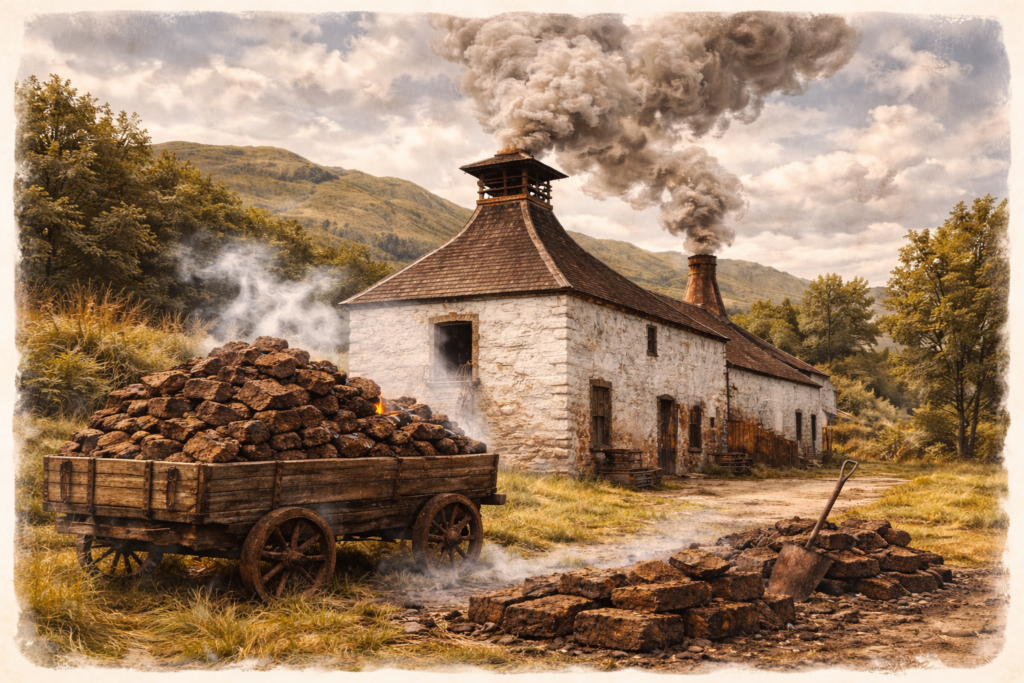
Peat is formed over thousands of years from partially decomposed organic material — mosses, grasses, heather, roots — compressed in waterlogged environments where oxygen is scarce. These conditions slow decomposition, creating dense, carbon-rich fuel.
Historically, peat was used because:
- It was abundant
- It was cheap
- It burned hot and slow
In whisky-making regions like Scotland, peat became the default fuel for drying malted barley long before flavour was ever a consideration.
The smoke flavour? That was originally a side effect.
Why Peat From Different Regions Tastes Different
Not all peat is created equal. The composition of peat varies depending on local vegetation, soil, water, and climate, and those differences show up clearly in whisky.
Islay Peat
Often described as:
- Medicinal
- Iodine-rich
- Maritime
- Tar-like
Islay peat typically contains more seaweed, moss, and coastal vegetation, which contributes to its briny, antiseptic character.
Highland Peat
Usually:
- Earthier
- Drier
- Woody
- Heather-driven
Highland peat tends to produce a more restrained, smoky style that integrates gently with malt sweetness.
Island & Orcadian Peat
Often:
- Floral
- Herbal
- Lightly smoky
Peat from areas like Orkney (famously used by Highland Park) contains a high proportion of heather, resulting in aromatic smoke rather than heavy medicinal notes.
Smoky vs Peaty: Not the Same Thing
This is where a lot of whisky drinkers — especially newer ones — get tripped up.
Peaty Whisky
- Refers to how the whisky was made
- Specifically: peat smoke used during malting
- Always involves phenols from peat
Smoky Whisky
- Refers to how the whisky tastes
- Can come from peat or other sources
You can have:
- Peaty but not very smoky (older peated whiskies where smoke has softened)
- Smoky but not peaty (whiskies with charred casks or toasted wood influence)
- Both peaty and smoky (young Islay malts, heavily peated expressions)
Other Sources of Smoke in Whisky
Peat isn’t the only way smoke enters whisky.
Cask Influence
- Heavily charred barrels can impart smoky, burnt, or toasted notes
- Especially common in ex-bourbon casks with deep char levels
Toasting vs Charring
- Toasting: sweeter smoke, baking spices
- Charring: bitter smoke, charcoal, ash
These flavours are wood-derived, not peat-derived, and they lack the medicinal phenolic edge.
Examples: Smoky Whiskies and How They Show It
Ardbeg 10 Year Old
- Nose: Bonfire smoke, iodine, citrus peel
- Palate: Oily peat smoke, lemon zest, black pepper
- Finish: Long, ashy, coastal
A textbook example of phenol-driven smoke — bold, medicinal, and unmistakably peated.
Feel free to check out my Ardbeg reviews to see how the peat manifests itself there!
Highland Park 12 Year Old
- Nose: Heather smoke, honey, dried herbs
- Palate: Gentle smoke woven into malt sweetness
- Finish: Soft, floral, lightly smoky
Peat is present, but it’s aromatic rather than aggressive.
Feel free to check out my Highland Park reviews to see how the peat manifests itself there!
Talisker 10 Year Old
- Nose: Peppery smoke, sea spray
- Palate: Smoke mixed with spice rather than peat-forward intensity
- Finish: Dry, warming, smoky
Often described as smoky, but less overtly peaty than Islay malts.
Feel free to check out my Talisker reviews to see how the peat manifests itself there!
How Smoke Evolves With Age
One of the most fascinating aspects of smoky whisky is how it changes over time.
- Young whisky: Smoke is sharp, dominant, sometimes abrasive
- Mid-aged whisky: Smoke integrates with sweetness and wood
- Older whisky: Smoke softens into ash, earth, or background warmth
This is why some heavily peated whiskies lose their aggressive edge after 15–20 years, becoming far more nuanced.
Why Smoky Whisky Polarises Drinkers
Smoke is intense, and intensity divides opinion.
For some drinkers:
- Smoke adds depth and complexity
- It slows down the tasting experience
For others:
- It overwhelms subtler flavours
- It feels medicinal or harsh
Neither reaction is wrong. Smoky whisky is one of the few styles where personal tolerance plays a massive role.
FAQ: Smoky Whisky Explained
What makes a whisky smoky?
The key to smoky whisky is the use of peat-smoked barley during malting. The smoke from burning peat releases phenolic compounds that stick to the grain and later appear as that signature smokiness in the finished whisky.
Is all Scotch whisky smoky?
No. Only certain regions, especially Islay, are known for smoky styles. Many other Scotch whiskies (Speyside, Highland, Lowland) and even some Islay whiskies are light or fruity with little to no peat influence. Though there are always exceptions.
What does “peaty” mean compared to “smoky”?
Peaty refers specifically to the influence of burning peat during drying, which delivers phenols and earthy, medicinal notes. Smoky can sometimes be used more loosely by drinkers, but in whisky it’s really the presence of peat-derived phenols that creates the true smoky character.
Does peat make whisky taste like campfire?
Sort of — but it’s more complex. Peated whisky can suggest smoke, ash, seaweed, medicinal notes, and earthiness rather than just “campfire.” Different levels of peat give wildly different results.
How is peat measured in whisky?
Phenol levels are sometimes measured in PPM (phenol parts per million), which gives a rough idea of peat intensity in the malted barley. Higher PPM usually means smokier whisky, but the final flavour also depends on fermentation, distillation, and maturation.
Are smoky whiskies only from Scotland?
No. While Scottish Islay whiskies are famous for peat, other world whiskies (Ireland, Japan, USA, and beyond) also make smoky expressions using peated barley or smoked malt.
Do beginners have to start with smoky whisky?
Not at all. Smoky whiskies can be very intense for newcomers. Many people start with light, fruity, or balanced styles, and then explore smoky profiles later.
What food pairs well with smoky whisky?
Smoky whisky pairs wonderfully with smoked meats, dark chocolate, blue cheese, oysters, and rich, creamy sauces. The smoke complements and contrasts with bold tastes beautifully.
Final Thoughts: Smoke Is a Story, Not a Gimmick
Smoke in whisky isn’t a marketing trick or a one-note flavour bomb. It’s the result of ancient fuel sources, regional geology, chemical compounds, and deliberate production choices.
Understanding phenols and peat doesn’t just help you sound smarter at tastings — it helps you:
- Choose bottles you’ll actually enjoy
- Understand why two “smoky” whiskies taste nothing alike
- Appreciate the craftsmanship behind one of whisky’s most divisive styles
Next time someone says, “I don’t like smoky whisky,” the real question is:
Which kind of smoke?
Because in whisky, smoke is never just smoke.