Karuizawa Whisky Casks Sell for $5.7 Million – But Has the Whisky Investment Bubble Already Burst?
In the world of collectible whisky, some names still have the power to stop collectors in their tracks. Karuizawa is one of them.
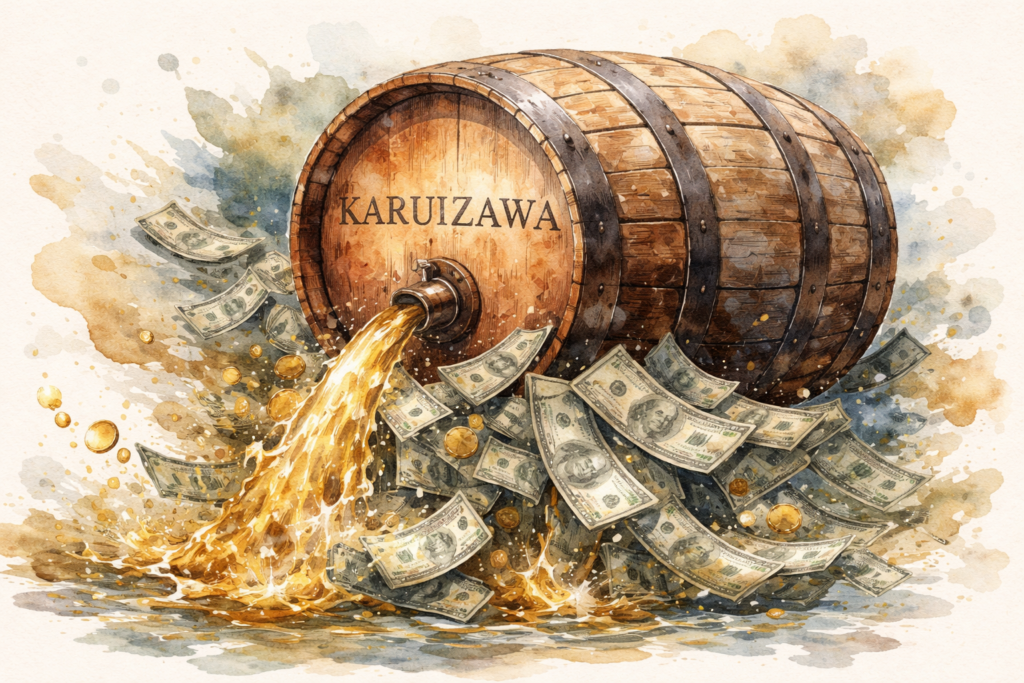
This week, two rare casks from the legendary closed Japanese distillery sold at auction for an astonishing $5.7 million, once again proving that the world’s rarest whiskies can command extraordinary prices.
The casks were distilled in 1999, the final year of production at the distillery, and matured in sherry butts before being offered at auction. With original Karuizawa stocks now almost entirely exhausted, sales like this are increasingly rare — and that scarcity is exactly what keeps collectors paying attention.
But this latest headline-grabbing sale raises a much bigger question.
Has the whisky investment bubble already started to burst?
The Legend of Karuizawa
Karuizawa distillery operated in Japan’s Nagano prefecture at the foot of Mount Asama. Founded in 1955, it remained relatively obscure for most of its life, producing heavily sherried single malt whisky in small quantities.
Production stopped in 2000, and the distillery was eventually dismantled in 2011.
At the time, few people could have predicted what would happen next.
Over the following decade, the remaining casks were gradually bottled and released to the market. Collectors quickly realised just how limited these whiskies were, and prices skyrocketed. Karuizawa soon became one of the most sought-after names in the world of whisky collecting.
Today, bottles from the distillery regularly appear at high-end auctions, often achieving extraordinary results.
And when entire casks surface — as in this recent sale — the prices can reach another level entirely.
If you want to learn more about Japanese whisky and it’s history be sure to check out my Japanese Whisky Explained article!
Another Japanese Ghost Distillery: Hanyu
Karuizawa is not the only Japanese distillery whose closure turned its whisky into legend.
Hanyu followed a similar path.
Founded in 1941, Hanyu was a small distillery located north of Tokyo. Like many Japanese producers at the time, it struggled financially in the late 1990s and eventually stopped distilling in 2000. Not long after, the distillery was dismantled.
But the story didn’t end there.
Ichiro Akuto, grandson of the distillery’s founder, managed to rescue around 400 casks of ageing whisky before the site disappeared. Those casks later became the famous Ichiro’s Malt Hanyu Card Series, a legendary collection of bottlings representing each playing card in a deck.
Today, these bottles are among the most collectible Japanese whiskies ever released. Complete sets have sold for extraordinary sums, and individual bottles are highly prized by collectors around the world.
Like Karuizawa, Hanyu became something whisky enthusiasts love: a lost distillery whose remaining whisky can never be recreated.
You can learn more about Hanyu in my Chichibu Distillery Spotlight!
The Rise of Whisky as an Investment
Over the past decade, whisky has transformed from a drink to something else entirely for some buyers.
An investment asset.
Auction prices climbed dramatically throughout the 2010s. Rare Scotch, Japanese single malts and limited releases regularly smashed previous records. Bottles that once sold for a few hundred euros suddenly appeared at auction for thousands — sometimes far more.
Japanese ghost distilleries like Karuizawa and Hanyu became some of the most desirable names in the entire market.
At the same time, major brands leaned into the luxury segment. Distilleries released increasingly expensive limited editions, often packaged like luxury art pieces rather than bottles meant to be opened.
For a while, it seemed like the whisky market could only move in one direction.
Up.
Is the Whisky Bubble Already Deflating?
Recently, though, the mood in the market has begun to shift.
If you follow whisky auctions closely, you may have noticed that prices are not rising quite as effortlessly as they once did. Some bottles that previously sold far above their retail price now struggle to reach the same heights. Auction results can be softer, and buyers appear to be becoming more selective.
Beyond the auction world, the wider spirits industry has also cooled slightly. Distilleries that once raced to expand production are slowing down, and parts of the craft spirits sector have seen closures and financial difficulties.
To me, it increasingly feels like the explosive whisky boom of the past decade may have peaked.
In other words, the bubble may already be deflating.
Are Ultra-Luxury Bottles Still Safe?
And yet sales like this Karuizawa auction still happen.
While the broader market appears to be cooling, the very top of the whisky world seems to operate under different rules.
The rarest bottles — especially those from legendary closed distilleries — continue to command extraordinary prices. Karuizawa releases still attract intense interest. Hanyu bottles remain highly sought after. And luxury Scotch brands such as Macallan continue to release ultra-premium expressions that find buyers despite eye-watering price tags.
This suggests the whisky market may be splitting into two tiers.
The mid-range collectible market, where prices appear to be stabilising or even falling slightly.
And the ultra-rare luxury segment, where scarcity and prestige still drive remarkable demand.
What Happens Next?
Personally, I believe we are likely to see prices continue to soften across much of the whisky investment market.
The dramatic growth of the past decade was unlikely to continue forever. Supply has increased as more distilleries release older stocks, and many collectors are becoming more cautious about what they buy.
But truly legendary whiskies — especially those tied to closed distilleries like Karuizawa and Hanyu — may remain in a category of their own.
There will always be collectors who want a piece of whisky history.
The real question is whether they will keep paying millions for it.
For now, at least, the Karuizawa sale suggests the answer is still yes.
But it will be fascinating to see how long that continues.
What do you think — is the whisky investment bubble already deflating, or will legendary bottles like Karuizawa continue to break records?