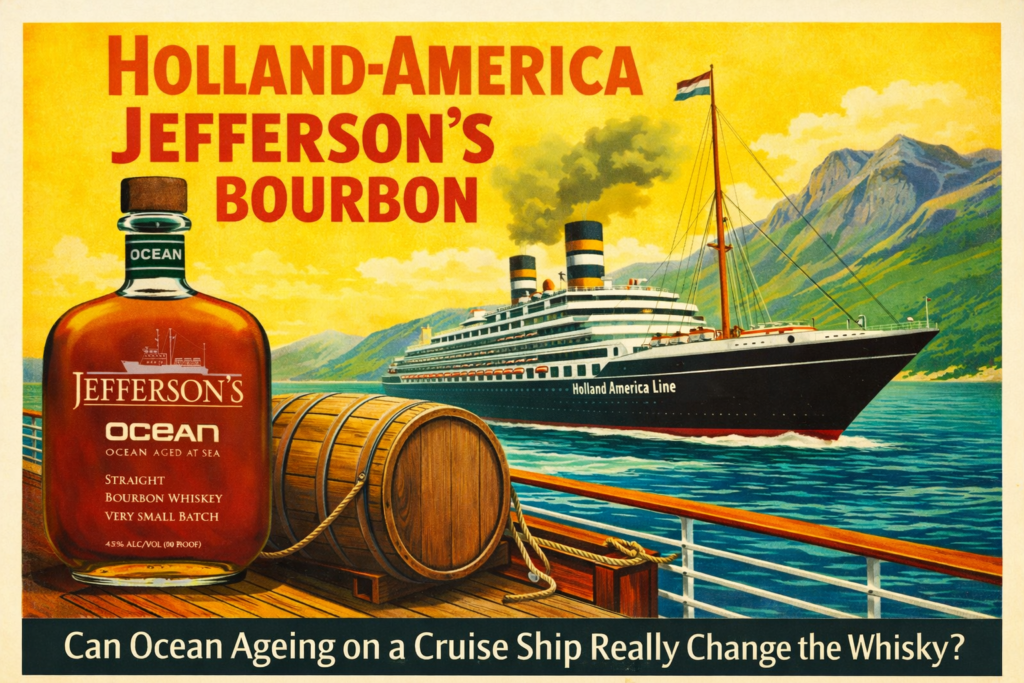
Jefferson’s Bourbon Heads Back to Sea — This Time Aboard Holland America Line
A Different Kind of Journey
I didn’t expect a cruise ship to pull me back into thinking about whisky maturation, but that’s exactly what happened when I read that Jefferson’s Bourbon is sending barrels out again, this time aboard ships operated by Holland America Line, because the idea itself isn’t new, yet the setting quietly changes everything about how it might play out in the glass.
Jefferson’s has already spent years exploring what happens when bourbon leaves the warehouse and is exposed to movement, temperature swings, and long journeys at sea, and while you can debate how dramatic the results are, there’s something in those Ocean releases that suggests the spirit has been handled differently, nudged along rather than left to slowly find its own rhythm.[1]
Why Movement Changes Whisky
The longer I spend thinking about it, the harder it becomes to ignore the role movement plays in shaping a whisky, because in a traditional rickhouse the process is almost meditative, driven by seasonal expansion and contraction as the spirit moves in and out of the wood over years, whereas at sea there’s an added layer of constant, low-level agitation that keeps the liquid in motion, subtly but persistently increasing its interaction with the oak and, in many cases, accelerating how flavours come together.
There’s a growing understanding across the industry that this kind of environment can lead to faster extraction and a more integrated profile earlier in the maturation cycle, though rarely in a way that feels entirely predictable, which is precisely why it remains so compelling to follow.[2] When that idea is pushed to its limits, you end up with something like Thalassa Whisky, where casks are matured aboard a three-masted sailing ship, fully exposed to wind, salt, and whatever the sea decides to do on any given day, creating whiskies that feel inseparable from the environment they’ve endured.
The Cruise Ship Contrast
That’s also what makes this new direction with Holland America Line so interesting, because these ships are designed to do almost the exact opposite of what those sailing vessels embrace, smoothing out the motion of the sea through advanced stabilisation systems that reduce roll and pitch to a level where passengers barely notice they’re moving at all.[3]
The barrels, of course, will still travel and still experience shifts in climate as they cross different regions, but the intensity of that movement—the very thing that defines more extreme forms of dynamic ageing—will be softened, turning what could have been a forceful interaction into something far more controlled and measured. It doesn’t remove the influence of the sea, but it reframes it, making it less about impact and more about nuance.
What This Means for the Bourbon
When you start thinking about it in those terms, the likely outcome becomes less about bold transformation and more about subtle evolution, where the bourbon may show slightly deeper integration and a smoother cohesion of flavours without leaning too heavily into maritime characteristics, meaning you’re unlikely to find the kind of saline edge that sometimes appears in more exposed sea-aged whiskies, but you might notice a textural shift, a sense that the spirit has been gently worked rather than aggressively shaped.
That middle ground—somewhere between stillness and constant motion—isn’t explored nearly as often, and that’s part of what makes this project worth paying attention to, because it suggests that dynamic ageing doesn’t have to be extreme to be meaningful.
A Personal Thread
There’s also, for me, something more personal woven into all of this, because my parents used to travel quite often with Holland America Line, and those journeys became part of how I remember them, even if I didn’t realise it at the time, so the idea that barrels of bourbon are now ageing aboard those same ships, moving along those same routes, adds a layer that goes beyond curiosity or experimentation. It turns something that could have remained purely technical into something that feels familiar, almost reflective, as if two entirely separate parts of life have quietly intersected.
Final Thoughts
What Jefferson’s Bourbon is doing here doesn’t feel like an attempt to redefine ocean-aged bourbon, but rather a way of exploring a different point along the spectrum of dynamic ageing, one that sits between the controlled stillness of a warehouse and the raw exposure of the open sea, and while the results may be less dramatic than those produced in harsher environments, they may also reveal something more restrained and deliberate, a reminder that movement doesn’t always need to be intense to leave its mark on a whisky.
Footnotes
[1] Jefferson’s Ocean Aged at Sea overview – https://jeffersonsbourbon.com/ocean/
[2] Discussion on maritime maturation and flavour integration – https://www.breakingbourbon.com/article/jeffersons-ocean-aged-at-sea-q-a-with-trey-zoeller
[3] Cruise ship stabilisation systems explained – https://www.royalcaribbean.com/blog/how-do-cruise-ship-stabilizers-work/