How to Read a Whisky Label: A Dram1 Academy Guide
There’s a quiet moment most whisky lovers know well. You’re standing in front of a shelf — maybe in a specialist shop, maybe scrolling online — and a label catches your eye. It looks impressive, maybe even a little mysterious. Numbers, names, casks, regions… it’s all there, but what does it actually tell you?
Learning how to read a whisky label is one of the most valuable skills you can develop as a whisky drinker. It turns guesswork into confidence. It helps you spot quality, understand style, and avoid bottles that simply don’t match your taste.
Let’s break it down together — properly, clearly, and without the fluff.
Why Whisky Labels Matter More Than You Think
A whisky label isn’t just branding. It’s a condensed story.
It tells you:
- Where the whisky was made
- How strong it is
- How it was matured
- Who bottled it
- And often, what kind of experience you’re about to have
Once you know what to look for, you can scan a bottle in seconds and understand far more than most casual buyers ever will.
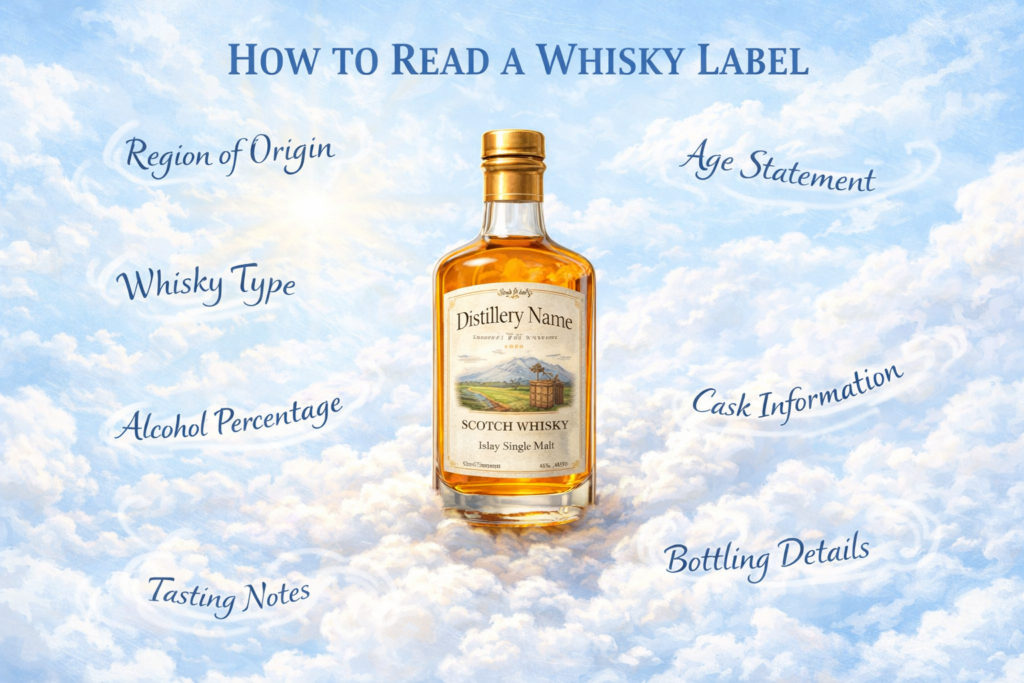
1. The Distillery: Where It All Begins
The distillery name is usually the most prominent feature on the label — and for good reason.
This tells you:
- The origin of the whisky
- The house style (light, fruity, smoky, heavy, etc.)
- A baseline expectation of quality and character
For example:
- Speyside distilleries often lean fruity and elegant
- Islay distilleries are typically smoky and coastal
- Highlands can vary widely but often bring body and structure
If you already know a distillery you love, spotting its name instantly gives you a strong clue about whether the bottle is worth your attention.
Pro tip: If the label doesn’t show a distillery name, you’re likely looking at a blend or an independently bottled whisky (more on that shortly).
2. The Category: What Kind of Whisky Is It?
Somewhere on the label — often just below the distillery — you’ll find the category.
Common categories include:
- Single Malt
- Blended Malt
- Blended Scotch Whisky
- Single Grain
- Bourbon (for American whiskey)
This matters because it defines the production method.
For example:
- Single Malt = one distillery, 100% malted barley
- Blended Whisky = a mix of different whiskies (often including grain whisky)
If you’re chasing complexity and character, single malts and well-crafted blended malts are often where enthusiasts gravitate.
If you’d like to learn more be sure to check out my Single Malt vs Blended Whisky article.
3. ABV (Alcohol by Volume): The Strength Tells a Story
ABV is one of the most important — and most overlooked — elements on a whisky label.
You’ll usually see something like:
- 40% ABV (the legal minimum for Scotch)
- 43%–46% (a step up in flavour intensity)
- 46%+ (often non-chill filtered)
- Cask strength (typically 50–65%+)
Higher ABV often means:
- More concentrated flavour
- Less dilution
- Greater control when adding water yourself
If you’re serious about flavour, 46% ABV and above is usually where things start getting interesting.
If you want to learn more about ABV in whisky be sure to check out my Whisky Proof & ABV explained article!
4. Volume: Not Just a Formality
You’ll see this near the bottom of the label:
- 700ml (standard in Europe)
- 750ml (common in the US)
It doesn’t affect flavour, but it’s useful for:
- Comparing value
- Understanding pricing differences across markets
5. Age Statement: Time in the Cask
If a whisky carries an age statement — say, 12, 15, or 18 years — this tells you the youngest whisky in the bottle.
Older doesn’t always mean better, but it does mean:
- More interaction with the cask
- Potentially deeper, more developed flavours
No age statement (NAS) whiskies rely more on blending skill and cask selection rather than age alone.
If you want to learn more about what age means for a whisky be sure to check out my The Age of Whisky article!
6. Cask Information: Where the Magic Happens
This is where labels start to get really interesting.
You might see terms like:
- Ex-Bourbon Cask
- Sherry Cask
- Double Cask / Triple Cask
- Port Finish / Wine Finish
Casks shape the whisky dramatically:
- Bourbon casks → vanilla, honey, coconut
- Sherry casks → dried fruit, spice, richness
- Wine casks → berries, tannins, sweetness
If a label clearly states the cask type, it’s giving you a strong hint about the flavour profile before you even open the bottle.
7. Bottler: Distillery vs Independent Bottling
Not all whisky is bottled by the distillery itself.
You’ll sometimes see:
- The distillery name (official bottling)
- A separate company listed (independent bottler)
Independent bottlers often:
- Source casks from distilleries
- Bottle at higher strength
- Avoid chill filtration or colouring
- Offer unique, limited releases
If you see names like Gordon & MacPhail, Signatory, or Cadenhead’s, you’re in indie territory — and often in for something more experimental.
8. Chill Filtration & Colouring: The Hidden Details
These aren’t always shown, but when they are, they matter.
Look for:
- Non-chill filtered → fuller texture, more oils
- Natural colour → no added caramel colouring
These are generally signs of a more “honest” whisky presentation.
Check out my articles on Chill Filtration and Natural Colour to learn more.
9. The SMWS Numbering System (A Quick Decode)
If you’ve ever seen a label that looks like “29.245” instead of a distillery name, you’ve stepped into the world of the Scotch Malt Whisky Society (SMWS).
Here’s how it works:
- The first number = the distillery
- The second number = the specific cask
So:
- 29 = a specific distillery
- 245 = the 245th cask they’ve bottled from that distillery
They don’t use distillery names on labels — part of the intrigue — but once you understand the system, it becomes a fun way to explore.
If you want to go deeper, check out the dedicated Dram1 article on SMWS bottle codes where this is broken down in full.
10. Other Clues Worth Noticing
A few extra details that can elevate your understanding:
- Region → can give context to style (check out the Scotch Whisky Regions here)
- Limited edition / single cask → rarity and uniqueness
- Batch number → variation between releases
- Distilled & bottled dates → exact maturation timeline
These aren’t always essential, but they help paint a fuller picture.
FAQ: How to Read a Whisky Label
What is the most important thing on a whisky label?
If you had to pick one, it’s the distillery and ABV. Together, they tell you where it comes from and how intense the flavour is likely to be.
Does a higher ABV always mean better whisky?
Not always, but it often means more flavour and less dilution. Many enthusiasts prefer whiskies at 46% ABV or higher.
What does “single malt” actually mean?
It means the whisky was made from 100% malted barley at a single distillery — nothing more, nothing less.
Are age statements important?
Yes, but they’re not everything. Age tells you how long the whisky matured, but cask quality and blending matter just as much.
How do I know if a whisky is good quality from the label?
Look for: 46% ABV or higher, Non-chill filtered, Natural colour, Clear cask information
These are strong indicators of a quality-focused bottling.
What does an SMWS number mean on a label?
It’s a code:
First number = distillery
Second number = cask
It replaces the distillery name and highlights the individuality of each bottling.
Putting It All Together
Once you know how to read a whisky label, everything changes.
You stop buying blindly.
You start choosing intentionally.
And suddenly, every bottle tells you something before you even pour a dram.
It’s one of those small skills that completely transforms your whisky journey.