Deep Roots. Timeless Bourbon. The Heartbeat of Kentucky Whiskey.
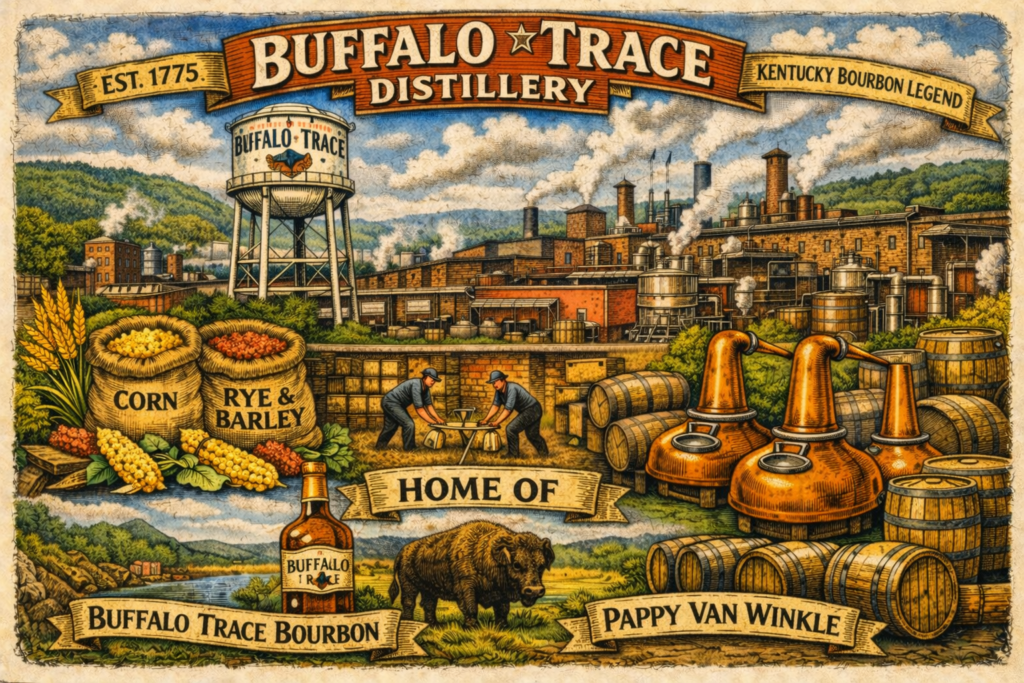
If there’s one name in American whiskey that makes seasoned drinkers and curious newcomers alike pause with recognition, it’s Buffalo Trace Distillery. Nestled in Frankfort, Kentucky, this legendary distillery has been making bourbon for over two centuries — surviving wars, prohibition, changing tastes, and even natural disasters — all while helping define what great American whiskey looks like today.
In a world where new distilleries appear every year and limited releases dominate headlines, Buffalo Trace stands apart by doing something deceptively simple: making consistently excellent whiskey, year after year, without losing sight of its roots.
A Heritage Carved by Time: The Story of Buffalo Trace
The story of Buffalo Trace begins long before bourbon became a category with rules and regulations. The land itself tells the first chapter. Ancient buffalo herds once crossed the Kentucky River at this very spot, carving a natural path through the landscape. Early settlers followed those same traces westward — and eventually, whiskey production followed too.
Distilling is believed to have taken place here as early as the late 1700s, making Buffalo Trace Distillery one of the oldest continuously operating distilling sites in the United States. Over time, the distillery operated under a number of different names, each reflecting a new era, ownership, or focus. Despite these changes, one thing remained constant: whiskey was always being made.
During Prohibition, when most American distilleries were forced to shut down entirely, Buffalo Trace survived by producing whiskey for medicinal purposes. That uninterrupted lineage gives the distillery a rare sense of continuity — it didn’t need to “restart” after Prohibition; it simply carried on.
Later recognition as a National Historic Landmark cemented its importance not just within the whiskey world, but within American industrial and cultural history as a whole.
Where Tradition Meets Precision
Buffalo Trace’s success isn’t built on nostalgia alone. While history is ever-present on the site, the distillery is deeply invested in precision, consistency, and long-term thinking.
From Grain to Glass
Every bourbon produced at Buffalo Trace begins with carefully selected grains — typically corn, rye or wheat, and malted barley. While exact mash bills are famously kept under wraps, it’s widely understood that multiple recipes are used, each designed to produce a distinct flavour profile.
Fermentation is treated as a defining stage rather than a formality. Yeast strains are closely guarded, and small variations in fermentation time and conditions help shape the whiskey’s eventual character long before it ever sees a barrel.
Distillation focuses on producing a spirit with structure and balance — robust enough to handle extended aging, yet refined enough to develop nuance rather than harshness over time.
Aging the Kentucky Way
Once filled into new charred American oak barrels, time and environment take over. Kentucky’s dramatic seasonal temperature shifts force the whiskey in and out of the wood, extracting flavour compounds that define bourbon’s signature profile.
Buffalo Trace’s warehouses — a mix of modern structures and historic rickhouses — create a wide range of aging conditions. Barrels resting on different floors experience different temperatures, airflow, and humidity levels, contributing to the diversity found across single barrels and batches.
This is where patience becomes non-negotiable. Whiskey is bottled when it’s ready — not when demand dictates.
A Portfolio That Shaped Modern Bourbon
Few distilleries anywhere in the world can match the breadth of Buffalo Trace’s portfolio. From everyday, approachable bottles to some of the most sought-after bourbons ever released, the range is both wide and deeply influential.
At the heart of it all is Buffalo Trace Kentucky Straight Bourbon Whiskey — a balanced, versatile bourbon that has become a benchmark for quality at its price point. It’s often the first bourbon people fall in love with, and the one they return to even after exploring far more expensive territory.
Beyond that flagship lie iconic names that have helped define entire subcategories of bourbon. Single-barrel releases, wheated bourbons, long-aged expressions, and heritage-driven bottlings all trace their origins back to this site.
What’s remarkable is how cohesive the portfolio feels. Despite the diversity, there’s a clear house style — structure, balance, and a sense of restraint that allows the whiskey to speak for itself.
Buffalo Trace doesn’t just produce one bourbon — it’s a cradle of icons. Among the names crafted within these brick warehouses are:
- Buffalo Trace – The flagship expression, smooth, balanced, and widely loved.
- Eagle Rare – A richly flavoured single barrel favorite.
- Blanton’s Single Barrel – The bourbon that pioneered single-barrel bottlings.
- W.L. Weller – Wheat bourbons with cult followings.
- Pappy Van Winkle Series – One of the most coveted bourbons in the world.
- Colonel E.H. Taylor, Jr. Series – A tribute to one of bourbon’s great pioneers, including limited premium releases that showcase traditional techniques.
Innovation Without Losing Identity
While Buffalo Trace is steeped in tradition, it is far from static. The distillery has long invested in experimental projects exploring barrel aging, warehouse conditions, and production variables — often years before those ideas became popular elsewhere.
Importantly, experimentation here is slow and deliberate. Projects are given years — sometimes decades — to evolve, and only released when they genuinely add something meaningful to the whiskey conversation.
This long-term approach is increasingly rare in modern spirits production, and it’s a key reason Buffalo Trace continues to command respect across the industry.
Visiting Buffalo Trace Distillery
A visit to Buffalo Trace is less about spectacle and more about substance. The distillery grounds feel lived-in and purposeful, with working warehouses, production buildings, and historic structures sitting side by side.
Tours focus heavily on education — explaining how bourbon is made, why decisions matter, and how small variables can lead to big differences in the glass. Tastings are designed to highlight flavour and process rather than hype or scarcity.
It’s an experience that appeals to casual visitors and hardcore enthusiasts alike, reinforcing Buffalo Trace’s role as both a producer and a teacher within the bourbon world.
Resilience Through Adversity
Over its long history, Buffalo Trace has faced fires, economic downturns, and natural disasters — including severe flooding that temporarily disrupted operations in recent years.
Each time, the distillery has rebuilt, recovered, and returned to full production. That resilience is more than logistical; it’s cultural. Buffalo Trace doesn’t rush, panic, or compromise. It fixes what needs fixing and keeps moving forward.
Much like the whiskey aging quietly in its warehouses, it improves by enduring.
Buffalo Trace Through Others’ Eyes
For those looking to explore additional perspectives, several respected whisky and spirits publications have written thoughtfully about Buffalo Trace’s history, influence, and output:
- The Whiskey Wash – “7 Things You Should Know About Buffalo Trace Distillery”
https://thewhiskeywash.com/whiskey-articles/7-things-you-should-know-about-buffalo-trace/ - LoveScotch – “Discover the Rich Heritage of Buffalo Trace Distillery”
https://lovescotch.com/blogs/the-lovescotch-blog/buffalo-trace-brand
These articles provide broader context and alternative viewpoints, complementing the perspective offered here without overshadowing it.
Final Thoughts
Buffalo Trace Distillery isn’t just a place where bourbon is made — it’s a place where bourbon history continues to unfold. Every barrel laid down carries generations of experience, restraint, and intent.
In an industry increasingly driven by speed, hype, and scarcity, Buffalo Trace remains committed to patience and purpose. Whether you’re pouring its flagship bourbon, exploring deeper into its portfolio, or standing among its rickhouses in Kentucky, one thing becomes clear very quickly:
This is a distillery that understands time — and knows exactly how to use it.