
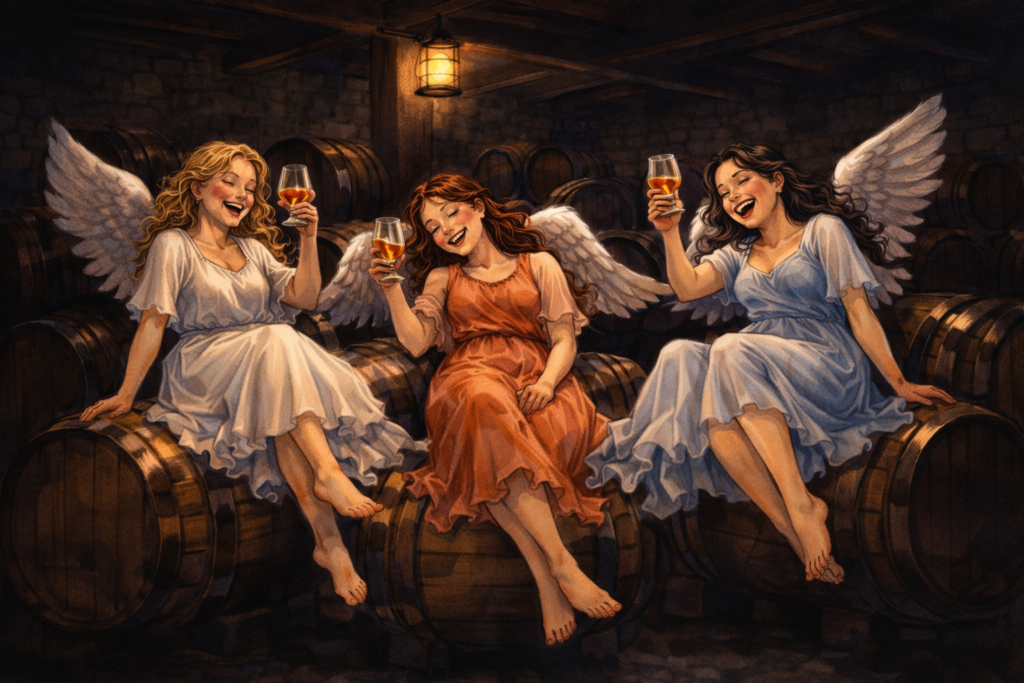
The Angel’s Share: Why Whisky Disappears and Why it Has To
At some point in every whisky journey, there’s a moment of quiet realisation.
A meaningful amount of the whisky you love is already gone.
Not spilled. Not stolen. Not secretly funnelled into a suspiciously cheerful warehouse manager’s hip flask. It has simply evaporated — drifting away through oak pores into the air, year after year, while nobody was watching.
This slow disappearance is known as the Angel’s Share, and while the name sounds playful, the impact is profound. It shapes flavour, controls strength, limits how old a whisky can become, and explains why certain styles exist in one country but would be impossible in another.
Whisky doesn’t just mature.
It sacrifices part of itself to get there.
What the Angel’s Share Actually Is
The Angel’s Share is the portion of whisky that evaporates from a cask during maturation.
Oak barrels are not sealed containers. They are porous, living vessels. Through microscopic pores in the wood, both alcohol vapour and water vapour escape into the surrounding air. This happens continuously, influenced by temperature, humidity, airflow, and time.
In traditional Scotch warehouses, annual losses often average around 2% per year, though this varies depending on cask size, warehouse type, and microclimate. Over decades, that loss compounds dramatically. A cask filled with 200 litres can be reduced to a fraction of that by the time it reaches extreme old age.
That missing liquid is the Angel’s Share.
And once it’s gone, it’s gone for good.
Why Losing Whisky Makes Whisky Better
At first glance, evaporation sounds like nothing but bad news. Less liquid means fewer bottles, higher prices, and heartbreak when a favourite expression disappears forever.
But here’s the essential truth: without the Angel’s Share, whisky would not become whisky as we know it.
Evaporation enables oxygen interaction. It encourages spirit to move in and out of the wood. It helps harsh elements soften, allows oak compounds to integrate, and concentrates flavour as volume decreases.
If you were to completely seal a barrel so no liquid or vapour could escape, maturation would stall. The spirit inside would barely interact with the wood. It would remain largely unchanged, flat, and undeveloped.
The Angel’s Share is not a flaw in the system.
It is the system.
Why People Started Blaming Angels
Centuries ago, distillers noticed something inconvenient. Warehouse stocks never quite added up. Barrels lost volume without leaking. Numbers drifted over time.
Angels were the perfect explanation. It was cheeky, memorable, and (crucially) sounded better than “microporous diffusion and vapour pressure gradients.”
It also fit the experience. Whisky warehouses smell incredible — warm oak, sugar, dried fruit, alcohol vapour. If supernatural beings existed and had good taste, they’d probably hang out there.
Today we understand the science perfectly well. But whisky culture has always preferred a good story to a sterile explanation. The Angel’s Share remains because it reminds us that whisky is supposed to be enjoyed, not audited.
The Bit That Confuses Everyone at First: Why ABV Can Rise or Fall
Here’s the key thing to understand early:
Both water and alcohol evaporate from a cask.
Which one disappears faster depends on climate.
Two factors dominate everything:
- Temperature
- Humidity
Change those, and you change how whisky ages.
Cool, Damp Climates: Slow Maturation, Falling Strength
In cooler, more humid environments — such as Scotland, Ireland, and many traditional Japanese warehouses — evaporation is relatively gentle.
What typically happens:
- Overall evaporation is slower
- Alcohol evaporates slightly faster than water
- ABV gradually decreases over time
This slow, steady process allows whisky to mature gracefully over long periods without being overwhelmed by oak.
But there’s a limit.
To be legally sold as whisky, the spirit must be bottled at 40% ABV or higher. Over many decades, some casks approach that line. Once they cross it, they lose the right to be called whisky, regardless of quality.
This is why extremely old Scotch is rare. Not because distillers lack patience, but because time quietly erodes strength. In cool climates, ageing is a balancing act between maturity and legality.
Hot, Dry Climates: Faster Ageing, Rising Strength
Move that same cask to a hot, dry environment and the rules flip.
Here:
- Evaporation is aggressive
- Water escapes faster than alcohol
- ABV increases over time
This is why whiskies aged in places like Kentucky can become incredibly powerful. Heat accelerates interaction with wood, rapidly extracting colour, flavour, and tannin.
But again, there’s a limit. Bourbon has legal restrictions on strength. Some long-aged barrels climb so high in alcohol that they risk becoming too strong to remain bourbon at all.
Same Angel’s Share.
Completely different outcome.
The Angel’s Share Around the World
As whisky production has spread globally, the Angel’s Share has shifted from background process to defining characteristic.
Taiwan: Intensity at a Price
Taiwan sits at the extreme end of whisky maturation.
At distilleries like Kavalan and Nantou, annual evaporation can reach 10–15% per year.
That means:
- Explosive flavour development
- Heavy oak influence in short timeframes
- Severe volume loss
A Taiwanese whisky aged for five years may show maturity comparable to a Scotch twice its age. The angels here are not subtle.
Australia: Melbourne’s Chaotic Charm
Australia, particularly Melbourne, offers a very different challenge.
Producers like Starward operate in a famously unpredictable climate. If you don’t like the weather, just wait ten minutes — and yes, that matters for whisky too.
Big swings throughout the day cause barrels to expand and contract repeatedly, pumping spirit in and out of the wood like a bellows.
Typical evaporation rates often sit around 6–8% per year, sometimes higher depending on storage.
The result is whisky that matures quickly, boldly, and confidently — often reaching peak balance far earlier than European equivalents.
India: When Time Is Ruthless
India presents one of the most challenging environments for whisky maturation.
At distilleries such as Paul John, Amrut and Piccadilly Distillery, annual evaporation can range from 8% to over 12% depending on location and conditions. In some cases, nearly half a cask can disappear within just a few years.
This forces a different philosophy. Age statements become risky. Precision matters. Timing is everything. Indian whiskies are not rushed — they simply mature at a pace dictated by relentless heat.
Israel: Same Spirit, Different Landscapes
Israel offers one of the most fascinating modern case studies in climate-driven ageing.
At Milk & Honey Distillery, evaporation typically ranges from 6–10% per year, depending on storage location.
Their recent terroir-focused releases have highlighted casks aged in different regions across Israel — coastal areas, inland zones, and more arid environments. Same spirit and cask types, but different humidity and temperatures. The result isn’t just a different Angel’s Share; it’s genuinely different flavour development.
Inside the Arctic Circle: When Angels Take Their Time
At Aurora Distillery, extreme cold slows evaporation dramatically.
Losses are far lower than hot-climate regions. Maturation is gentler. Wood influence is restrained. The Angel’s Share doesn’t disappear — it simply becomes patient.
Cold climates don’t stop ageing. They whisper instead of shout.
Warehouses: Where Climate Gets Personal
Climate matters, but warehouse style often decides how that climate expresses itself.
Dunnage Warehouses
Low, thick-walled buildings with earthen floors and limited airflow.
- Stable temperatures
- High humidity
- Gentle evaporation
- Ideal for very long ageing
Racked Warehouses
Tall, airy buildings with barrels stacked high.
- Greater temperature variation
- Higher evaporation
- Faster, bolder maturation
- More variation between casks
A barrel near the roof can mature faster (and lose more) than a barrel near the floor, even in the same building. Warehouses can create their own little weather systems.
Climate-Controlled Warehouses
Used to stabilise conditions or protect valuable long-term stock.
They can slow evaporation, but can’t eliminate it without halting meaningful maturation entirely. Remember: seal the barrel completely and the whisky doesn’t meaningfully develop. No angels, no evolution.
When Whisky Travels: Dynamic Ageing
Most whisky stays put. Some moves.
The Thalassa Whiskies from Dam Dranken explore what happens when casks experience multiple climates over time while travelling.
As ships move:
- ABV may fall in one region and rise in another
- Evaporation patterns shift
- Maturation becomes unpredictable
The Angel’s Share never stops. It just adapts.
Why Age Statements Mean Completely Different Things Around the World
Here’s the conclusion that changes how you read a label forever:
Age statements measure time, not experience.
A five-year-old whisky from India, Australia, or Taiwan has lived a far more intense life than a five-year-old Scotch. Heat, evaporation, and wood interaction compress years of change into a short span.
That doesn’t make younger whiskies inferior. It makes them different.
Once you understand the Angel’s Share, age statements stop being a scoreboard and start being context.
Angel’s Share FAQ
How much whisky is lost to the Angel’s Share each year?
It depends on climate and storage. Traditional Scotch warehouses often average around 2% per year. Hotter climates can push 6–8% (Melbourne), 8–12%+ (India), and even 10–15% (Taiwan) in some conditions.
Does a higher Angel’s Share always mean better whisky?
No. It usually means faster maturation and stronger cask influence, but balance still matters. Too much evaporation and too much heat can push whisky into overly oaky, drying territory.
Can a whisky stop being whisky while it ages?
Yes. If ABV drops below 40%, it can no longer legally be called whisky, even if it tastes wonderful.
Why can bourbon get stronger in the barrel while Scotch often gets weaker?
In hot, dry climates, water tends to evaporate faster than alcohol, so ABV rises. In cool, humid climates, alcohol tends to evaporate faster than water, so ABV falls.
Do small casks lose more to the Angel’s Share?
Generally, yes. Smaller casks have more surface area relative to volume, which usually increases interaction with wood and can increase evaporation and maturation speed.
Does warehouse placement matter?
A lot. Higher levels in tall racked warehouses tend to be warmer and drier, which can increase evaporation and speed up maturation. Dunnage warehouses usually age more slowly and evenly.
Could you stop the Angel’s Share by sealing a barrel?
You could reduce evaporation, but if you truly sealed a barrel so it couldn’t breathe at all, the spirit wouldn’t properly mature or take on the flavour and complexity we associate with whisky.
Is the Angel’s Share the same as oxidation?
They’re related but not identical. The Angel’s Share is evaporation. Oxidation and oxygen interaction are part of the wider maturation process happening alongside it.
The Final Truth
Every whisky loses something to become itself.
Whether it’s 2% per year in a Scottish dunnage warehouse or 12% under the Indian sun, the Angel’s Share is the quiet cost of character.
Some angels sip politely.
Some drink like they’re on shore leave.
Either way, they leave behind whisky shaped by place, patience, and sacrifice.
And once you understand that, you never look at a glass of whisky — or an age statement — the same way again.
Great article, Martijn! I was actually just researching this yesterday and ChatGPT recommended your article! Great level of detail but still concise and easy to read. Fantastic job!
Hi Alastair, thank you so much for the feedback! Happy to hear you found the article helpful for your research!