
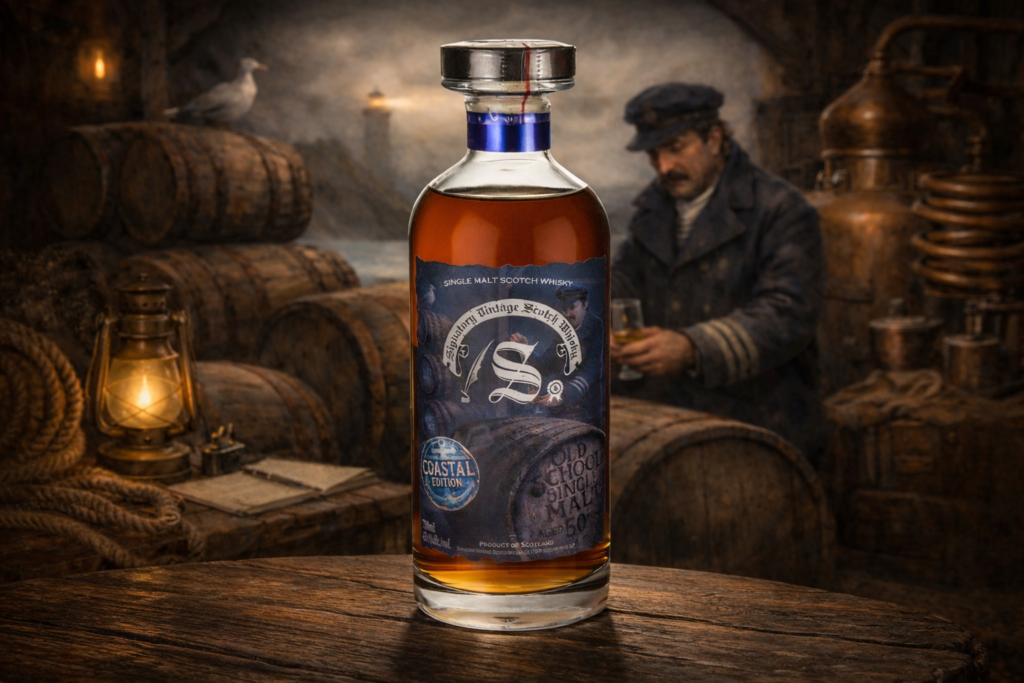
Old School Single Malt 50 Year Old Coastal Edition by Signatory Vintage
There are bottles you buy because they make sense.
And then there are bottles you buy because your pulse tells you not to hesitate.
When the Old School Single Malt Coastal Edition 50 Year Old from Signatory Vintage appeared on the shelves, priced under €400, I didn’t analyse. I acted.
Fifty years old.
Let that sink in.
In a world where 30 year old whiskies flirt with four figures and “luxury” often means heavy glass and marketing smoke, here was a half-century-old single malt at a price that felt almost rebellious. It sold out in minutes — of course it did — but for a brief moment, it felt like the industry had blinked.
This Signatory 50 Review isn’t just about tasting notes. It’s about what this bottle represents.
Signatory and the Old School Philosophy
If you’ve followed independent bottlers for any length of time, you know that Signatory has quietly built one of the most formidable mature stock libraries in Scotland. Founded in 1988, they’ve never chased hype in the way others have. Their focus has always been casks first, packaging second.
The Old School range feels like a statement piece. Long maturation. Honest presentation. Sensible pricing — or at least, pricing that doesn’t insult drinkers.
Before this Coastal Edition, there was the 45 Year Old Tropical Fruit Edition. Another shock to the system. Another ultra-aged whisky that didn’t require a second mortgage.
Is this a market correction? Warehouses filled in the 1970s finally surfacing without speculative madness attached? Or is this simply Signatory doing what Signatory has always done — releasing whisky on their terms?
I want to believe it’s a sign of the times. I want to believe very old whisky might slowly become drinkable again — not just collectible.
And after tasting this 50 year old, I believe there’s still magic left in those old casks.
Tasting Notes: Signatory 50 Review – Old School Coastal Edition
Stats
- Age: 50 Years
- ABV: 43,1% (86,2 Proof)
- Distillery: Undisclosed (widely speculated to be Bunnahabhain Distillery or possibly Old Pulteney Distillery)
- Region: Scotland
- Flavour Profile: Oak & Ember
- Chill-Filtration: No
- Colouring: No
Nose
The first inhale stopped me mid-thought.
This is not fragile old whisky. This is not oak dust and resignation.
It’s deep. Dark. Alive.
Molasses rises first — thick, almost sticky in its richness. Then Turkish delight, the rose note subtle but unmistakable. Candied pineapple glows through the darkness, adding a flash of brightness that keeps the nose from becoming brooding.
Dark cacao and cigar smoke follow, and suddenly you’re somewhere else entirely — a wood-panelled study, old mahogany furniture polished by decades of quiet evenings. There’s a humidor warmth to it. Leather. Time.
And beneath it all, something maritime. Not brine crashing in your face. Not iodine. Just a faint coastal breeze threading through the richness.
Fifty years in oak and it smells composed, not tired. That alone is remarkable.
Palate
The first sip feels like stepping into velvet.
Tiramisu. Proper tiramisu. Espresso beans crushed and folded into layers of cacao and extra dark chocolate. There’s bitterness here, but it’s elegant — the kind that balances sweetness rather than fights it.
Dark molasses returns, heavier now, coating the tongue. Then that coastal whisper shows up again: a fleeting note of smoked cod, saline and savoury, intertwined with salted liquorice.
That liquorice note is gorgeous — sweet, salty, slightly medicinal — and it anchors everything.
The peat is barely audible. Not smoke, but memory of smoke. Like embers in a hearth long after the fire has died down.
At 43%, you might expect fragility. Instead, there’s integration. The oak is present, yes, but never dominant. No bitterness screaming about its age. Just structure. Confidence. Patience rewarded.
This is what half a century should taste like.
Finish
Medium-long, but emotionally longer.
Cacao and espresso linger first, warming rather than burning. Black pepper gently pricks at the edges. Charred oak folds into a subtle saline edge that confirms its coastal identity.
The image that kept returning to me was this: sitting on a grandfather’s old leather couch in front of a crackling fireplace, waves crashing somewhere outside in the dark.
It’s maritime comfort. Not sea spray on your face — sea spray filtered through memory and warmth.
By the time it fades, you’re not chasing intensity. You’re chasing another quiet moment with it.
What Makes This Whisky Stand Out
Let’s be blunt.
In this Signatory 50 Review, the age matters — but the price might matter even more.
A 50 year old single malt that actually tastes like it deserves its age, released at under €400, challenges the narrative that ultra-mature whisky must live in glass coffins behind velvet ropes.
This dram doesn’t rely on hype. It doesn’t scream for attention. It delivers depth, balance, texture, and coastal nuance with the calm authority of something that has nothing left to prove.
It feels like whisky from another era — not just in age, but in philosophy.
Food Pairing
Don’t pair it.
This whisky sings perfectly on its own and deserves to be enjoyed entirely a cappella.
Anything on the plate would feel like interruption rather than enhancement.
Who Is This Whisky For?
Drinkers who open their rare bottles.
Collectors who still remember whisky is meant to be poured.
Fans of old-school maturation and subtle coastal character.
If you’re chasing high-proof fireworks, this may feel restrained.
If you value depth, integration and the quiet authority of time, it’s extraordinary.
Verdict
Strengths
Incredible value for a 50 year old single malt
Deep, richly layered profile without over-oaking
Beautiful balance between dark sweetness and maritime subtlety
Mature, composed and genuinely evocative
Weaknesses
Availability — unfortunately it vanished almost instantly
Final Thoughts
Writing this Signatory 50 Review feels slightly surreal.
Because bottles like this aren’t supposed to exist anymore. Not at this age. Not at this price. Not with this level of integrity.
And yet here it is.
It doesn’t shout. It doesn’t flex. It simply sits in the glass, dark and composed, asking you to slow down.
If this is a sign that very old whisky might become accessible again — even occasionally — then I’m here for it. If it’s an anomaly, I’m grateful I caught it.
Either way, this bottle reminded me why I fell in love with whisky in the first place.
Not for status. Not for speculation.
For moments like this.

Defo a Bunna. 100%. No ifs, buts or maybes lol.
Haha you seem to have no doubt! Whats your source? 🙌🥃