Suntory Merges Laphroaig and Bowmore Operations on Islay as Whisky Demand Cools
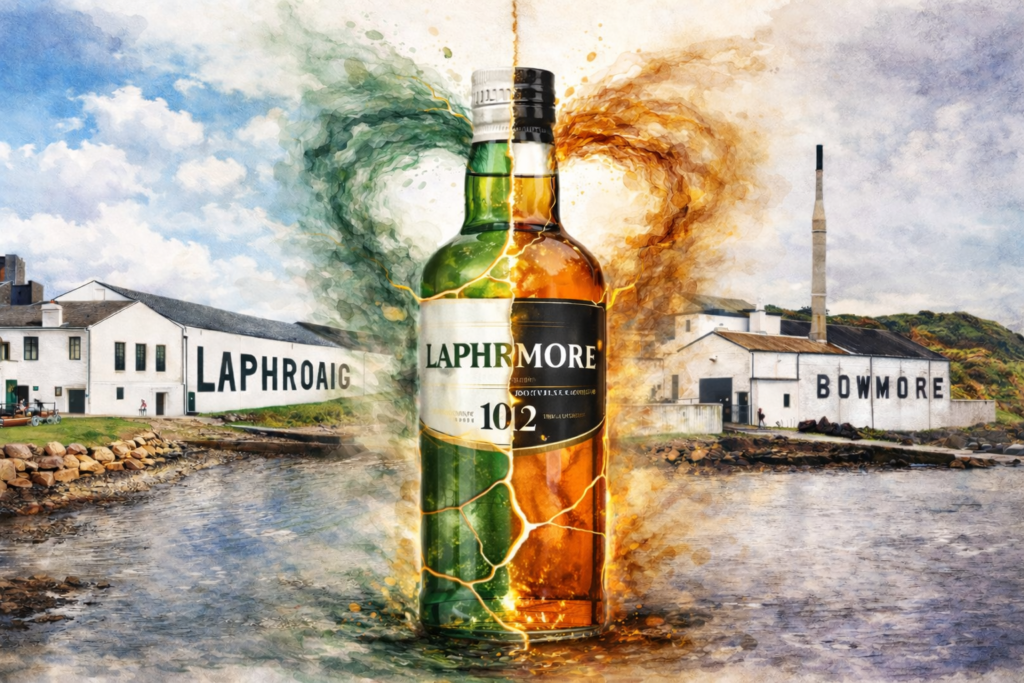
Suntory Global Spirits is merging operational teams across Laphroaig and Bowmore on Islay, while keeping both distilleries running. It’s a strategic move to align production with long-term demand — and it’s one of the clearest signals yet that the post-pandemic whisky surge has ended.
This isn’t a minor portfolio tweak. Laphroaig and Bowmore are two of the most recognisable Scotch whisky brands on the planet. When owners take cost and capacity decisions at this level, it reflects a wider market correction, not a local issue.
What Suntory Is Doing at Laphroaig and Bowmore
The change is operational rather than brand-led:
- Production and operational teams are being consolidated across both distilleries
- Distillation continues at both sites
- Visitor centres remain open
- Brand identities are expected to remain distinct
In other words: this is about matching output to demand, not shutting Islay down. But it still matters — because it shows how seriously the industry is preparing for a slower cycle.
Impact on the Island Community
For the people of Islay, the reassurance that there are no mandatory job losses is significant. Distilling is not just an industry on the island; it is woven into the social and economic fabric of the community. The option for employees to voluntarily opt out, rather than facing enforced redundancies, softens what could otherwise have been a deeply destabilising moment. It provides space for individual choice while maintaining operational continuity. On a small island where jobs, families and heritage are tightly interconnected, that distinction matters. Stability preserves more than payroll numbers; it protects local skills, generational knowledge and the sense of identity that Islay’s distilleries help sustain.
What This Could Mean for the Future of Laphroaig and Bowmore
Looking ahead, the merger raises questions about how two of Islay’s most iconic names — Laphroaig and Bowmore — will evolve within a larger strategic framework. Greater centralisation could bring efficiencies in production, distribution and global marketing, potentially strengthening both brands in key growth markets. At the same time, their power has always rested on distinct identity: Laphroaig’s uncompromising medicinal peat and Bowmore’s balance of smoke and fruit shaped by coastal maturation. The challenge will be preserving those identities while aligning with broader corporate objectives. If managed carefully, increased investment and strategic clarity could elevate both distilleries’ global standing. If not, there is always the risk that uniqueness gives way to uniformity — something Islay drinkers are quick to notice.
Why This Matters: The Whisky Boom Is Over
The whisky category rode an extraordinary wave during Covid and the years immediately after. Demand spiked, premium releases multiplied, and prices climbed across core ranges and limited editions alike.
That was always going to normalise. The only question was how hard the landing would be.
Now we’re seeing the industry take defensive, preventative steps — and the reason is simple: nobody wants another whisky loch. Every major whisky company knows what happens when production planning continues as if the boom years are permanent. Warehouses fill. Cash gets tied up. Discounting starts. Brand perception takes a hit. It can take a decade to undo.
From that perspective, Suntory’s move looks like disciplined risk management.
The Bigger Problem: Premiumisation Has Hit Its Ceiling
Here’s the part the industry doesn’t love saying out loud.
For years, Scotch has been chasing premium positioning as if it’s the only growth engine: higher price ladders, more “exclusive” releases, more collectible narratives, more luxury cues.
Premium whisky will always exist — and it should. But when too much of the category leans into scarcity and status, you end up with a distorted market where the consumer isn’t a drinker anymore. They’re an allocator, a flipper, a collector, or an investor.
That demand is fragile. When conditions tighten, it evaporates quickly.
The Stable Demand Is Still the Best Demand: People Who Drink Whisky
Laphroaig and Bowmore didn’t become legendary because they were “rare.” They became legendary because they were good — and because people actually opened them.
If you want proof that drinkers still matter, you don’t need to look at auction results. You look at the bottles that built the brands:
- Laphroaig 10 Year Old
- Laphroaig Quarter Cask
- Bowmore 12 Year Old
- Bowmore 15 Year Old
- Bowmore 18 Year Old
These aren’t just “portfolio items.” They’re the bottles people come back to. They’re the bottles that create loyalists. They’re the bottles that make someone say, “That’s my Islay.”
My Take: The Recovery Starts by Serving Drinkers Again
If the category wants to turn declining demand around, the answer isn’t more premium theatre. It’s a reset back to whisky’s purpose: make it worth buying to open, pour, and enjoy.
That means:
- Core ranges that feel fairly priced for what’s in the bottle
- Less obsession with artificial scarcity
- More attention to quality, consistency, and character
- Communication that speaks to flavour and craft rather than “investment potential”
Collectors will always exist, and some will always chase the rare stuff. But that’s not the foundation you build sustainable demand on.
Drinkers are.
And drinkers will always want Bowmore and Laphroaig — as long as the brands remember who they’re for.
The Takeaway
Suntory’s operational merger on Islay is not a crisis headline. It’s a market signal.
If two of the biggest names in Scotch whisky are consolidating operations to match long-term demand, the industry is officially in correction mode. The smarter brands will respond by strengthening what people actually drink — not just what people display.
Because in the end, whisky doesn’t survive on hype.
It survives on the next pour.