Talisker Distillery: Campfire, Coastline & the Whisky That Made Me Fall for Smoke
Some distilleries you admire. Others you respect. Talisker Distillery is different — it imprints itself on you.
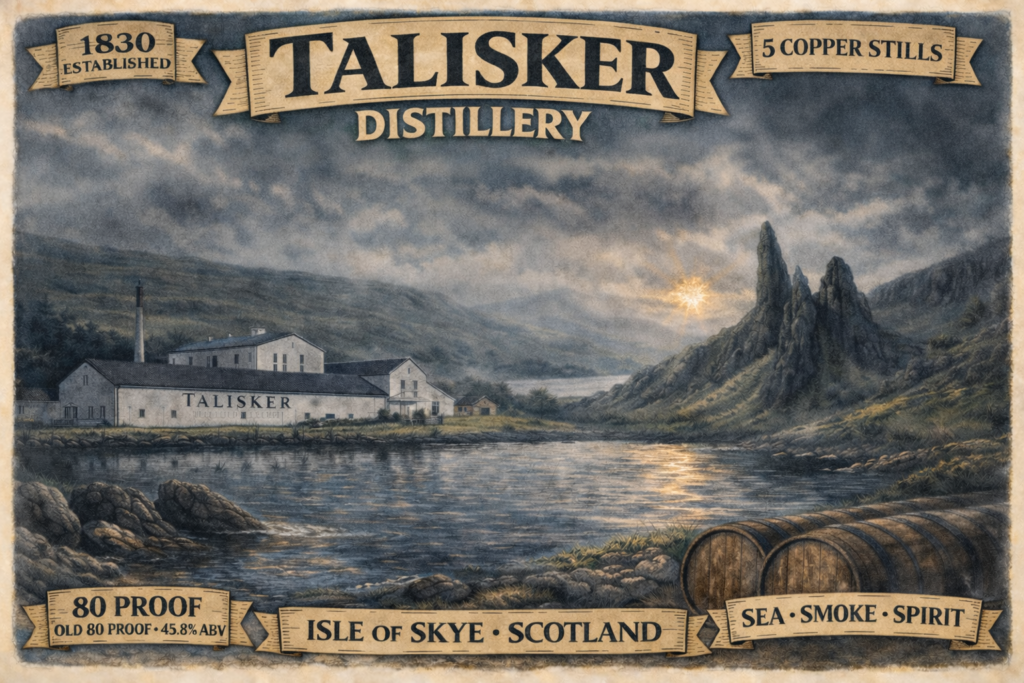
Set on the shores of Loch Harport on the Isle of Skye, Talisker exists in a place where the weather has teeth and the landscape refuses to be gentle. Atlantic winds, salt-laced air, and an exposed coastline shape everything here — including the whisky. Talisker is bold, peppery, smoky, and unmistakably maritime. You don’t just taste it. You feel it.
For me, Talisker Distillery isn’t just an important name in Scotch whisky. It’s the one that lit the fuse.
My First Smoky Whisky: Talisker 10
Talisker 10 Year Old was the first smoky whisky I ever tried — and it stopped me in my tracks.
I remember lifting the glass and thinking, this smells like a sweatshirt after a long night sitting around a campfire. Not the fire itself, but the next morning — when the smoke has settled into the fabric. Warm. Comforting. Familiar. That moment was a revelation.
This wasn’t medicinal smoke or aggression for shock value. This was campfire in a glass.
That single dram changed everything. It opened the door to peat, to island malts, and to whisky as something emotional as well as flavour-driven. Talisker didn’t just introduce me to smoke — it made me fall in love with it immediately.
A Distillery Shaped by Skye
Founded in 1830 by brothers Hugh and Kenneth MacAskill, Talisker Distillery is the oldest operating distillery on the Isle of Skye. From the very beginning, it was shaped by isolation. Skye was remote, difficult to reach, and relentlessly exposed — conditions that rewarded robustness over refinement.
Talisker’s water flows from springs on Hawk Hill, filtering through peat-rich ground before reaching the distillery. Add coastal maturation and salt-heavy sea air, and you get Talisker’s unmistakable backbone: brine, mineral weight, seaweed, smoke, and spice bound tightly together.
This isn’t romantic storytelling. You can taste the geography.
The Talisker House Style
Talisker produces a spirit that is instantly recognisable, even blind.
The defining traits are consistent:
- Earthy, grounded peat smoke
- A signature cracked black pepper heat
- Coastal salinity — brine, wet stone, sea spray
- Subtle sweetness of malt, orchard fruit, and gentle honey
What makes Talisker special is the tension. It’s never just smoky or just sweet. There’s warmth and bite in equal measure, making it a whisky that stays engaging rather than overwhelming.
Five Stills, Fire, and Survival
Talisker Distillery operates with an unusual configuration of five copper stills — two wash stills and three spirit stills. Historically, these stills were run hot, producing a muscular, peppery spirit that helped define Talisker’s character.
That intensity nearly proved catastrophic in 1960, when a still boil-over caused a major fire that shut the distillery down. When Talisker rebuilt, it made a crucial decision: replicate the original still shapes as closely as possible rather than modernising. That choice preserved the spirit character — and you’re still tasting the result today.
It’s one of the clearest examples of tradition winning out over convenience.
Why Talisker Is Bottled at 45.8% ABV (80 Proof)
One of the most recognisable quirks of Talisker Distillery is its decision to bottle many expressions at 45.8% ABV — a number that looks oddly specific until you know the history.
45.8% ABV corresponds exactly to 80 proof in the old English proof system. Historically, this was the strength at which spirit would ignite when gunpowder was soaked in it — a practical benchmark of quality and robustness long before modern alcohol measurement existed.
Talisker’s connection to 80 proof isn’t a modern affectation. It’s a nod to tradition and a strength that perfectly suits the whisky. At 45.8%, Talisker carries its smoke, pepper, and maritime weight with authority, while retaining texture and balance. Drop it lower and the whisky loses tension. Push it higher and the pepper can dominate.
That old-school proof point has become part of Talisker’s identity — not because it looks good on paper, but because it works in the glass.
Talisker Distillery Core Range Highlights
While Talisker releases numerous special editions, its core range defines the brand:
- Talisker 10 Year Old – The benchmark. Peppery, smoky, coastal, and still one of the most characterful age-stated whiskies widely available.
- Talisker Storm – Younger, bolder, and more aggressive, leaning heavily into smoke and spice.
- Talisker Skye – Softer and more approachable, designed to showcase sweetness alongside the smoke.
- Talisker Distillers Edition – Finished in Amoroso sherry casks, adding richness and dried fruit to the classic profile.
Each expression tells the same story — just with different chapters highlighted.
Talisker vs Islay Heavyweights
Talisker is often compared to Islay malts — and the comparison is fair — but the differences are just as important as the similarities.
Against Islay heavyweights like Laphroaig Distillery, Ardbeg Distillery, and Lagavulin Distillery, Talisker’s smoke is less medicinal and less phenolic. You won’t find iodine-heavy hospital notes or thick tar and asphalt.
Instead, Talisker’s smoke is drier, earthier, and more campfire-led. The heat arrives as cracked black pepper mid-palate rather than an upfront peat blast. The maritime influence feels like open sea air and salt spray, not coastal bonfires.
Put simply:
- Islay whiskies lead with smoke
- Talisker leads with balance, spice, and coastal tension
Both are powerful. They just speak different dialects of peat.
Talisker vs Other Island Malts
Among Island malts, Talisker stands apart through sheer intensity.
Compared to Highland Park Distillery, Talisker is sharper and more confrontational. Highland Park leans into heather, honey, and aromatic peat, while Talisker trades florals for salt, pepper, and raw energy.
Against Tobermory Distillery, Talisker is darker and more assertive. Tobermory focuses on fruit and spirit-driven sweetness; Talisker pushes smoke and spice to the foreground.
Next to Arran Distillery, Talisker feels wilder and less polished. Arran offers clarity and precision. Talisker offers drama and edge.
If Island malts were personalities, Talisker would be the one standing closest to the fire, coat already smelling of smoke.
Fun Facts & Lore from Talisker Distillery
- Talisker was praised by Robert Louis Stevenson, who called it the “king o’ drinks” in his 1880 poem — a line that still defines the brand’s cultural legacy.
- For much of its history, Talisker spirit travelled by sea, reinforcing its maritime character long before branding caught up with reality.
- Despite being an Island malt, Talisker is often the whisky that bridges the gap for drinkers moving from Highland styles into peat-heavy territory.
FAQ: Talisker Distillery
Where is Talisker Distillery located?
Talisker Distillery is located on the Isle of Skye, on the shores of Loch Harport in northwest Scotland.
Is Talisker an Islay whisky?
No. Talisker is an Island malt from Skye, not Islay — although its smoky profile often invites comparison.
Why does Talisker taste peppery?
The cracked black pepper heat comes from Talisker’s distillation style, cut points, and spirit weight rather than peat alone.
What’s the best Talisker whisky to start with?
Talisker 10 Year Old remains the clearest introduction to Talisker Distillery’s house style.
Is Talisker heavily peated?
Talisker is moderately peated, but its spice and coastal influence make it feel more intense than the peat level suggests.
Final Thoughts
Talisker Distillery doesn’t chase trends or sand down its edges. It stands exactly where it always has — shaped by wind, salt, fire, and time.
For many drinkers, Talisker is a first step into smoke. For me, it was the moment whisky became more than flavour. Campfire in a glass. A sweatshirt that still smells like last night’s fire. And a distillery that proves, even now, that character still matters.