The Macallan Distillery Spotlight — History, Style, Hype, and Hard Questions
Few Scotch whisky names carry the same cultural weight as The Macallan. For some, it represents the pinnacle of Speyside luxury; for others, it’s the poster child for modern whisky excess. Either way, Macallan is unavoidable. Its journey from a small Speyside farm distillery to a global status symbol is one of the most influential stories in Scotch whisky—and one that continues to shape how whisky is made, priced, collected, and talked about today.
This is a distillery built on tradition, transformed by ambition, and constantly navigating the tension between heritage and hype.
From Easter Elchies to the World Stage
The story begins in 1824, when Alexander Reid—farmer and schoolteacher—licensed a small distillery on the Easter Elchies estate above the River Spey. From the outset, The Macallan Distillery was defined by a belief that quality came from control: local barley, careful distillation, and a deliberate approach to spirit character.
For much of the 19th and early 20th centuries, Macallan remained relatively understated, producing whisky largely destined for blends. That changed in the latter half of the 20th century as single malts gained prominence. Under a series of owners—and later firmly under the stewardship of Edrington—Macallan began to lean into its strengths: weighty spirit, small stills, and an obsession with wood.
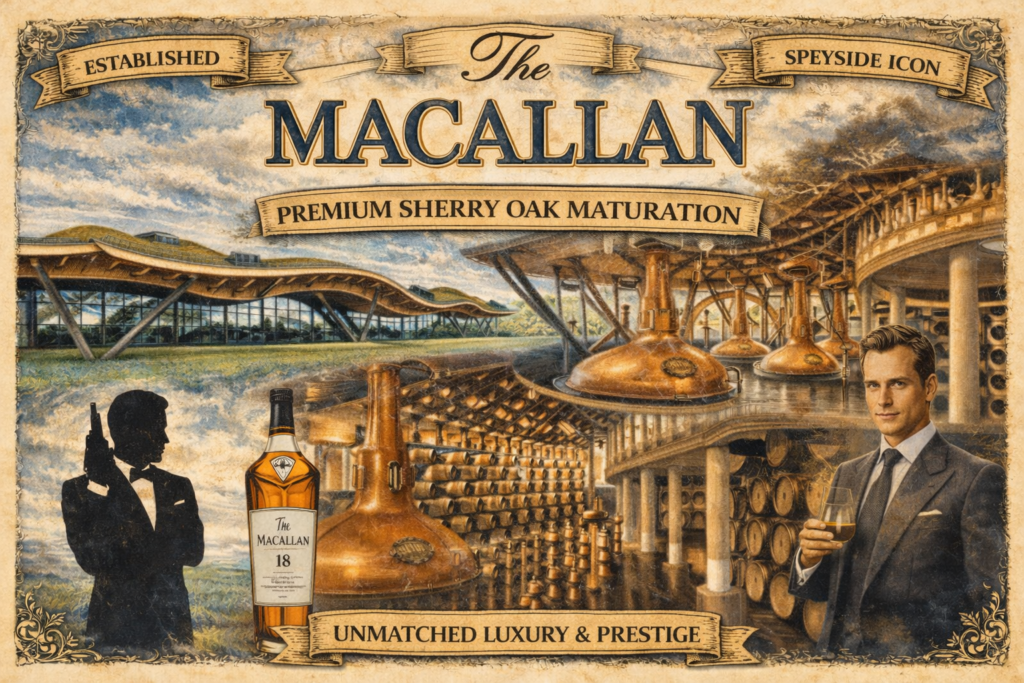
By the 1990s and early 2000s, Macallan wasn’t just a respected Speyside malt; it was becoming a global luxury brand. The construction of its striking new distillery in 2018, blending futuristic design with gravity-fed efficiency, was both a technical upgrade and a symbolic statement of intent.
House Style: Built on Spirit and Wood
Macallan’s new-make spirit is famously rich. Its relatively small copper pot stills increase reflux and copper contact, producing a dense, oily spirit capable of standing up to heavy oak influence. This matters, because oak—specifically sherry-seasoned oak—has always been Macallan’s calling card.
Long before sherry casks became fashionable, Macallan was investing heavily in bespoke cask programmes in Jerez. European oak brings spice, tannin, dried fruit, and structure; American oak contributes sweetness, vanilla, and citrus lift. Together, they form the backbone of the distillery’s signature profile: raisins, orange peel, ginger, clove, chocolate, and polished oak.
Over time, this approach expanded into defined families such as the Sherry Oak, Double Cask, and Triple Cask Matured ranges—each offering a different lens on the same core DNA.
The People Behind the Whisky
While The Macallan Distillery is often perceived as a brand-first operation, its whisky has long been shaped by deeply technical minds. A succession of master distillers and whisky makers have guided the spirit with a steady hand, prioritising consistency and wood management above all else.
Rather than chasing extremes—peat levels, experimental yeast strains, or wild finishes—Macallan’s leadership has historically focused on refinement. Their challenge has never been making bold whisky; it’s been maintaining a recognisable house style across vast global demand while still delivering moments of genuine excellence.
Macallan in Pop Culture: From Bond to Boardrooms
Macallan’s cultural reach extends far beyond the whisky shelf. Its association with James Bond is no accident. Bond’s world—tailored suits, quiet confidence, understated luxury—mirrors exactly how Macallan wants to be perceived. When a character like Bond chooses a dram, it reinforces the idea that Macallan is the whisky of success, sophistication, and discernment.
More recently, Macallan has found a home in modern prestige television, notably in Suits, where decanters of Macallan sit comfortably in glass-walled offices and power plays unfold over expensive pours. These placements aren’t about tasting notes—they’re about signalling status. And few whisky brands understand that language better.
Hype, Collectability, and the Price Problem
Here’s where the conversation gets complicated.
Macallan is one of the most collectible whiskies on the planet. Limited editions, special releases, and ultra-aged expressions routinely command eye-watering sums at auction. In that world, whisky becomes an asset class, and The Macallan Distillery sits comfortably at the top.
But for drinkers—not investors—the value equation is harder to justify. An 18-year-old Macallan will often cost nearly three times as much as other well-regarded 18-year-old Scotch whiskies. That premium isn’t just about age or liquid quality; it’s about brand power.
This has drawn criticism from whisky lovers, particularly when combined with:
- Lower bottling strengths compared to many enthusiast-focused distilleries
- A growing reliance on no age statement releases for special bottlings
- Age-stated whiskies priced well beyond what many consider reasonable value
None of this makes Macallan “bad whisky”—far from it. But it does place it under a harsher spotlight. When you charge more, expectations rise. And not every release lands as convincingly as the label suggests it should.
Who Is Macallan Whisky Really For?
Macallan makes sense for certain drinkers—and less so for others.
- Sherry-Cask Lovers who prioritise dried fruit, spice, and oak-driven complexity
- Collectors drawn to prestige, presentation, and long-term value
- Luxury Buyers seeking a recognisable, high-end gift
- Newcomers wanting an accessible introduction to rich Speyside malt
If you’re chasing cask strength intensity, maximalist flavour, or sheer value for money, Macallan may feel conservative or overpriced. But if balance, polish, and consistency matter most, it still delivers what it promises.
Similar-Style Whiskies That Deserve Your Attention
If you enjoy The Macallan Distillery flavour profile but want alternatives that often offer higher ABV, clearer age statements, or better value, these are worth serious consideration:
- Bunnahabhain 12 Year Old – A compelling alternative to Macallan 12, offering richness, subtle coastal influence, and excellent balance.
- Glen Garioch 15 – Robust, slightly old-school Highland malt with weight, spice, and character.
- GlenDronach 12, 15, or 18 Year Old – A benchmark for sherry maturation, delivering depth, darkness, and intensity.
- GlenAllachie 12, 15, 18 – Modern wood management done right, with bold sherry influence and higher bottling strengths.
- Tamdhu 12 Year Old – A sherry-led Speyside malt that stays firmly rooted in tradition, offering clarity and value.
- Glenfarclas 12, 15, 25– Family-owned consistency with classic sherried profiles across a wide age range.
- Glen Moray Sherry Cask Finish – A genuine budget option that still delivers dried fruit sweetness and approachable oak influence.
Frequently Asked Questions
Is Macallan overrated?
That depends on perspective. As a luxury brand, Macallan excels. As a value-driven enthusiast whisky, it faces stiff competition.
Why is Macallan so expensive?
Scarcity, global demand, strong secondary markets, and a deliberate luxury positioning all play a role.
Is Macallan whisky good to drink or better to collect?
Many expressions are excellent to drink—but some limited releases are clearly designed with collectors in mind.
What flavour profile defines Macallan?
Expect dried fruits, orange zest, spice, chocolate, toffee, and polished oak, driven primarily by sherry-seasoned casks.
Final Thoughts
The Macallan Distillery doesn’t need defending—but it does deserve context. It’s a distillery that helped define modern single malt whisky, even if it now exists at a crossroads between drinkability and desirability. Whether you see it as a benchmark or a bellwether, its influence on Scotch whisky is undeniable.